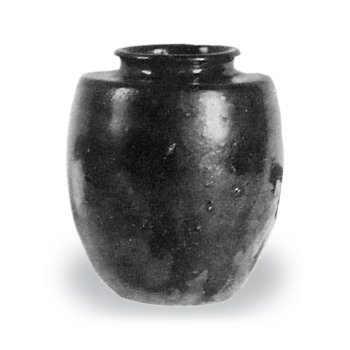
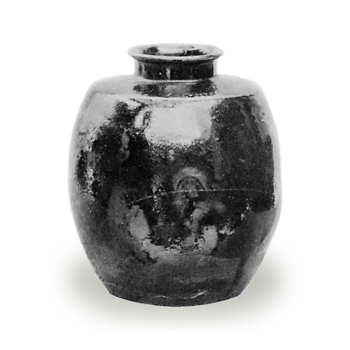
Made in China; Collection of Viscount Matsudaira Yorikazu
[Name]
Since this tea caddy was originally owned by Furuta Oribe, it is unclear whether it was named after the place where he acquired it (Osaka) or if it had this name even before that; the details are now lost to history.
[Dimensions]
Height: Approx. 8.9 cm (2 sun 9 bu 5 rin)
Body diameter: Approx. 6.9 cm (2 sun 3 bu)
Mouth diameter: Approx. 4.2 cm (1 sun 4 bu)
Base diameter: Approx. 3.9 cm (1 sun 3 bu)
Shoulder width: Approx. 1.2 cm or approx. 1.3 cm (4 bu or 4 bu 5 rin)
Weight: Approx. 138g (36 monme 8 bu)
【Accessories】
・Lids: 3 pieces
Main lid: With a “su” (recess on the underside)
Replacement lid: Kobori Enshu style, without a ‘su’
Same (replacement lid): Katagiri Sekishu style, with a “su”
・Carrying bag (for the tea caddy): White ha-niwa silk, with a white cord knot
・Cover bags (3):
- Tang-style weave with swastika pattern (lining: sea-green silk, cord: purple)
- Dantsu silk with cloud-and-crane pattern (lining: pale green silk, cord: purple)
- Dantsu with Tang floral and arabesque pattern (lining is damaged and frayed, cord is purple)
・Bag box: Paulownia wood, 2 pieces (large and small)
・Hikiya (wooden container to protect the tea caddy): Black lacquer
・Box: Paulownia wood box. Includes a label and a paper label.
Inscribed: “Osaka Katatsuki Tea Caddy.”
[Miscellaneous Notes]
Osaka Katatsuki. Originally owned by Furuta Oribe. Among the eight items listed in the estate distribution of December 1654 (Jōō 3), this item was presented by the late Daikan (Tokugawa Yorinobu) to the Lord (Tokugawa Yorinobu) prior to his promotion in rank.
(From the “Saijō Matsudaira Family Documents”)
Lord Tokugawa Yorinobu bequeathed many Meibutsu to his second son, Lord Sakyo-no-taifu Yorizumi, including the “Osaka Katatsuki”—a renowned national Meibutsu—a hanging scroll bearing the calligraphy of Issan Ichinei, and various items of military equipment, such as the Ichinotani helmet of Takenaka Hanbei.
Regarding this, his retainer, Watanabe Wakasa-no-kami Naotsuna, made the following statement: “It is commonly said that the renowned Meibutsu bestowed by His Lordship Tōshō Daigongen (Tokugawa Ieyasu) should be passed down to the eldest son’s household (the Kishū Tokugawa main line), which is the heir apparent, and I believe this criticism is quite reasonable. Even if you were to bestow such prized possessions upon Lord Yorizumi, who is a son born out of wedlock, aside from the armor, there would likely be no guests of high enough standing to whom he could display the tea ceremony utensils.”
To this, Lord Yorinobu replied with a laugh: “Since Sakyo (Yorizumi) holds a low rank with little land revenue, he may one day have to ask the Chief Minister of the Main House for financial assistance. At that time, simply making a request might not be enough to persuade him. If he pawns these Meibutsu items to borrow money, it will fulfill his obligation to the Main House and also serve as a supplement to Sakyo’s own funds. That is why I am bestowing them upon him, even though they are beyond his station,” he said, laughing. This, too, is a most reasonable and wonderful anecdote.
(From Nanryū Genkōroku)
【History of Ownership】
Originally owned by Furuta Oribe, it was passed down to Tokugawa Yorinobu, the founder of the Kishū Domain, and in December of the 3rd year of Jōō (1654), Yorinobu transferred it to his second son, Yorizumi. In December of Kanbun 10 (1670), Yorizumi became the lord of the Saijo Domain (present-day Saijo City, Ehime Prefecture) in Iyo Province, with a revenue of 30,000 koku, and became the founder of the Saijo Domain. The Saijo Family Documents and the Nanyu Gankoroku record that, along with the “Osaka Katatsuki,” he was bestowed with a calligraphic work by Issan Ichinei and the Ichinotani helmet worn by Takenaka Hanbei.
[Record of Actual Viewing]
On October 23, 1919, I viewed the actual item at the residence of Viscount Matsudaira Yorikazu in Iikura Katamachi, Azabu Ward, Tokyo.
The rim is folded back somewhat deeply, and two rows of ridges run around the neck (koshiki). Overall, the glaze is a mixture of dark amber and purple; from the shoulder, there are three large streams of dark amber glaze flowing down, as well as a separate single stream. The glaze pools are somewhat thick and contain a hint of blue-green. A single sunken line runs down the center of the body, and persimmon-colored specks are scattered throughout this area.
It feels light in the hand, and there is a triangular piece of clinging material (traces of other objects adhering in the kiln) extending from the rim to the shoulder. From the lower rim downward, the iron-stained (reddish-black) clay body is exposed, and the spatula-marked finish is extremely old-fashioned and charming. The thread cut at the base is somewhat rough and irregular, with jagged marks from the spatula at the starting point of the cut. Additionally, on the shoulder—directly opposite the glaze drips—there is a persimmon-colored mark about 1 sun (approx. 3 cm) long, resembling an iron handprint.
The interior features glaze on the rim, with wheel marks visible below it. The spatula marks are used extensively throughout, and the lower edge reveals a significant amount of the raw clay surface; this is a magnificent tea caddy rich in visual interest.