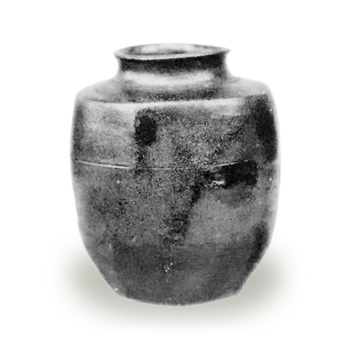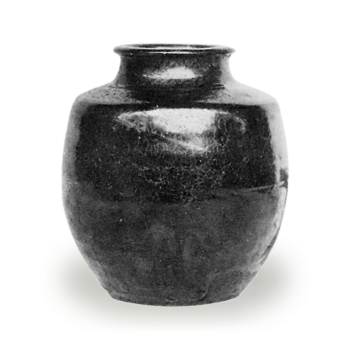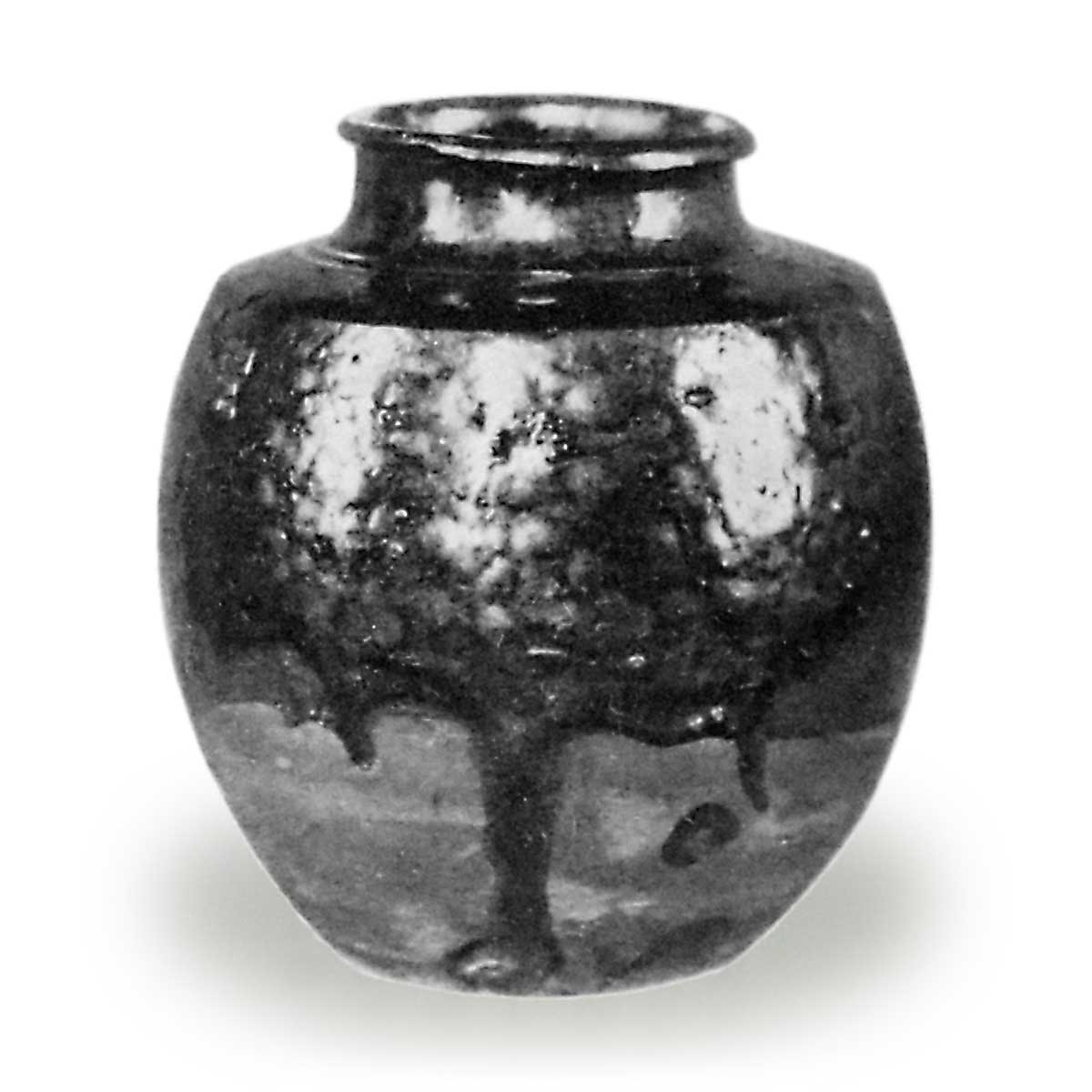
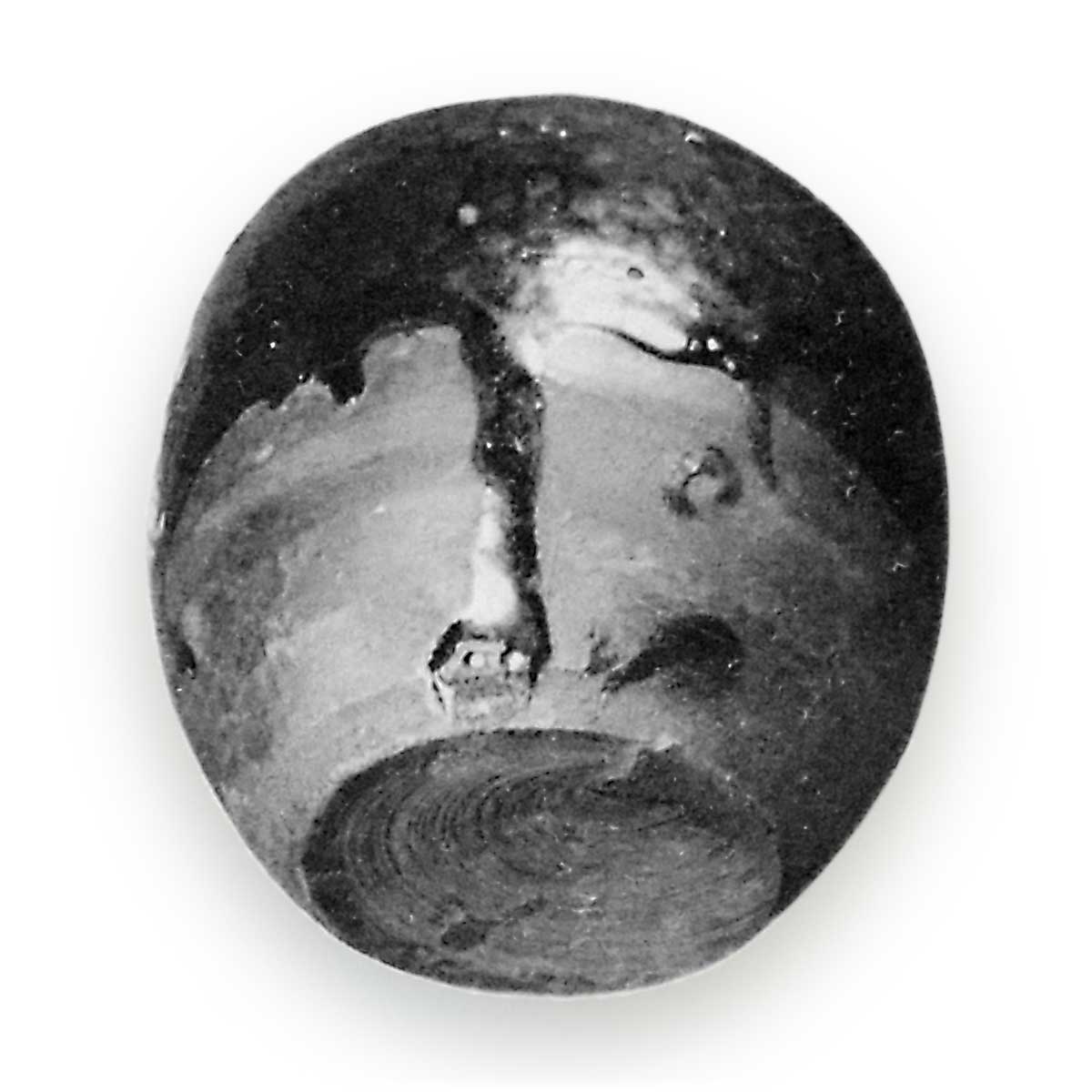
Chinese-made (Made in China) Daimeibutsu Duke Collection of Ietatsu Tokugawa
[Origin of the Name]
The Tsuda Sōyuki Chayū Nikki states: “Hoshi Katatsuki. There are undulations (unevenness) in the glaze, which are thought to resemble stars.” Furthermore, the Catalog of Imperial Artifacts and Paintings held by the Tokugawa family notes: “Because it features a star-like appearance, Ashikaga Yoshimasa, the 8th Shogun of the Muromachi Shogunate (known as Lord Yoshimasa of Higashiyama), bestowed this name upon it.” The Diary of Sōtan also states, “Something resembling stars can be seen on the glaze.”
[Dimensions]
Height: Approx. 8.3 cm (2 sun 7 bu 5 rin)
Body diameter: approx. 7.8 cm (2 sun 5 bu 7 rin)
Mouth diameter: approx. 4.0 cm (1 sun 3 bu 1 rin)
Base diameter: slightly over 4.5 cm (slightly over 1 sun 5 bu)
Neck height: approx. 1.2 cm (4 bu)
Shoulder width: approx. 1.4 cm (4 bu 5 rin)
Weight: approx. 121.5 g (32 monme 4 bu)
[Accessories]
・Ivory lid: 1
・O-mono-bukuro (bag for the tea caddy): White ha-ni-bi
・Shifuku (covers): 2
- Cloth with a Seigaiha, Tang floral, and treasure motif (lining is Jodo-kaiki, cord knot is purple)
- Cloth with a fine dragon-and-bird-shoulder-strap pattern (lining: iridescent sea-green silk; cord: purple)
・Hikiya (wooden container to protect the tea caddy): Plain, black lacquered
Bag for the Hikiya: Tang-style woven fabric with a tortoiseshell-and-phoenix pattern (lining: light green sea-green silk; cord: purple)
・Tea caddy boxes: 2 (inner box, outer box)
Inner box: Unfinished paulownia wood box, inscribed with “Hoshi Katatsuki” in ink
Outer box: Black-lacquered box, inscribed with “Hoshi Katatsuki” in gold powder
・Pouch boxes: 2 (inner box, outer box)
Inner box: Unfinished paulownia wood box, inscribed with “Hoshi Katatsuki Pouch Donsu No. 2” in ink
Outer box: Black lacquered box, with the characters “Hoshi Katatsuki Bag No. 2” in gold powder
[Miscellaneous Notes]
『Meibutsu-ki』: Hoshi (Hoshi Katatsuki). Owned by the Kii-dono (the Kishu Tokugawa family). Previously owned by Sugimura Sōji, then by Hariya Genroku (Hikoro in some versions). It then passed to Sen Sōtan, and was subsequently owned by Kato Higo-no-kami (Kato Kiyomasa).
Higashiyama Gomono Uchibetsuchō and Tenshō Meibutsu-ki: Hoshikatsubukuro. Located in Kyoto, owned by Hariya Genroku (Hikoro in some versions).
Manpō Zensho: Hoshikatsubukuro. Owned by Hariya Hikoro. The glaze is a deep amber color with unevenness. The thread-cut pattern on the base is slightly worn, and there are traces of chipping (dimension and diagram of the tea caddy included).
Hōan Bunko-bon Ganka Meibutsu-ki: Hoshi (Star Katatsuki). Classified under the section for Chinese-style tea caddies (katatsuki) belonging to the Kii clan (the Kishū Tokugawa family). It bears a red inscription and was once owned by Katō Kiyomasa; it was presented to the Kii family when the Shogun visited them.
Kokin Meibutsu Ruiju: Hoshi (Star). A Chinese katamuki. Daimeibutsu. Owned by the Kii family (the Kishū Tokugawa family).
Rinbō Kiryū: Star. A treasure of the Shogun’s family.
It was owned by Sugimura Sōji and Hariya Genroku, passed from Sen Sōtan to Kato Higo-no-kami (Kato Kiyomasa), and presented to the Shogunate by the Lord of Kishu (the Kishu Tokugawa family). Metallic specks within the glaze resemble stars. It is a piece of exceptional craftsmanship. It features an avalanche (drip) of black glaze, and the areas where the glaze has been removed resemble round beads. It was made in a later period. The pouches are made of fabric from Honno-ji Temple and white plum blossom fabric.
From the “Tsuda Sōyuki Chado Nikki” (Tsuda Sōyuki’s Tea Ceremony Diary):
On the morning of March 4, Genki 2 (1571), a tea gathering hosted by Hariya Hikoroku. The guests were Tsuda Sōyuki and Kusabe Dōsetsu.
Since there was no tea room, a makeshift structure was hastily erected, and a space of six tatami mats was enclosed with folding screens. A Hoshikatsuchi was brought out on a square tray. Although tea was not prepared, the meal served was very lavish, and various decorations, such as artificial flowers, were displayed.
The Hoshikatsuchi has a good shape and size, but the quality of the clay is not very good. The glaze is a single color applied thinly. There are variations in height (unevenness) within the glaze, which is thought to be what was called “Hoshi” (star). There is a single streak of glaze runoff, and the edge where the glaze meets the unglazed area is raised, causing the glaze to pool there.
“Tsuda Sōyuki’s Tea Ceremony Diary”:
On the morning of October 18, Tenshō 10 (1582), a tea gathering hosted by Hariya Sōwa. The guests were Ueda Sōji and Tsuda Sōyuki. Later, Matsuya Genshirō and Gensaburō joined the gathering.
A “Hoshi Katatsuki” was displayed in the tokonoma, placed inside a bag on a shihō-bon tray. It did not contain tea.
I saw the “Hoshi Katatsuki” again. The shape and size are good, but the clay is not of high quality. The glazing technique follows the standard mold, but the visual effects, such as the glaze run, are not pleasing. There is no swirl at the base where the glaze breaks. There are ridges on the rim, and one side of the flared rim is thinner. The glaze surface has high and low areas, and the glaze line (hagi) is high. There is a dark, dense glaze toward the edge, while the overall glaze is gray. In some places, the glaze is scattered within the clay.
“Illustration of the Kitano Grand Tea Ceremony (Kitano Shrine Collection)”: A catalog of items exhibited at the Kitano Grand Tea Ceremony on October 1, 1587 (Tenshō 15).
Listed as items owned by Hariya Genroku are “One Star Shoulder-Strike (Hoshi Katatsuki)” and “One Painting of Reed Leaves by Zhao Chang (a painting of reed leaves by Zhao Chang).”
“Niyōshū” (by the monk Jōtai): November 17, Keichō 2 (1597).
(First half omitted) It is stated that he purchased the “Hoshi Katatsuki” previously owned by Hariya Genjūrō for 70 gold pieces, and I had the opportunity to view that katatsuki. On this occasion, I acquired a small katatsuki purchased from Sakai and a small shiribukura jar presented by Kanamori Izumo-no-kami.
Sōtan Nikki: February 19, 1599 (Keichō 4), at noon; a tea gathering hosted by Sōbon (possibly Furuta Oribe?) in Fushimi.
The sole guest was Kamiya Sōtan. The four-and-a-half-mat tea room had an irori hearth, and an old dog-shaped kettle was placed on the trivet. A calligraphy scroll hung in the tokonoma, and beside the hanging scroll, a “katatsuki” (star-shaped katatsuki) was placed on a square tray. Nothing was placed on the hanging shelf; while going to the hand-washing basin, the calligraphy scroll was removed, and the tea caddy was placed on the tray in front of the water jar, and so on.
The Hoshi-katatsuki has broad shoulders, a narrow lower section, and a rounded body. The glaze is black, with an avalanche-like (dripping) pattern flowing outward on the exterior. The clay is a bluish-black, slightly whitish in tone. Star-like specks are visible on the glaze. The lid is of medium-quality ivory. The indentation (kaku) on the underside of the lid is shallow and positioned toward the top; it appears new. The bag is made of pale green satin, lined with reddish-brown bamboo-patterned fabric (striped?). The knot on the cord is purple.
“Kishū Family Documents”: Hoshikata-tsuki. In June of Keichō 16 (1611), it was presented to Lord Nanryū (Tokugawa Yorinobu) as part of Kato Kiyomasa’s遺物, along with a Samonji tachi and a Kunikuni-toshi katana. (*Note: Lord Nanryū’s principal consort, Yōrin-in, was Kiyomasa’s daughter.) In April of Genroku 10 (1697), upon the Shogun’s arrival, it was presented to Shogun Tokugawa Tsunayoshi by Tokugawa Mitsusada (Lord Taizan), the second lord of the Kishū Domain. Height: 2 sun 7 bu 5 rin; blade diameter: 2 sun 5 bu 5 rin.
“Catalog of the Tokugawa Family’s Artifacts and Paintings”: Star-Shouldered Vase. Chinese-made. Presented by the Kii Daikan on April 11, Genroku 15 (1702; *Note: The date Genroku 10 on the previous page may be a misprint or from a different record*). Lord Higashiyama Yoshimasa (Ashikaga Yoshimasa) gave it this name because the glaze has a star-like pattern. Height: slightly over 8.3 cm (2 sun 7 bu 5 rin), body diameter: approx. 7.9 cm (2 sun 6 bu), mouth diameter: approx. 4.2 cm (1 sun 4 bu), base diameter: approx. 4.5 cm (1 sun 5 bu).
The entire piece is covered in a high-quality black persimmon-colored glaze, featuring a star-like pattern on a birch-colored (reddish-brown) ground. The rim (around the base) has a left-handed thread-cut finish. It comes with two storage bags: one made of white gokudon (with a purple circular pattern on the lining) and one made of Honnoji-don (with the same lining). The imperial bag is made of white habutae silk. The lid is ivory. The Hikiya is lacquered black. The Hikiya’s bag features a brown phoenix pattern on a navy background. The inner box is made of natural paulownia wood, while the outer box is lacquered black with gold-leaf lettering (a diagram of the tea caddy is included).
“Jō-godo”: Hoshi-katatsuki. Presented by the Kii Daikan on April 11, Genroku 15 (Year of the Ox). This tea caddy was presented upon the Shogun’s arrival and is stored in the third-tier chest. It comes with two covers: one featuring a Seigaiha arabesque and treasure motifs (with a Jōdai-style wave pattern on the reverse), and another of satin with slender dragon tails (with a brown wave pattern on the reverse). It has a single lid.
[History]
Originally owned by Sugimura Sōji, it was held by Hariya Hikoroku in Kyoto during the Genki era (1570–1573) and by Hariya Sōwa during the Tenshō era (1573–1592). On November 17, 1597 (Keichō 2), Toyotomi Hideyoshi purchased this item for 70 gold pieces; thereafter, it appears to have passed through Sōhan to the wealthy merchant Kamiya Sōtan of Hakata. (The entry in the miscellaneous tea ceremony records stating that it “passed to Sen Sōtan” is believed to be a misprint for “Sōtan”).
Shortly thereafter, it became the property of Katō Kiyomasa, and in June of Keichō 16 (1611), it was passed down as part of Kiyomasa’s estate to Tokugawa Yorinobu (Nanryū-in), the founder of the Kishū Domain. This was likely because Yorinobu’s principal consort (Yōrin-in) was Kiyomasa’s daughter.
On April 11, Genroku 10 (1697) (or Genroku 15), when Shogun Tokugawa Tsunayoshi visited the Kishu Domain residence, Tokugawa Mitsusada (Taizan-ko), the second lord of the Kishu Domain, presented it to the Shogun. Since then, it has remained in the shogunate’s treasury, never leaving the premises, and remains in the collection of Lord Tokugawa Ietatsu to this day.
[Record of Actual Viewing]
On November 8, 1918, I viewed the actual object at the residence of Duke Tokugawa Ietatsu in Sendagaya, Tokyo Prefecture.
The rim of the mouth is deeply folded, and the tip of the rim is thin like a blade. There are traces of clinging (remnants of something that adhered inside the kiln) on the rim, and some areas are slightly warped. There is also one spot of clinging around the shoulder. At the base of the neck, there are two raised ridges, with a somewhat deep groove between them.
From the middle of the tea caddy down, the raw, dark gray clay surface is visible up to a fairly high point. A single glaze drip has cascaded over this exposed clay and stopped at the edge of the foot rim, but about half of this glaze pool has chipped away. The foot rim is narrow, and the shape of the foot is pleasing, though the raised portion of the base is worn down in two or three places.
When held, it feels light and has a soft, squishy texture. The entire surface is dotted with small, blister-like spots where pale gray and light purple blend together. It is said that this piece was named “Hoshikata-tsuki” (Star Shoulder) because these spots resemble stars in the night sky. This is likely the result of a chance change in the glaze that occurred during firing in the kiln. It is a unique piece—a sort of oddity—and can be described as a truly exceptional teapot, unparalleled in its kind.