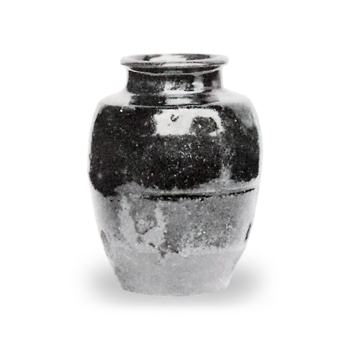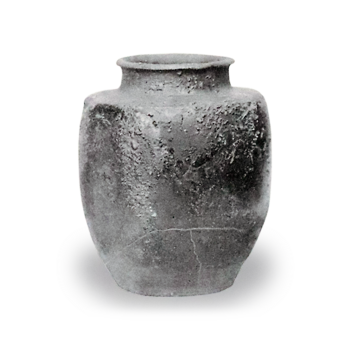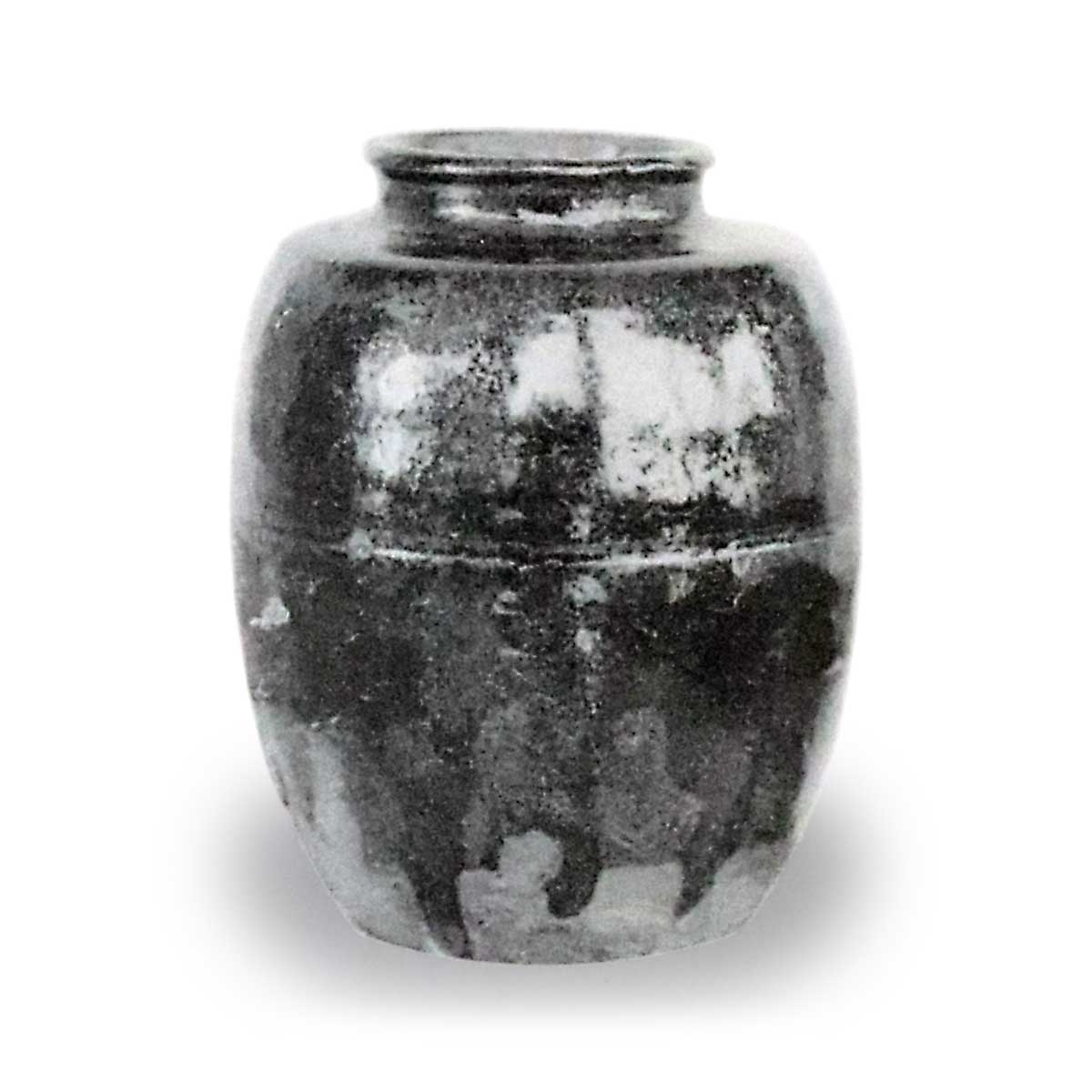
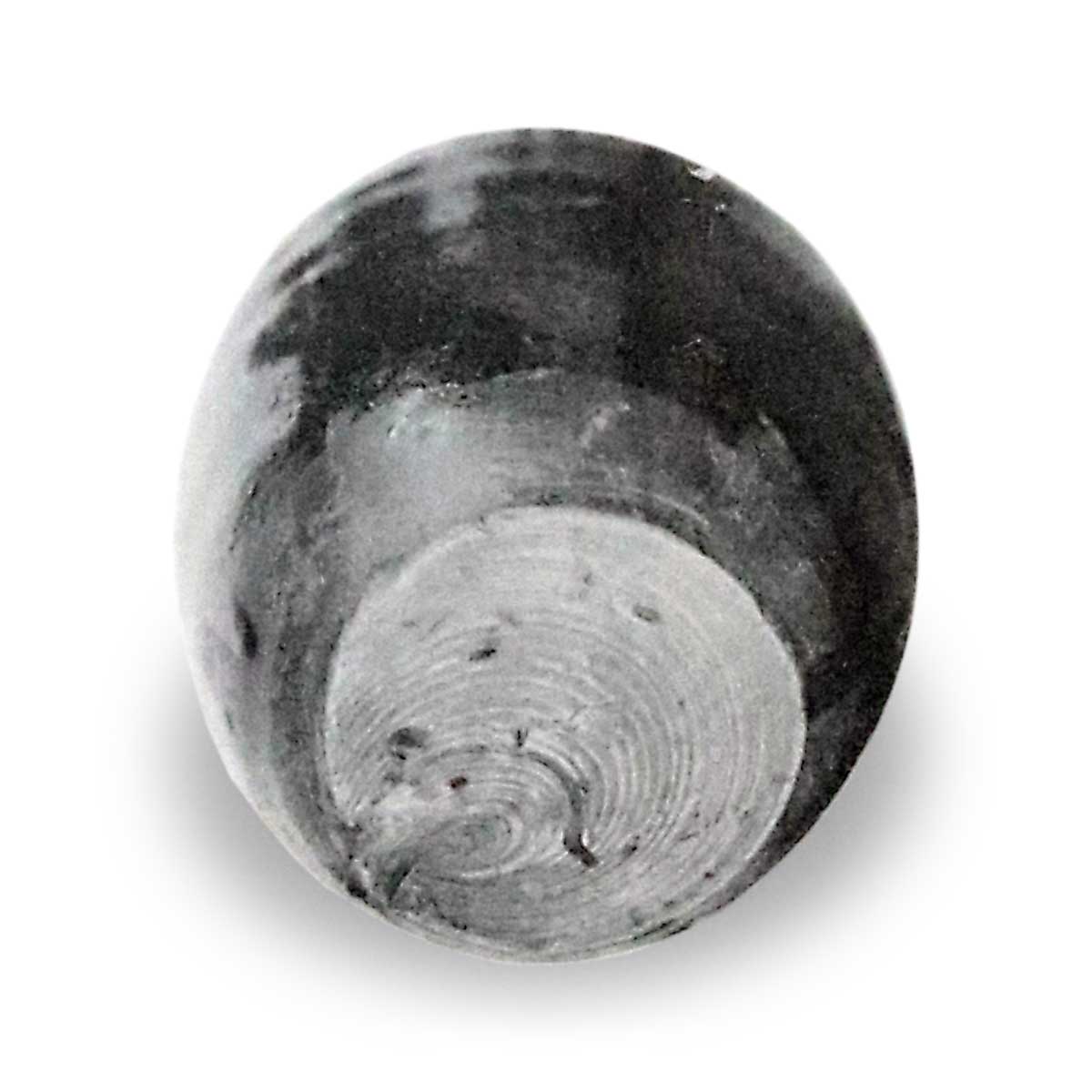
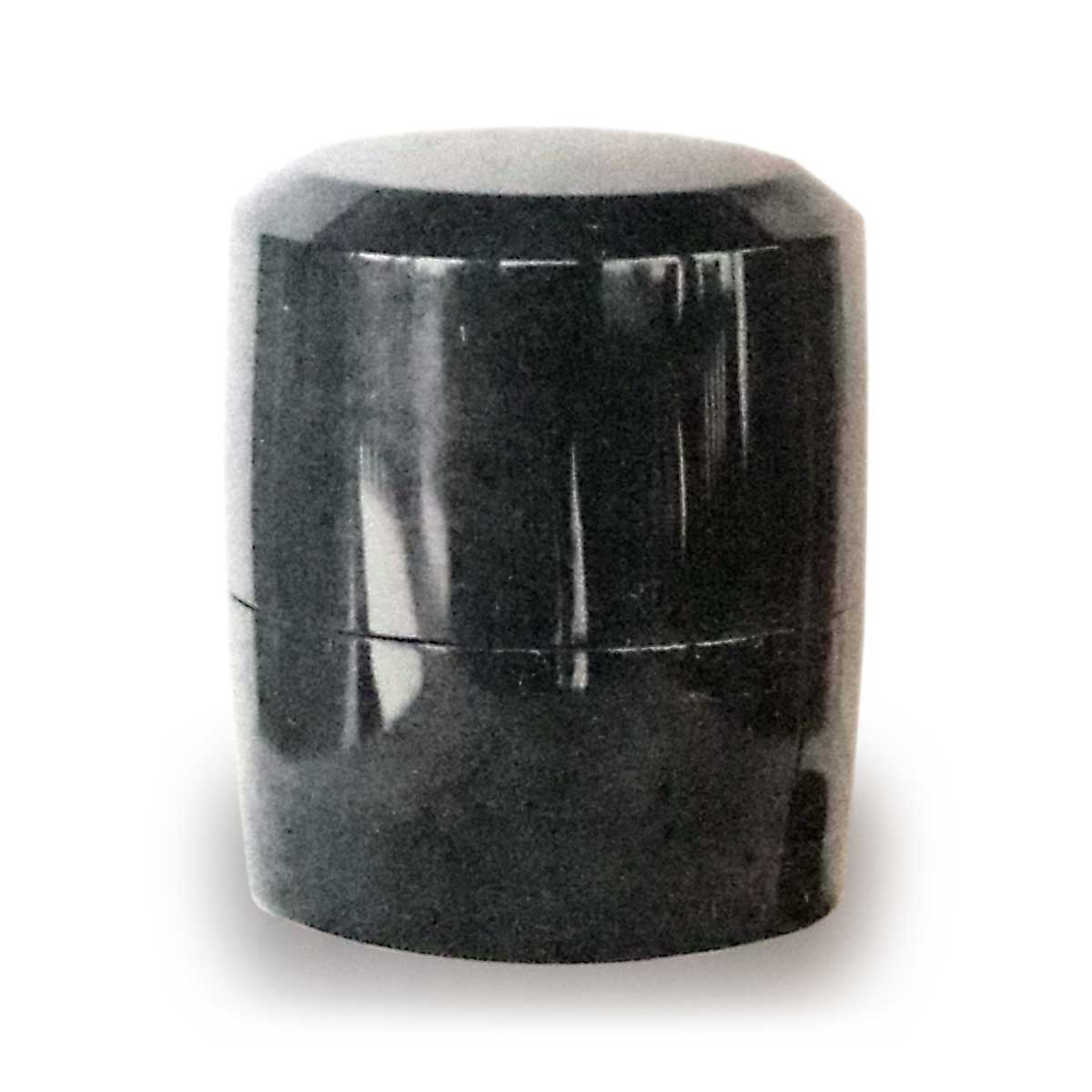
A Daimeibutsu tea caddy of Chinese origin (Han-saku), currently in the collection of Duke Tadashige Shimazu.
Origin of the Name
In “Higashiyama-den Kashiki-no-ki,” a work traditionally attributed to Soami, it is written: “Ake no Koromo is somewhat lacking in refinement and rather crude. Since Ake no Koromo (a vermilion robe) is the attire worn by those of the Fifth Rank, this teapot is of a value equivalent to the Fifth Rank.” However, this theory seems somewhat far-fetched. In reality, the name likely stems from the fact that the glaze on the tea caddy has a reddish hue, and the cascade of glaze flowing down from the waist resembles the folds of a vermilion robe worn by a person. For now, we will record both theories and await further research in the future.
Modern Equivalents of Dimensions and Weight
Height: Approx. 9.1 cm (3 sun)
Body diameter: Approx. 7.2 cm (2 sun 3 bu 8 rin)
Mouth diameter: approx. 3.9 cm (1 sun 3 bu)
Base diameter: approx. 4.5 cm (1 sun 4 bu 8 rin)
Koshiki (rim) height: approx. 0.8 cm (2 bu 7 rin)
Shoulder width: approx. 0.9 cm (3 bu)
Weight: approx. 126 g (33 monme 6 bu)
List of Accessories
There are three lids, and a nest (kago) is included. The storage pouch is made of white habutae silk with a white cord.
There are two covers: “Hino Koto” and “Moegi Donshu Unko.”
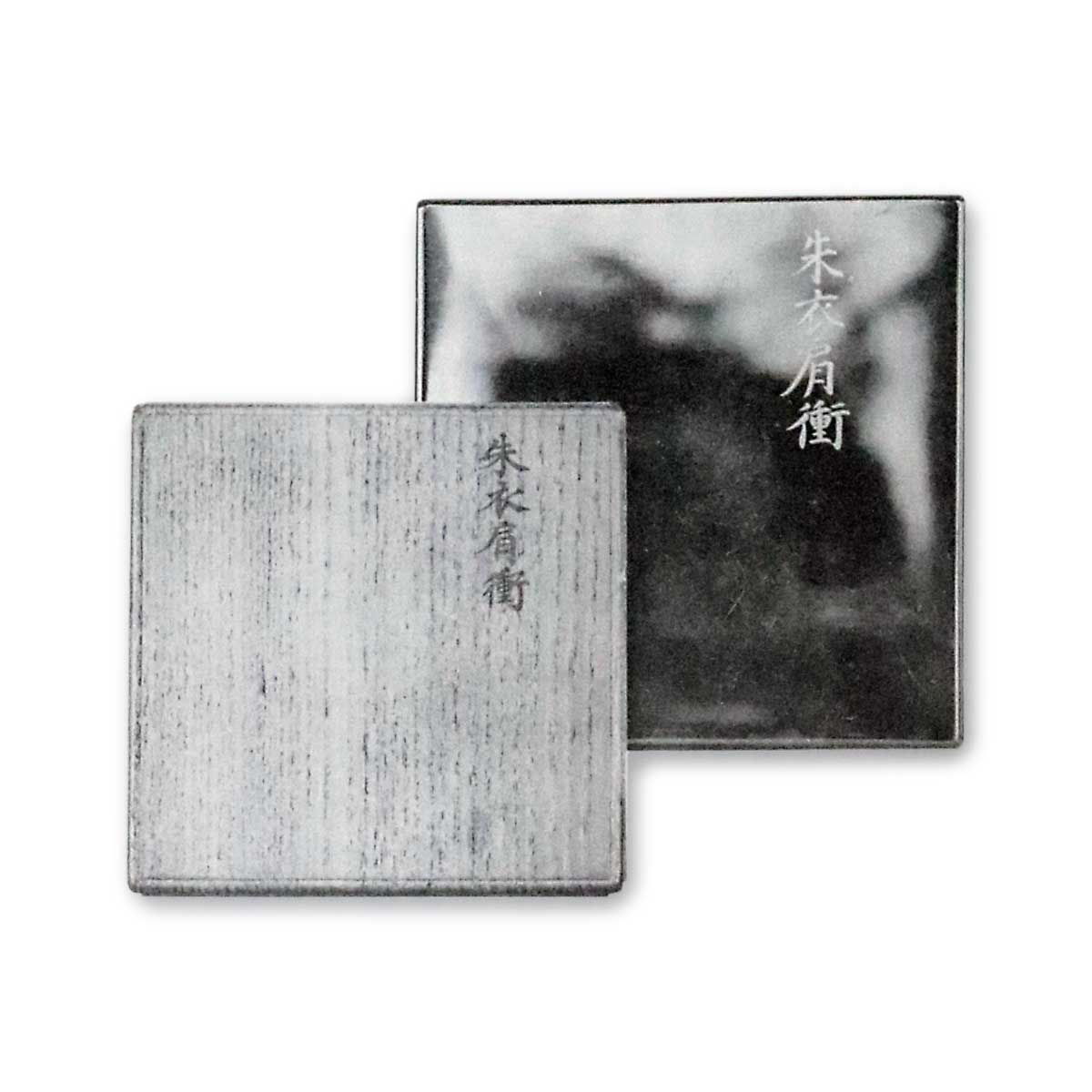
The unpainted paulownia wood box containing the pouches is labeled “Shu-i: Two Tea Canisters and Two Replacement Lids.”
Hikiya is coated in black lacquer with gold leaf sprinkled on the surface, and the interior is finished in a pear-skin texture. The bag containing Hikiya is made of black velvet.
The inner box is coated in black lacquer with gold-leaf lettering, and a label reading “Ichiban Ochamochi Ichiban” is affixed to it.
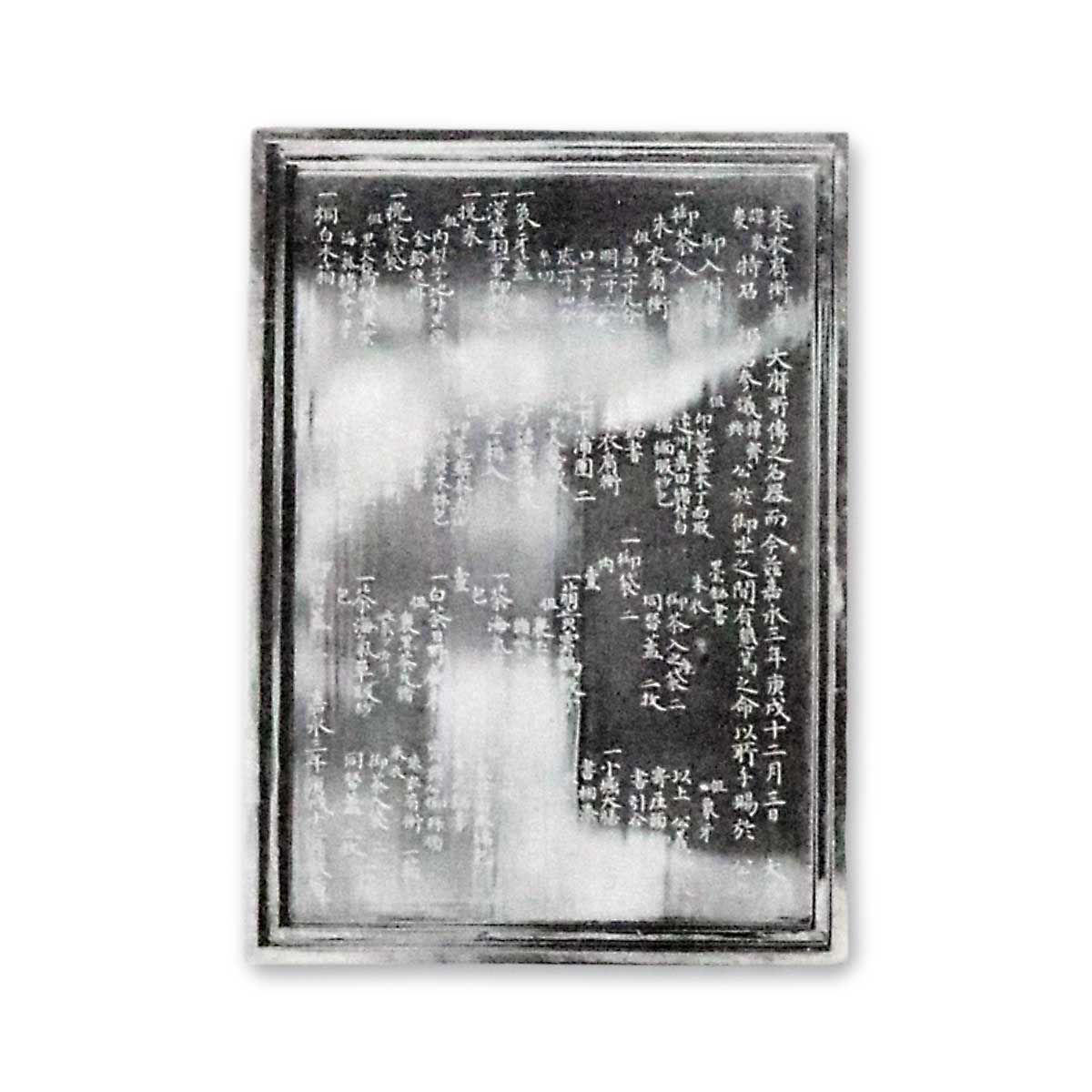
The outer box is also coated in black lacquer, and on the back, there is a Chinese inscription written in gold-leaf characters. It is recorded that “The Shu-i Katatsuki is a renowned artifact passed down through the Shogunate (Ōfu), but on December 3, 1850 (Kaei 3), Shogun Ieyoshi (Ōkimi) specially summoned Lord Shimazu Nariaki (Kunimune Sangi) to the throne room and, with heartfelt words, personally bestowed it upon him.”
The outermost box, which holds all the items, is finished in black lacquer and features a lock; the inscription in gold powder states that Lord Shimazu Narioki received it as a gift.
Evaluations and Characteristics of the “Shui Katsuzumi” as Seen in Various Tea Books
・As mentioned earlier, the Tōyama-den Kashiki-no-ki and Chaki Meibutsu Zui contain the following harsh evaluation: “It is somewhat lacking in refinement and rather crude. Since the ‘Ake no Koromo’ is the attire of the Fifth Rank, this is a teapot of the Fifth Rank.“
・In ”Kankyū Gohitsu,“ there is a record of the author unexpectedly viewing three of the world’s most famous Meibutsu—”Hatsuhana,“ ”Osozaki,“ and ”Ake no Koromo“—while attending a shogunate ceremony (Kadō) on June 16 of a certain year. According to this account, ”Ake no Koromo is a Chinese piece lacking any particular visual appeal. It is made of purple clay with a raised bottom. There are two faint pale yellow streaks at the glaze boundary. The handle (and overall construction) is robustly crafted, typical of Chinese ware,” and its dimensions are also measured in detail.
・In Ganka Meibutsu Ki and Kokin Meibutsu Ruiju, it is introduced as a Daimeibutsu, a famous Chinese-style katamuki owned by the Lord of Kishu (Kii-dono).
・In Rinpō-kīryū, it is described as an imperial artifact of the Shogun’s family, presented by the Lord of Kishū, with the following characteristics noted: “It has a strong persimmon color with a reddish tint. It belongs to the slightly younger (newer) category, with a genuine thread-cut finish. The clay is vermilion in color.”
Used at a tea ceremony hosted by Tokugawa Ieyasu
On December 14, 1611 (Keichō 16), the retired shogun Tokugawa Ieyasu hosted a tea ceremony in Sunpu, inviting Oda Yurakusai (Jōan), Hino Yuishin, Yamana Zentaka, and others. At this event, this “Shui Katatsuki” was displayed as a thin tea utensil alongside the “Narashiba Katatsuki,” known as the Meibutsu (finest tea utensil) in the land. The hanging scroll was a calligraphy by Kyodo, the flower vase was made of antique bronze, and Ieyasu himself arranged the flowers. Yurakusai was asked to prepare the tea. Afterward, Yurakusai presented gold and other treasures to Ieyasu. (From “The Records of Sumpu Administration” and “The Chronological Compilation of Military Virtues”)
Use by Shogun Iemitsu and the Kii Tokugawa Family
When the third shogun, Tokugawa Iemitsu, visited the residence of Tokugawa Yorinobu (Kii Daikan), the lord of the Kishu domain, Yorinobu frequently used this “Ake no Koromo (Shui)” tea caddy to entertain the shogun.
・March 4, 1628 (Kan’ei 5): Mito Yorifusa, Todo Takatora, and others were in attendance. A hanging scroll by Kyodo was displayed, and a Yose-yaki tea bowl was used.
・February 20, 1630 (Kan’ei 7): Tokugawa Tadanaga and Mito Yorifusa were in attendance. A hanging scroll by Shiba Reiseki was displayed, a Yose-yaki tea bowl was used, and a “Mushi-gui” tea scoop made by Rikyu was used. (From “Tobu Jitsuroku”)
Presentation from the Kii Clan to the Shogunate
On May 23, 1667 (Kanbun 7), when Kii Daikan (Yorinobu) retired, this “Vermilion Robe Shoulder-Patch” was presented to the Shogunate (the Shogun’s family).
A vermilion-inked note states: “This vermilion-lacquered tea caddy was bestowed by the Shogun himself upon Shimazu Nariaki (a mistake for Nariyuki) as a reward for bringing Ryukyuan artisans to Edo to serve the Shogunate, in recognition of the fact that, in previous years, the father of Matsudaira Satsuma-no-kami Nariakira (a mistake for Nariyuki) had brought Ryukyuan artisans to serve the Shogunate. Consequently, it is currently in the possession of the Shimazu family.” (From “Catalog of Artifacts and Paintings in the Tokugawa Family Collection”)
Furthermore, the shogunate’s inventory of artifacts (“Jō-godo”) records that it was presented to the shogunate when the Kii Daikan retired in Kanbun 7 (1667).
Use at Shogunate Tea Ceremonies
On September 1, 1670 (Kanbun 10), when the fourth shogun, Tokugawa Ietsuna, invited the lord of the Mito Domain (Mito Saishō) to the Kuro-shōin to entertain him, the shogun personally prepared and served tea.
The “Shui” tea caddy was used on this occasion. A “Ingetsu-e” hanging scroll, a “Mishima-hake-me” tea bowl, and a “Osorori” flower vase were also used. (From “Tokugawa-ke Chakai no Ki”)
Summary of its history until it was bestowed upon the Shimazu family
This tea caddy was originally a prized masterpiece cherished by Takeno Jōō, the tea master of Oda Nobunaga. It was later passed down to Tokugawa Ieyasu, who used it in 1611 (Keichō 16) when entertaining Oda Yurakusai.
Subsequently, Ieyasu bestowed it upon Tokugawa Yorinobu (Kii Daikan) of Kishū. In 1628 and 1630 (Kan’ei 5 and 7), when the third shogun, Iemitsu, visited the Kishū domain residence, Yorinobu used this tea caddy to entertain the shogun.
When Yorinobu retired in 1667 (Kanbun 7), it was once again presented to the shogunate and has since been preserved as a treasure of the shogunal family (Yanagi-e Imperial Treasures).
As time passed, on December 3, 1850 (the 3rd year of the Kaei era), toward the end of the Edo period, Shogun Tokugawa Ieyoshi commended the Satsuma Domain for escorting an envoy (tribute mission) from Ryukyu to Edo. He summoned Shimazu Nariaki to the throne room and, with his own hands, bestowed this renowned treasure, the “Shui Katatsuki,” upon the Shimazu family.
Academic Inspection Record (Appraisal Record) from the Taisho Era
On September 20, 1921 (Taisho 10), this tea caddy was physically examined at the residence of Lord Shimazu Tadashige in Osaki, Tokyo.
The rim is thick, and the flared edge is shallow. The base is low, the shoulders protrude firmly (with a sharp, defined curve), and the body is slightly flared. A thick, sunken ridge (horizontal line) runs around just under half of the tea caddy. From the rim downward, the vermilion-colored clay (body) is visible, showing fine traces of thread-cutting. In the center of the base, there is a small firing crack (a crack formed during firing), and slightly deep spatula marks and flaking of the clay can also be seen.
Overall, the amber-colored glaze emits a beautiful luster, dotted with small, pitted spots. A slightly reddish-yellow glaze cascades down from below the shoulder, becoming a denser flow beneath the body’s cord-like lines, and splits into three streaks at the base where it meets the unglazed clay. One of these streams reaches the very edge of the base (where the footring meets the body) and stops there; at its tip (the exposed edge), a faint hint of “jakatsu” (scaly kiln change) color appears. On the exact opposite side of this front view (the side facing the viewer), there is also a short stream where the glaze has pooled slightly thicker.
Amidst the overall amber-colored glaze, a flow of reddish-yellow glaze forms a shape resembling a “curtain,” and this appearance closely resembles “the hem of a vermilion robe worn by a high-ranking monk.” The origin of the beautiful name “Ake no Koromo” (Vermilion Robe) likely stems precisely from this visual scene.
Although it is somewhat small for a Chinese “Han-style” shoulder-rest tea caddy, the pattern of the yellow glaze is exceptionally intriguing, and together with its name “Vermilion Robe,” it is a fascinating and charming tea caddy.