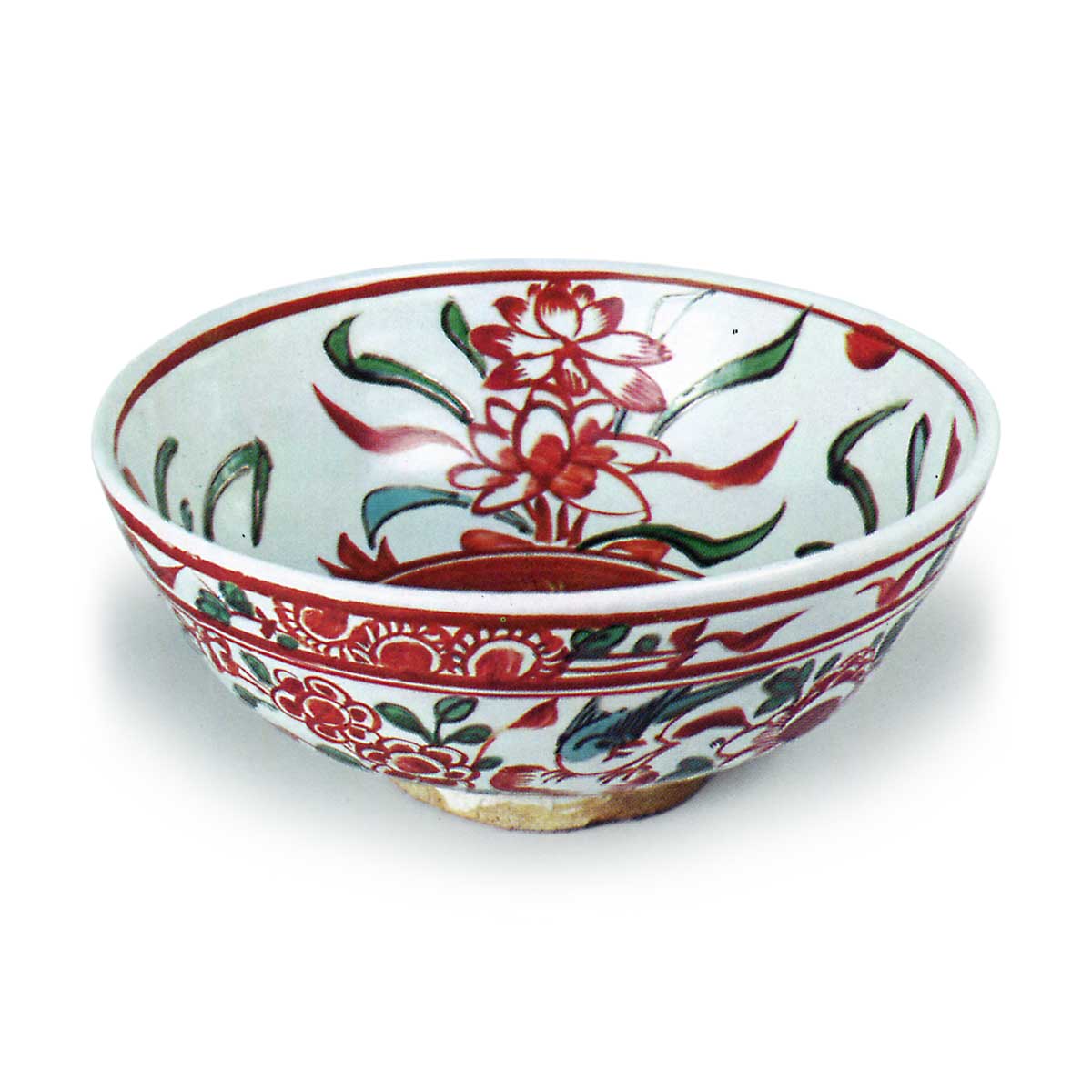
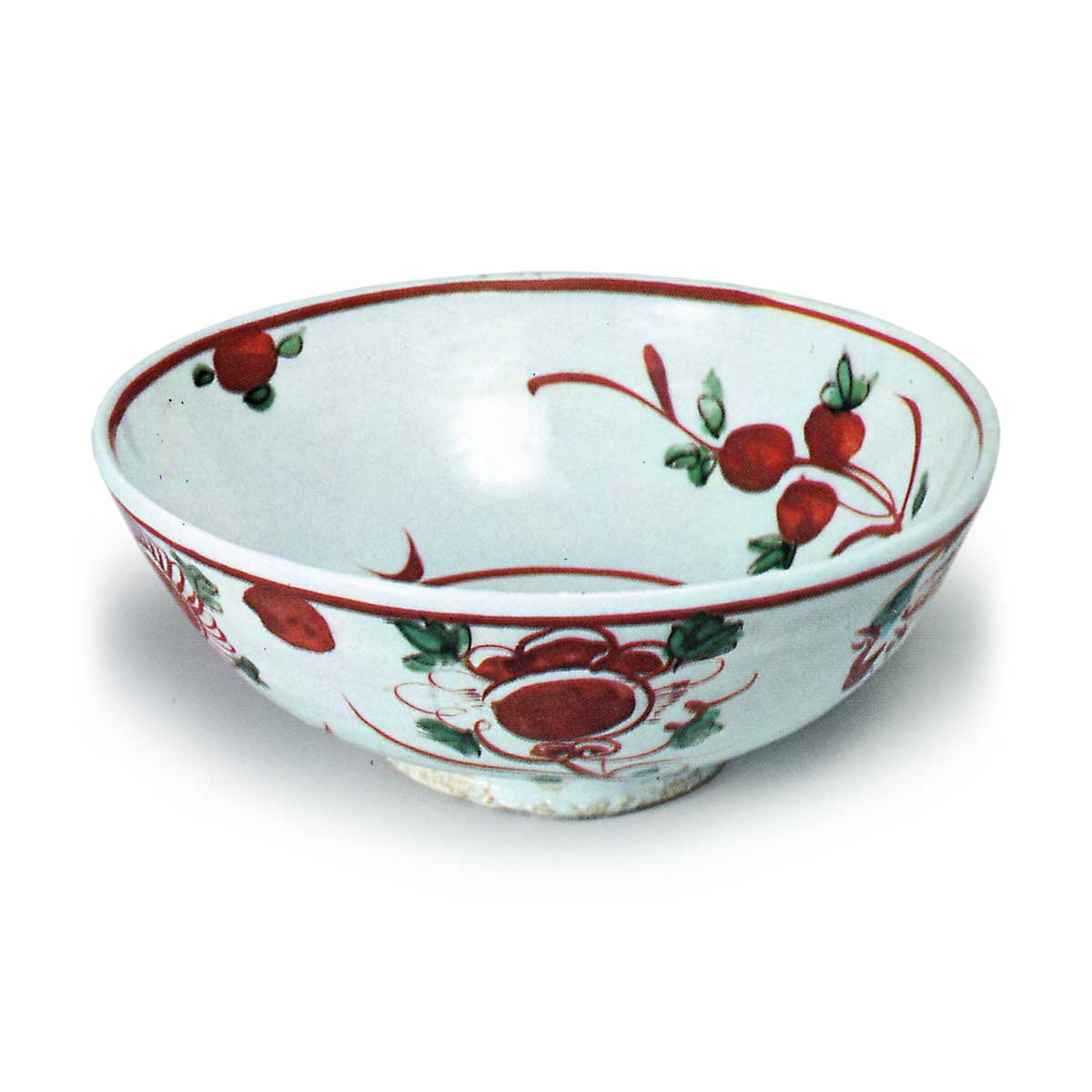
220 Wuzhou Red-Painted Imitation Bowl
Height 11.4 cm, Mouth diameter 23.3 cm, Base diameter 9.3 cm
221 Wuzhou Red-Painted Imitation Bowl
Height 8.2 cm, Mouth diameter 19.1 cm, Base diameter 7.4 cm
222 Wuzhou Red-painted Imitation Bowl
Height 6.8 cm, Mouth diameter 16.7 cm, Base diameter 6.7 cm
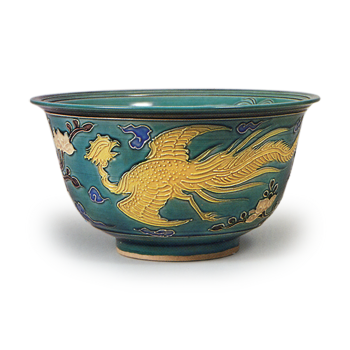
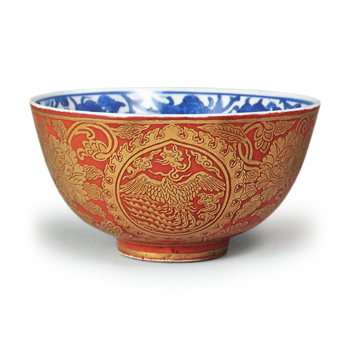
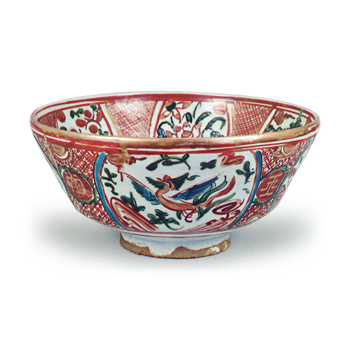
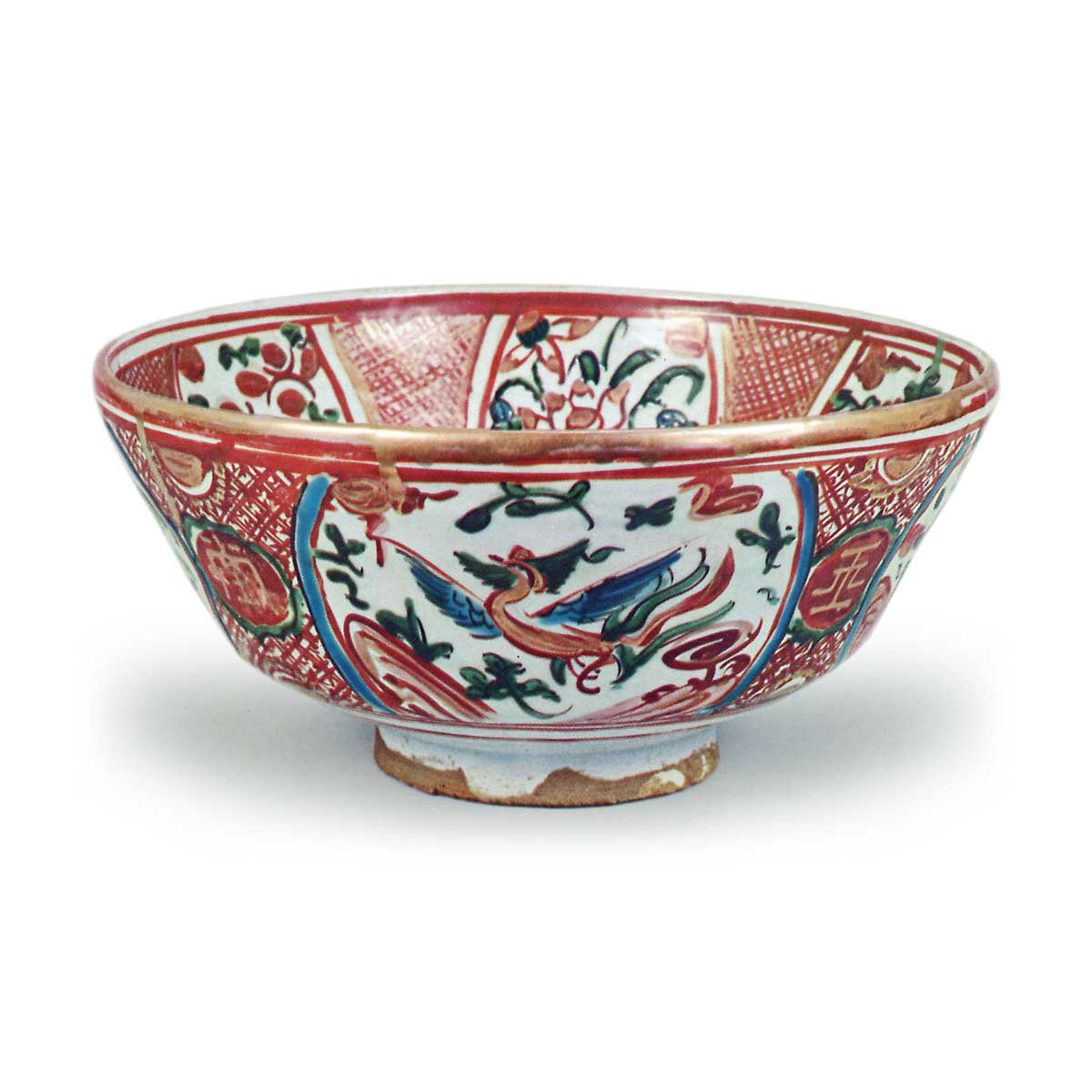
All of these are bowls modeled after late Ming Dynasty Wuzhou red-painted ware, and the patterns depicted on them are all distinct.
The bowl in Figure 220 has a slightly tapered body and rim. The footring is left unglazed, and the body is covered with a thick layer of bluish white glaze. In the center of the interior, the character “福” (fuku, meaning “good fortune”) is written in blue and red within a gold-painted circular motif. The exterior is divided into six sections, with floral motifs and fine diagonal lattice patterns alternately painted in red, gold, green, blue, and black overglaze.
The exterior features windows on all four sides, with lotus pond designs on two sides and dragon-phoenix designs on the other two; circular motifs containing characters are arranged across the base. The “Eiraku” mark is stamped on the glaze-free area beside the foot rim. The lid of the box bears the inscription “Gold-painted Goshū Red-painted Large Bowl,” while the underside of the lid is inscribed with “Made by Zenichirō.”
Fig. 221 is slightly smaller than the previous example. Within the circular design on a red ground at the center of the interior, a fruit motif is painted in gold; on the sides, lotus and grass motifs are depicted on all four sides, leaving some blank space. A single band encircles the outer rim, and several birds are arranged among floral motifs at the bottom. The “Eiraku” mark is stamped beside the foot.
Figure 222 is even smaller than the previous two pieces and is a faithful reproduction of the so-called “Kai” bowl. In deep red and green, the character “Kai” is depicted within the circular design at the center of the interior; lotus motifs extend to both sides, while peonies, chrysanthemums, and phoenixes are painted with a casual brushstroke on the exterior. The mark “Kawabami Shiryu” is stamped inside the footring.