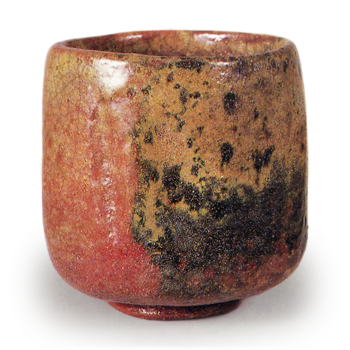
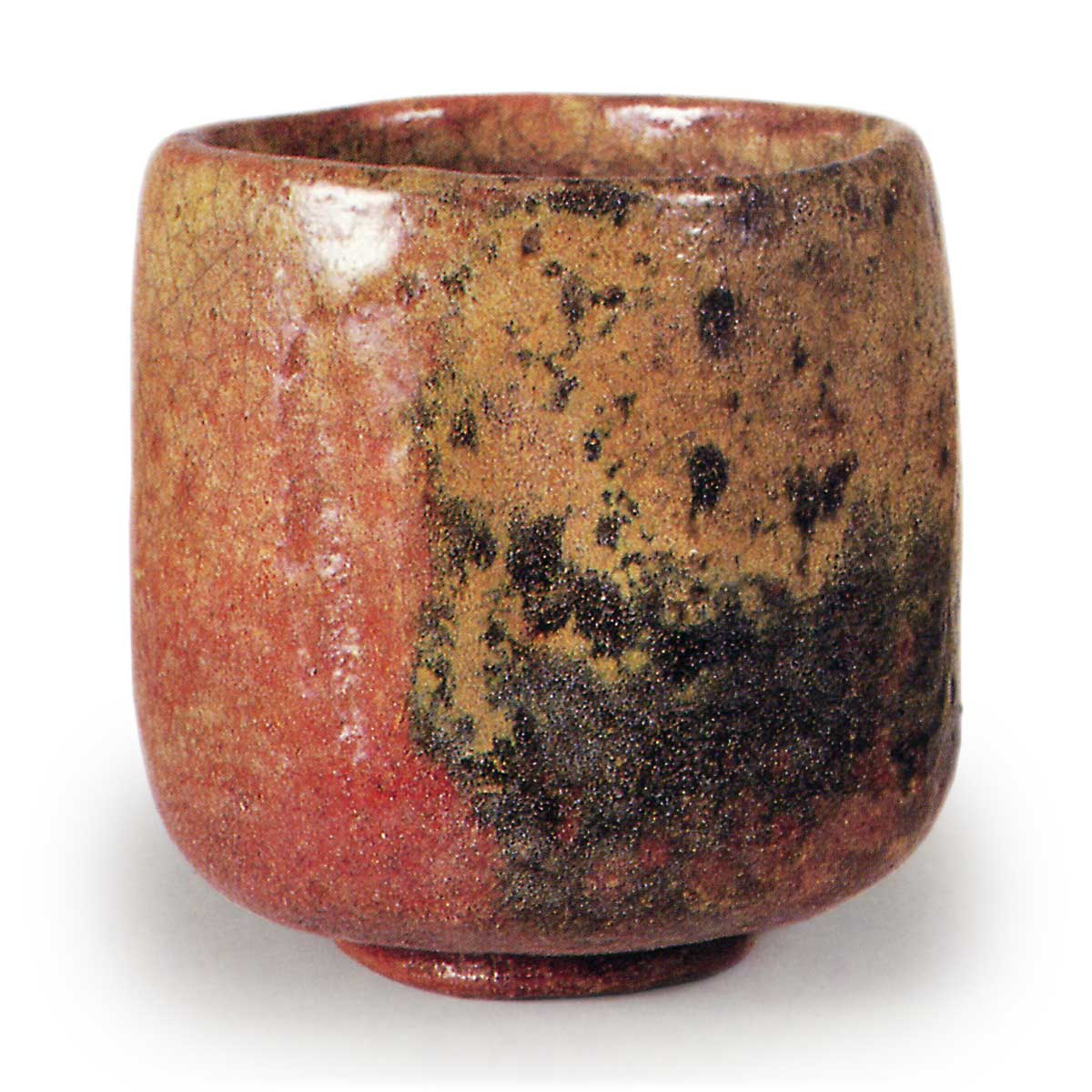
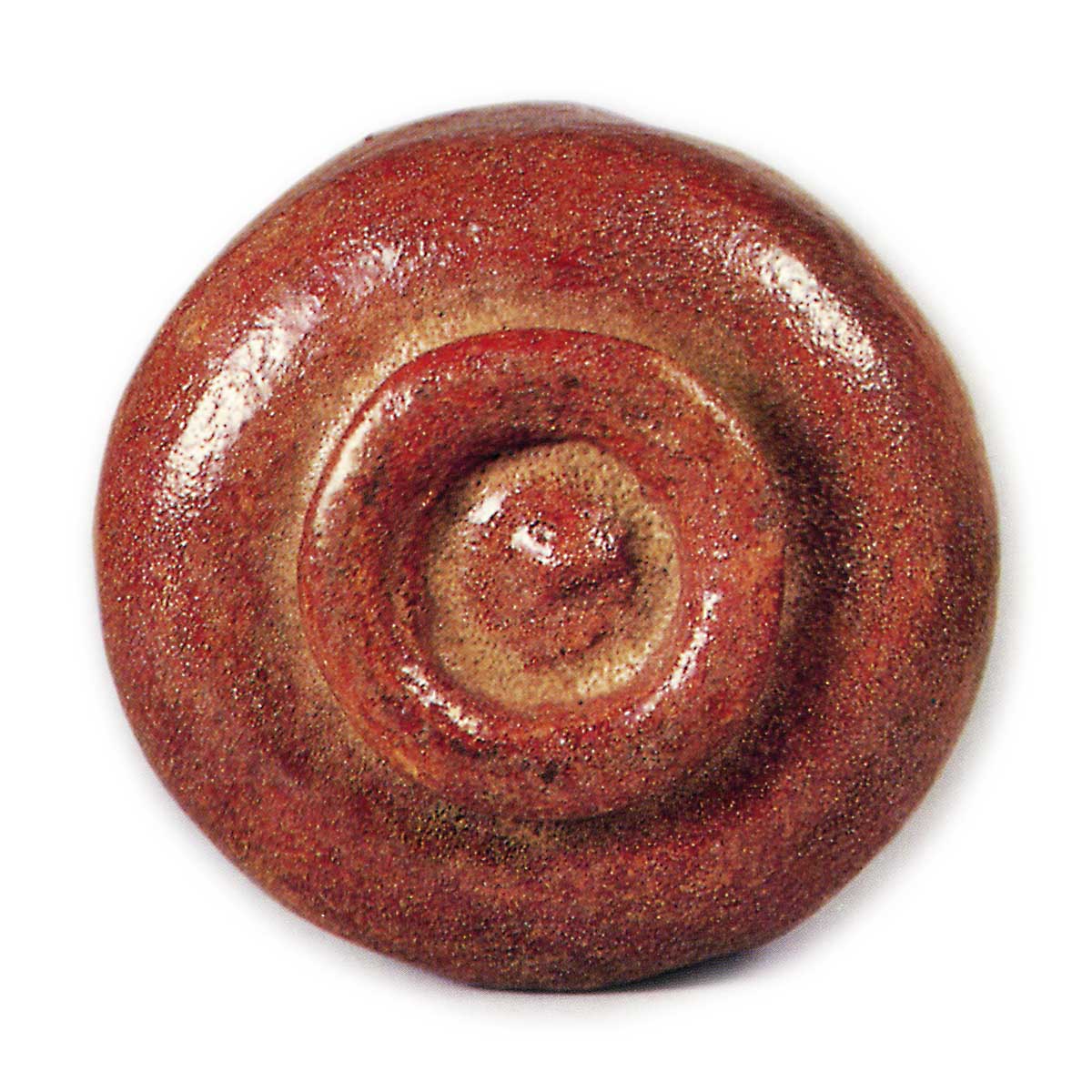
Height: 10.0 cm, Mouth Diameter: 8.5 cm, Foot Diameter: 5.2 cm
Yuki Art Museum
The exterior of the inner box lid bears the inscription “Red Cylindrical Tea Bowl, Raku-yaki, Kichizaemon,” while the interior of the lid features an inscription by Kakukaku Sai Genso reading “Inscription: Fukujusō (seal).” Although this is a so-called “joint box,” the seal stamped on the exterior of the lid is that of Ichinyu; therefore, it is presumed that this piece was likely created by Sonyu during Ichinyu’s later years, and that the Ichinyu seal was applied to the exterior of the lid. Ichinyu retired in the fourth year of Genroku (1691), when Soin was 27 years old, and passed away in the ninth year of Genroku (1696); this piece was likely created during that period. Consequently, it is believed to predate the black tea bowl inscribed “Kanoko-mottan” (Kinoe-tori tea bowl) by quite some time.
The overall thick, stocky form—a characteristic of Sōnyū’s work since his youth—is evident here. This tea bowl is also formed quite thickly. It is a cylindrical bowl with a flared base; the rim, as is typical, curves inward, and the rim line is rounded with gentle undulations. A step is carved on the interior, and a deep tea pool is carved out in the interior surface. On the exterior, two broad vertical lines and a single line are applied, and the rim is also decorated with sharp, flat lines. It features a large, mushroom-shaped foot, the interior of which is carved into a rounded shape, with the “kabuto-kin” (helmet-shaped rim) standing out distinctly.
Significant kiln coloration extends from the outer rim to the base, creating a landscape of dark green and rust-brown hues; the rest of the surface has a slightly grainy glaze finish. However, areas with thick glaze appear milky white and exhibit coarse craquelure.
This is an outstanding example among Sōnyū’s red-glazed tea bowls, and the box provided by Genso is also of excellent quality; however, next to Genso’s inscription, Ryōryōsai has added a definitive note reading, “Mufun-ya, Left (seal).” I understand that this piece has been passed down in the Kōnoike family of Osaka.