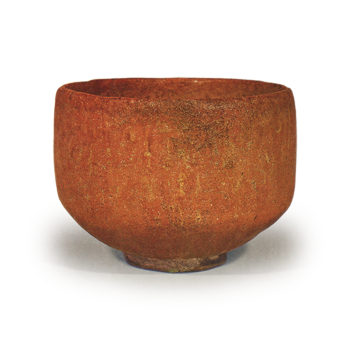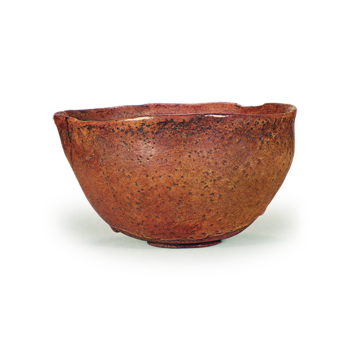
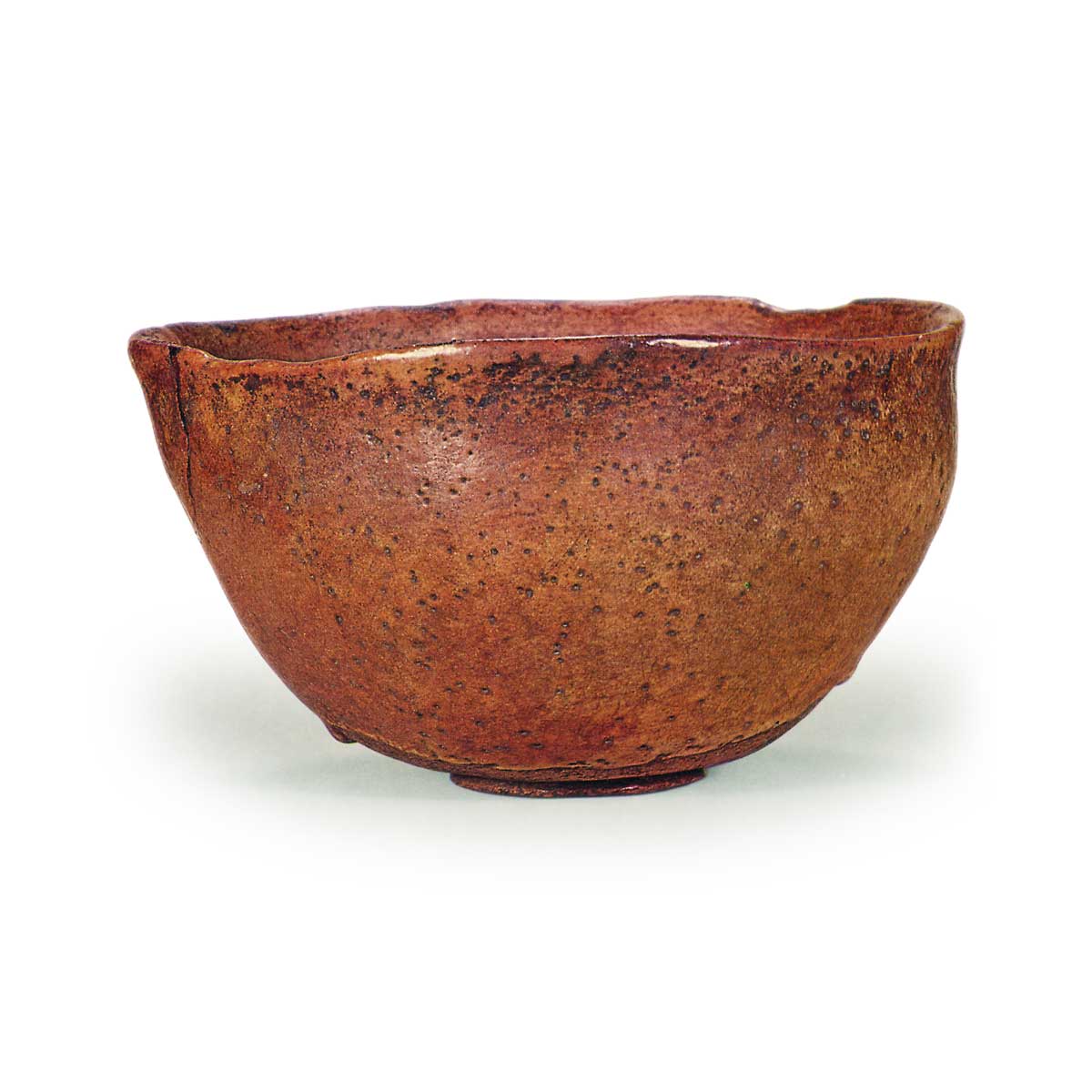

Akagama
Accessories
Inner box, paulownia, white wood
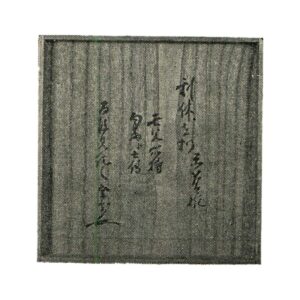
Same lid, inscription, Sen’sō Sōshitsu brush
Outer box, zelkova, red lacquered inscription, Gen’en Sōshitsu brush
Cover, round ground peony stitching, pure silk stitching
Provenance
Sen Sōtan—Osaka, money changer Omiya Hanbei—Hyogo, Yamaguchi family
Listed
Taisho Meiki Kanko (Taisho Masterpieces of Tea Ceremony Utensils)
Dimensions
Height: 7.7–8.0 cm, mouth diameter: 13.8–14.2 cm, foot diameter: 4.1 cm, same height: 0.4 cm, weight: 340 g
The seven types of Rikyu inscriptions are marked with red, but this one is also marked with red, indicating that it is second only to the head inspector. Since the position of head inspector is second only to the blind, this inscription was added. The box inscription by Sensou reads, “Belonged to my late father, said to be by Koudou,” so it is probably an inscription by Sōtan.There is a Rikyu seal at the side of the high foot, but excluding the North Wild Black bowl mentioned in the letter from Etsu, this is the only Nagajiro tea bowl with a direct inscription of Rikyu’s seal, making it a valuable relic.
It has the rare shape of a well, and similar pieces are extremely rare. It is also rare for it to be made of earthenware. It is thinly made, with the rim slightly turned up at the edges, a flat high foot with a groove inside, and a notch at the edge of the foot. It is considered to be the prototype of the Kōetsu shape. The red base is covered with a translucent glaze, which gives it a subtle color, and there are small holes all over the surface. It is thought to be an early work.