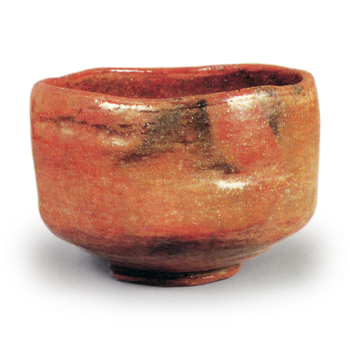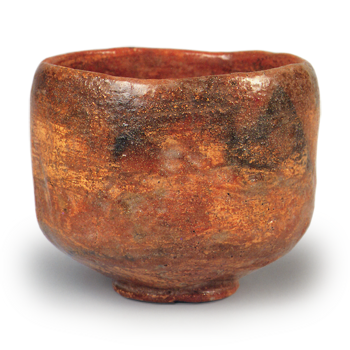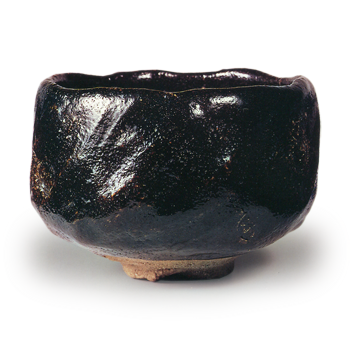
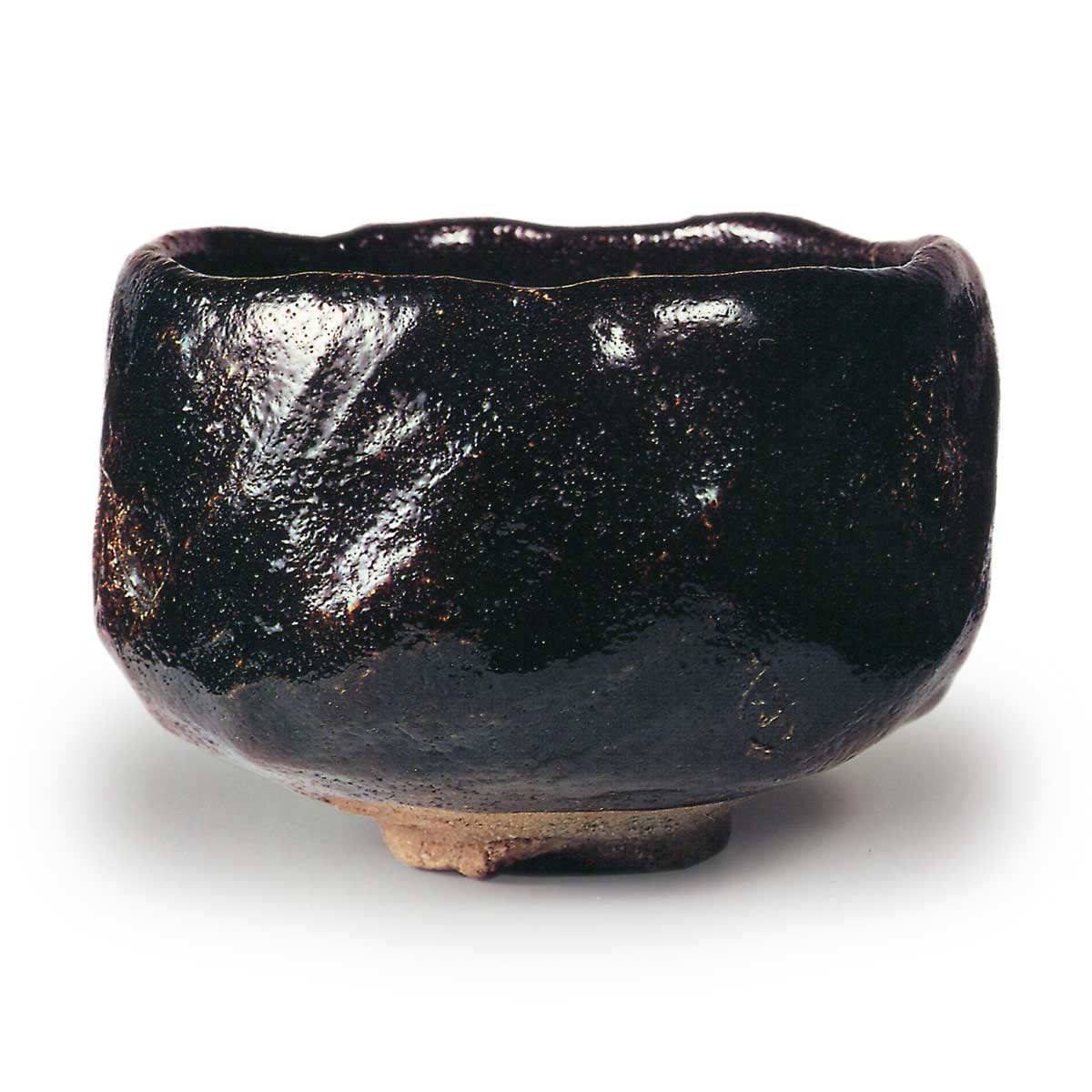
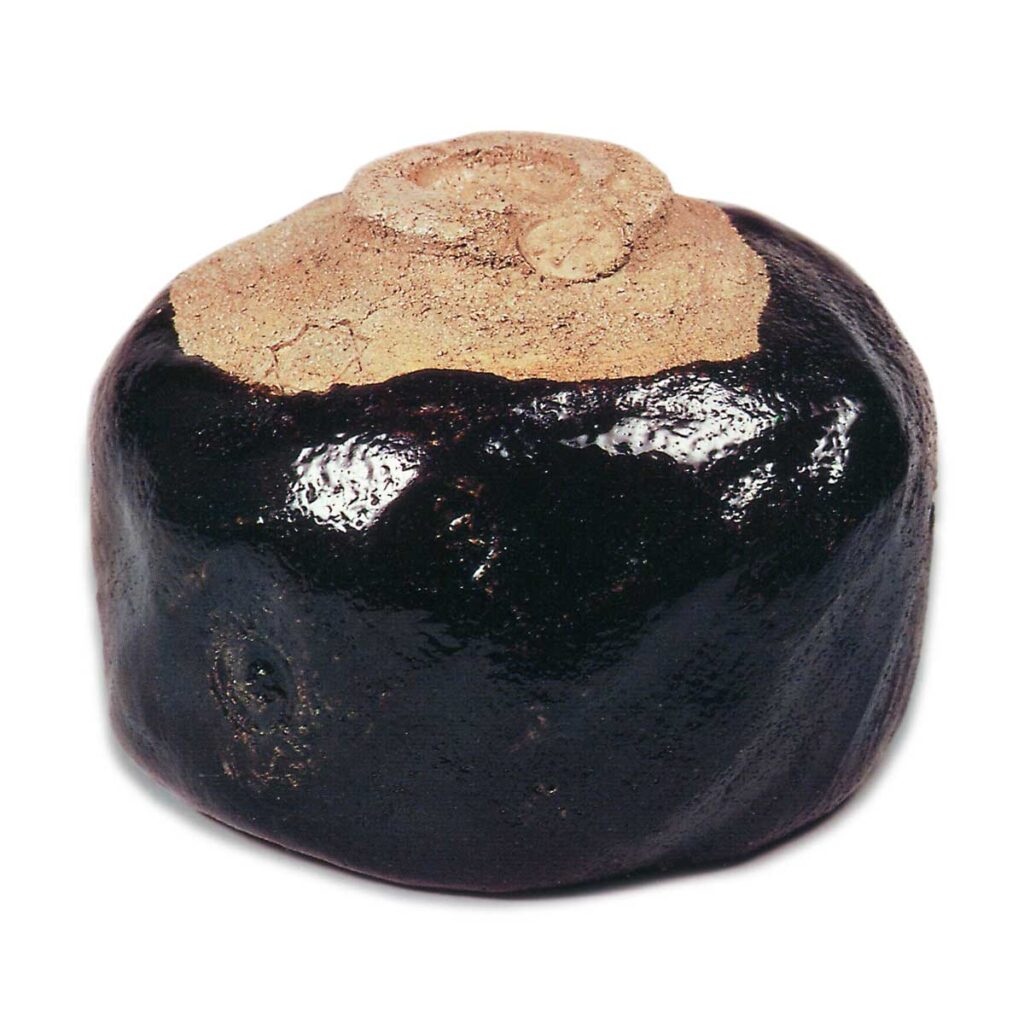
Height: 8.6 cm, Mouth Diameter: 10.8 cm, Foot Diameter: 4.6 cm
On the underside of the lid of the original box made by Risai, it reads: “Black Tea Bowl, Kan-do-ken Ryō-nyū Seal, Made in 1730.” A black “Inu-ne” seal is stamped on the outer side of the left rib, and the “Kan-do-rojin” seal is also stamped on the underside of the box bottom. Furthermore, a separate box with two-sided slats is included, on which Rokkōsai has inscribed: “Black tea bowl made by Ryōin at Ishiyama, inscribed ‘Kogetsu,’ left (signature).” Ryōin retired to Ishiyama in Ōmi after the age of seventy, and this tea bowl is a representative work from that period. Furthermore, it is typical for Ryōnyū’s tea bowls to have all the same seals stamped on the accompanying box as those on the bowl itself, including the seal indicating the year of production. This strict practice may have arisen because potters such as Kagabunzan produced imitations even during Ryōnyū’s lifetime. Rokurōsai’s inscription likely refers to works created in Ishiyama, Ōmi.
Created during the period after he shaved his head and retired to Ishiyama—especially after passing his seventieth birthday—when he found companionship in the beauty of nature, these works can be said to have been created as he freely enjoyed hand-forming clay, no longer bound by formal conventions. With a stocky form, it is shaped unevenly, with thick and thin sections; diagonal lines are drawn around the body with the fingers; the footring is small, and the interior of the footring is carved out into a clear, round hollow, with a deep pool of tea at the bottom. While the piece transcends the distinction between skill and lack thereof, the execution of the footring is, as expected, masterful, offering a glimpse of the skill of a master craftsman in the tradition of Nonko. The seal stamped on the footring’s base is an unconventional touch, yet it serves as a notable highlight.
One “Raku” seal is stamped on the interior, eight on the exterior, the “Kando Rojin” seal on the side of the foot where the clay is exposed, and a small “Bo-shi” seal—matching the one on the inner box’s slats—is stamped on the foot’s base. The black glaze melts lustrously, revealing white clay from the foot down to the lower body.