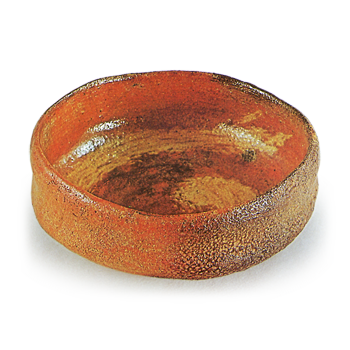
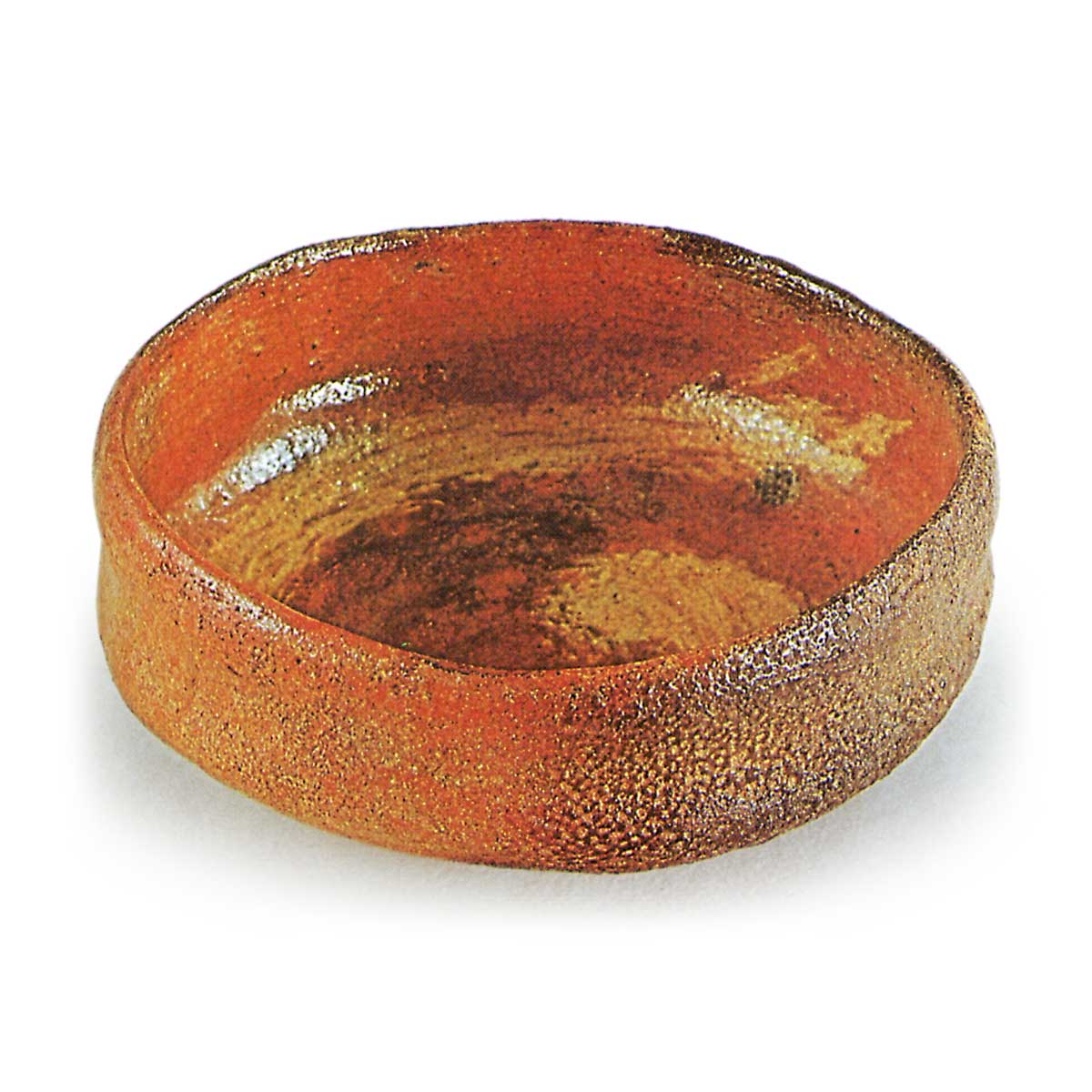
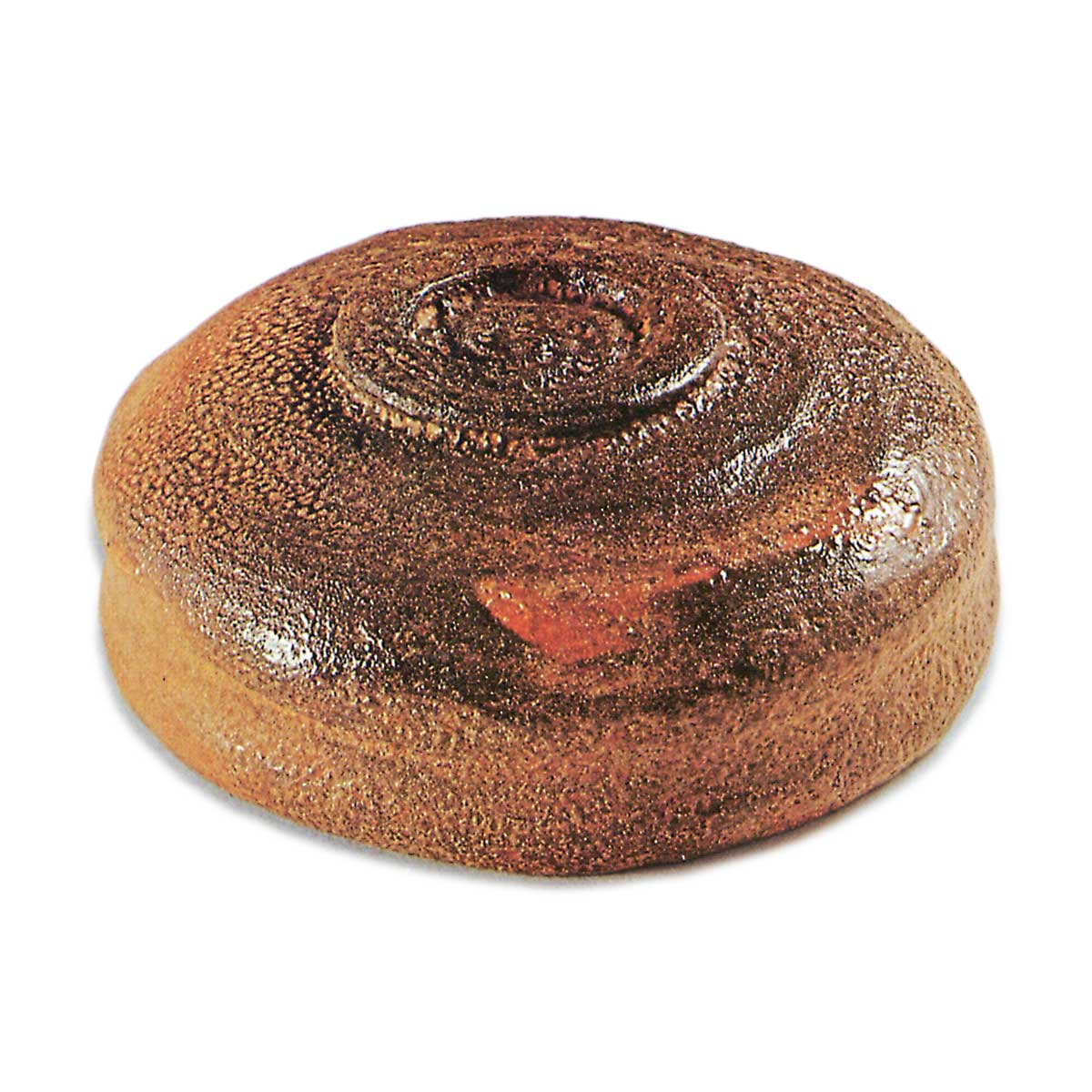
Height 5.5 cm, Mouth diameter 13.8–14.1 cm, Foot diameter 6.0 cm
This is a so-called “horse-trough” shaped flat tea bowl, based on the flat tea bowls of the Chōjirō-yaki style favored by Rikyu. Consequently, it does not display Dōnyū’s distinctive artistic style to a great extent, but rather follows the Chōjirō style in features such as the inward-curving rim, the flared body, and the construction of the foot. The foot is low with a wide base; the interior of the foot is carved into a round, shallow cavity. A “tomoe” (swastika) pattern is painted clearly and vividly in white brushstrokes inside, over which a transparent glaze has been applied to create a red raku finish. On the exterior, the glaze has undergone a blue kiln change on one side, resulting in a wrinkled texture. The character “Tomoe” is inscribed on the front of the inner box lid. According to the inscription by Bunshuku Sōshū, the second generation of Kankūan, on the underside of the lid—which reads, “Kichibei-yaki flat red tea bowl; the character ‘Tomoe’ is in Sōtan’s hand; Sōshū (seal)”—it is evident that the character “Tomoe” was written by Sōtan. Furthermore, on the underside of the outer box lid, Chokusai has inscribed: “Nonkou Red Flat Tea Bowl, with a box inscription by Bunsoku; there is also a box with a single character ‘He’; this is said to be in Sōtan’s hand; Sōmori (seal).” Originally owned by Sōtan, it was later passed down to Kankūan, and in the Meiji era, it became part of the Fujita family’s collection.