
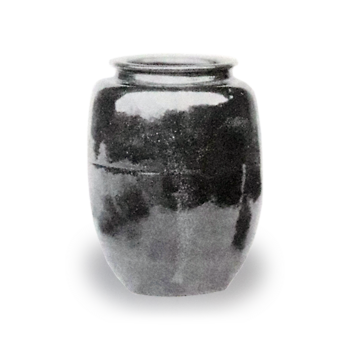
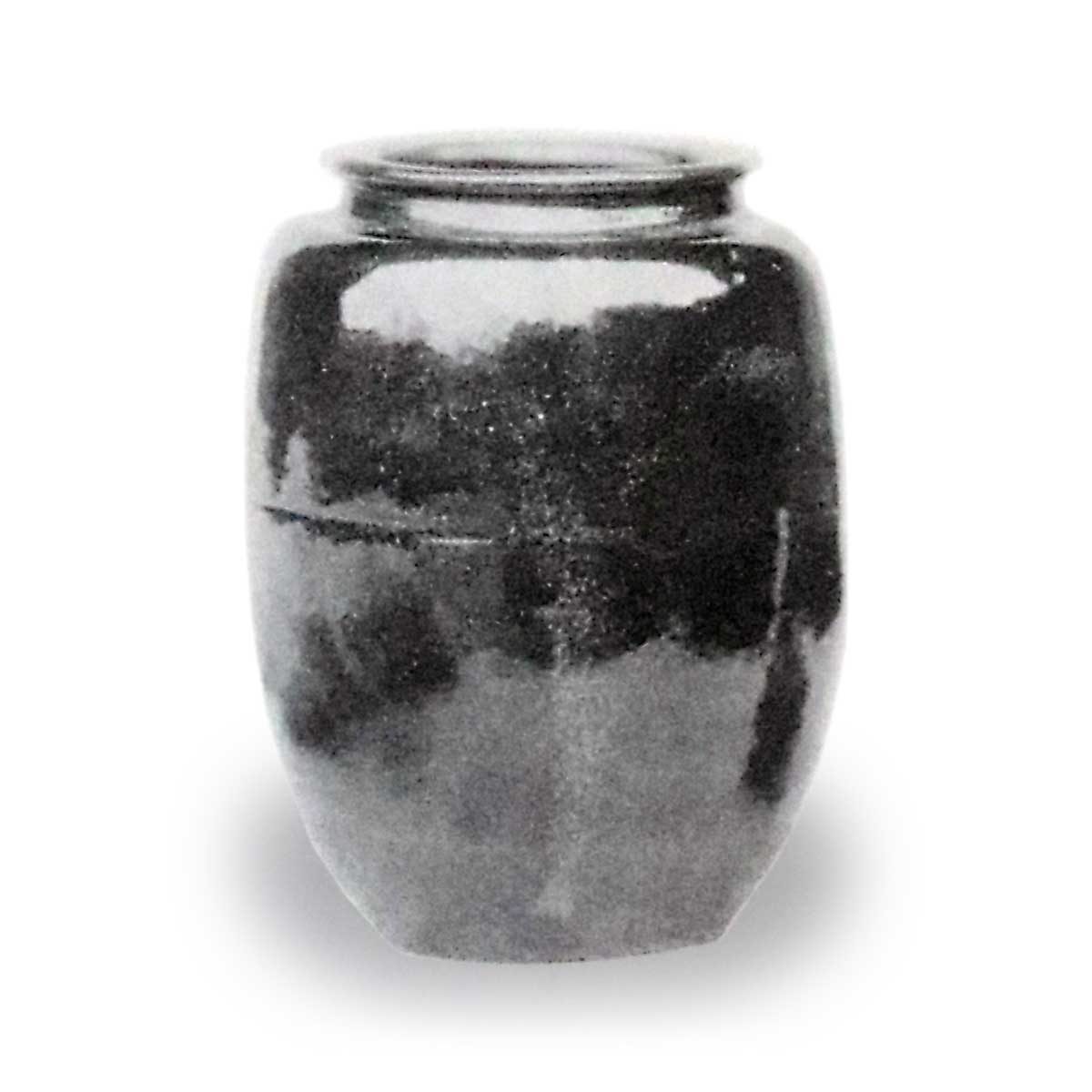
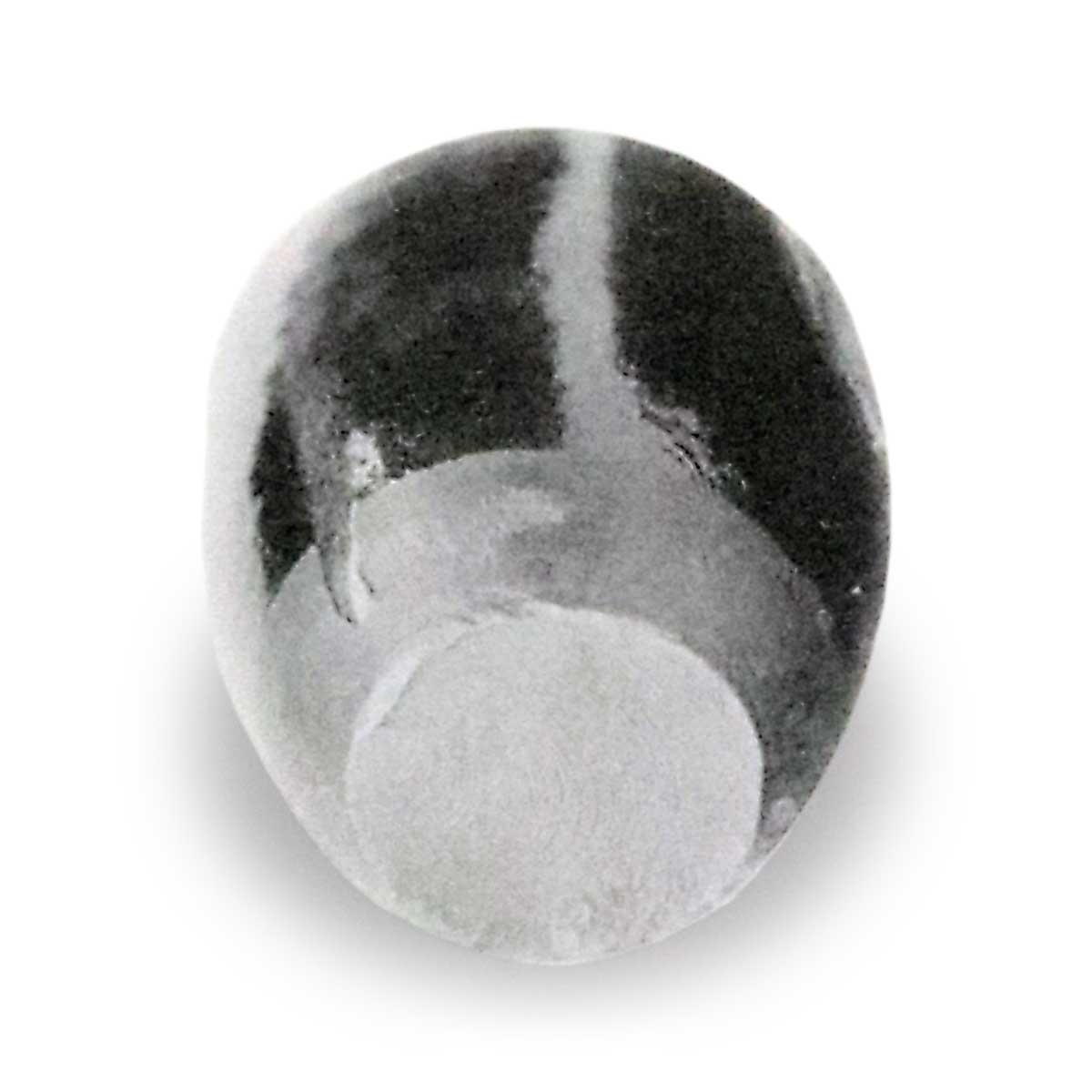
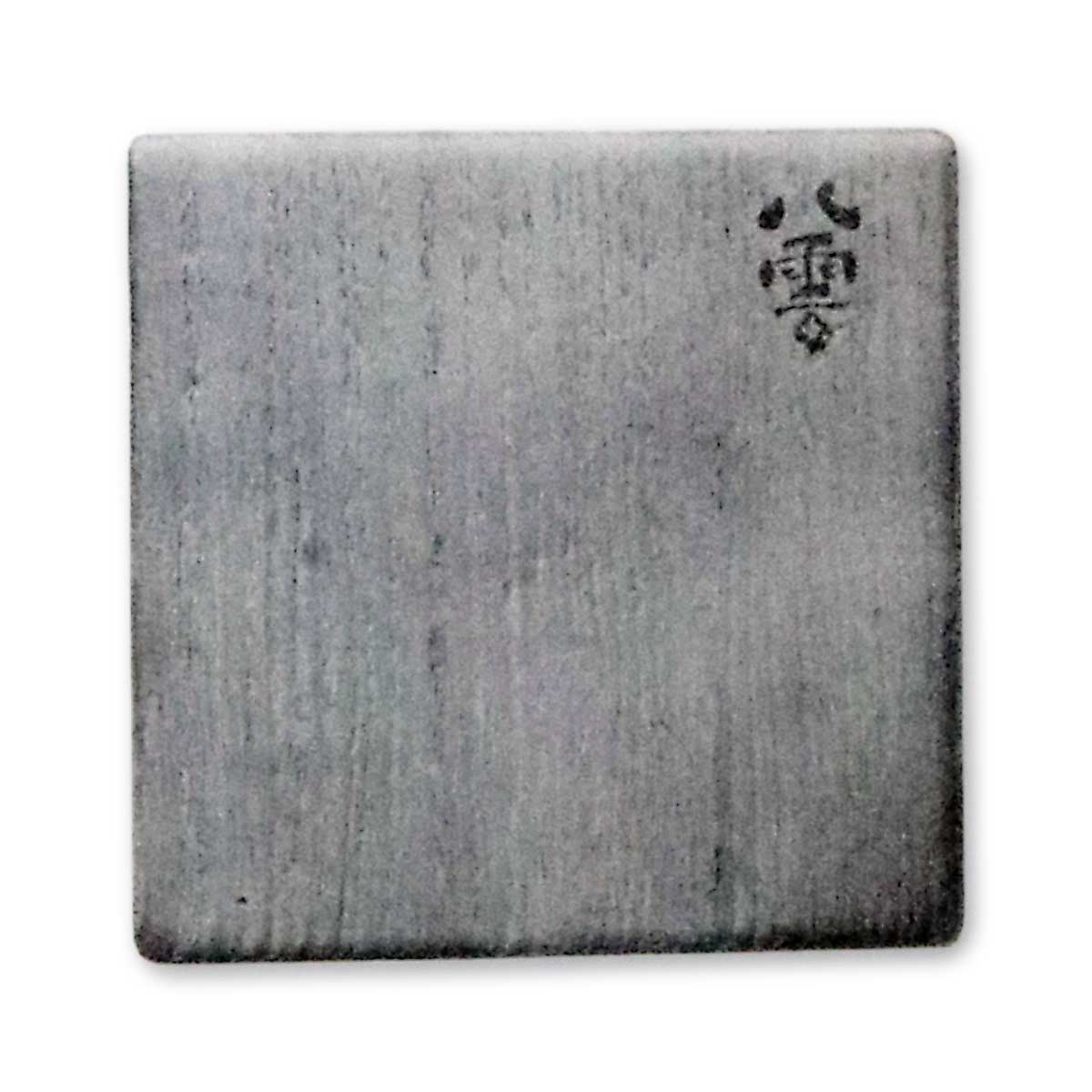
A Chinese tea caddy currently in the collection of Baron Konoike Zen’emon.
Origin of the Name
This tea caddy was once owned by Katagiri Izumo-no-kami (Sadataka), the father of the daimyo tea master Katagiri Sekishu. The name “Yakumo Katatsuki” combines the name of his official post, “Izumo,” with the appearance of the yellow glaze (kōyaku) on the front (the standing form), which resembles billowing clouds. This name was inspired by the divine poem of Susanoo-no-Mikoto —considered Japan’s oldest waka poem—which describes “Eight clouds rise, the eightfold fence of Izumo; for my wife, I build an eightfold fence; that eightfold fence,” the tea caddy was named “Yagumo Katatsuki.” This origin is detailed in “Yagumo Katatsuki Ki,” written by Hayashi Ryoho.
It is said that the former name (old name) of this tea caddy was “Shōju-in Katatsuki,” but today we have no way of knowing who this “Shōju-in” was.
Modern Equivalents of Dimensions and Weight
Height: Approx. 7.2 cm (2 sun 3 bu 8 rin)
Body Diameter: Approx. 5.6 cm (1 sun 8 bu 5 rin)
Mouth Diameter: Approx. 3.6 cm (1 sun 2 bu)
Base diameter: approx. 3.2 cm – 3.6 cm (1 sun 5 rin or 1 sun 2 rin)
Koshiki height: approx. 0.5 cm (1 bu 6 rin)
Shoulder width: approx. 0.5 cm (1 bu 5 rin)
Weight: approx. 75.4 g (20 monme 1 bu)
List of Accessories
There are three lids, each with a recess (kō). There is a purple chirimen fukusa (wrapping cloth) for the tea caddy.
There are four types of storage pouches (shifuku).
・Sandan Donshu (lining: konkaiki, cord: purple)
・Yuraku Donshu (lining: kabechoro, cord: purple)
・Sōkun Donshu (lining: mon-kabe, cord: purple)
・Kantō Ori-tome (lining: kabe-choro, cord: brown)
These items are housed in a white paulownia wood box bearing a handwritten inscription by Kobori Enshū that reads: “Yakumo Bag, Two Sets (two sets = four pieces).”
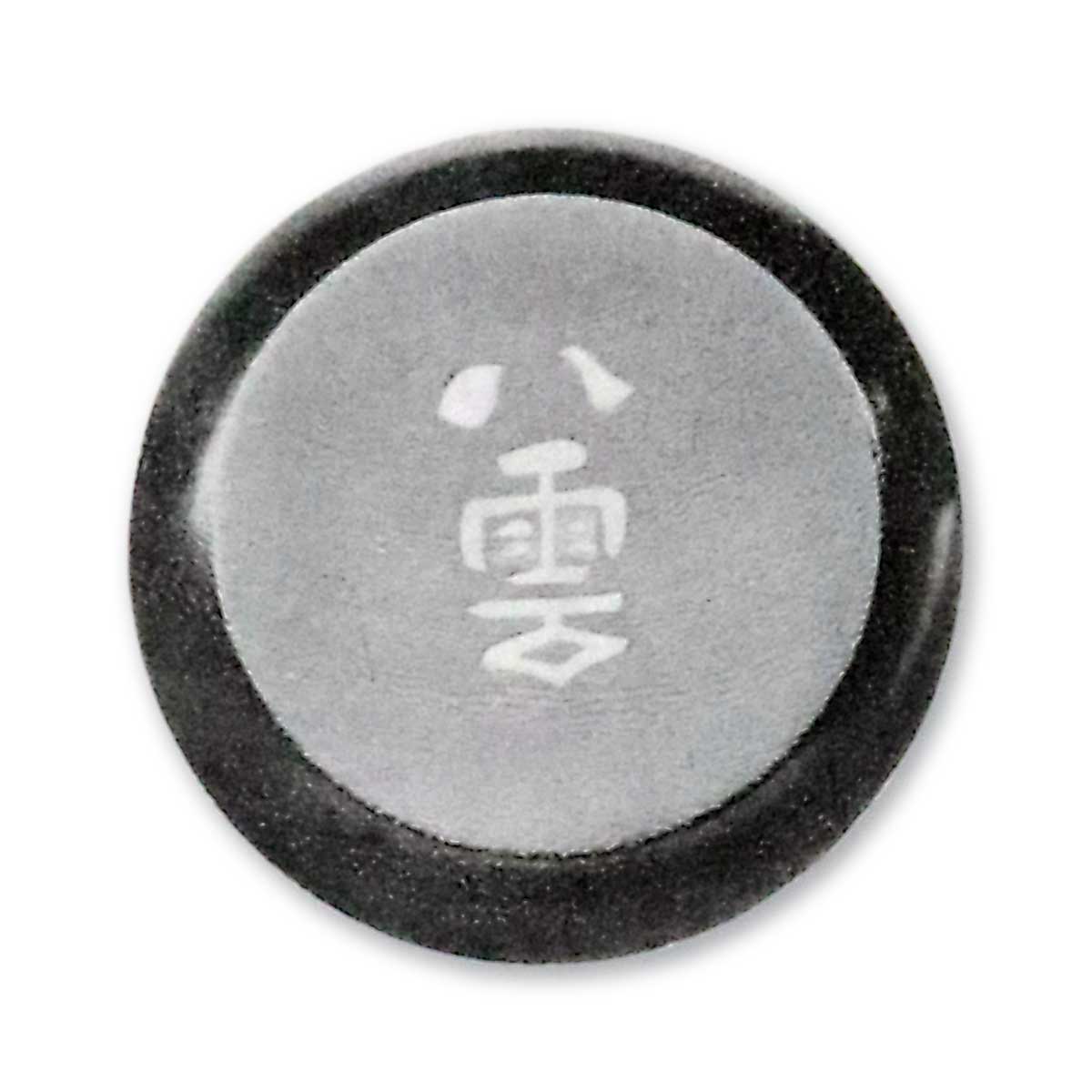
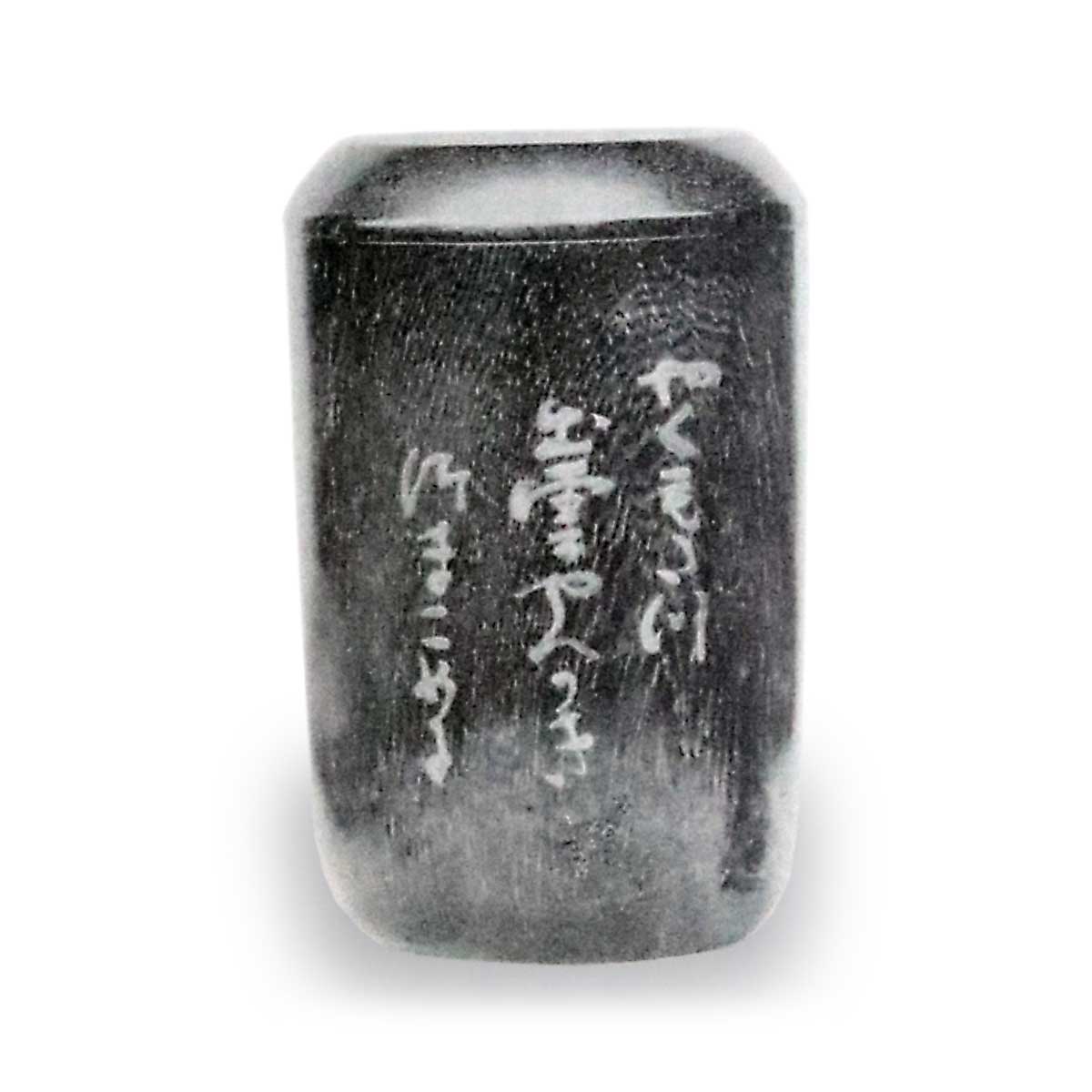
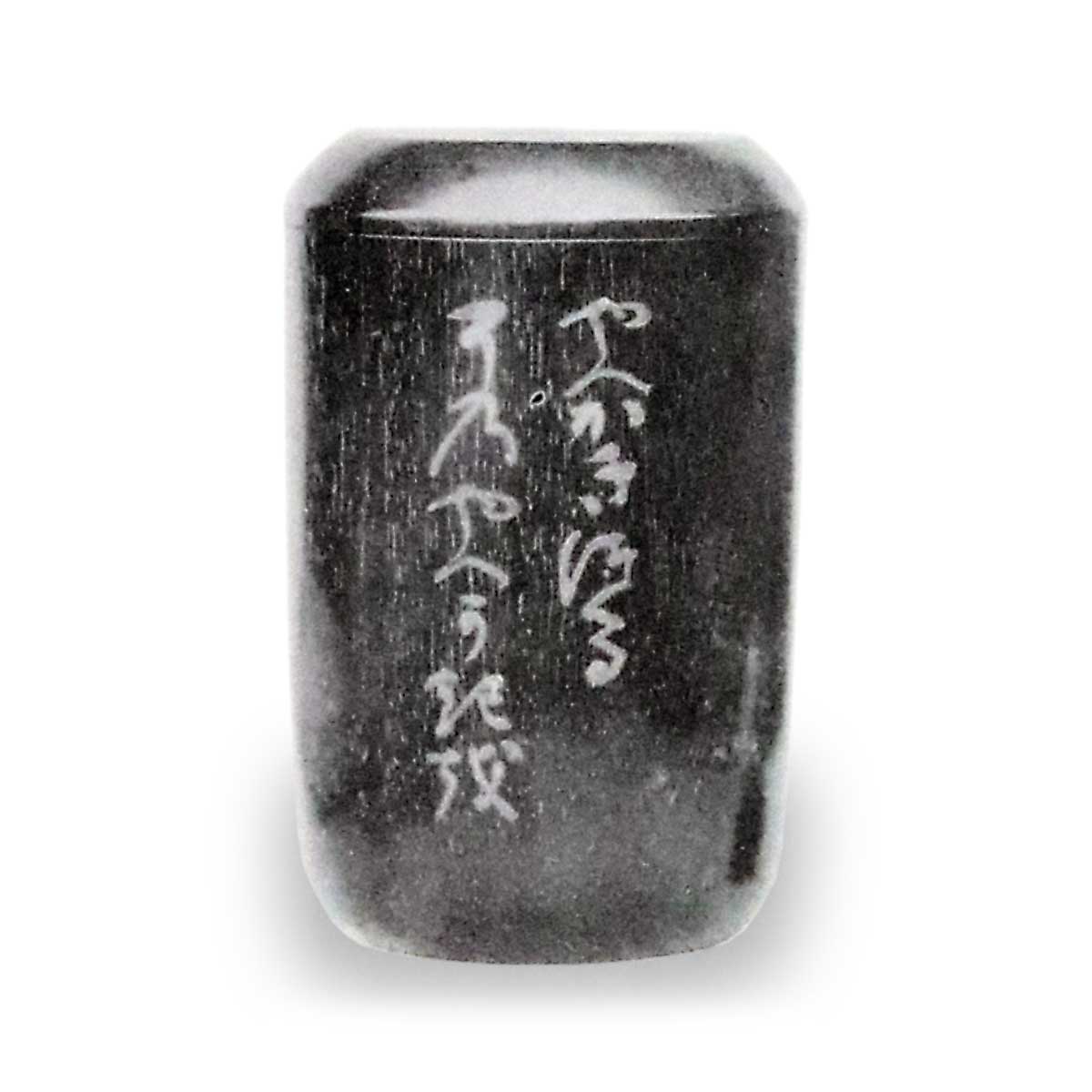
Hikiya is made of ironwood (tagayasan), and based on Kobori Enshu’s inscription, characters are inlaid in silver on the lid and body. On the lid, “Yakumo” is inlaid within a circular frame, while the body features the following divine poem inlaid: “Yakumo rises, Izumo’s double-layered gate—gather it, create that double-layered gate, that very double-layered gate.” The Hikiya lacks its original pouch and is wrapped in a white chirimen fukusa.
The inner box is made of untreated paulownia wood. A label by Kobori Enshū reads “Yakumo,” and a paper label written in ink states, “Traditionally known as the Shōju-in Katatsuki.”
The outer box is made of paulownia wood and features a lock. A label by Chaya Sōko bears the inscription “Yakumo Katatsuki” on both the front and back.
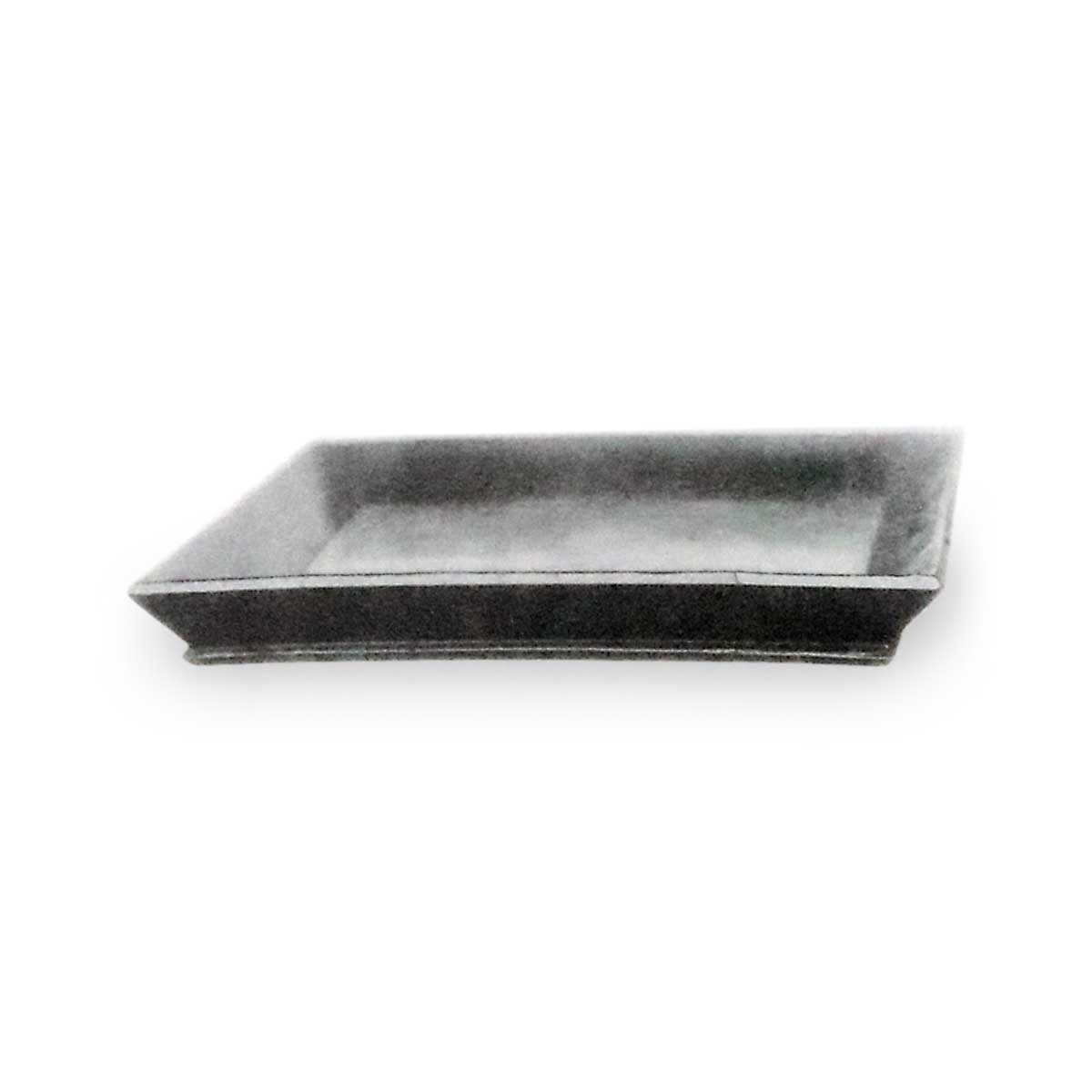
An accompanying tray, approximately 29 cm (9.6 inches) in diameter, is included. The character “丁” is painted in vermilion at the center of the bottom. The inner box is finished in Shunkei lacquer, with a paper label reading “Yakumo Katatsuki Tray”; the outer box is made of paulownia wood, with a paper label reading “Yakumo Katatsuki Tray, Inscription by Chaya Soko.”
“The Record of the Yakumo Katatsuki” (scroll) by Hayashi Ryuhō
A scroll written in Classical Chinese by Hayashi Ryuhō (Kyōyōken), the son of Hayashi Dōshun (Razan), is included, detailing this tea caddy. The following is a paraphrased translation of its contents.
“Nakajima Sōko came and said, ‘Recently, I acquired a small tea caddy (commonly known as a ‘small katatsuki’). This was originally part of the collection of Katagiri Izumo-no-kami and was widely known. After Izumo-no-kami passed away, there were no heirs, so the whereabouts of this tea caddy were unknown. As I am very fond of tea (I have a passion for it), I had been searching for over a decade to acquire it. And now, by good fortune, it has finally come into my possession. I did not hesitate to pay a high price for it, and I am truly delighted.”
Since this tea caddy came from Izumo-no-kami’s family and features a scene resembling yellow clouds within its black ceramic surface, Sōko named it “Yagumo” (Eight Clouds). Its form stands just over 7 centimeters tall, and the width of its opening possesses a vitality that seems to connect to a microcosm (a hidden paradise). It is truly a jewel in the palm of one’s hand, a treasure so precious that even a jade disc worth a string of castles could not replace it. If I could wrap this in a fine cloth, set up a small tea room, invite guests, and offer them a bowl of tea, my life would be fulfilled—what more could I possibly wish for?
Sōko asked me to write this account. I am not well-versed in the tea ceremony, but since I have known Sōko in Kyoto since childhood and have been friends for over thirty years, I could not remain silent.
(Excerpt: Citing the Chinese teaching that the smaller the tea ware, the better it retains the aroma, and further likening the scenery depicted on the tea caddy to Mount Penglai, home of the immortals, and the world of Susanoo’s “Yagumo Tatsu” waka poetry, he expresses his gratitude for being able to enjoy tea in a time of peace.)
Winter of Kanbun 2 (1662), written by Hayashi Shi (Rihō) of Kōyōken; transcribed by his son Harutsune. ”
(Note: Following Hayashi Sagamine’s Chinese text in this scroll is a colored illustration of Mount Penglai painted by Kano Tanyu, followed by Japanese inscriptions by Kobori Masayuki (Fujiwara no Masayuki), the son of Kobori Enshu, and the court noble Asukai Masatoyo.)
Inscriptions by Kobori Masayuki and Asukai Masatoyo
・Inscription by Kobori Masayuki:
“Long ago, a tea caddy owned by Katagiri Izumo-no-kami, who was known as Shōju-in Katatsuki, came to be called ‘Yakumo’ after its name was changed. This is also recorded in the writings of Master Hayashi Sagihō (Kōbun-in). I understand that Lord Asukai Masatoyo has inscribed a waka poem dedicated to Yakumo.
When I recalled and mentioned that my late father, Enshu-no-kami (Kobori Enshu), had kept this tea caddy close at hand and cherished it for a time due to certain circumstances, the current owner (Nakajima Soko) smiled warmly. Perhaps my heartfelt wish—‘Please cherish this tea caddy, filled with memories of my father, forever’—was evident on my face, for Soko smiled once more. Unable to refuse the owner’s request, I put pen to paper with my humble brush.
Junior Fifth Rank, Lower Grade, Fujiwara (Kobori) Masayuki”
・Inscription by Asukai Masatoyo:
“The late Chaya Soko (Nakajima Soko) owned a small tea caddy named ‘Yakumo.’
My late father, Asukai Masaaki (Dainagon), had been asked by Sōko to write the ‘Yagumo no Kanoe’ and sent it to him, but I was told that the waka was subsequently lost in a fire, so he asked me (Masatoyo) to write it again.
(The Yagumo Poem: Yagumo rises / Izumo’s eightfold fence / Among my wives / I build an eightfold fence / That eightfold fence)
As it was a request from an elder, I could not refuse and thus wrote it.
Summer of the first year of the Jōkyō era (1684) Asukai Masatoyo”
Records of “Yagumo Katatsuki” found in various tea books
・‘Kagaya Sōzō Kōchō Kōnoike Zōchō’: A Chinese tea caddy. The pouches are “Yuraku donsu” and “Usudonsu.” The thread-cutting marks are authentic.
・Meibutsu-shū: Owned by Mr. Yamanaka. Authentic thread-cut; covered entirely in an amber-colored glaze with a scenic quality; the base has a slightly rounded, raised shape. (Dimensions recorded as 2.35 inches in height, etc.) The pouches are Yuraku Donshu and Uzu Donshu. The Hikiya is made of ironwood, and on both the front and back of the body, a waka poem about the “Yagumo” is written in powder on the upper and lower verses.
Praise for the “Yagumo Katatsuki” by Chaya Soko (from Matsunoha no Ki)
This is an elegant record written in Japanese by Nakajima (Chaya) Soko himself, the former owner of this tea caddy.
“There are countless objects of delight in this world, but among them, the beauty and flavor of tea leaves are truly special. (Omitted: Describes the sound of grinding tea and the tranquil atmosphere of the tea ceremony.) For some time now, it has been said that in this village where white clouds rise, there exists a katatsuki tea caddy wrapped in brocade. Though it lay buried and unknown to the world for a long time, I acquired it, placed it in my tea room under the eaves, and now, morning and night, I prepare tea and enjoy it quietly by myself. The form of this small bottle is a pleasure to be cherished forever.
I do not know what its original name was, but I have decided to rename it “Yakumo.” I asked Hayashi Rofu Hōin (Hayashi-shi), a master of Confucianism, to compose a Chinese-style inscription for it, and Asukai Masaaki, the Grand Councillor and a master of poetry, to write a divine ode to Yakumo. Bitchū-no-kami Masayuki (son of Kobori Enshū) also dipped his brush in ink, recalling how his late father had cherished this tea caddy. Furthermore, Kanō Tanyū, the greatest painter in the land, painted a magnificent picture of Mount Penglai.
This tea caddy is a masterpiece worthy of the name “Yakumo,” a name that will be revered for generations to come.”
(Subsequently, Hayashi Rōhō had promised to view this tea caddy in Sōko’s new tea room, but as he was unable to attend due to official duties, a Chinese poem he composed based on his imagination is included. )
Other Records
・“Sohō Bunshū”: Hayashi Sohō’s collected writings also include the aforementioned “Yagumo Katatsuki-ki” (the Chinese text said to have been recited by Nakajima Sōko when he visited).
・“Chaki Meibutsu Zui” by Kusama Waraku: The Yagumo Katatsuki was owned by Kōnoike Zen’emon. It was formerly known as the Shōju-in Katatsuki. Detailed records include its dimensions, the gold-leaf calligraphy of waka poems on the ironwood handle, the inclusion of a volume of biographies of Hayashi Dōshun (Rōzan, Sagamine’s father), Kobori Enshū, and Asukai Masaaki, as well as the fact that “Yakumo” is inscribed on the inner box and “Yakumo Katatsuki” on the outer box.
Displayed at a Meiji-era tea ceremony
On April 7, 1910 (Meiji 43), this tea caddy was used at a tea ceremony hosted by Marquis Inoue Seigai (Kaoru)—a prominent politician and tea master—at “Hassōan” in Uchidayama, Azabu, Tokyo.
The guest list included prominent tea masters and businessmen representative of the modern era, such as Masuda Takashi (Don’ō), Hara Tomitarō (Sankei), and Nozaki Kōta (Gen’an).
The alcove featured a hanging scroll with a waka poem by Fujiwara no Teika; the flower vase was a Chinese basket passed down from Shoseibo; the tea caddy was this “Yakumo Katatsuki”; and the tea bowl was the Meibutsu “Seto Hakuan”—an exceptionally luxurious set of tea utensils. (From Kokon Chayūshū)
Summary of its History
It was originally owned by a man named “Shōjuin,” and later passed to “Katagiri Izumo-no-kami Takatoshi,” the father of the daimyo and tea master Katagiri Sekishū. Takatoshi was the eldest son of Katagiri Katamoto (a senior retainer of Toyotomi Hideyori) and was the lord of Ibaraki Castle in Settsu Province. He died in 1638 (Kan’ei 15) at the age of 38, and since he had no heir, the family line was cut off.
Afterward, this tea caddy was temporarily in the possession of Kobori Enshū, but its whereabouts became unknown. The wealthy merchant Chaya Shirojirō (Nakajima Sōko) searched for it for over a decade before finally discovering and acquiring it. Sōko cherished this tea caddy deeply; he commissioned Hayashi Rōhō to write a biography of it, asked Asukai Masaaki to compose a waka poem about Yakumo, and had Kano Tanyū paint a picture on it, thereby elevating the tea caddy’s value to the highest possible level.
Since this tea caddy is listed in the records (Konoike Store Ledger) of the Osaka tea utensil merchant Kagaya from the Manji era (1658–1661), it is believed that shortly after Nakajima Sōko’s death, it came into the possession of the Konoike family, a wealthy merchant family in Osaka.
In the late Meiji period, Marquis Kaoru Inoue (Seigai) kept this tea caddy for a time and used it at tea gatherings such as those at the aforementioned Hassō-an; however, shortly after the Marquis’s death, it was returned to the Kōnoike family.
Academic Inspection Record (Appraisal Record) from the Taisho Era
On May 18, 1921 (Taisho 10), this tea caddy was physically examined at the villa of Baron Konoike Zen’emon in Osaka Prefecture.
The rim is rounded, and the flared lip is deep. The footring is low, and the shoulder width is narrow. There is a slight break in the horizontal groove around the body. From the rim downward, the red-clay-colored (reddish) clay body is visible, and the traces of the thread-cutting are extremely fine. The rim of the base shows marks as if cut with a spatula, and on the inner side of the base, there is one instance each of a kiln stick mark (where it adhered to another tool in the kiln) and a glaze splatter.
Overall, within the amber-colored glaze, white glaze splatters are scattered unevenly, resembling “thin clouds.” From just below the shoulder to the base of the rim, a single stream of “pale blue glaze” cascades down; this pool of glaze is slightly thicker and takes on a faint “lapis lazuli” hue. Additionally, there are areas where the yellow glaze has been missed around the middle and the base, creating a very interesting visual effect (pattern).
Inside, the glaze covers the rim, while the vermilion-colored clay is visible below it, and the wheel marks are sharp and distinct. The center of the swirl on the bottom protrudes slightly.
Overall, the amber luster is exceptionally beautiful, and the scene of drifting clouds possesses an extremely elegant and refined charm. This is an exquisitely crafted, refined tea caddy.
