Specialty item
Accessories: Inner box, paulownia wood with inscription by Kobori Enshu; middle box, oak with Haruaki lacquer and gold lettering, inscription, three accompanying documents
Provenance: Kobori Enshu—Enshu family—Manyaitaro and Dōnin Hyōe—Sumitomo family (handled by Toda Ryūin, around 1889)
References: Enshu Zoucho (Enshu Collection Catalog), Meibutsu Mekki Monjo (Famous Artifacts Appraisal Record), Bunsei 2nd Year Various Families’ Rare Artifacts Record, Honya Ryoun, Kushinroku (Record of Efforts), Kikuniya Hikojiro, Kansou Zasshi (Random Notes from a Leisurely Window), Noshizenzo’s Account, Taisho Meiki Kanko (Taisho Era Famous Artifacts Guide)
Dimensions
Height: 7.7 cm, Mouth diameter: 13.6–14.0 cm, Foot diameter: 5.0 cm, Same height: 0.7 cm, Weight: 266 g
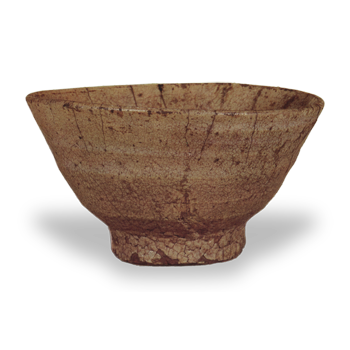
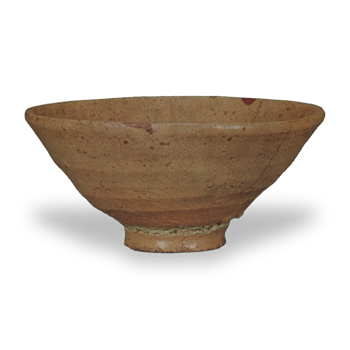
When Kobori Enshu was stationed in Fushimi, a tool shop owner casually brought this item, which he purchased and cherished greatly, hence the name. Compared to the famous “O-ido” tea bowl, this piece does not have any particularly striking features, but its subtle, melancholic charm is what gives it its value. It is perhaps only Enshu who could have discovered such understated beauty in this piece.
The term “old well” does not refer to the age of the well itself. Originally, it was called a “small well” because it was smaller than the famous “O-ido,” but since “small well” sounded too plain, the term “old well” was used instead. Though small in size and lacking the boldness of a bamboo jointed base, it has a spacious and deep interior. The interesting glaze accumulation on the inner and outer surfaces is among the finest in well-style tea bowls. The abundant glaze has created these pools and flows throughout the piece. It stands alongside an old well as a pair of masterpieces.
Inner box: Paulownia wood, white lacquer, inscription by Kobori Enshu
Middle box: Oak wood, Haru-kei lacquer, gold powder characters, inscription