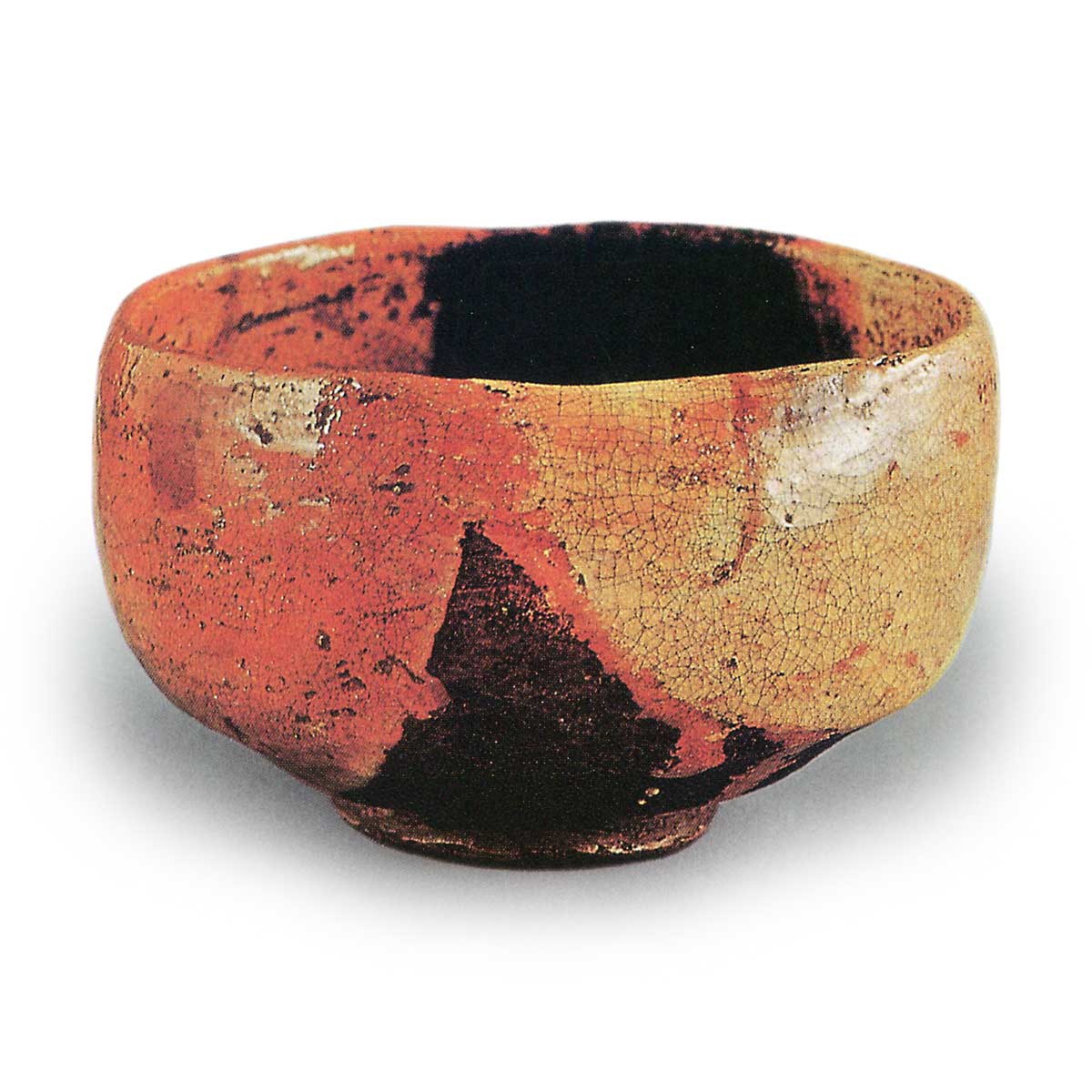
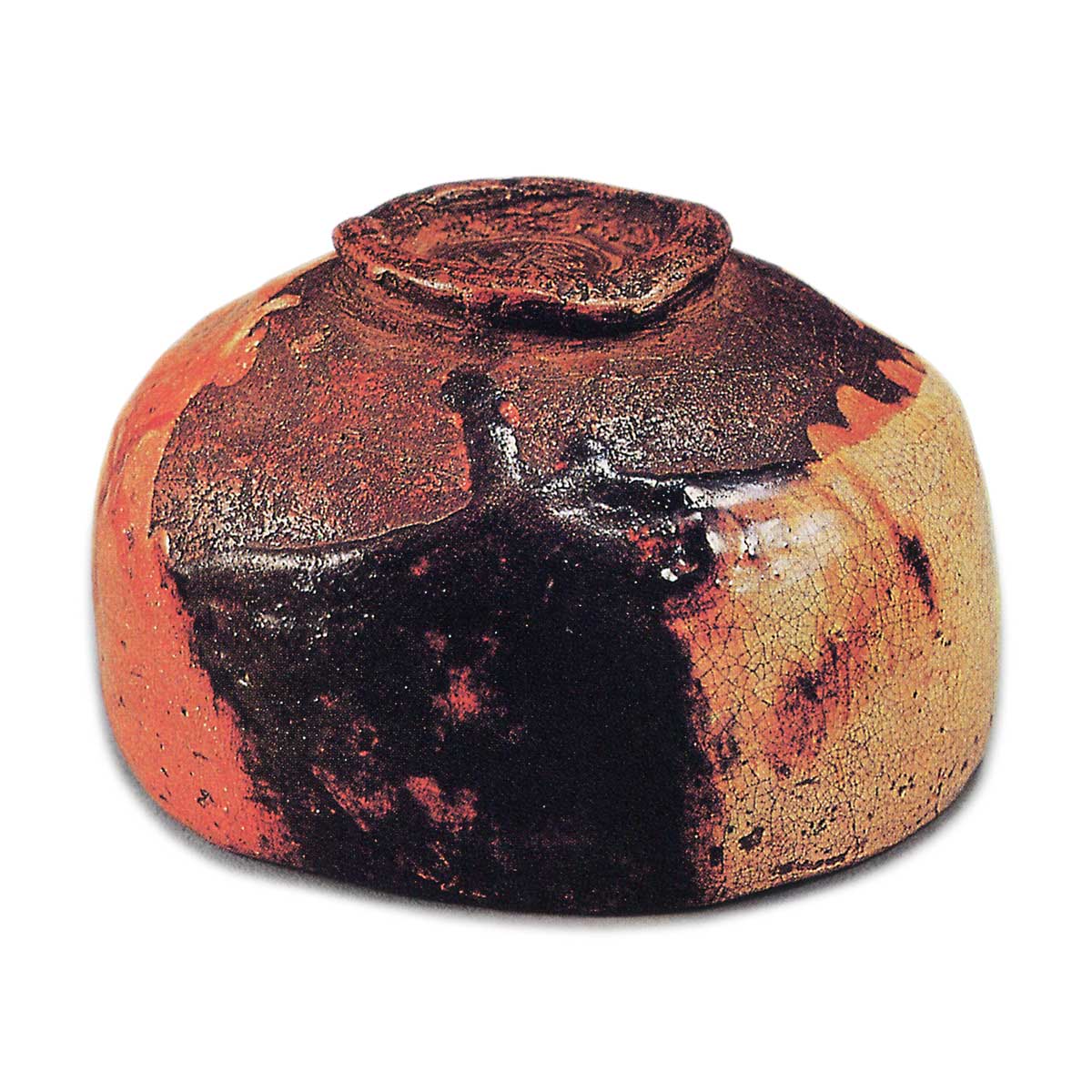
Height: 7.8 cm; Mouth diameter: 10.8–11.9 cm; Foot diameter: 5.5 cm
On the inside of the inner box lid, Kakukaku Saiharaso has inscribed “Nonkou Red Tea Bowl: Niji-sai (Seal)”; on the inside of the outer box lid, Jushinsai has written “Nonkou Red Tea Bowl: Inscription by Kakukaku, Niji-sai (Seal)”; and on the outside of the same lid, Takusai has also provided an authenticating inscription.
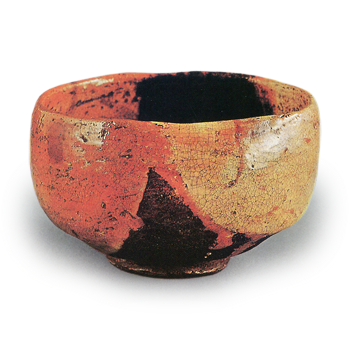
Its shallow, richly rounded form shares a style common to works such as the “Kaguyama” of the Kaga Shichishu, and it possesses a charm similar to Kōetsu’s “Kuichigai.” Furthermore, the glaze—which features an amber glaze applied to parts of the bowl, similar to Kōetsu’s “Kamiya”—suggests a connection to and influence from Kōetsu. From the foot to the middle of the bowl, it is carved with a casual, rough-hewn technique, and the “Raku” seal is clearly stamped in the center of the foot; it is a tea bowl with an exposed seal mark, made from a sticky red clay. Leaving a crescent-shaped section of the unglazed clay exposed from the foot to the lower body, the bowl is glazed with three colors on both the interior and exterior; even among Dōnyū’s highly artistic tea bowls, this piece stands out for its exceptionally strong decorative quality. The glazing process involved first applying a yellowish-brown glaze over nearly the entire surface, leaving only the foot rim unglazed, and then applying a transparent glaze, an amber glaze, and a white glaze on top. The colors are clearly divided into red, amber, pale yellow, and white; the glaze is thick, and craquelure is visible on the glaze surface.
It was held in the collection of the Kōnoike family of Osaka from quite early on and was virtually unknown to the public until around the Taishō era; however, it was introduced upon the publication of Taishō Meiki-kan (The Taishō Encyclopedia of Fine Art), after which its reputation soared.