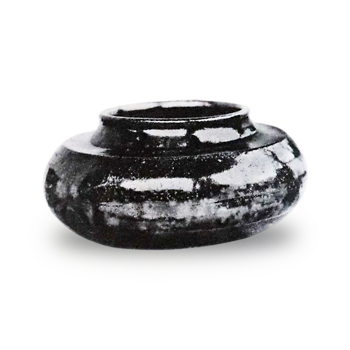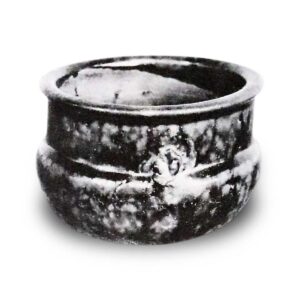
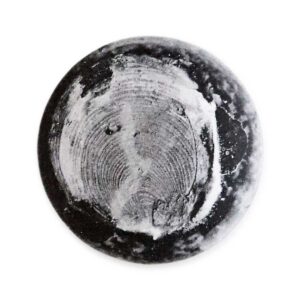
Old Seto, Revival-Period Meibutsu; Collection of Marquis Tokugawa Kunikazu
Name
Originally a three-legged incense burner, its legs were removed according to the preferences of Kobori Enshū, and it was remade into a tea caddy. It is called “Okimon” because floral patterns are raised (embossed) along the “koshiki” (the raised rim at the neck). It is called “Taikai” because it is a large tea caddy with a wide mouth.
Dimensions (converted to centimeters)
Height: Approx. 5.8 cm (1 sun 9 bu)
Body diameter: Approx. 8.1 cm – 8.7 cm (2 sun 6 bu 6 rin to 2 sun 8 bu 6 rin)
Mouth diameter: approx. 8.6 cm (2 sun 8 bu 5)
Base diameter: approx. 5.6 cm to 5.8 cm (1 sun 8 bu 5 to 1 sun 9 bu)
(From the rim to the middle of the body: approx. 2.0 cm / 6 bu 5)
Accessories
・Lids: 2
Beveled lid: Enshū style, made by Insai
Sukuhi lid: Enshū style, made by Ryūsa
Lid dimensions: Diameter approx. 9.1 cm (2 sun 9 bu 9 rin)
・Storage pouch: Shōha-style tea-colored, with a cord fastening
・Pouches: 2
Shuin-gire: Ura-moegi-colored kabechoro, with a purple cord fastening
Shimizu-gire: Ura-moegi-colored kabechoro, with a light yellow cord fastening
(However, the characters “Jiajing” appear on the side facing the customer)
・Bag Box: Antique paulownia wood, Shunkei matte lacquer
The three characters “Okomon-bukuro” are written in gold powder; the three characters “Top-Grade” are affixed as a paper label.
(Inscription on the inside of the box: Top-Grade / Okomon-bukuro)
・Inner Box: Paulownia wood, natural finish; “Okomon” written in ink with an Enshū brush.
・Outer box: Paulownia, “Chūtsugi” finish, Shunkei matte lacquer.
(Inscription: “Okomon”)
Pouch: Onando jusu-ji (silk satin) with plum and bamboo motifs; lining in Tang tea color; cord fastening in dark brown.
Sahari (Sawari): Currently missing. The gold-powder characters for “Sahari” were written with an Enshū brush.
・Wrapping: Ancient sarasa cloth (heavily worn)
・Outer Box: Paulownia
・Inscription in Ink: Author unknown
・Accompanying Note: Hanji paper
“Okimono Daikai Tea Jar / Replacement Pouch / Goshuin Cut”
[Miscellaneous Notes, Provenance, and Summary and Interpretation of Various Sources]
Miscellaneous Notes (Entries from Various Sources)
・Kofu Seto, Okomon:
Owned by Kobori Sōho (Enshū), it subsequently passed to Minoya Shōgorō, the townsperson Kashiwagi Tōhaku, Kuchiki Iga-no-kami (Iyo-no-kami), and Matsudaira Sakon-shōgan Norimura. Later, it passed to Hotta Sagami-no-kami.
Dimensions: Height approx. 5.8 cm (1 sun 8 bu 9 rin); width at the widest point of the body approx. 8.7 cm (2 sun 8 bu 6 rin); base diameter approx. 5.8 cm (1 sun 9 bu).
The glaze is a light brown with a slight blackish tint; the upper glaze flows like a cluster of clouds, and the lower section features a pear-skin glaze. The clay is firm and has a grayish-brown color with a slight reddish tint. The thread-cutting is fine and standard, and the twisted rim is exquisite.
According to ancient tradition, it is said to have been an incense burner, and traces of the base (chin) can be seen. The inner box is made of unpainted paulownia wood with chamfered edges. The satin lining of the pouch features a plum and bamboo pattern, with a purple reverse side. On the side of the “Shuin-giri” pouch designated for the customer’s seal, the characters “Jiajing” are inscribed. The “Shimizu-giri” pouch has a reverse side in pale green (moe-gi kabechoro), and the cord is light yellow (asagi). The inner box measures 3 sun 5 bu 6 rin square (approximately 10.8 cm square). The outer box is made of medium-grade paulownia wood with a matte Shunkei lacquer finish. It originally had round metal fittings (or cords) made by Sahari.
・Gokujutsu Mekiri-sho:
Formerly owned by Kuchiki Sawa-ō; currently in the possession of Lord Matsudaira Sakon-shōgan. A thick, high-quality piece. The base glaze features persimmon-colored and black glaze in places. The earthen glaze is coarsely textured and firm, resembling that of a Honshikiri. It was originally a three-legged incense burner from which the legs were removed to create a tea caddy.
・Collection of Tea Utensil Appraisals:
Valued at 3,000 pieces of gold. Originally owned by Kuchiki Izumi-no-kami, later by Lord Matsudaira Sakon-shōgan. Thick-walled, with persimmon-colored and black glazes smeared across the base. The craftsmanship is intriguing; it is a genuine “Itokiri” style. Originally, the three legs of an incense burner were removed to convert it into a tea caddy. The clay is coarse and tea-brown in color.
・Enshū Gosenshun Jūhachi-hin:
The original model (authentic piece serving as the standard) of Kose-to ware. Owned by Lord Matsudaira Sakon-shōkan.
・Sekima-sō Chadō Wakuge:
Originally owned by Lord Enshū; currently owned by Lord Sakon-shōkan. Also known as Kutsuki Iyo. According to one account, the inscription on the box is said to be in the hand of the second-generation Sōkei.
・“Collection of Famous Pieces from Various Families”:
Passed from Kobori Sōho to Minoya Shōjirō, the townsperson Kashiwagi Tōhaku, Kutsuki Iyo-no-kami, Tsuchiya Sōshū, and Hotta Sagami-no-kami, before later becoming part of the Mito Tokugawa family’s collection (ceremonial paraphernalia).
・“Katsu Kaishū’s Record of Inscribed Objects”:
Viewed on May 29, Genbun 4 (1739). Owned by Matsudaira Sakon-shōgan.
Height: approx. 5.7 cm (1 sun 8 bu 7 rin)
Mouth diameter: approx. 8.6 cm (2 sun 8 bu 5 rin)
Upper body diameter: approx. 8.3 cm (2 sun 7 bu 5 rin)
Lower body diameter: approx. 5.8 cm (1 sun 9 bu 2 rin)
Base diameter: approx. 6.1 cm (2 sun)
Kozuki height: approx. 2.0 cm (6 bu)
Weight: 55 monme (approx. 206.25 g)
The glaze is bright and crisp, with red speckles. It is said to be the work of Zaichuan. The clay is standard Kose-to clay.
・“Kobori Family Record of Road Equipment Dispatches”:
On May 25, Genroku 7 (1694), a tea caddy with an embossed crest was transferred to Koseki Shōjirō for 6 ryō of gold.
・Shōtoku 5 Tea Utensil Expense Ledger:
On October 6, Shōtoku 5 (1715), one tea caddy with an embossed crest was transferred to Taihō Kōemon for 94 ryō and 2 bu of gold.
・Appendix to the Complete Catalog of Tea Ceremony Utensils:
On February 18, Kyōhō 11 (1726), it was used at a tea ceremony hosted by Matsudaira Sakon-shōgan Norimura.
Provenance
Originally owned by Kobori Sōho, it was passed down through Minoya Shōjirō (Shō in some versions) and Kashiwagi Tōhaku to Kuchiki Iyo-no-kami, and subsequently became the property of Matsudaira Sakon-shōgan Norimura, the author of the San-saku Monmei-ki. It was used at Norimura’s tea ceremony in February of Kyōhō 11, and subsequently passed to Tsuchiya Sagami-no-kami and then to Hotta Sagami-no-kami, eventually becoming a treasured possession of the Mito Tokugawa family. On October 21, Taishō 7 (1918), during an auction of the Mito Tokugawa family’s collection, it was purchased by an unnamed individual for 13,800 yen.
Record of Actual Viewing
“Oki-mon Daikai”
Viewed on September 2, Taisho 7, at the residence of Marquis Tokugawa Kunijun in Komecho, Honjo Ward, Tokyo.
This is an Old Seto “Ōkai” tea caddy; originally an incense burner, its legs were removed in accordance with Kobori Enshū’s preferences and it was repurposed as a tea caddy. It is believed to have been given this name due to the raised peony flower crest pattern, which is rendered in a relief-like style.
The overall appearance features a black ground mixed with persimmon-colored hues, and the luster of the black-speckled glaze is magnificent. The interior features a swirling pattern extending all the way to the bottom. There is one repair mark on the rim. Within the thread-cut (hon-ito-kiri) pattern on the bottom, there are three marks where the legs were cut off, and some of these marks have been filled with lacquer. It is a truly large and dignified piece; it can be described as a Daikai tea caddy with a unique style and charm.