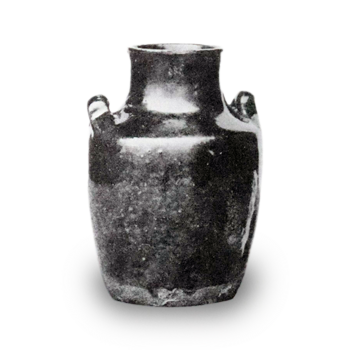
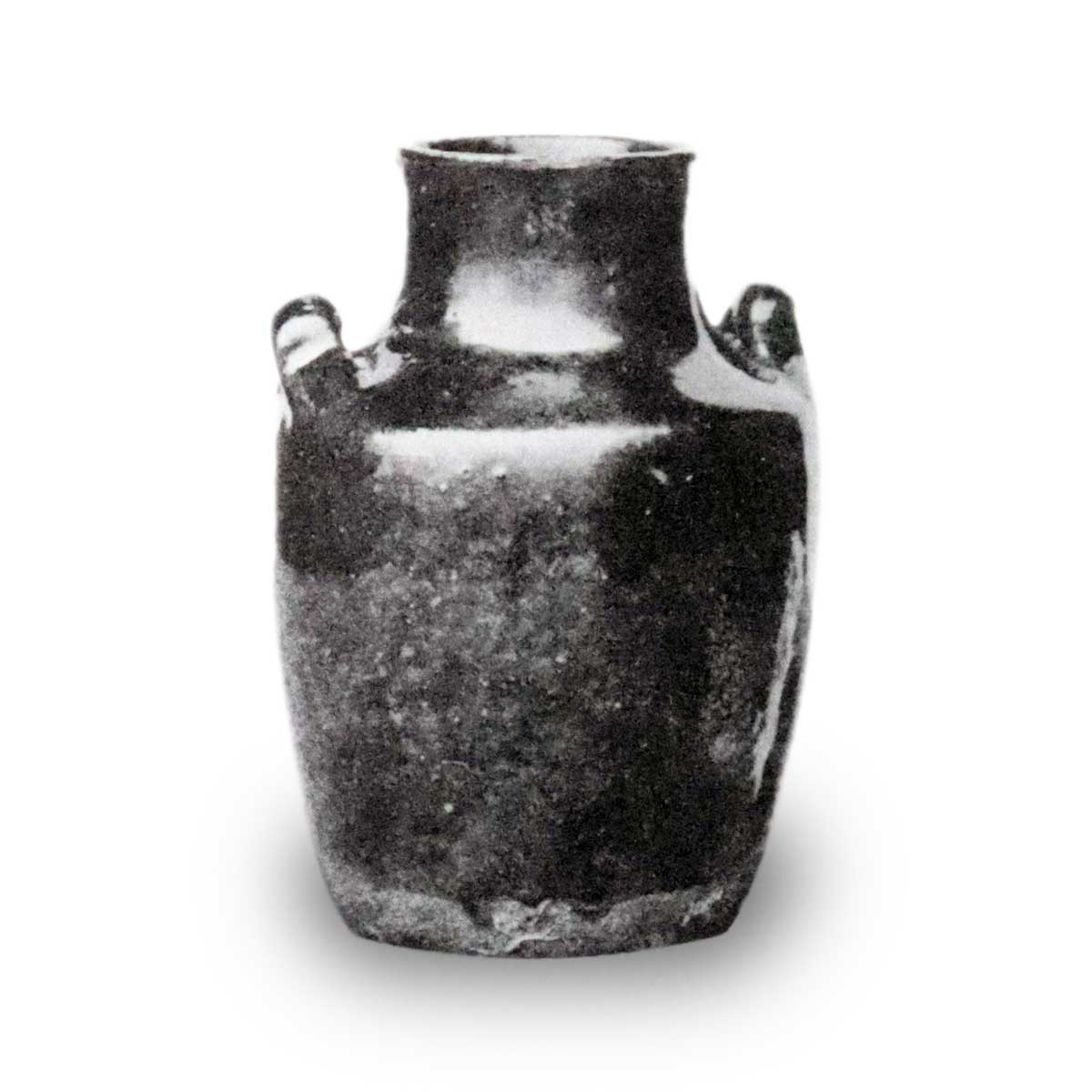
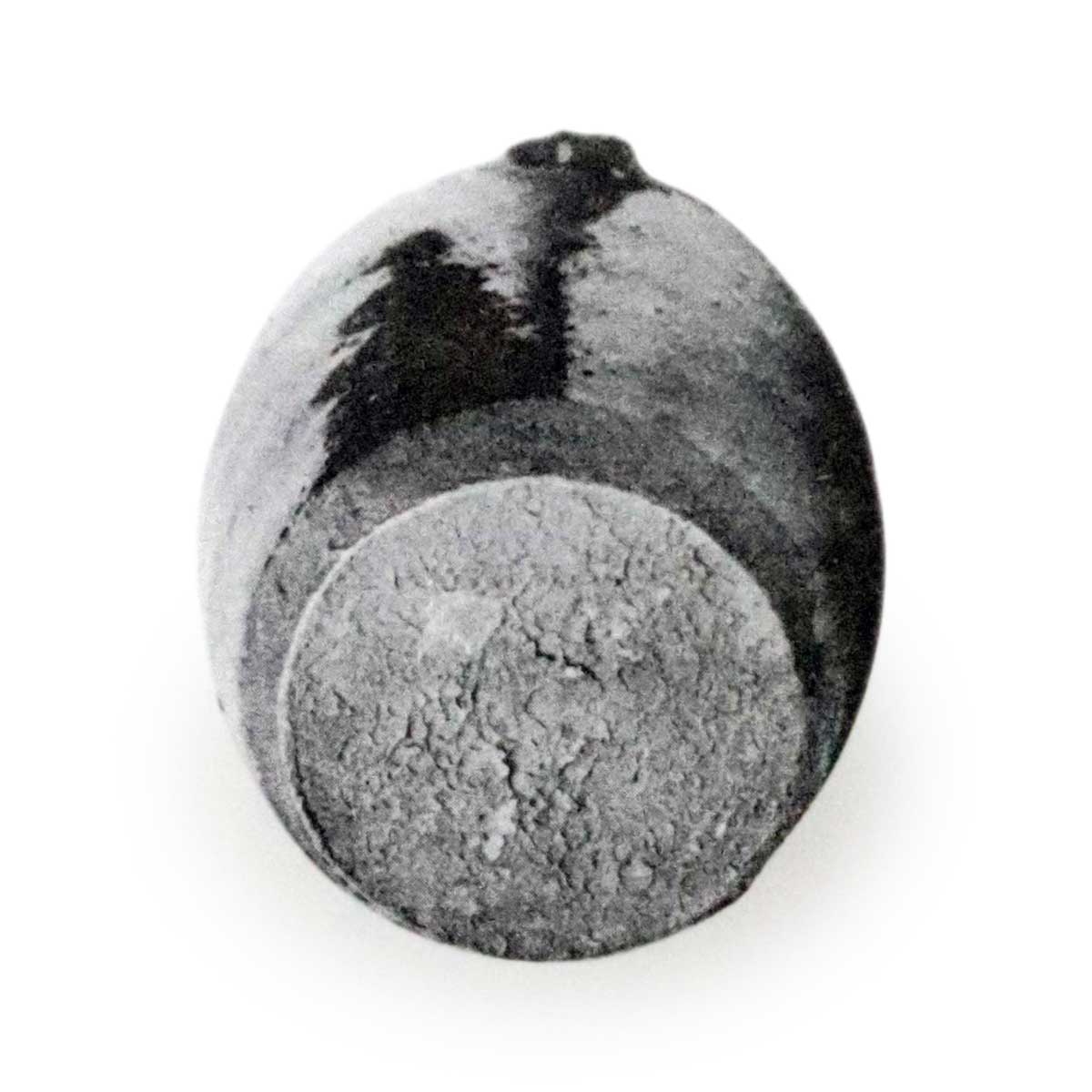
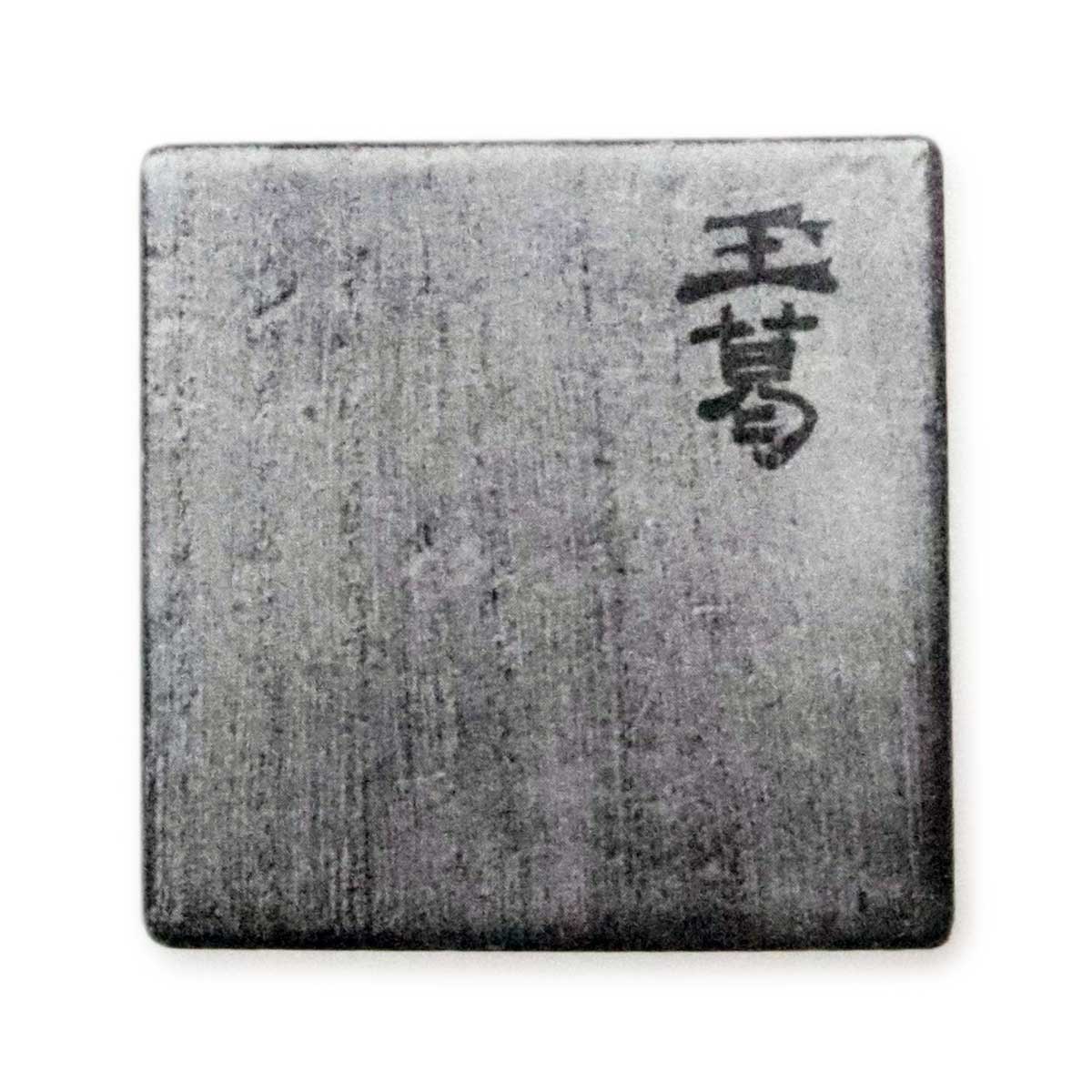
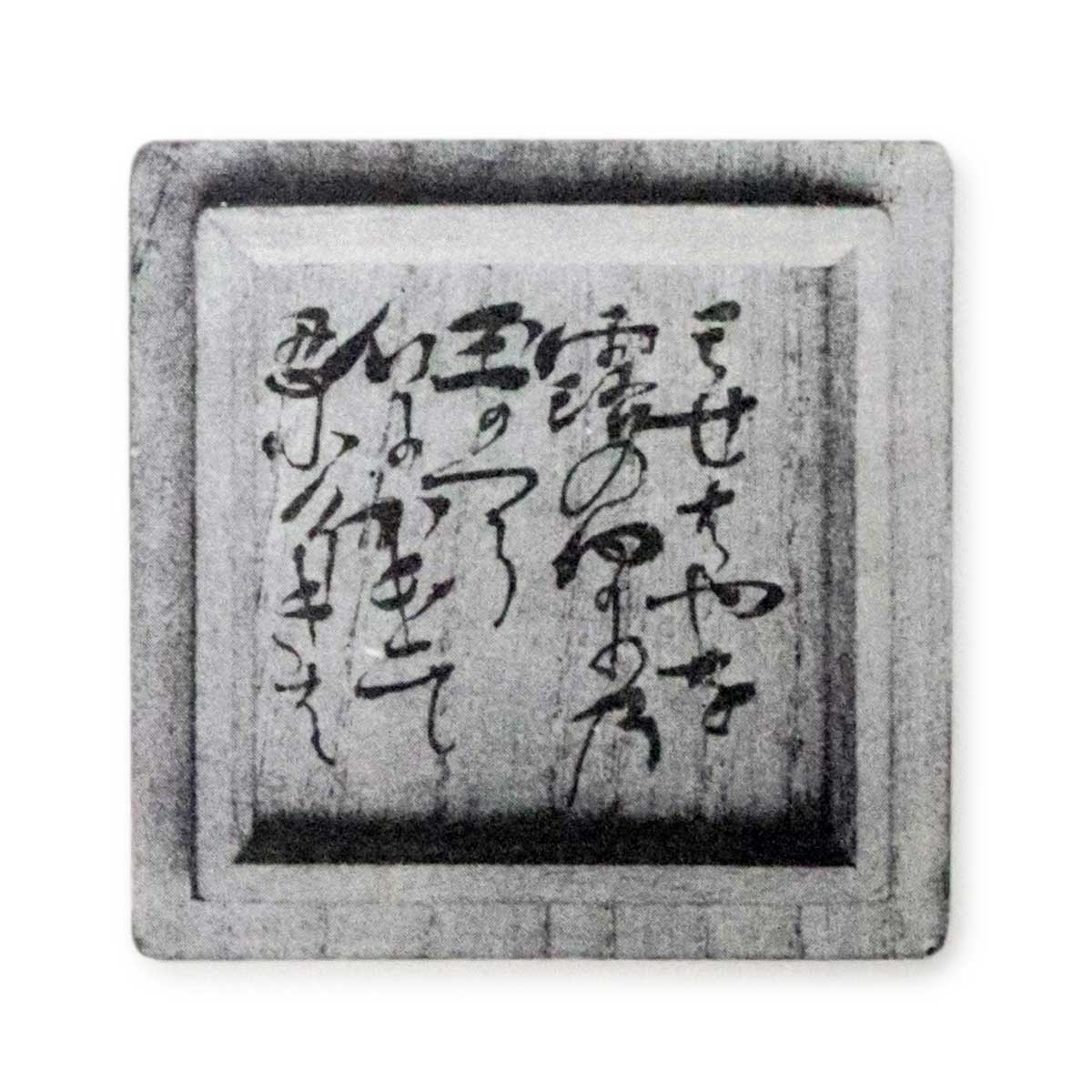
Made in China; Collection of Marquis Nagataka Asano
Name
This is an abbreviation for “Kan-saku Tsuru-kubi” (Chinese-made crane head). An accompanying inscription states, “This is one of two Meibutsu that were once known as ‘Cranes’ in Sakai.” The accompanying box by Kobori Enshū bears the inscription “Tamakuzu,” and a waka poem is written on the underside of the lid; however, this name does not seem to fit this tea caddy, and it is possible that the box was mistakenly swapped with that of another tea caddy long ago. Further research (subsequent consideration) is required.
Dimensions
Height: Approx. 7.6 cm (2 sun 5 bu 2 rin)
Body diameter (below the shoulder): Approx. 5.5 cm (1 sun 8 bu)
Mouth diameter: Approx. 3.0 cm (1 sun)
Base diameter: Approx. 3.6 cm (1 sun 2 bu)
Neck length: Approx. 1.7 cm (5 bu 5 rin)
Handle height: Approx. 1.1 cm (3 bu 5 rin)
Weight: Approx. 76.1 g (20 monme 3 bu)
Accessories
・Lid: 1
・Pouch: 1
Tea-colored Guangdong (lining: iridescent sea mist; tie cord: purple)
・Pouch box: Paulownia wood
・Hikiya (cylinder for storing the tea caddy): Black lacquer
Pouch: Double-strand Kinran (lining in iridescent colors, purple tie cord)
・Hikiya box: Black persimmon wood, with chamfered edges
・Inner box: Paulownia, natural wood; inscribed by Kobori Enshū
Inscription on the front: “Tamakazura”
Inscription on the back: “How lovely it would be—the dew-kissed Tamakazura—to keep in my heart the image I cherish”
(Note) The poem “Tamakazura” appears in the “Koi 4” section of the Senzai Wakashū with a preface stating, “This poem expresses the heart of love as depicted in The Tale of Genji,” and the author is unknown.
・Outer box: Paulownia wood, Shunkei lacquer
・Outer Box (outermost box): Paulownia wood; newly crafted
・Accompanying Letters: 2 letters
Memorandum
When Lord Hidetada toured the Kanto region and passed through Makabe District, Tsushu Province, Lord Nagamasa instructed us to serve as his guides, and we paid our respects. After successfully completing our duties, we were honored to receive a haori from Lord Hidetada as a reward. Later, when Lord Nagamasa returned to the castle, he personally prepared tea for us there, and furthermore, we were presented with a Mishima tea bowl and a Han-style “katatsuki” tea caddy. This tea caddy with handles is a Meibutsu known as “Tsuru” and is something that should be treasured by our descendants for generations to come.
The 25th day of the first month of the first year of Kan’ei (1624), Year of the Rat — Nobufusa
Memorandum on the “Kan-tsuru” Tea Caddy
- A Kan-style shoulder-type tea caddy with two handles.
(However, the exterior of the pouch features a Kandou pattern, while the interior is an old “Kaiki” pattern.) - The name of the tea caddy is traditionally passed down as “Tsuru.”
- Height: Approximately 7.7 cm (2 sun 5 bu 5 rin)
- Width (diameter at the base of the shoulder handles): Approximately 5.5 cm (1 sun 8 bu)
- Diameter of the rim: approx. 3.0 cm (1 sun) *Note: “Sufuta” (nest-shaped lid)
- Height of the neck: approx. 1.8 cm from the base of the handles (6 bu)
- Diameter of the base: approx. 3.6 cm (1 sun 2 bu) *Note: “Okoshi-soko” (raised-plate base)
- A blue glaze run (glaze drip) is present in the middle.
However, there are two “dimples” on the unglazed body beneath the glaze run. - Weight: Approx. 75.8 g (20 monme 2 bu)
- Inner pouch: The exterior is double-vine Kinran; the interior is “Umi-ki”
(Illustration of the tea caddy omitted) The shape is as shown here. The color of the glaze is omitted as it is difficult to describe in writing.
Additionally, there is a replacement paulownia wood box containing a calligraphic inscription and a waka poem by a Enshū master.
(On the back of the paper)
The tea caddy on the right is one of the two Meibutsu once known as “Tsuru” in Sakai; it is the tea caddy referred to as “Tsuru.” It is said that one of these two tea caddies was presented during the “Tea Ceremony of the Collection of Meibutsu Tea Utensils” held at Taiko (Toyotomi Hideyoshi)’s Juraku-dai, and we have passed it down through the generations based on the tradition described above.
Month Day - The size and shape of the tea caddy shown above are as described in the inscription, and it has not a single scratch. That is all.
Miscellaneous Notes
The entry on the left (below) pertains to a sister piece of this tea caddy that was presented at the Juraku tea ceremony; it is included here for reference.
It is said that the “Meibutsu Tea Ceremony” was held at Juraku-dai at the request of Lady Kitano during the Taiko’s era, and that tea was served to Lord Okazaki. The kettle was an Ashiya kettle, inscribed with the name “Nonomiya.” The water jar was crafted by Fujishiro of Seto, with the inscription “Kinuta.” The tea caddy was made in the Chinese style, with the inscription “Shigure.” This is the tea caddy known as “Kotsuru” (Little Crane), one of the two Meibutsu once called “Ōtsuru” (Great Crane) and “Kotsuru” (Little Crane) in Sakai. It is a famous Meibutsu said to have also been called “Hinatsuru” (Baby Crane) when it was in the possession of the Botan-ka (Shōhaku) family in the mid-period. After this Juraku tea ceremony, it was renamed “Shigure.” Later, a tea ceremony featuring Meibutsu tea utensils was held at Juraku-dai in the presence of Lord Kin’go Chūnagon (Hideaki Kobayakawa). The tea bowls were five rare pieces from Goryeo that had been brought over via Daitoku-ji Temple, known as “Momiji-de” (Maple Leaf Design), and the tea caddy bearing the inscription “Yūhiyama” was also a Meibutsu tea utensil. (Omitted) Among the famous Meibutsu mentioned above, the tea caddy named “Shigure” and the tea bowl named “Yūhiyama” are particularly prized. Since they were depicted in the initial decorative diagram for the tea preparation on the tray, although the shapes and glaze colors of these famous Meibutsu are considered secret traditions, they were made public in the form of a diagram (diagram omitted). The “Shigure” tea caddy features a black glaze and handles; the glaze stops in this manner, creating a pattern resembling cumulus clouds. It is approximately 8.5 cm (2 sun 8 bu) in height, 6.7 cm (2 sun 2 bu) in circumference, and weighs approximately 123.8 g (33 monme).
(From The Complete Book of the Way of Tea and The Complete Book of Ten Thousand Treasures)
Origin
Long ago, there were two Chinese-made tea caddies in Sakai called “Ōtsuru” and “Kotsuru,” and one of them is said to have been a Meibutsu used at tea ceremonies held at Jurakudai. Comparing their dimensions today, the “Ōtsuru” is approximately 8.5 cm (2 sun 8 bu) in height and weighs about 123.8 g (33 monme), while this tea caddy is approximately 7.6 cm (2 sun 5 bu 2 rin) in height and weighs about 76.1 g (20 monme 3 bu), so this teapot is likely the one referred to as “Kotsuru.”
According to the aforementioned document from the first year of the Kan’ei era (1624), which includes an accompanying note, when Shogun Hidetada inspected the Kanto region, a retainer of Asano Nagamasa—the founder of the Aki Domain—named Nobufusa served as a guide for Nagamasa in Makabe District, Hitachi Province. In recognition of this service, he was later invited to a tea ceremony at Edo Castle, where he was presented with this tea caddy. Incidentally, in Keichō 11 (1606), Hidetada granted Nagamasa 50,000 koku in Makabe District, Hitachi Province, as a retirement allowance (yōrō-ryō). In Keichō 18 (1613), Nagamasa’s second son, Nagateru, succeeded as head of the main branch of the clan, and in Genna 2 (1616), he became lord of Hiroshima Castle and was enfeoffed with 400,000 koku in the Aki and Bitchū regions.
The tea caddy known as “Shigure” was originally owned by Go-Komatsu-in; it was subsequently received by the Sanjō family, and later, after having been in the possession of Hongō Shirozaemon, a resident of Sakai in Izumi Province, it was acquired by the Taikō (Hideyoshi). Later, Lord Hosokawa Tadaoki received it as a gift, and Lord Tadayoshi inherited it when he succeeded to the family headship. After Lord Tadayoshi’s death, it was presented as part of his estate to Lord Daiyū-in (Tokugawa Iemitsu). It is said that the seal impression of the Sanjō Naifu (Sanjō Sanetomi, among others), which had been on the inside of the pot’s lid, was previously scraped off by the Taikō, and Lord Hideyoshi himself had his own seal affixed in its place.
(Excerpt from Chronicle of Lord Hosokawa Sansai)
Record of Actual Observation
On May 11, Taisho 9 (1920), I viewed the actual object at the Izumi Villa (country residence) of Marquis Nagataka Asano in Hiroshima City.
The rim has no flared edge; the neck is long, and a pair of asymmetrical handles, twisted outward at the shoulders, stand facing each other. From the shoulders down, the vessel tapers gently; the base is flat, and fine wrinkles appear all over the surface, with traces of “adhesion” (where other materials adhered inside the kiln) visible in places.
The entire piece is covered in a black amber glaze with a beautiful luster, and the clay from the hem downward is vermilion in color. From the shoulder, an avalanche of the same glaze flows down to the waist, where it stops; the tip of the glaze (where it dripped and stopped) has a slight blue-lapis-lazuli hue. Inside, the glaze covers the area around the neck, while below that, shallow wheel marks run around the interior, and the center of the base is flat. The form is compact, with relatively large handles that are slightly asymmetrical, adding to its charm; in particular, the single drop of blue-lapis-lazuli glaze in the decorative pattern is the very lifeblood of this tea caddy.