
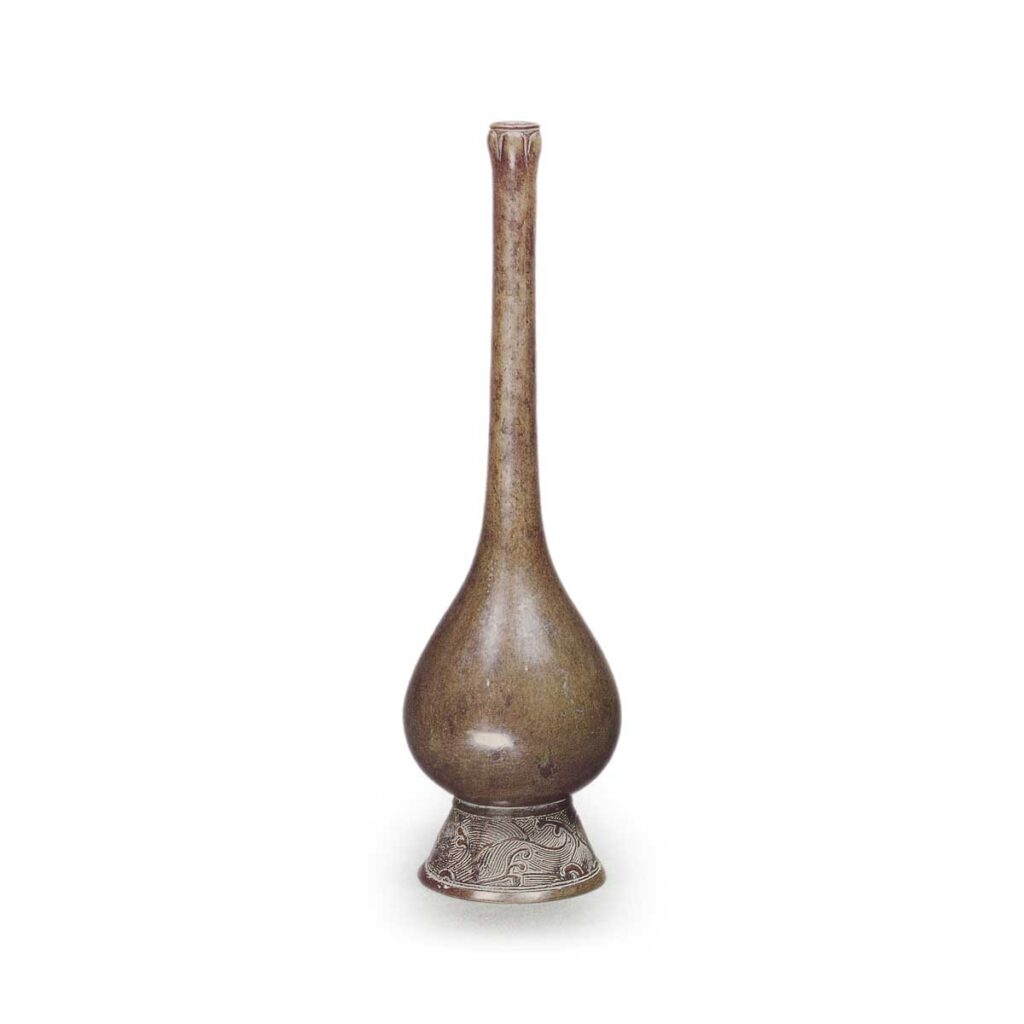
Daimeibutsu
Accessories: Box, black lacquered with gold-leaf lettering, accompanied by a certificate
Two accompanying letters written by Matsudaira Kai-no-kami
From Ota Seikyu to Sasaki Kurozaemon
Listed in Kokin Meibutsu Ruiju
Dimensions
Height: 26.6 cm, Mouth Diameter: 1.7 cm, Body Diameter: 7.8 cm, Base Diameter: 6.6 cm, Weight: 405 g
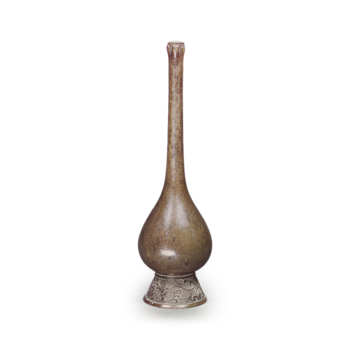
This flower vase is known to have been owned by Rikyu. It features a large sorori shape with a kumiko-style rim, a peach-shaped base, and a footring.
The footring is carved with a wave pattern, and the golden-hued copper color (or perhaps this is a sand-finished finish) is simply irresistible.
As can be seen from the “Kanko-guchi” (citrus-mouth) shape, it resembles both a crane’s beak and a standing crane; thus, in Matsudaira Kai-no-kami’s accompanying letter, it is described as “originally called ‘Crane’s Beak,’ but renamed ‘Crane’s Single Cry’—a flower vase without equal in the world.”
Furthermore, the Yanagisawa documents state:
- Regarding the Taiko’s gifts to various daimyo:
Monkey Kettle: Furuta Oribe
Tsuru Isshō: Ankokuji Chōrō
. Furthermore, the Domon Genzaburō Nikki and Matsuya Kaiki state, “Tsuru Isshō, a royal artifact, was bestowed upon the Lord of Mito.”
Additionally,
Matsuya Hisamasa’s Diary, October 28, Morning
At Sakai Sen Sōeki’s residence: Shōsa, Hisamasa, and Masamichi, the three of us
The Kawanokama, suspended by a fine chain
placed on the floor with a crane’s beak, set on a lacquered board, with flowers not in water,
about one shaku in height, made of purple copper
This is also recorded
Excerpting the tea gathering records involving “Tsuru Ichisei” from Volume 9 of the Tankosha edition of The Complete Collection of Classical Works on the Way of Tea (“Matsuya Hisamasa’s Tea Gathering Records”),
on the morning of September 13 (Tenshō 6) - To Lord Yoshiro in Kyoto, regarding Soeki: Hisamasa
One large kettle, Tenmoku, flowers in a narrow arrangement, using the Crane’s Beak
is recorded.
Based on the above, it can be understood that the transmission of this “Tsuruichi” went from Ankokuji Ekei to Rikyu, and then became an imperial possession of the Yanagi-in, passing down to the Mito family.
Information regarding the flower arranger Ota Seikyu is also included, but it is omitted here.
Although it is labeled as a Chinese import, with its clean, elegant form and the wave pattern on the foot—a traditional Japanese motif—this piece perfectly aligns with the Japanese sensibility. How, then, could such a work have sprung from the rough, vague minds of those from the continent? While the gold may be gilded or made of gilt bronze, might the actual craftsmanship have been that of a Japanese artisan? I dare to raise this question and await the correction of the learned.

