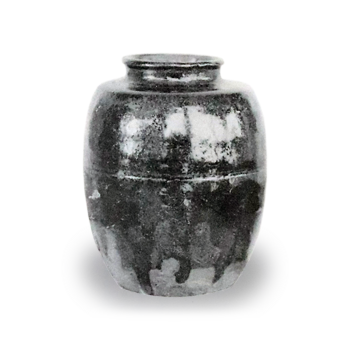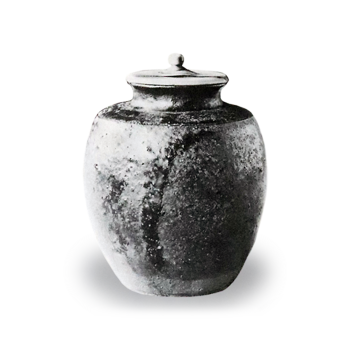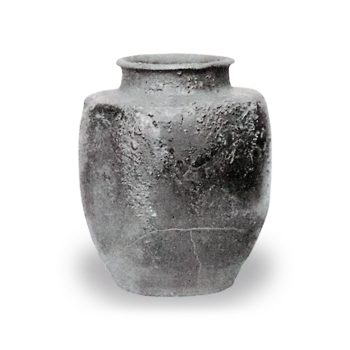
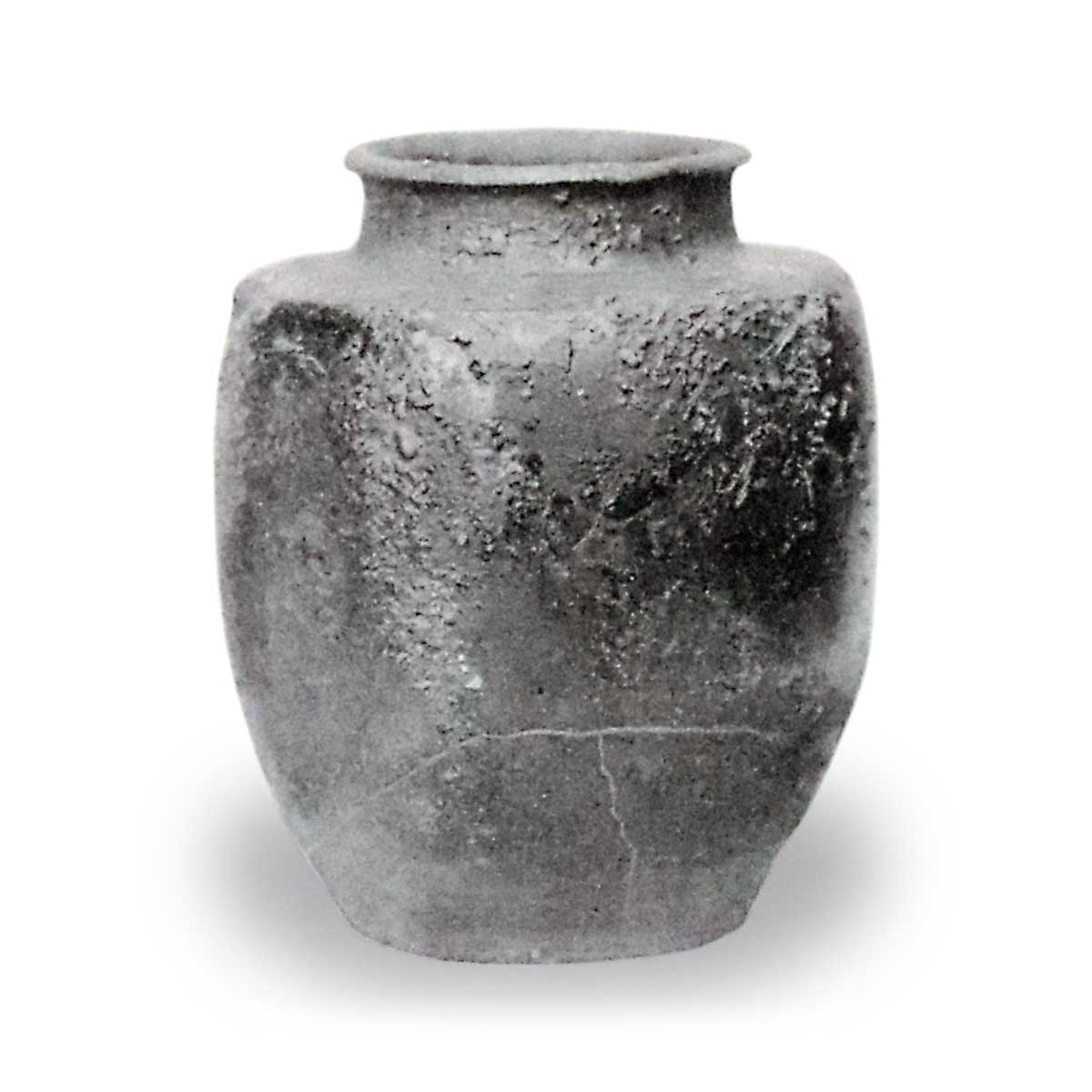
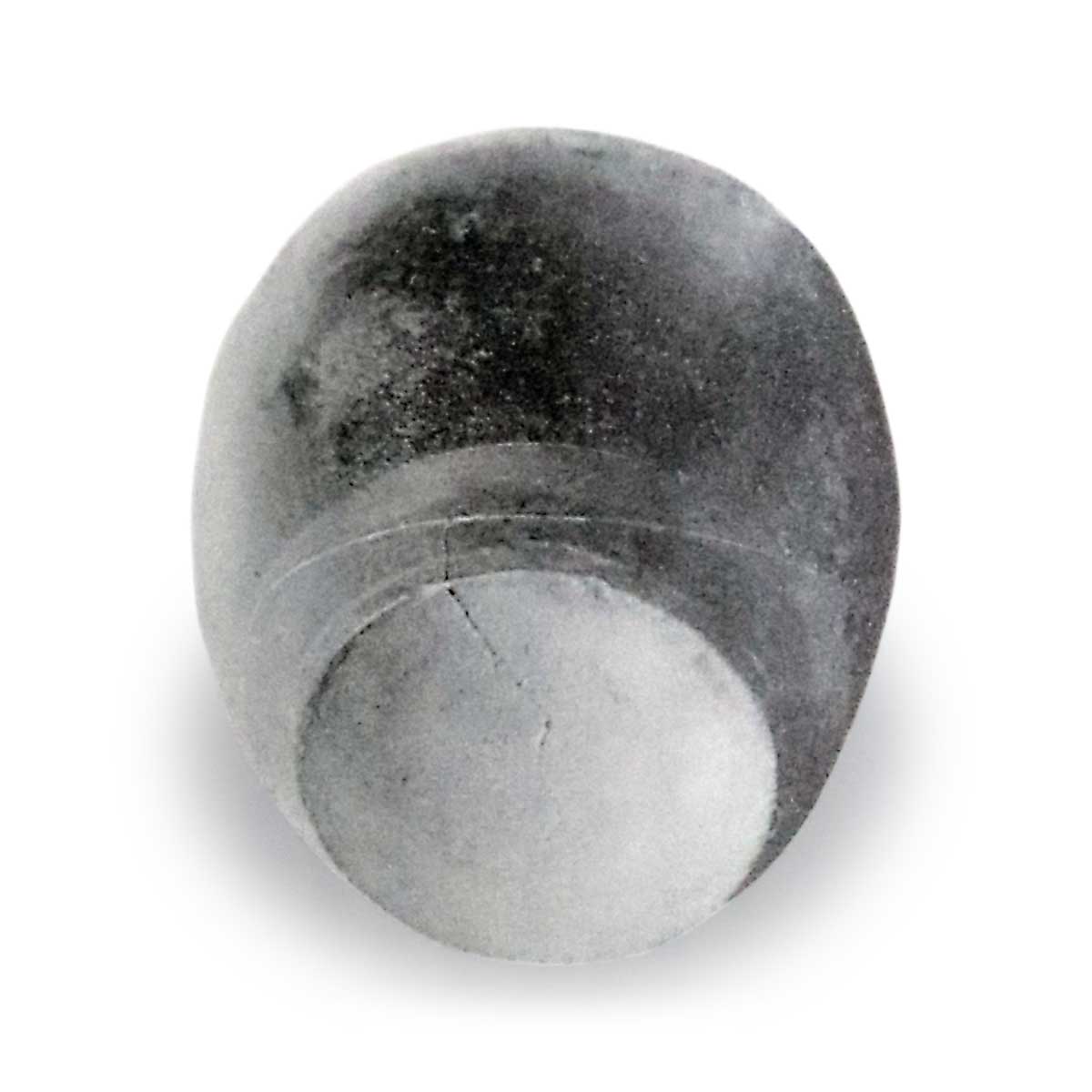
A Daimeibutsu tea caddy made in China (Han-style). It was formerly known as the “Sakuma Katatsuki” or “Kanamori Katatsuki.”
It is currently in the collection of Count Sadamichi Hisamatsu.
Origin of the Name
The book Chaki Benran states: “Unzan is the name of a type of fabric. It features a purple ground with patterns woven in the same color. The name was derived from the fact that a bag made of this fabric was hung over the tea caddy.” In other words, it is believed that the name of the bag (shifuku) used to cover the tea caddy became the name of the tea caddy itself.
Additionally, it was formerly known as the “Sakuma Katatsuki” or “Kanamori Katatsuki,” a name derived from the fact that its first owner was Sakuma Fukansai, and it was later owned by Kanamori Izumonomori.
Modern Equivalents of Dimensions and Weight
Height: Approx. 9.1 cm (3 sun)
Body Diameter: Approx. 7.9 cm (2.6 sun)
Mouth diameter: approx. 4.5 cm (1.5 sun)
Base diameter: approx. 4.8 cm (1.6 sun)
Rim height: approx. 1.3 cm (0.42 cm)
Shoulder width: approx. 1.2 cm (0.4 cm)
Weight: approx. 141 g (37 monme 6 bu)
List of Accessories
The lid is a single piece and features a recessed center. The storage pouch is made of white chirimen silk with a white cord.
There is one “Ori-Kantō” cover (pouch).
There is a wooden mold (made of paulownia) shaped like the tea caddy, housed in a bag made of Donshu fabric.
There is a plain paulownia wood box to hold these pouches and the wooden mold.
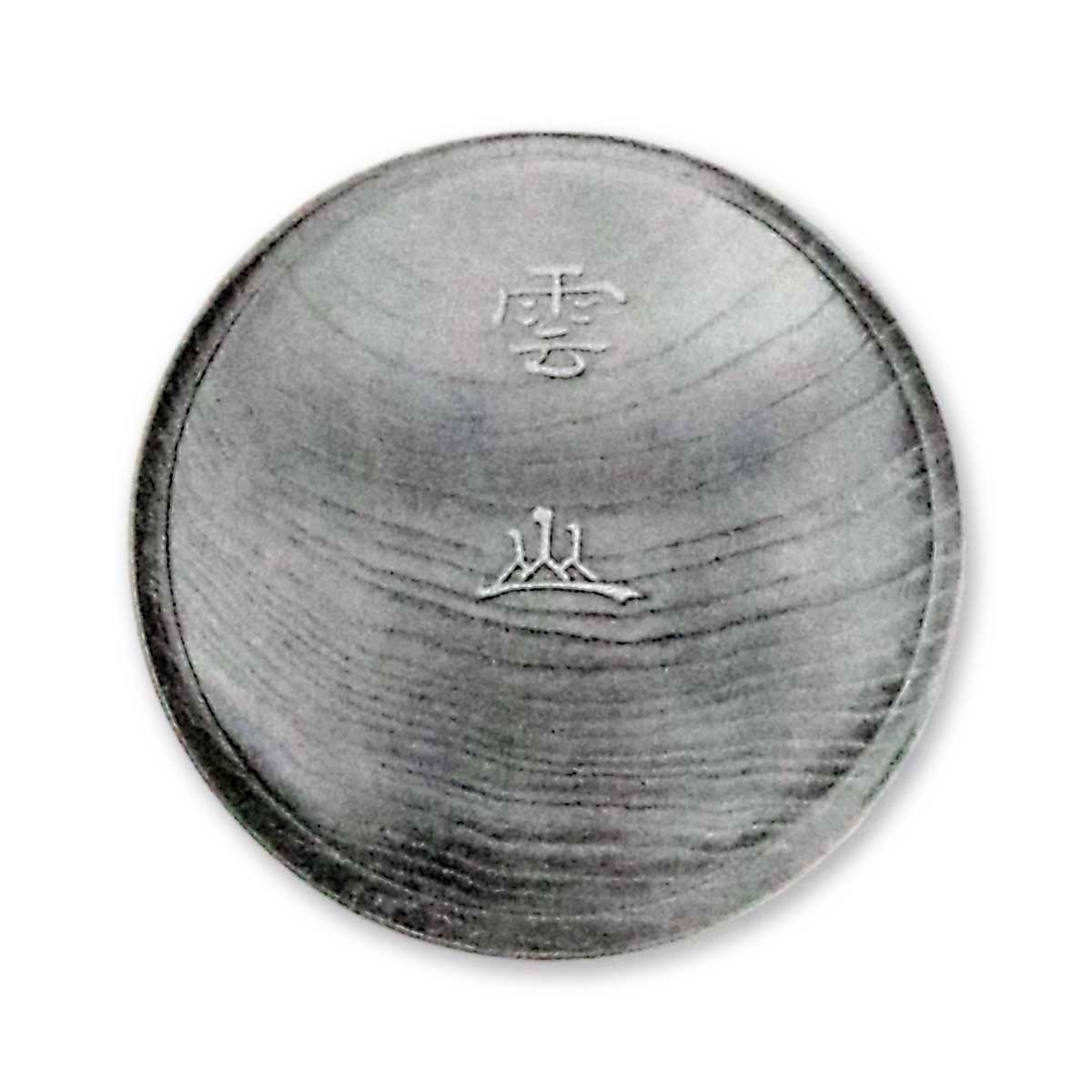
Hikiya is made of mulberry wood and finished using the “kaki-awase-nuri” technique; the characters “Unzan” are inscribed in gold leaf. This inscription is by Matsuura Senpaku, who went by the pseudonym Shingetsuan.
The inner box is finished in “tame-nuri” and features a lock. The middle box is made of untreated paulownia wood. The outer box is made of paulownia wood and finished in black “kaki-awase-nuri.”
One accompanying letter is included.
Record of its History and Miraculous Survival
The reason this Unzan tea caddy came into the possession of our family (the Hisamatsu family) is made clear by a separate letter from Anchiken (Matsudaira Sadatomo). Furthermore, as recorded by Kobori Enshū, this tea caddy was originally a treasured possession of Ashikaga Yoshimasa (Higashiyama-dono), making it a treasure of ancient and authentic lineage—an extremely rare and precious artifact.
For this reason, even after it was passed down to our family, it was kept under strict security in the main keep of Matsuyama Castle as one of our family heirlooms. However, on New Year’s Day of the fourth year of the Tenmei era (1784), the main keep of Matsuyama Castle was destroyed by a fire caused by a lightning strike. At that time, the protective cover and all other accompanying documents were reduced to ashes, but this tea caddy alone survived the fire without any damage to its form. This is a testament to the vessel’s inherent virtue, and it must truly be called a great miracle.
Katsunari, the current head of the family, had a new cover made based on old records to commemorate his 70th birthday celebration. He also commissioned his friend, the poet Matsuura Shingetsu, to inscribe the Hikiya maker’s name on it. Believing that one who has not yet attained the profound mysteries of the tea ceremony should not use this tea caddy indiscriminately, he has kept it deeply hidden away until today. However, this year, as I prepared to hold a banquet to celebrate my 80th birthday, and due to strong encouragement from those around me, I have finally decided to use this renowned tea caddy on this occasion. It is not that I dare to play with this masterpiece myself. I record the details here to pass them on to my descendants.
June 24, 1911 (Meiji 44) Recorded by Katsunari, Third Rank, Senior
(Note: Hisamatsu Katsunari was deeply versed in the tea ceremony and went by the pseudonyms Seito or Ninsō. He passed away the following year, in February 1912 (Meiji 45), at the age of 81.)
Characteristics of the “Unzan (Sakuma) Katatsuki” as seen in various tea ceremony texts
・Sekkenso Chado Wakugei: “Unzan” is also known as “Sakuma Katatsuki” or “Kanamori Katatsuki.” Dimensions such as a height of three sun (approx. 9.1 cm) are recorded. There are three lids, all of which are superbly crafted. The original bags were made of “Hino Kanto” and “Kamiyanagi” fabrics; those with patterns on a purple background are called “Unzan-giri (saki).” The base is raised, showing slight signs of wear. The base glaze has an amber-colored flow, and the clay (body) is a fine, dark grayish-black with a large crack (fissure) extending from the edge of the clay. The application of the glaze is superb.
・“Tenno Meibutsu-ki”: Owned by Sakuma Uemon-no-jo (Nobuyoshi, son of Nobumori; later known as Fukansai).
・“Higashiyama Gomono Naibetsucho”: A katatsuki owned by Sakuma Fukansai, which was in the possession of Kanamori Nagato-dono.
Appearance at a tea ceremony during the Azuchi-Momoyama period
・On October 18, Tenshō 5 (1577), Tsuda Sōyuki and Sōmu were invited to a tea ceremony hosted by Sakuma Jinkurō (Nobue). Tsuda Sōyuki’s diary reads: “We displayed a katatsuki tea caddy in the tokonoma. An arare kettle was placed in the hearth, and during the hand-washing ritual, we placed the katatsuki on a shihō-bon tray, though it had no bag. This was the first time I had seen this katatsuki. Its shape features a low body and is slightly large. The shape of the rim and the quality of the clay are excellent; the color is slightly reddish or tends toward black, and the clay particles are fine. The glaze is black, with a single streak of glaze run and marks that look as if scratched by a fingernail. The glaze run is slightly warped, and the bottom shows signs of having been scraped (hege-soko). “The wheel marks are clearly visible on the rim, and there appear to be no horizontal bands on the body,” he observed in detail.
・There is also a record stating, “I viewed Lord Jinkuro’s katatsuki” at a tea gathering on November 27, Tenshō 9 (1581). (From Tsuda Sōyū’s Tea Ceremony Diary)
・ On November 21, 1588 (Tenshō 16), Sen no Rikyū (Sōeki) and Imai Sōkyū were invited to a tea gathering hosted by Sakuma Fukansai (the name adopted by Jinkurō Nobuaki after he took monastic vows). A sarugama kettle was suspended over the hearth, and during the hand-washing break, this katatsuki tea caddy was taken out, and tea was prepared in a Seto tea bowl. (From the Imai Sōkyū Diary)
Sale for 3,000 ryō and receipt (with accompanying note)
Kyōgoku Tango-no-kami (Takakuni) purchased the “Sakuma Katatsuki” that had been in the possession of Kanamori Izumo-no-kami (Kashige). The sale price was a staggering “3,000 ōban (3,000 ryō—equivalent to several hundred million yen today).”
The receipt dated October 5, 1643 (Kan’ei 20) states, “Of the total price of 3,000 ryō, we have first received 300 ryō here. For the sake of certainty, we, as retainers of the Kanamori family, have also drawn up this document,” and was submitted by two retainers of the Kanamori family to four retainers of the Kyogoku family.
Furthermore, a document dated November 20 of the same year, written by Kanamori Izumo-no-kami himself, states: “The price for the Sakuma Katatsuki in my possession was set at 3,000 large gold coins, and I have received the full amount without exception in both Edo and Kyoto. I record this here as proof for future reference.”
From Kanamori Izumo-no-kami Shigetaka (Sender) to Kyogoku Tango-no-kami (Recipient)
From the Kanamori Katatsuki to the Unzan Katatsuki
As the ownership of this tea caddy passed from the Kanamori family to the Kyogoku family, it came to be recorded as the “Kanamori Katatsuki.”
・Meibutsu-ki: Kanamori Katatsuki. Owned by Kyogoku Tango-no-kami (posthumous Buddhist name: Anchi Kakuko).
・Kokon Meibutsu Ruiju: Kanamori Katatsuki. A Daimeibutsu tea caddy owned by Kyogoku Tango-no-kami.
・Ganka Meibutsu-ki: Kanamori Katatsuki. Owned by Kyogoku Tango-no-kami.
On the other hand, Sado Shoshinshu states, “While it is said that ‘one cloud, two mountains’ refers to the Zangetsu Katatsuki, it has been passed down that the Unzan is of superior quality,” indicating that it was also known by the name “Unzan Katatsuki.”
Unshu Matsudaira-ke Chaki Benran states, “The Unzan Katatsuki is valued at 3,000 ryō. Unzan is the name of a fabric, woven with a purple pattern of the same color. It was named after this fabric was draped over a tea caddy. It was a personal possession of Lord Higashiyama (Ashikaga Yoshimasa) and a treasured item of Hosokawa Yūsai. The three types—the Unzan Katatsuki, the Hikisaki, and the Fuji Komatsu Kinwatashi—are worth 30,000 ryō.”
Details of its provenance based on Mito-ya Kinbei’s records
The Meiki Benran (Ueno Library copy) contains very detailed information.
“The Unzan Katatsuki was owned by Matsudaira Oki-no-kami (of the Iyo Matsuyama Domain). It is also known as the Sakuma Katatsuki. Its dimensions, including a height of three sun (approximately 9.1 cm), are recorded. The base glaze is applied to the vermilion stripes on the tea caddy, and the color is a glaze known as Yamagiri. The pouch features an indigo-ground twill pattern. The character ‘Toku’ is inscribed on the underside of the lid. The square tray was owned by Taiko Hideyoshi. Because it was used by Sakuma Shōkan, it is called the Sakuma Katatsuki. It was subsequently passed to Kanamori Izumo-no-kami, then to Kyōgoku Tango-no-kami (Anchi-dono), and finally handed down to his grandson, Matsudaira Oki-no-kami.
The Sale of 3,000 Ryo to Save His Subjects
The Kansei Shūshū Shokafu records the moving reason why Kanamori Shigetaka parted with this Meibutsu.
“Kanamori Izumo-no-kami Shigetaka succeeded to the family headship in the first year of Genna (1615) by order of Ieyasu; at that time, he presented famous swords and other items to the Shogunate, and also presented famous swords and the ‘Katatsuki and Unzan tea caddies’ to the second Shogun, Hidetada (Taito-in). However, Lord Hidetada later returned the Unzan tea caddy to him, saying, ‘Since this is a Meibutsu of the realm, keep it in your family and treasure it.’
However, starting in the 7th year of the Kan’ei era (1630), his domain (Hida Province) was struck by a severe famine.
Therefore, Shigetaka obtained permission from the shogunate to transfer this Unzan tea caddy to Kyogoku Tango-no-kami Takahiro, and with the payment of “three thousand gold pieces (three thousand ryō),” he provided relief to his vassals and the suffering peasants.”
This is a truly beautiful and moving historical anecdote about how a masterpiece saved the lives of the people under his rule.
The Anecdote of Rikyu and the Unzan Tea Bowl
In the town of Sakai, there lived a man who owned a famous Meibutsu “Unzan” shoulder-shaped tea bowl. He invited Sen no Rikyu to his home and served tea using that very bowl. However, since Rikyu seemed completely unimpressed, the owner, in a fit of temper after Rikyu had left, smashed the tea bowl to pieces. Someone who had been present gathered up the shards, took them home, and restored the teapot with his own hands. The Tale of Rikyu and the Unzan Teapot (Continued) and the Surprising Purchase
(Continued from the previous page)
He held a tea ceremony using the restored teapot and invited Sen Rikyu once again. Upon seeing it, Rikyu praised it highly, saying, “Is this not the Unzan I saw some time ago? This is truly magnificent.” The person who had restored it explained the circumstances and hurriedly returned it to its original owner.
After that, this tea caddy traveled from place to place and eventually came into the possession of a certain daimyo (the Kanamori family). A physician, having heard that Kyogoku Yasutomo (Tango-no-kami) desired it greatly, visited the daimyo and, while discussing the tea ceremony, mentioned, “Lord Yasutomo desires that Unzan greatly and often says, ‘If I could only obtain that, I would have no further wishes regarding tea caddies for the rest of my life.’”
The daimyo then joked, “If he wants it that badly, I might as well give it to him, but two da of gold (the weight of two horses) won’t be enough. I won’t part with it for less than two da.” The physician hurried to Yasutomo and relayed the story.
Anchi was astonished and pressed, “Is that true?” When the physician replied, “He certainly said so directly,” Anchi asked, “Please take two da of gold to him immediately and bring it back.” The physician hurried to the daimyo and conveyed this request, but the daimyo refused, saying, “I was only joking. In truth, I have no intention of parting with it, no matter how much is offered.”
The physician found himself caught between a rock and a hard place and was greatly perplexed. When he tried to explain this to Anchi, the daimyo would not listen at all, and a major dispute ensued. Eventually, other people intervened, and after various discussions (step-by-step negotiations), it was finally decided that the land would be ceded to Anchi for “two thousand ryō.”
In fact, at that time, the daimyo’s (the Kanamori clan’s) territory had suffered severe damage (losses) due to famine and other disasters, and he had decided to accept the money to save his peasants. After privately reporting this reason to the shogunate, the tea caddy was ceded to Anchi. “Two da of gold” was, in fact, the staggering sum of “12,000 ryō.”
Anchi was overjoyed and, on one occasion, showed this tea caddy to Kobori Enshū. Enshū remarked, “It is precisely because this katatsuki is cracked and the joints do not align that Rikyū found it amusing and praised it, making it famous. Indeed, it is best to leave such items as they are.”
Therefore, the claim that “while modern tea bowls are repaired and used even if cracked, tea caddies are never repaired and used if they have cracks or are broken” is incorrect; Meibutsu imported Chinese pieces, for example, are repaired and used even if they are cracked.
(This famous anecdote is recorded in multiple tea books, including Chaji Hiroku, Chasō Kanwa, Chawa Shigetsu Shū, and Zoku Chawa Shin’ō.
The very next day, a messenger arrived from Tango-no-kami bearing “three thousand gold pieces” and a letter stating, “We must have this.” Izumo-no-kami (of the Kanamori family) was greatly surprised and told the messenger, “I said that only in jest,” but the messenger replied, “My lord has ordered me to take it back at all costs,” and refused to back down, forcibly taking the tea caddy and returning home. (From Sakurayama Ichiyu Nikki)
The Unzan Tea Caddy and the Kanamori Family’s Good Deeds
When Hida Province (Hishu) suffered a severe crop failure that led to many deaths from starvation, the lord of the castle (Kanamori Shigetaka) sold a family heirloom tea caddy called “Unzan” for 3,000 pieces of gold. He used that money to purchase rice and grain from other provinces, thereby saving the lives of many of his subjects. The people praised him, saying, “The descendants of the Kanamori clan will surely prosper.” (From Asano Zatsurai)
The Tragedy of the Kyogoku Family (Explanation based on Hankanfu)
Kyogoku Yasutomo (Takahiro), who had purchased the Unzan tea caddy for a high price, was the lord of Miyazu Castle in Tango Province. However, suffering from an eye disease, he ceded the family headship to his eldest son, Takakuni, in 1654 (the 3rd year of the Jōō era) and retired, taking the name Yasutomo-sai.
However, in 1666 (Kanbun 6), his father, Yasutomo, lodged various complaints with the shogunate, accusing his son Takakuni of “tyrannical conduct (misrule).” As a result, Takakuni was stripped of his fief (kaei) and exiled to the Nanbu Domain. The shogunate was astonished by this extraordinary situation in which a son was punished due to his father’s accusations. Some argued, “For a parent to denounce the misdeeds of his own son! Even if Takakuni must be punished, since these are lands held by the family for generations, shouldn’t at least the third son be allowed to succeed him?” However, in the end, the Kyogoku clan (Miyazu Domain) was abolished.
Yasutomo withdrew to the banks of the Kurodani River in Kyoto and died in despair. People in the community whispered, “Although governance had been poor since the time of his father, Anchi, it became even worse under his son, Takakuni, who increased the burdens of labor and taxes, tormenting the peasants. As a result, the peasants were on the verge of revolting. Anchi wanted his beloved younger son, not his eldest son Takakuni, to succeed him, so he reported Takakuni’s misdeeds to the shogunate.” Due to this bitter family feud and misrule, the once-illustrious family was brought to ruin.
In stark contrast to the Kanamori family, who sold a tea caddy for three thousand ryō to save their subjects, the Kyogoku family, who purchased the Unzan, met a tragic end. Everyone can surely deeply appreciate the “wisdom of the seller and the folly of the buyer.” (From Kokon Chawa)
The Passing to the Matsudaira Family and Another Anecdote About the Broken Tea Caddy
・On May 11, 1676 (Enpō 4), Lord Kyōgoku Tango-no-kami Nyūdō Yasutomo presented the “Unzan” tea caddy and six pouches to the Matsudaira family as mementos (relics). (From Matsuyama-kō’s Shuiroku)
・The “Unzan” tea caddy, a treasure of our family (the Matsudaira family), was received by Lord Matsudaira Oki-no-kami Sadanori (Hachirōzaemon) as a memento from Lord Kyogoku Yasutomo in the 4th year of Enpō.
According to an old legend, this “Unzan” tea caddy was originally purchased by a retainer of Kanamori Sōwa at a shop for the low price of “160 sen.”
When Lord Kanamori (Izumo-no-kami) expressed a desire for it, it was presented to him, and he rewarded the owner with five ryō of gold.
Later, when Lord Yasutomo saw it at a tea gathering and expressed a desire to have it, Lord Kanamori said, “I will not part with it unless you offer one thousand gold coins.” The next day, Lord Yasutomo actually gathered one thousand gold coins, loaded them onto a cart, and brought them to acquire the tea caddy.
However, Lord Anchi, furious that he had spent his family’s entire fortune on this tea caddy and suffered as a result, smashed it against a pillar, shattering it into pieces. Someone nearby gathered the fragments and set them aside, and it is said that, astonishingly, the pieces fused back together overnight, restoring it to its original form.
It is said to have been restored to its original state. Furthermore, when they tried to burn it over a charcoal fire, the tea caddy floated into the air and would not burn. Seeing this, he thought, “What a mysterious vessel. It is truly blessed with good fortune,” and named it “Unzan” (Mountain of Fortune), which later came to be called “Unzan” (Cloud Mountain). The Suikenroku Shui records that “this vessel, made by mixing clay from Japan, India, and China, is Japan’s greatest treasure.” (From Matsuyama Sōwa. These are, strictly speaking, legendary anecdotes.)
Detailed record from Chaki Meibutsu Zui
“Sakuma Katatsuki” (later renamed Unzan), owned by Lord Matsudaira Oki-no-kami. The base is raised, the base glaze is amber-colored with a mottled pattern, and the clay is purple. It is beautiful overall; although it has a large flaw, it is a magnificent piece. The lid consists of three pieces and has no “su” (groove). It comes in a paulownia box; the lining is made of Karakuwa silk, and the bag is of brocade cotton.
The outer box is black lacquered and inscribed in powder-painted characters with “Unzan Tea Caddy.” The round pouch is made of pale yellow crepe. There are also two other Unzan pouches and a Hino Kantō pouch. The accompanying tray is a Wakasa tray; on the underside, the character “Ki” is painted in red lacquer, and Kyogoku Yasutomo’s signature (kao) is written in ink. A tea scoop made by Rikyu is also included.
This tea caddy was originally a personal possession of Lord Toyotomi Hideyoshi. It was passed down to Sakuma Shōkan (Fukansai) and later owned by Kanamori Izumo-no-kami, but Lord Kyōgoku Yasutomo requested it, and it was subsequently transferred to Matsudaira Oki-no-kami.
A copy of the accompanying certificate records the enormous sum paid for it. A vivid receipt remains, stating: “I have indeed received in Kyoto a total of 2,700 oban coins—including 1,300 oban (equivalent to 9,980 ryō)—as part of the 3,000 oban payment. November 20, 1643.”
Summary of its History
It was originally owned by Toyotomi Hideyoshi and later passed down to Sakuma Fukansai (Jinkurō). The Tsuda Sōyū Chayū Nikki records that it was used at a tea ceremony hosted by Sakuma in 1577 (Tenshō 5).
It subsequently passed into the hands of a resident of Sakai, but because Sen no Rikyū failed to praise it at all, the owner became angry and smashed it to pieces. It is said that when another person pieced the fragments back together and showed it to Rikyu again, Rikyu praised it for the first time.
Later, Kanamori Yoshishige, the lord of Hida Province, purchased it for 100 ingots of gold. In 1615 (Genna 1), his son, Shigetaka, presented it to Shogun Tokugawa Hidetada, but it was immediately returned with the instruction, “Since this is a famous vessel passed down through generations, treat it with care.”
In 1643, Kyogoku Takahiro (Nyudo Yasutomo), lord of Miyazu Castle in Tango, coveted the tea caddy and attempted to acquire it for 3,000 large gold coins (equivalent to several hundred million yen). Around that time, Hida Province, the domain of the Kanamori family, was struck by famine, so Shigetora, reluctantly, sold this tea caddy to Takahiro to save his subjects.
Delighted, Takahiro consulted Kobori Enshu about having the tea caddy’s seam neatly repaired, but Enshu is said to have strongly advised against it, stating, “Leaving it cracked is precisely what fulfills Rikyu’s original intent, which he praised.”
After Takahiro’s death, his younger brother Takada (lord of Tanabe Castle) presented this tea caddy as part of his brother’s estate to Matsudaira Oki-no-kami Sadanao, lord of Matsuyama in Iyo. This was likely due to the connection that Sadanao’s father had been the son-in-law of Yasutomo (Takahiro).
Since then, this tea caddy has been kept in the treasure chamber of Matsuyama Castle’s main keep. Even when the keep was destroyed by a fire caused by a lightning strike on New Year’s Day of Tenmei 4 (1784), it miraculously retained its original form and has survived to this day.
Academic Inspection Record (Appraisal Record) from the Taisho Era
On March 30, 1921, this tea caddy was physically examined at the residence of Count Hisamatsu Sadatomo in Shiba Ward, Tokyo.
The rim is slightly deep and flared, with the base of the rim protruding outward; a single fine horizontal groove runs around its circumference. The body is slightly flared and tapers toward the base. The unglazed clay body is visible below the rim, and the bottom is formed by a raised rim, with the traces of the thread-cutting slightly elevated. From the middle of the body to the bottom, there are traces of a large crack that has been repaired with gold powder.
Because this tea caddy was caught in the fire at Matsuyama Castle, the original glaze has been scorched (charred), and there are areas where it has developed red rust, resembling iron. Additionally, in some areas where the original glaze survived, the heat caused it to blister (fire blistering), retaining a blue-gray hue similar to that of the Meibutsu “Nitta Katatsuki,” allowing one to fully imagine the beauty it possessed when intact.
The interior features deep wheel marks, and the center of the base is slightly recessed (in a “mirror-drop” style). Due to exposure to intense heat, the interior has taken on a shiny, silver-paper-like hue.
Typically, tea caddies that have suffered fire damage are repaired with lacquer, often transforming them into something completely different from their original state (resembling lacquerware). However, this tea caddy has undergone no repairs with lacquer or other materials; instead, it retains its charred appearance as it emerged from the fire. This makes it a particularly rare and valuable example.