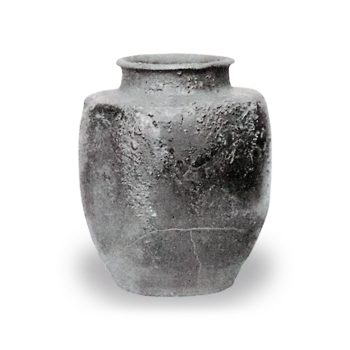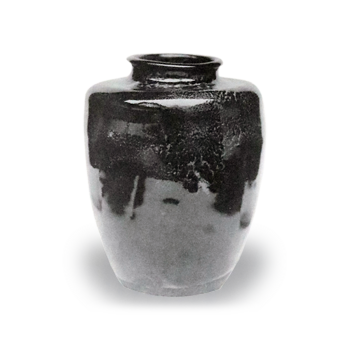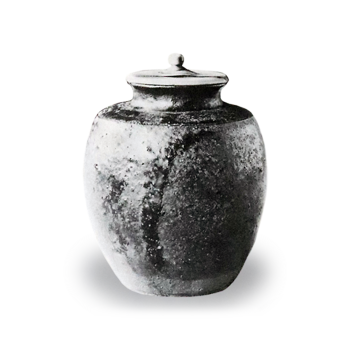
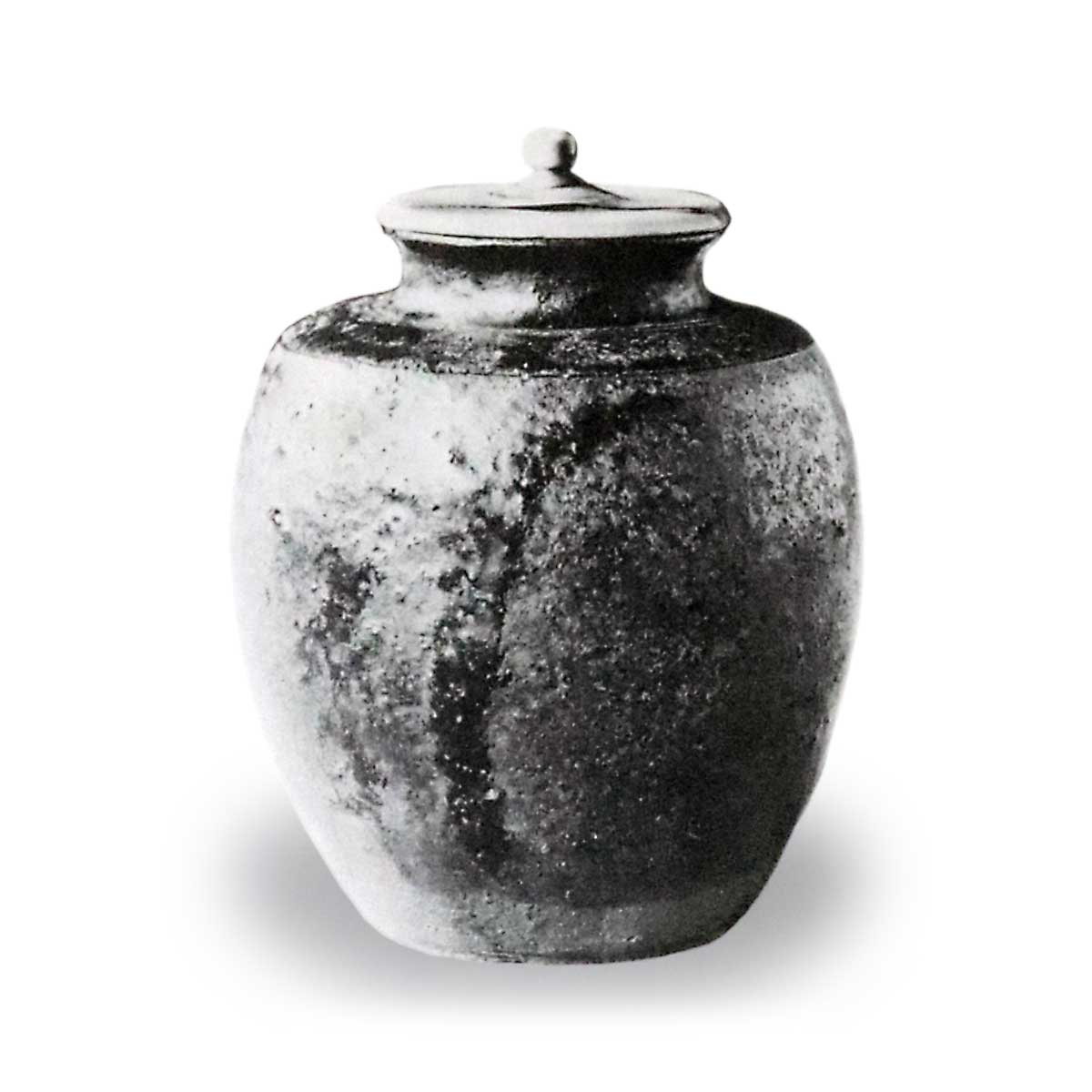
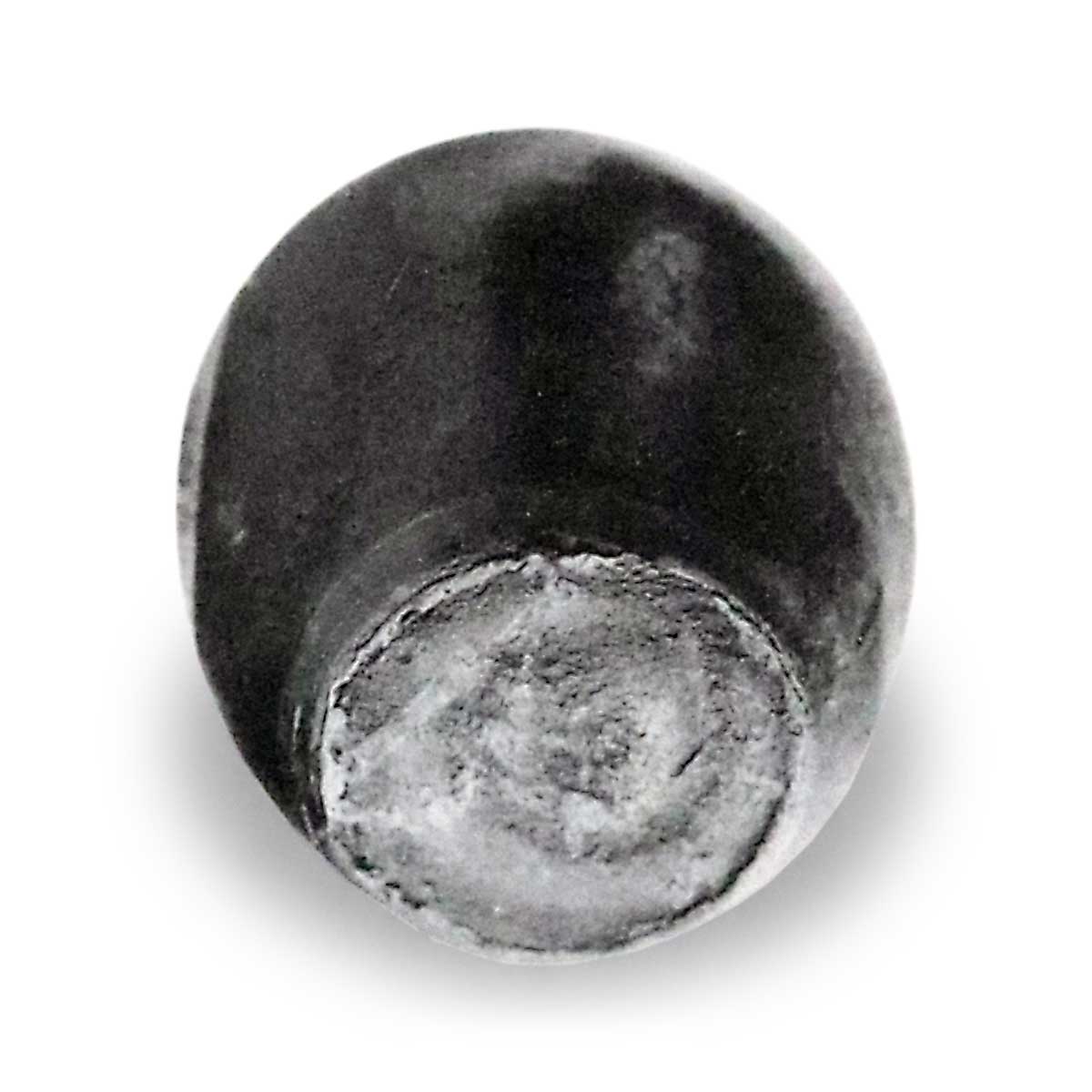
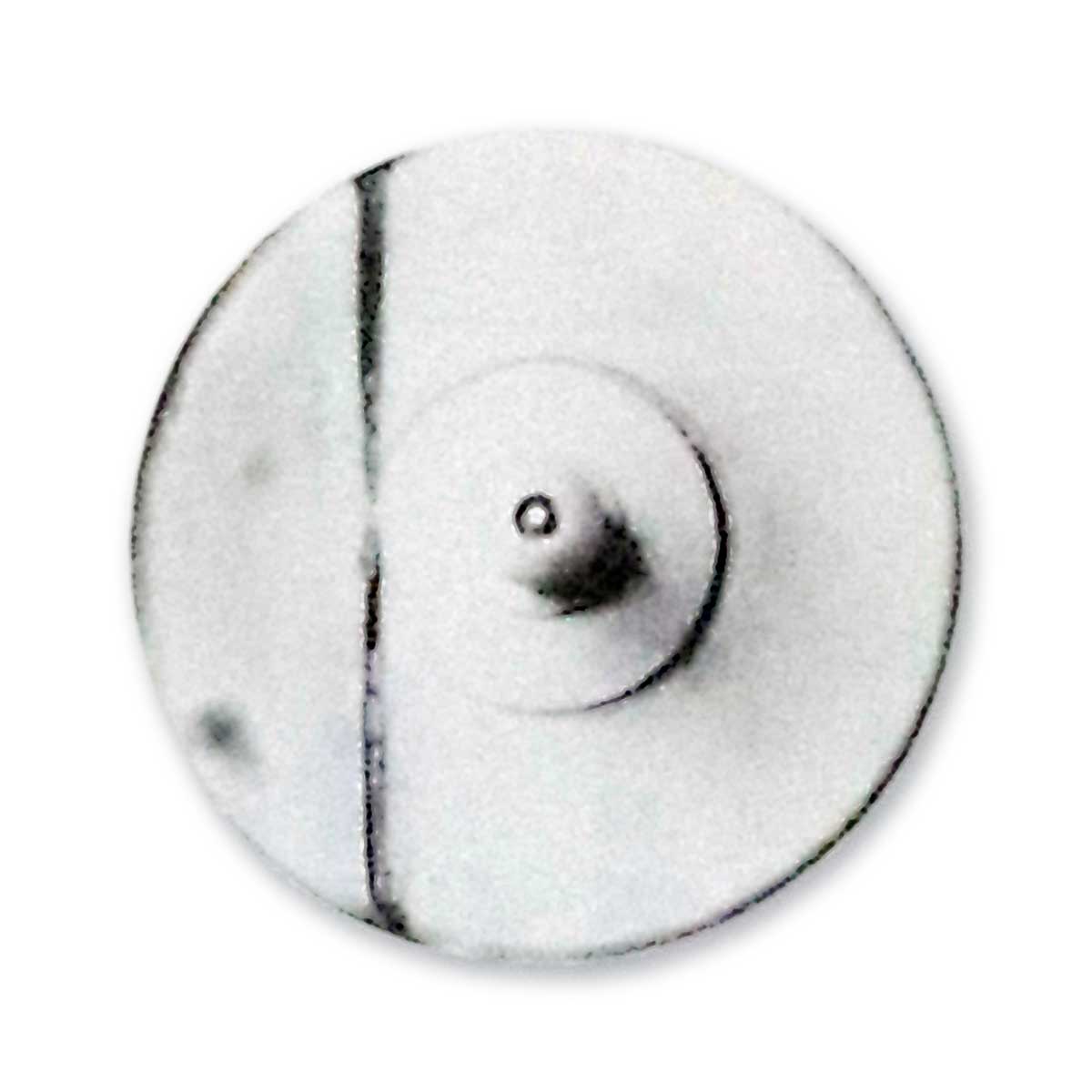
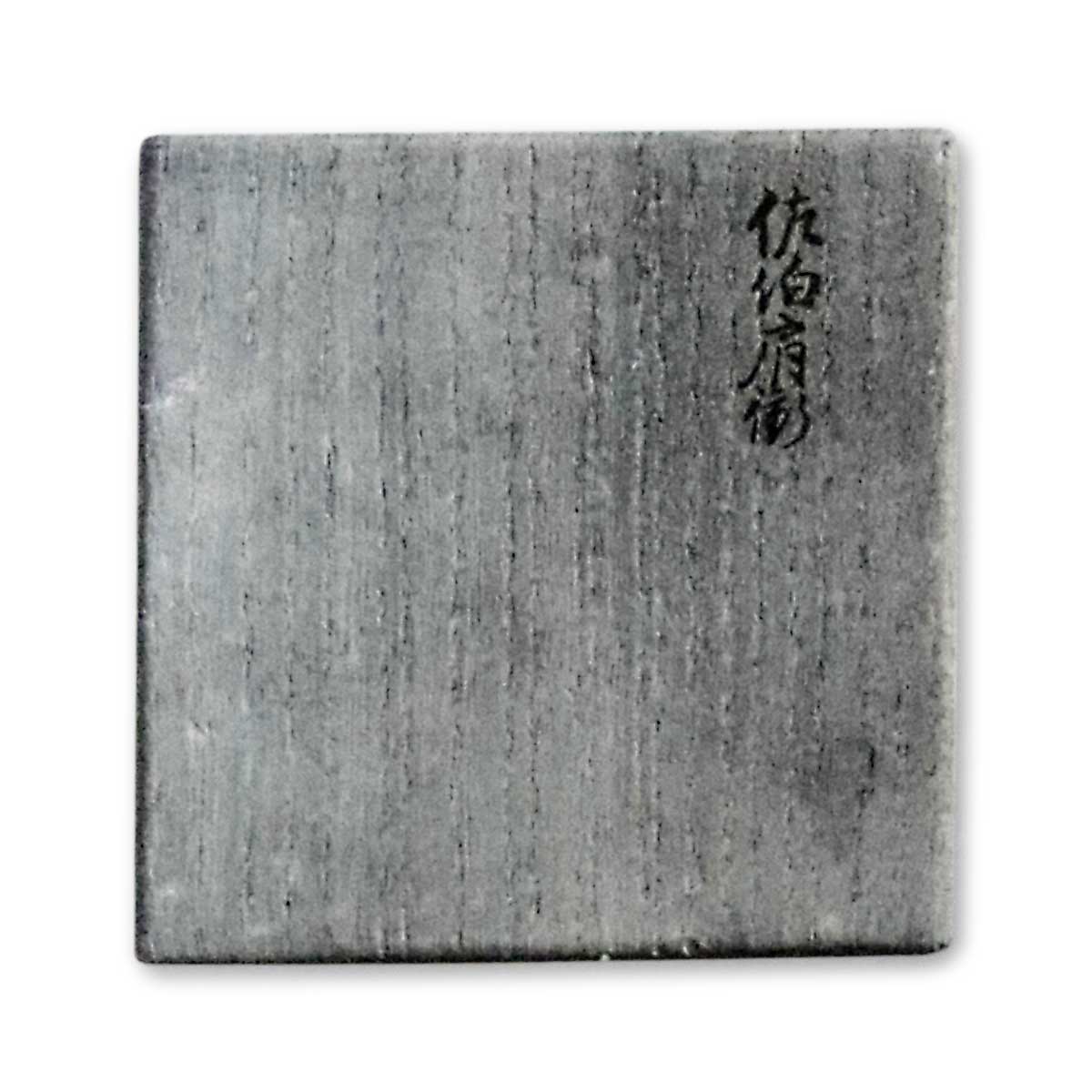
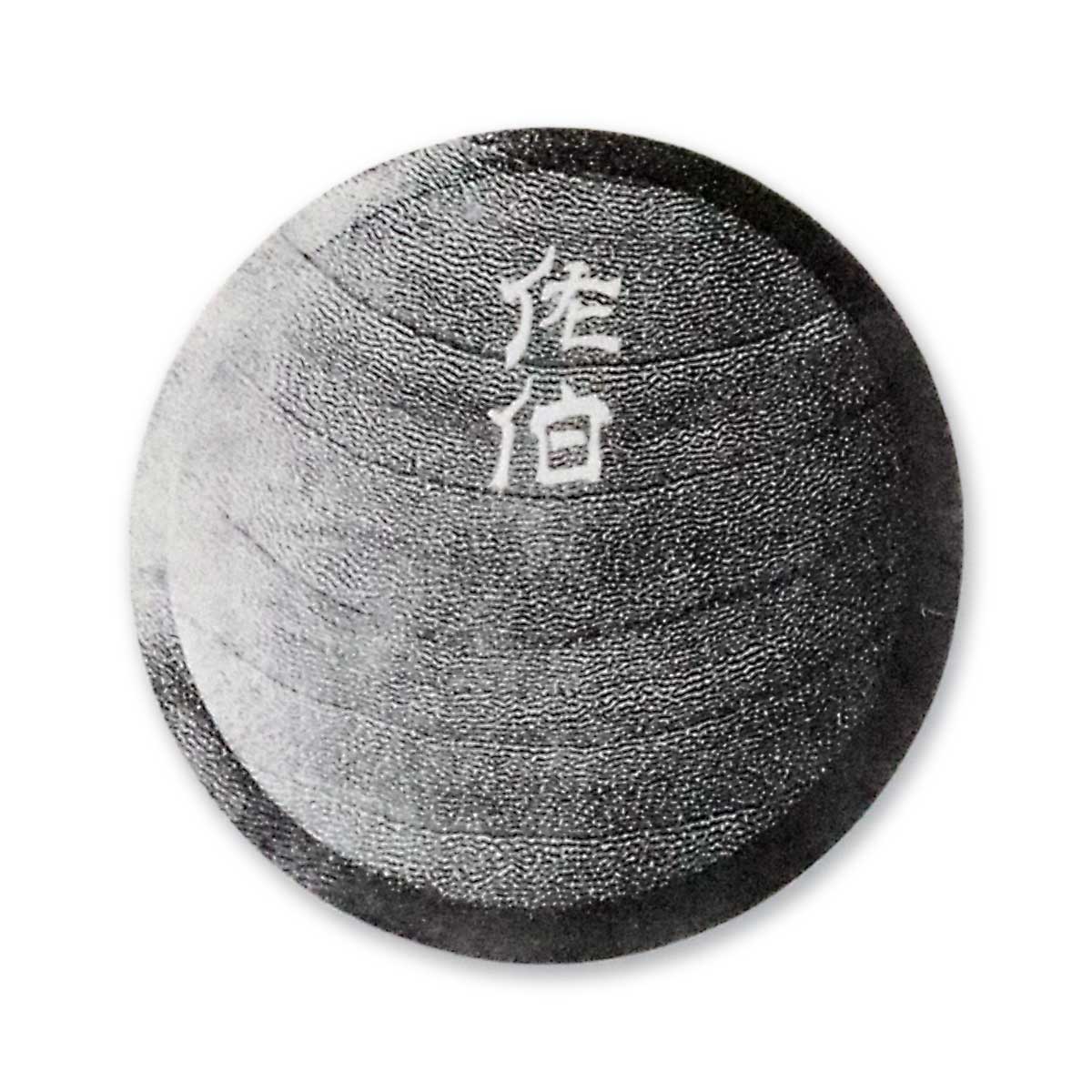

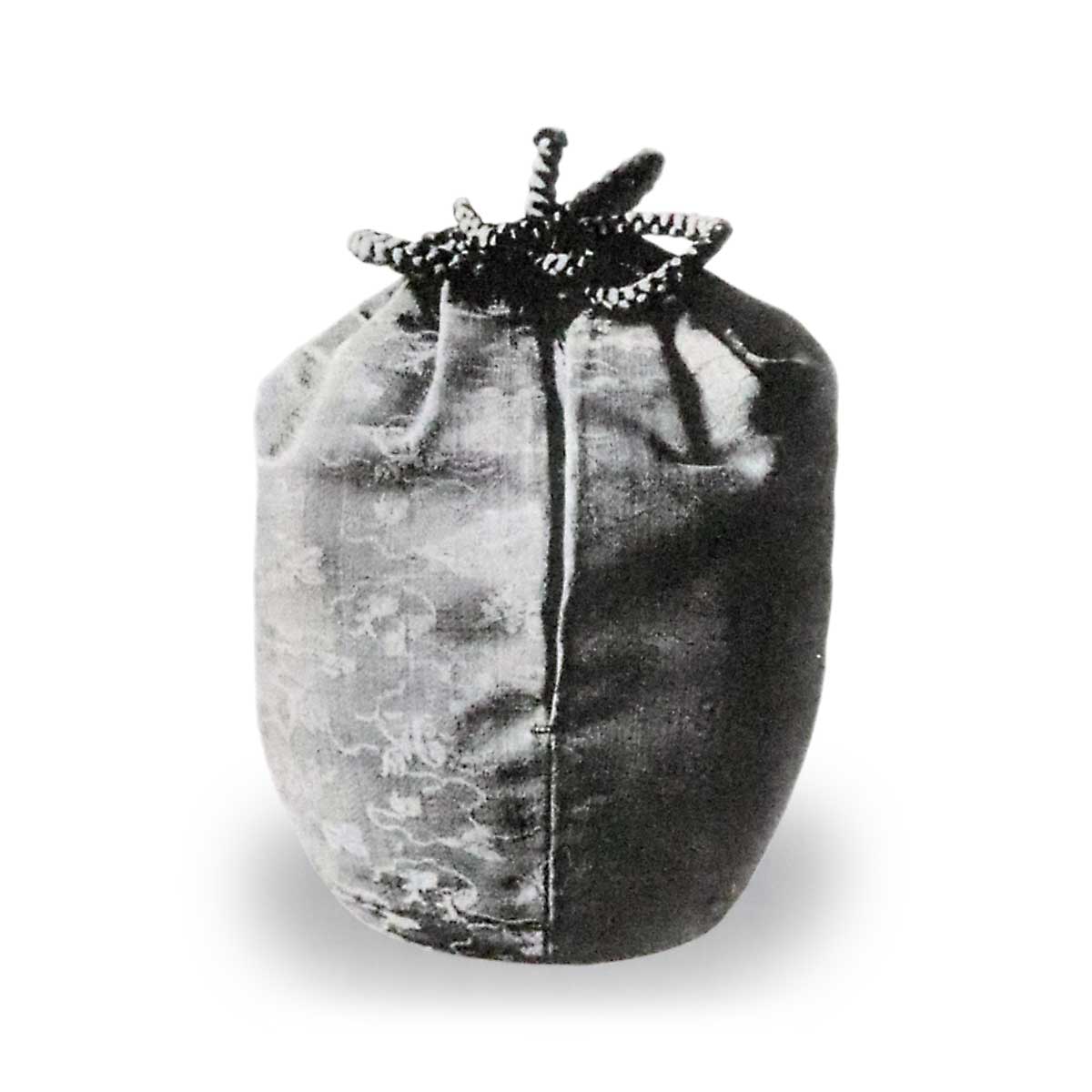
A Daimeibutsu tea caddy made in China (Han-style), currently in the collection of Mr. Ichiro Tamura of Kobe.
Origin of the Name
It is said that Saiki Tarō Koresada, a retainer of the Sengoku-period daimyō Ōtomo Sōrin of Bungo (Oita Prefecture), happened to pick up this tea caddy during a battle in which he engaged the Shimazu army led by Shimazu Masahisa. Since then, it is said that this tea caddy has been called “Saiki Katatsuki,” taking the surname of the man who found it.
Modern Equivalents of Dimensions and Weight
Height: Approx. 8.8 cm (2 sun 9 bu)
Body Diameter: Approx. 7.9 cm (2 sun 6 bu 1 rin)
Mouth Diameter: Approx. 4.2 cm (1 sun 4 bu)
Base Diameter: Approx. 4.5 cm (1 sun 5 bu)
Koshiki Height: Approx. 1.0 cm (3 bu 4 rin)
Shoulder width: approx. 1.4 cm (4 bu 5 rin)
Weight: approx. 132 g (35 monme 3 bu)
List of Accessories
There is one lid (with a recess). The storage bag is made of white chirimen silk with a white cord.
There are two types of storage bags: “Onodo-ji Flower and Bird Pattern Donshu” and “Kata-shima Koto.”
There is a white paulownia wood box to hold these bags.
The Hikiya is made of tagayasan wood and bears a gold-lettered inscription by Kobori Enshu. The bag for the Hikiya is made of white chirimen.
The box for the tea caddy is a white paulownia wood box, which also bears an inscription by Kobori Enshu.
Records of the “Saeki Katatsuki” found in various tea ceremony texts
・『Higashiyama Go-mono Uchi Betsucho』: Saeki. Owned by Todo Izumi-no-kami (Todo Takatora).
・Kobutsu-ki: Saeki. Owned by Todo Daigakuto (Todo Takatsugu).
・Ganka-meibutsu-ki: Saiki. A Chinese-style katatsuki. Owned by Todo Daigakuto. A vermilion inscription states, “Presented to the Shogun’s family and offered to the Sannomaru-sama (the Shogun’s family, etc.).”
・『Kokin Meibutsu Ruiju』: Saiki. A Chinese-style katatsuki. Daimeibutsu. Owned by Todo Daigakuto.
Displayed at a tea ceremony in the early Edo period
On the afternoon of September 23, Genna 5 (1619), a tea ceremony was held at the residence of Seki Saiji, a retainer of Todo Izumino-no-kami (Takatora). The guests were Nakamura Sakon and Matsuya Genzaburō Hisayoshi.
In the tokonoma at that time, the renowned Meibutsu “Otsu-zakura Katatsuki,” “Saeki Katatsuki,” and “Shoseibō Katatsuki” were displayed, and the “Seto Katatsuki” was also displayed above them.
A tea ceremony was held featuring these four masterpieces. (From Sakurayama Ichiyu Nikki)
Display at a Tea Ceremony in the Kanei Era
On September 9, Kanei 9 (1632), a tea ceremony hosted by Lord Todo Daigaku (Takatsugu) was held at the castle in Anotsu, Ise Province (Tsushima Domain). The guests included Lord Shimazu no Tonosuke, Matsuya Hisashige, Miyake Kisa of Kyoto, and Tanzai of Kyoto.
A calligraphy scroll by Kyodo was hung in the tokonoma, and in front of it was displayed a “bon-ishi” (Sue no Matsuyama). (Detailed dimensions of the bon-ishi and the bowl are recorded.)
It was at this time that the “Saiki Katatsuki” made its debut. Its height was neither too high nor too low, and its shape appeared beautifully well-proportioned. It was glazed in black, with a dry, cascading texture, and the base was unfinished (roughly crafted, as if incomplete). It was large enough to be unwieldy (four fuse), slightly too large even for Tanzai’s hands. There was no tray specifically for the katatsuki. The bag was made of Donshu in a deep pale yellow, featuring about three bird motifs and a water-floating-grass pattern, with a purple cord.
A blue-and-white “warikōdai” (split-footed) tea bowl was used.
(From Matsuya Hoki and Hisashige Nikki)
A Presentation from the Tōdō Family to the Shogunate
Tōdō Takatsugu (Daigakudō, son of Takatora) was born in Itajima, Iyo, in Keichō 6 (1601). He retired on September 29, 1669 (Kanbun 9), and on October 23, he presented this “Saeki Katatsuki” tea caddy, along with the famous sword “Sadamune,” to the Shogun’s family. He passed away in 1676 (Enpō 4) at the age of 76. (From Kansei Shūshū Shokafu)
Kobori Enshū’s Harsh Criticism
According to one account, Bichū-dono (Kobori Enshū) reportedly stated that Kobori Enshū (Sōfu) had harshly criticized the Saeki Katatsuki, saying, “Although the Saeki Katatsuki is counted among the Meibutsu, it is all name and no substance. It is an item that was damaged by fire, and on top of that, it is a tea caddy with an unattractive shape.” (From Sōyūki. It seems it did not align with Enshū’s aesthetic sensibilities.)
A Remarkable History Surviving the Flames of War (Explanation based on Saikoku Seisuiki)
This tea caddy was originally owned by Ashikaga Yoshiteru, shogun of the Muromachi shogunate. One year, Yoshiteru bestowed it upon Ōtomo Sōrin, a daimyō of Kyushu. Sōrin then gave it to his vassal, Usuki Nyūdō Shōsaku, who was skilled in the tea ceremony (suki).
However, in Tenshō 14 (1586), when the Shimazu army of Satsuma (led by Shimazu Masahisa) invaded Funai in Bungo (Oita), the Ōtomo forces abandoned the castle and fled. Amidst the chaos, this tea caddy fell into the hands of Shimazu Masahisa.
On March 17 of the following year, Tenshō 15 (1587), as the Shimazu army was attempting to return to Satsuma, Saeki Tarō Yorisada, a vassal of the Ōtomo clan, ambushed them. After a fierce battle (the Battle of Azusa Pass), the Shimazu forces retreated, but as they did so, Saeki’s soldiers gathered the supplies the Shimazu forces had abandoned. Among those supplies was, surprisingly, this “Katatsuki Tea Jar.” Upon learning this, Saeki Tarō Yorisada was overjoyed. A priceless treasure that had fallen into enemy hands and was destined to be lost forever had, by a strange twist of fate, returned to Saeki’s possession.
Later, this tea caddy passed into the hands of Tokugawa Ieyasu, becoming an important treasure (a “Gojūmono”), and was subsequently bestowed by Ieyasu upon Tōdō Takatora. After Tōdō Takatsugu presented it to the shogunate in 1669 (Kanbun 9), it was received by an ancestor of the Honjō Viscounts and passed down through the generations as a treasured heirloom of the Honjō family.
Then, on September 17, 1917, it was offered at an auction of the Honjo family’s collection held at the Art Club in Tokyo, and passed into the hands of its current owner (Mr. Ichiro Tamura).
Academic Inspection Record (Appraisal Record) from the Taisho Era
On May 19, 1921, this tea caddy was physically examined at the residence of Mr. Ichiro Tamura in Kobe.
The rim has a shallow twist, and the base of the koshiki (flange) flares outward, with a single indented line running around its circumference. A single groove also runs along the firmly and powerfully flared shoulder. The body protrudes slightly, and the vessel tapers gradually from the waist downward. Around the hem, the clay body (underglaze) appears to have an iron-rich hue. The base is constructed with a raised rim, slightly elevated around the edge, and the inner surface has a jagged, uneven texture.
Overall, the piece features a black amber-colored glaze pattern against a chestnut-brown base. On the front (the main focal point), a single streak of black amber glaze cascades down from below the shoulder, reaching just above the rim.
From the rim to the base, there are traces of a large crack that has been repaired. It is likely that the piece was damaged in a fire in the past, and the color of the glaze changed due to the heat. (It appears that Kobori Enshu’s harsh criticism that it was “a piece scorched by fire” was indeed accurate.)
Inside, the glaze covers the rim, while the wheel marks are prominent below that. The center of the base is ring-shaped, with a slight indentation at its center.
Due to exposure to the heat of the fire, there are areas where the surface glaze has cracked and deteriorated, losing its luster.
Overall, because the general appearance is monotonous and simple, the single streak of “avalanche” flowing down the front stands out strikingly, creating a uniquely fascinating charm in this tea caddy.