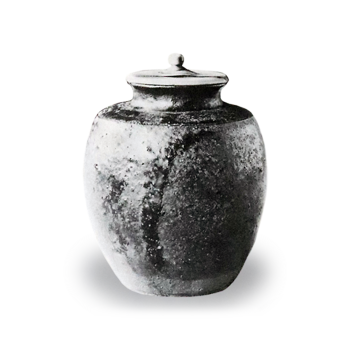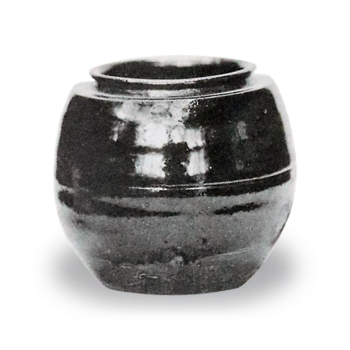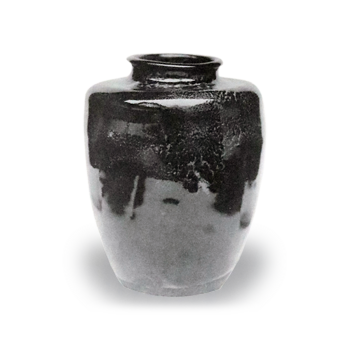
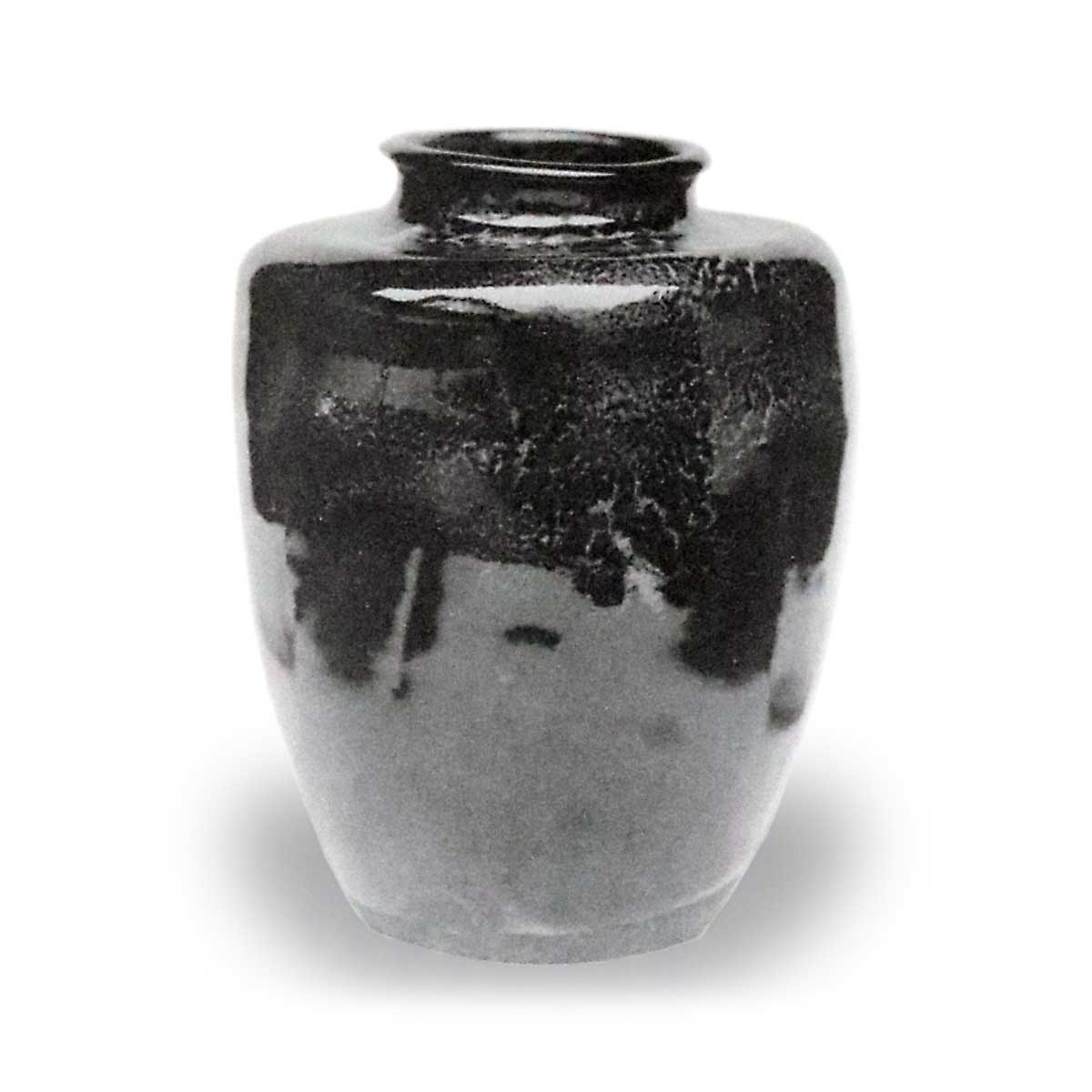
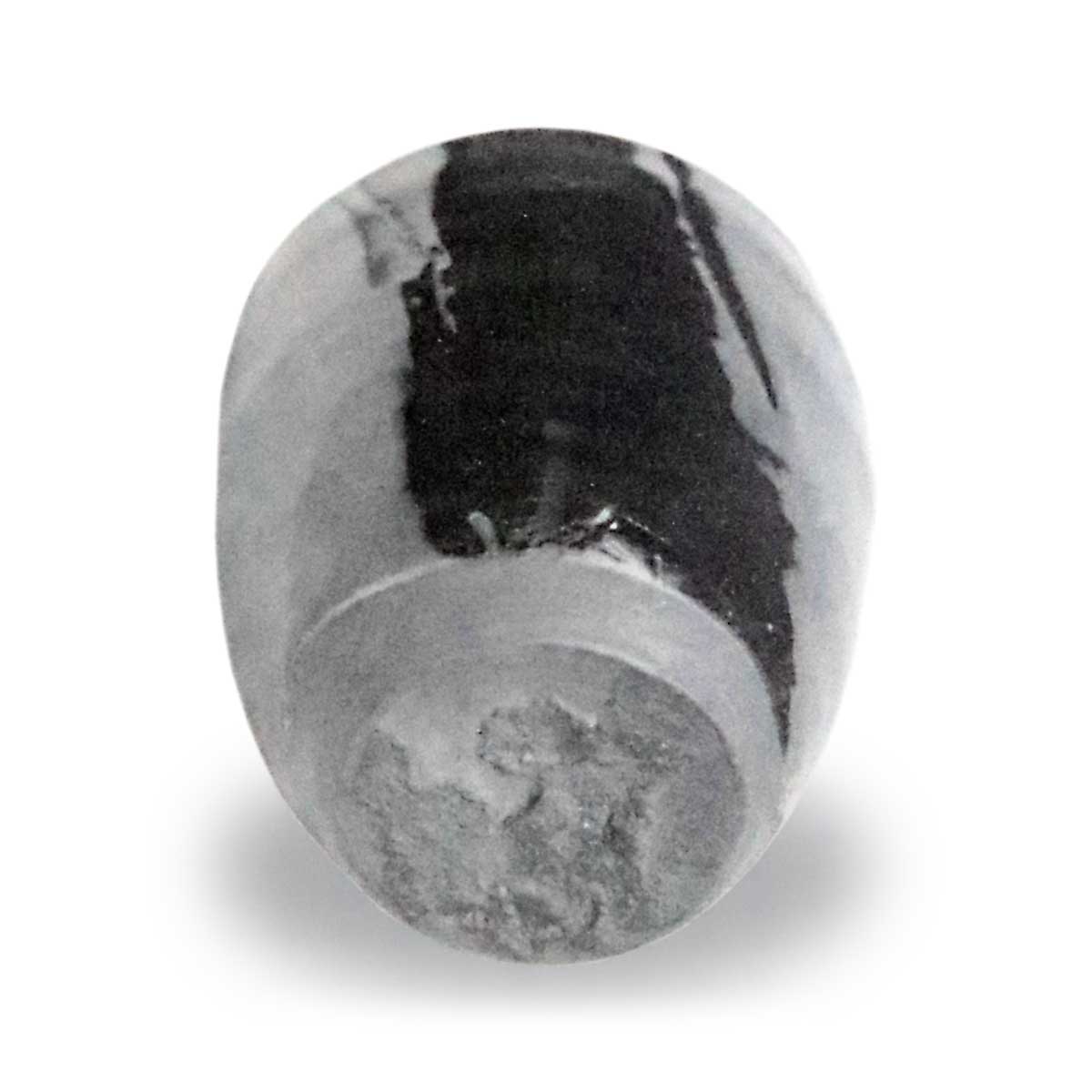
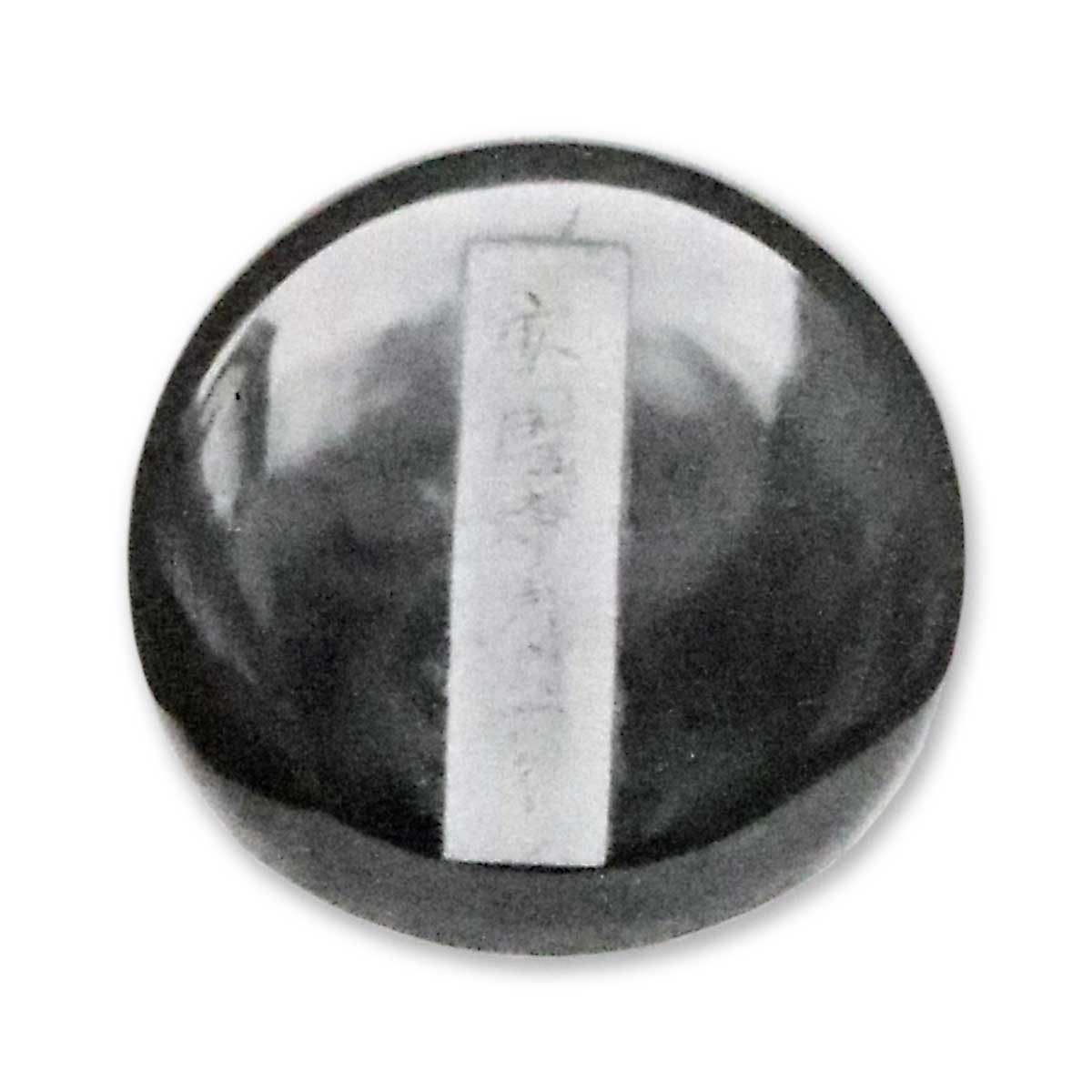
A Daimeibutsu tea caddy made in China (Han-style); also known as the “Nakayama Katatsuki.”
It is currently in the collection of Mr. Hiroshi Masuda of Tokyo.
Origin of the Name
The name “Ankokuji Katatsuki” was given because it was once owned by Ankokuji Ekei, a monk and daimyo during the Warring States period. Later, Hosokawa Sansai named it “Nakayama Katatsuki” in reference to the spirit of the waka poem “Sayano Nakayama” by the monk Saigyo. The details of this naming are recorded in his later work, “Zaki.”
Modern Equivalents of Dimensions and Weight
Height: Just over 10.9 cm (just over 3 sun 6 bu)
Body Diameter: Shoulder section approx. 8.5 cm (2 sun 8 bu), center of body approx. 7.9 cm (2 sun 6 bu)
Mouth Diameter: Approx. 4.5 cm (1 sun 5 bu)
Base Diameter: Approx. 4.7 cm (1 sun 5 bu 5 rin)
Koshiki (rim) height: approx. 0.9 cm (3 bu)
Shoulder width: approx. 1.8 cm (6 bu)
Weight: approx. 172.5 g (46 monme)
List of Accessories
There are two lids, and a su (nest) is included. The storage bag is made of light yellow Donshu (donzu) fabric with a wave-cherry blossom pattern.
There are five types of cover bags, made from Meibutsu fabrics such as Tang brocade with a Tang floral pattern, Tomita-giri, Aoki Koto, Iyo-suzuri, and Tang brocade with a pale green ground and a treasure pattern.
Hikiya is black lacquered, and a piece of paper bearing the inscription “Angokuji Katatsuki” is affixed to the lid. The Hikiya does not have a pouch; instead, it is wrapped in a double-layered purple fukusa.
Both the inner and outer boxes are made of paulownia wood with a Tame-nuri finish.
There is an “outer case” designed to hold all of these boxes and pouches.
An anecdote (miscellany) from the battlefield regarding Ieyasu and the Ankokuji Katatsuki
This is an anecdote concerning Tsuda Hidemasa (who initially went by the names Masahide and Kodairaji; After entering service, he took the name Kōan)
In the 5th year of Keichō (1600), when Tokugawa Ieyasu (Tōshōgū) headed to the Kantō region to subdue Uesugi Kagekatsu, Tsuda Hideyasu accompanied him. Upon arriving at Ōyama in Shimotsuke Province (present-day Ōyama City, Tochigi Prefecture), news arrived that “Ishida Mitsunari and others had staged a rebellion in Osaka” (the so-called Ōyama Council). Ieyasu was in a very foul mood, and the vassals waiting before him all fell silent, unable to speak.
Amid that tense atmosphere, Tsuda Hidemasa plucked up the courage to speak.
“When Your Lordship has eventually subdued the rebels, the assets of Ankokuji Ekei of the Western Army will surely be confiscated. If you would grant me just one of the ‘Katatsuki tea caddies’ among them, I would like to use it to enjoy the tea ceremony.“
Upon hearing this, Ieyasu, impressed by the spirit shown by Hidemasa—who had served him faithfully throughout these tense times—promised, ”Once we have achieved a splendid victory, I shall certainly grant your wish.”
And after achieving a great victory at the Battle of Sekigahara, Ieyasu, true to his word, bestowed upon Hidemasa the Katatsuki tea caddy that had been confiscated from Ankokuji Kei.
Hidemasa Tsuda was also granted a hanging scroll featuring calligraphy by Sōgi (Kuroki) by the second shogun, Tokugawa Hidetada (Taito-in). He passed away in Kyoto in 1635 at the age of 90 and was buried at Myōshin-ji Temple. His wife was the adopted daughter of Kazumasu Takigawa. (From Kansei Shūshū Shokafu and Tōshōgū Gijiki Furoku)
The Sale of the Tea Jar and the Origin of the Name “Nakayama”
According to sources such as the Matsuya Hoki and the Sansai Monogatari, this tea jar has an even more complex history.
“Originally, this was a katamuki-style tea jar owned by Genji (Hosokawa Yūsai), but since he did not like it, he sold it to Ankokuji Ekei for 1,000 sen. Ankokuji later presented it to Lord Ieyasu. During the Ishida Mitsunari Rebellion (the Battle of Sekigahara), Tsuda Heizaemon (Hidemasa) said to Ieyasu, ‘There is no doubt that the realm will fall into your hands. When that time comes, you will surely acquire many katatsuki tea caddies, so please allow me to receive one.’ Ieyasu was pleased to hear this. Sure enough, in the single day of the Battle of Sekigahara, as many as 16 katatsuki tea caddies were gathered for Ieyasu.
Ieyasu intended to grant Tsuda new lands, but Tsuda repeatedly pleaded, “Rather than an increase in my fief, as I stated at Aonohara (Sekigahara), I wish to receive a tea caddy.” Ieyasu replied, “That is reasonable,” and bestowed upon Tsuda the Ankokuji katamuki tea caddy that had been confiscated.
Later, Hosokawa Tadaoki (Sansai) bought this tea caddy back from Tsuda for “10,000 kan” (a colossal sum).
Hosokawa Sansai likened the return of the tea caddy, which he had once parted with, to the waka poem by the monk Saigyo: “I never thought I would cross the Sayama Mountains again in my old age; it was life itself that allowed me to do so.” He named this tea caddy “Nakayama.”
(Meaning of the waka: I never thought that, having grown old, I would cross this Nakayama of Saya once more. It is only because I was still alive that I was able to cross it again like this.)
Sansai later passed this on to his son, Hosokawa Tadatoshi (Etchū-no-kami), but Tadatoshi sold it to Sakai Miyauchi-shōsuke for 1,600 gold coins.”
The Elegant Deceptions of Tea Masters (Alternative Accounts from Chadō Kojidan and Other Sources)
On the other hand, tea texts also record a completely different, elegant anecdote.
“Tsuda Kodōji (Kōan) was a retainer of Takigawa Kazumasu. After retiring from the world, he was given a full set of tea utensils by Ieyasu and enjoyed the tea ceremony. Among those utensils was the ‘Nakayama’ tea caddy, which had been presented to Ieyasu as a relic of Yūsai.
One day, Kōan invited Hosokawa Sansai to a tea gathering. Sansai had long wished to bring this ‘Nakayama’—which had once belonged to his father (Yūsai)—back into his family’s possession, but since it was an item Kōan had received from Ieyasu, he had been unable to bring himself to ask.
As the tea gathering drew to a close, Sansai asked, “Please let me take another good look at the ‘Nakayama’.” While Koan was in the back room, Sansai quickly slipped the tea caddy into his sleeve and, leaving the others behind, said, “Please tell Koan, ‘It was a matter of life and death—the ‘Nakayama’ of Saya (I’ve had to cross over again),’” before leaving without so much as a farewell.
When Kōan emerged from the back room and heard this, he laughed heartily, saying, “I never thought I’d have to cross it again in my old age, but I’ve been outwitted!”
The next day, a vast sum of gold was delivered from Sansai. Far from being angry, Kōan expressed his deep gratitude, calling it “an amusing idea,” and used the money to build a temple in Kitano, which he designated as his family temple.”
Although the details of these anecdotes differ, they tell the story of the tea caddy’s extraordinary fate as it passed from the Hosokawa family to Ankokuji, then to Tsuda Hidemasa, and finally back to the Hosokawa family.
When Hosokawa Sansai bought this tea caddy back from Tsuda Kodairi (Hidemasa), Sansai declared, “I will spare no expense,” but Tsuda modestly replied, “I do not need that much,” and it was ultimately repurchased for “500 gold pieces.” Delighted, Sansai named it “Nakayama” and treasured it, later passing it on to his son, Hosokawa Tadatoshi (Governor of Etchu).
However, in the second year of the Kan’ei era (1625), while Hosokawa Tadatoshi was the lord of Kokura in Buzen Province (present-day Kitakyushu City, Fukuoka Prefecture) with a fief of 370,000 koku, his domain was struck by a severe drought from April to August. The peasants were struggling to find even immediate food, and had absolutely no reserves (food for the coming year) to fall back on. They appealed to the officials, saying, “If this continues, we will starve to death.”
Tadatoshi was deeply troubled by this and felt great pain in his heart. However, realizing that a small amount of aid would be far from sufficient, Tadatoshi finally made a momentous decision. He entrusted this “Nakayama Katatsuki” (also known as the “Angokuji Katatsuki”)—a world-renowned masterpiece passed down through generations from his predecessors (Yūsai and Sansai)—to one of his personal attendants, ordering him, “Take this to Kyoto and sell it. Simply pawning it to borrow money will not be enough to save the people. Sell it for as high a price as possible, and use the money to buy whatever food you can for the peasants.”
When the retainer brought this famous Meibutsu to the capital, many people expressed interest in it. However, rumors began to circulate that “since this is a Meibutsu, might it be problematic to sell it privately?” So, just to be safe, he sought permission from the Kyoto Shoshidai. The Shoshidai, Itakura Shigemune, replied, “Regardless of the history of that katatsuki, if Lord Etchū-no-kami (Tadatoshi) currently needs money and wishes to sell it, there is no problem whatsoever. “Let anyone who desires it purchase it without hesitation. However, as I have only heard of its reputation and have not yet seen the actual item, I would like to see it once the sale is finalized,” he said, granting permission.
Ultimately, through the intercession of the Senior Councilor Doi Toshikatsu, Sakai Miyauchi-no-suke (Tadakatsu) purchased it for the enormous sum of “1,800 ryō of gold (1,800 pieces).”
As soon as his personal attendants received the money, they went down to Osaka and bought up every grain they could find—rice, soybeans, wheat, millet, and other crops that would serve as food for the peasants—and sent them by ship to Kokura. Tadatoshi distributed all the grain that arrived to his subjects, and the peasants, who were exhausted from hunger, were greatly helped and spared from starvation. This story became a major topic of conversation throughout the land, and there was no one who did not praise it as “a wonderful example of what a feudal lord should be.”
The Grant of the Kumamoto Domain as a Reward for Good Deeds
Several years later, in the 8th year of the Kan’ei era (1631), Kato Higo-no-kami Tadahiro (son of Kato Kiyomasa) was found guilty of a crime, and Higo Province (Kumamoto Prefecture) was confiscated (kaei). Subsequently, a meeting was held within Edo Castle to decide on the new lord of Higo.
That evening, just after the Rōjū had returned home, another urgent order to return to the castle was issued. Shogun Tokugawa Iemitsu (Daio-in) appeared extremely displeased and angrily declared, “The matter of the ‘new lord of Higo,’ which we were supposed to discuss today and announce shortly, has for some reason already leaked to the public and become the subject of rumors.”
In response, the senior councilors Doi Toshikatsu and Ii Naotaka reported as follows:
“We believe this is a wonderful occurrence, demonstrating that the thoughts of those above (Your Excellency, the Shogun) and the wishes of those below (the common people) were entirely in harmony. Even if we were to rush to spread the news throughout Edo, it would be impossible to inform everyone within a single day. However, our retainers who went out into the streets of Edo to gather rumors reported that, whether at ‘Shiba no Tsuji’ or ‘around Ushigome,’ the townspeople were saying, ‘It seems Lord Hosokawa Etchū-no-kami has been granted Higo Province.’ Even though no one had made an official announcement, the prevailing rumor among the people was that ‘Lord Hosokawa should be granted the province.’”
Upon hearing this, Shogun Iemitsu’s mood improved, and the matter was settled peacefully.
Without anyone specifically saying so, the common people had begun to whisper that “Lord Hosokawa should rule Higo Province” because of the wonderful good deed (good karma) Tadatora had once performed: selling a treasured heirloom to save his subjects from famine. The saying, “Heaven has no mouth; it speaks through people” (Heaven does not speak directly, but conveys its will through the mouths of people), truly applies here. Thus, the Hosokawa family became the lords of the Higo Kumamoto Domain (540,000 koku).
Records of the “Ankokuji (Nakayama) Katatsuki” found in various tea books
・Kobutsuki: The Nakayama Katatsuki was owned by Sakai Miyauchi-no-shōsuke. It was previously owned by Ankokuji, and later by Hosokawa Sansai. There is a story that Sansai named it “Nakayama” based on the circumstances under which he acquired it, and that he treasured it like no other.
・Ganka Meibutsu-ki and Kokon Meibutsu Ruiju: Nakayama Tang-style Katatsuki, Daimeibutsu. Owned by Lord Sakai Miyauchi.
A Loyal Vassal’s Admonition in the Sakai Clan (Explanation based on The Seven Virtues of the Warrior Class)
This is an anecdote concerning Sakai Miyauchi-no-suke Tadayuki, the lord of the Shonai Domain (Yamagata Prefecture), who purchased this tea caddy for a high price.
Sakai Tadayuki sought to acquire this tea caddy for “a thousand pieces of gold” (an enormous sum) and intended to invite his senior retainers to the inaugural tea ceremony. Upon hearing this, his retainer, Kōriki Kihē, said, “I beg your pardon, but please exclude me from that gathering. If I were to see the tea caddy, I would surely shed tears and defile this masterpiece.” When Tadakatsu angrily demanded an explanation, Kihē offered the following stern admonition (extreme admonition):
“A treasure worth a thousand Sen is not something even a great daimyo with an income of four or fifty thousand koku should purchase lightly. Yet, my lord, you have abandoned righteousness and prioritized your own desires without regard for the hardships of your subjects and vassals. Seeing this, how could I possibly hold back my tears?”
Tadakatsu, struck to the core, flew into a rage and attempted to kill Kihei. However, the senior councilors Matsudaira Izumino-no-kami Nobutsuna and Toda Samon Ujitetsu intervened to broker a reconciliation, and Kihei was entrusted to the care of the Matsuura clan in Hirado, Hizen (Nagasaki Prefecture). (Thus, as the price for acquiring the masterpiece, he lost one of his loyal vassals.)
Presentation to the Shogunate and the Great Fire of Meireki
On March 7, 1650 (Keian 3), Sakai Tadakatsu’s son, Sakai Tadakata (Tadanao), presented this “Nakayama Tea Jar” to the shogunate along with the famous wakizashi “Kunitsugu” as part of his father’s遺品. (From the Kansei Shūshū Shokafu)
According to the Tokugawa-ke Godo Shogakuroku (Catalog of the Tokugawa Family’s Artifacts and Paintings), this tea caddy was caught in the flames during the Great Fire of Meireki (also known as the Furisode Fire) on January 19, Meireki 3 (1657), when Edo Castle was engulfed in flames, and it was subsequently restored (gosenhi). Its dimensions are 3.6 sun in height and 2.5 sun 7 rin in diameter. The body is lacquered black, and the base is raised. It is noted that there are traces of fire damage.
Summary of its History
This tea caddy was originally owned by Hosokawa Yūsai, who passed it on to Sansai; however, since Sansai did not take a liking to it, he gave it to Ankokuji Ekei. It subsequently passed to Tsuda Kodai (Hidemasa, Kōan), but Hosokawa Sansai strongly wished to reclaim it. At a tea gathering hosted by Tsuda, he remarked, “It was as if I had been given a new lease on life at Sayama’s Nakayama (to think I would encounter this tea caddy again),” and took it home. The next day, it is said that Sansai presented Tsuda with 200 gold ingots and other items, and Tsuda used that money to build a temple in Kitano, Kyoto.
Later, in the third year of the Kan’ei era (1626), when the Hosokawa family’s domain in Buzen was struck by drought and famine, Hosokawa Tadatoshi sold this tea caddy to Sakai Tadakatsu for “1,800 ryō of gold” and used the proceeds to fund relief efforts for his subjects. The public praised this noble act, and it was rumored that Tadatoshi’s subsequent appointment as lord of the Higo Kumamoto domain was a reward for this benevolent governance.
It was presented to the shogunate by the Sakai family in the first year of Keian (1648; the reference to the third year of Keian in the text is likely a typographical error), but when the shogunate’s treasure house was destroyed in the Great Fire of Meireki in the third year of Meireki, it miraculously survived the blaze without losing its original form. It was subsequently passed down to Matsudaira Iga-no-kami, lord of Ueda Castle in Shinano Province, and in 1913 (Taisho 2), at an auction held by the Matsudaira family, it was purchased by Masuda Kōen (younger brother of Eisaku and Don’ō), a businessman and prominent tea master.
On February 1, 1919 (Taisho 8), this tea caddy was unveiled at the “Kuro Asahi-an Tenpyo Tea Ceremony” hosted by Masuda Kōen, where he invited renowned tea masters and connoisseurs such as Takahashi Hōan and Nezu Kaichirō as guests.
The story of Masuda Kōen’s “discovery”
At the Tenpyo Tea Gathering in 1919, this “Angokuji Katatsuki” was used alongside a Sahari-style water jar and a National Treasure-class “Taihisan” Tenmoku tea bowl.
This Ankokuji Katatsuki is a renowned Daimeibutsu that the abbot (Masuda Kōen) “unearthed” at an auction held in 1913 (Taisho 2) by Viscount Matsudaira Nobumasa (former lord of the Ueda domain) for the exceptionally low price of “800 yen.” A strip of paper was affixed to the black-lacquered Hikiya box, bearing the inscription “Ankokuji Katatsuki”—though the author’s identity remains unknown—and a similar piece of paper was simply pasted onto the outer box, which featured a “tame-nuri” finish. It was offered for sale in a virtually bare state, lacking any protective cover or certificate of provenance.
Consequently, while everyone recognized it as a Chinese-made tea caddy with an interesting design, no one was able to discern (or identify) that this was the world-renowned Daimeibutsu known as the “Angokuji Katatsuki.”
It is said that Mr. Masuda himself actually bid on it with some hesitation (half-believing, half-doubting), but he was lucky enough to win the auction by a narrow margin of just seven or eight yen.
Even more strangely, it was later discovered that the bags accompanying three other tea caddies subsequently offered by the Sakai family were actually the original bags that had once been hung on this Ankokuji Katatsuki. As if guided by a deep karmic connection from the past, those bags are now also in Mr. Masuda’s possession, and the set has been reunited as accessories for this tea caddy. (From Toto Chakai-ki, Volume 7, Part 1: Tenpyo Chakai)
Academic Field Report (Appraisal Record) from the Taisho Era
On April 20, 1920 (Taisho 9), this tea caddy was physically examined at the residence of Mr. Eisaku Masuda in Shimomeguro, Tokyo Prefecture.
The twist at the rim is standard, but the rounded rim is slightly warped on one side. The area around the koshiki (flange) is slightly sunken, and the shoulder tips are slightly chamfered. The shoulders are wide, and the body tapers gradually from the middle downwards. The wheel marks on the body are shallow and irregular.
The luster of the dark amber glaze is exceptionally beautiful. From the rim of the neck to the shoulder tip, and extending down to about halfway along the body, white or grayish “snake-and-scorpion” mottling appears. This mottling—sometimes coarse, sometimes fine, or drifting across the black glaze like cumulus clouds or bubbles floating on water—creates an indescribably magnificent pattern.
There is a repair mark (a patch) on the rim where a somewhat large chip was once present. From the shoulder to the waist, there are two long, diagonal “glaze breaks” (areas where the glaze has not adhered), and slightly away from these, in the center of the body, there is another glaze break approximately 2 cm (about 7 mm) in length.
From the lower rim downward, the iron-rich, rust-colored clay (body) is visible; the base is made with a slab-built construction and is covered entirely with kiln marks (traces of where it adhered to other tools inside the kiln).
Inside, the glaze covers the rim of the spout, and a glaze flow approximately 2 cm (about 6–7 mm) wide extends all the way to the edge of the base.
The luster of the black glaze is magnificent overall, and in particular, these “grayish-white mottled patterns” are an extremely rare and beautiful feature almost unseen in other Chinese-made (Han-style) tea caddies.