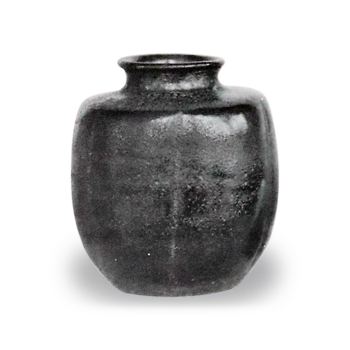
Chinese-made (Tang-style) tall-bodied tea caddy; currently in the collection of Mr. Hiroshi Masuda of Tokyo.
Origin of the Name
This tea caddy was named “Sakai Katatsuki” because it was once owned by Sakai Tadakatsu (pen name: Kuin), a daimyo who served as a senior councilor (Rōjū), and was an ancestor of Count Sakai Tadamichi, the former lord of the Obama Domain in Wakasa Province.
Modern Equivalents of Dimensions and Weight
Height: Approx. 8.9 cm (2 sun 9 bu 5 rin)
Body Diameter: Approx. 8.9 cm at the center (2 sun 9 bu 4 rin)
Mouth Diameter: Approx. 6.1 cm (2 sun)
Base Diameter: Approx. 3.9 cm (1 sun 3 bu)
Koshiki Height: Approx. 0.8 cm (2 bu 5 rin or 2 bu 3 rin)
Shoulder width: approx. 0.8 cm (2 bu 5 rin)
Weight: approx. 171 g (45 monme 6 bu)
List of Accessories
There is one lid, which has a recess (kago). The storage pouch is made of purple chirimen (crepe silk) with a brown cord.
There are three types of protective covers (pouches): “Rikyu Koto,” “Daito-giri,” and “Cha-ji Karakusa-hōzukushi Junko.”
The untreated paulownia wood box containing these bags bears an inscription by Kobori Enshu that reads, “Tang-style Large Katatsuki, Bags.” A certificate by the calligraphy appraiser Kobori Ryoban is affixed to the inside of the box lid, stating, “The inscription ‘Tang-style Large Katatsuki’ on the box by Kobori Enshu is undoubtedly in his own hand.”
The inner case is made using a lacquer technique called Zonsei, featuring yellow and red cloud patterns with a black interior. The pouch is made of brown leather.
The inner box is black lacquered, with the characters “Ōkatatsuki” written in gold powder in Kobori Enshū’s hand. Affixed to the underside of its lid is a paper note recording the tea caddy’s dimensions and weight (46 sen).
The outer box is made of untreated paulownia wood. The front is inscribed with “Tang: Sakai Ōkatatsuki,” while the back records its provenance: “Owned by Sakai Kūin (Tadakatsu); the inventory of accessories was compiled by Kobori Enshū (Enshū), and it was passed down from Sakai Enshū (Tadakatsu).”
Records of the “Sakai (Ō) Katatsuki” found in various tea books
・Chaki Benran: Among tea caddies of the “dōtaka” style are the Kishū family’s Herame Katatsuki, the Sendai family’s Higuchi Katatsuki, and this Sakai Katatsuki. All of these feature vertical grooves carved with a spatula around the body, along with slight warping; the areas between these grooves are slightly bulged and raised, hence the name “dōtaka.”
・Sekishū-ryū Kagenroku: “A large Chinese-style katatsuki. Owned by Sakai Kūin (Tadakatsu).” This is a record of an inspection of a tea caddy delivered by Tetsuya Jirōbei in November of Kyōhō 12 (1727). The dimensions and weight (46 monme) are recorded in detail. The clay is a grayish-brown, darker than usual, and is covered with a light yellow water glaze (thin glaze) or a very pale yellow water glaze over the base glaze. The bottom has been raised with a spatula, and amber-colored glaze spatters are visible around the edges. There is also a hint of amber at the rim, and the body features a horizontal band (stripe) along with five vertical stripes (spatula marks).
Its History and the Glamorous Tea Ceremonies of the Taisho Era
It was originally owned by the Sakai family of Wakasa (Fukui Prefecture), but later passed to Aochi Tankei (Kijiro), a wealthy merchant (satsushi) in Asakusa, Edo. In 1920 (Taisho 9), when the Aochi family’s tea utensils were auctioned off, Masuda Kōen (the younger brother of Eisaku Masuda, a businessman) won the bid.
Shortly thereafter, on April 18, 1920, at a grand tea gathering (Daishi-kai) held at the residence of Takao Masuda in Shinagawa, Masuda Kōen displayed this tea caddy, and it shone with a special radiance.
The display, set up in the eight-mat room at the rear of the Ōkyōkan, featured a hanging scroll by Fujiwara no Nobuzane depicting the Thirty-Six Immortal Poets (Sakanoue no Korenori) in the tokonoma; a vase known as the “Iga Mimi-tsuke Hana-ire,” reputed to be the finest in the land, arranged with wild roses; and an antique maki-e inkstone box placed beside it. On the biwa shelf, this “Sakai Ōkatatsuki” tea caddy and its Tomita-ori cover were placed atop a round tsuisu tray, while a National Treasure-class “Taihisan Tenmoku tea bowl” was displayed alongside it on a Chinese-style tenmoku stand.
This magnificent display was a once-in-a-lifetime showcase for Masuda Kōen, and it was truly a sight to behold. (From Taishō Kōshin Chadōki)
Academic Field Notes (Appraisal Record) from the Taisho Era
On April 20, 1920 (two days after the tea gathering mentioned above), I conducted an on-site examination of this tea caddy at the residence of Mr. Eisaku Masuda (Kōen) in Shimomeguro, Tokyo.
The rim is deeply flared, and the area around the koshiki (rim) is slightly recessed. From the shoulder, the body bulges out prominently, then tapers sharply toward the base. The horizontal groove running down the center of the body is interrupted in one place.
From the shoulder to the rim, six deep vertical spatula marks (tate-bō-suji) run at nearly equal intervals, rising slightly diagonally to create a natural shape resembling an “akoda” (a type of gourd similar to a pumpkin). The clay is visible below the rim, with variations in height depending on how the glaze has settled.
Overall, light yellow and off-white glazes are applied thickly or thinly over the amber-colored glaze, creating a very interesting pattern. A glaze with a slight persimmon hue flows down from the horizontal lines on the body, with one of these streaks reaching all the way to the base where the clay is exposed.
The base is made of iron-rich, reddish-brown clay and features a flat-bottomed construction. The piece is completely free of flaws (flawless), and the hue of its pale yellow glaze bears a slight resemblance to the glaze of the renowned “Nitta Katatsuki.”
Inside, the glaze covers the rim of the mouth, while below that, fine wheel marks spiral around, and the center of the base forms a swirl pattern.
At first glance, it is a magnificent tea caddy with a dignified, imposing presence and a very rich appearance.