
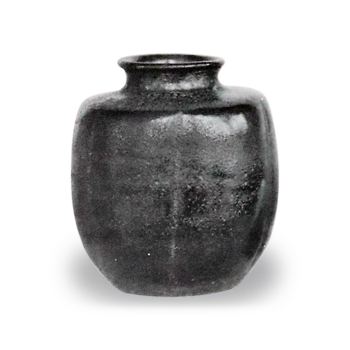
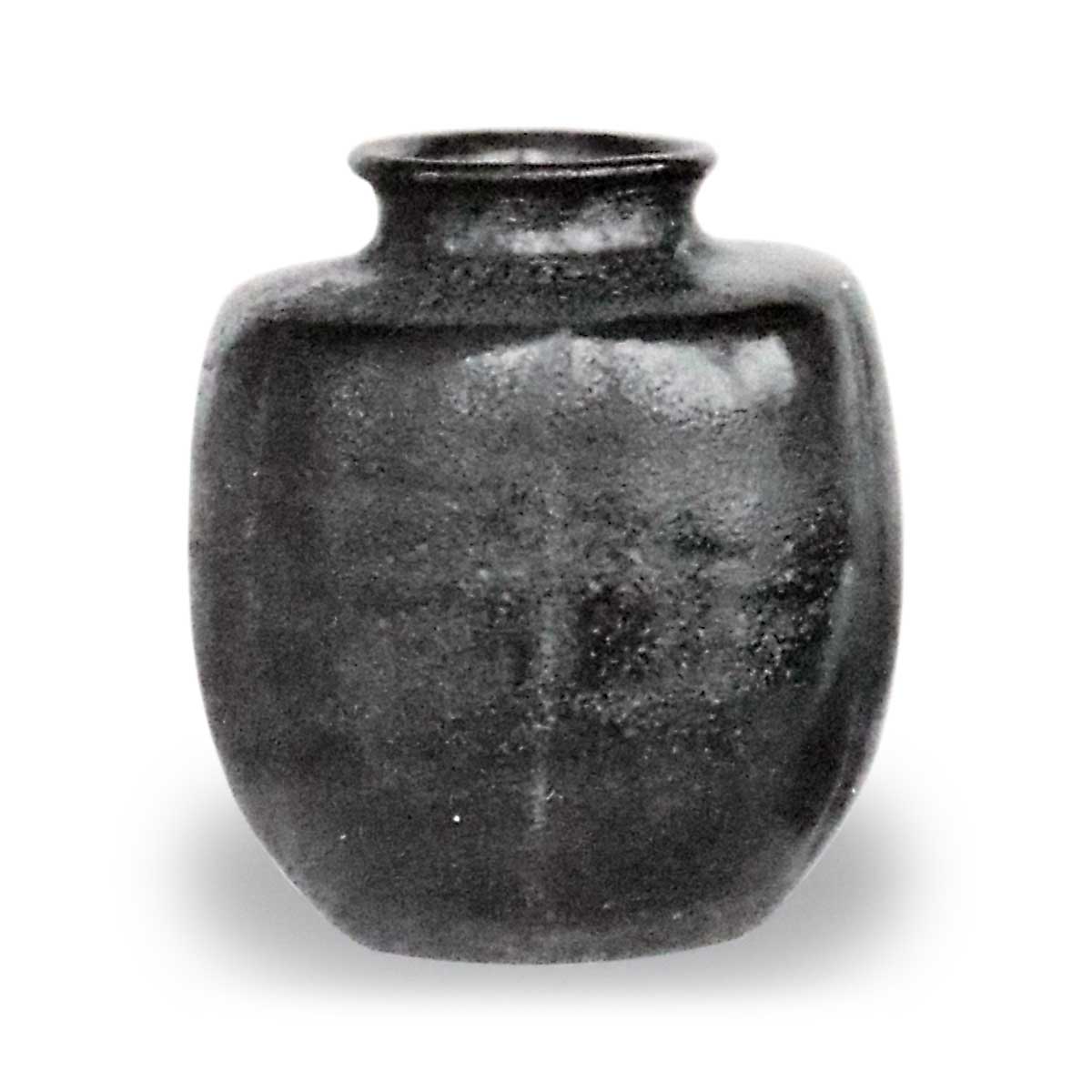


A renowned tea caddy made in China (Han-saku), currently in the collection of Duke Tadashige Shimazu.
Origin of the Name
During the Azuchi-Momoyama period (around the Tenshō era), it was owned by Hirano Dōze, a wealthy merchant and tea master from Sakai, which is why it was named “Hirano Katatsuki.”
Modern Equivalents of Dimensions and Weight
Height: Approx. 8.5 cm (2 sun 8 bu)
Body Diameter: Approx. 7.8 cm (2 sun 5 bu 6 rin)
Mouth Diameter: Approx. 3.9 cm (1 sun 3 bu)
Base Diameter: Approx. 4.8 cm (1 sun 6 bu)
Koshiki (Rim) Height: Approx. 1.1 cm (3 bu 5 rin or 4 bu)
Shoulder width: approx. 1.5 cm (5 bu)
Weight: approx. 120 g (32 monme)
List of Accessories
There is one lid, which has a recess (kō), but shows signs of fire damage. The storage pouch is made of white ha-niji fabric with a white cord.
The protective cover (bag) is by “Unkaku Junko.”
The carrying case is black lacquered, and the bag for storing it is made of Satsuma Koto fabric.
The inner box is tume-nuri lacquered with chamfered edges and features gold-leaf lettering. The outer box is black lacquered with gold-leaf lettering.
Records from Tea Ceremony Accounts of the Azuchi-Momoyama Period
According to the Matsuya Diary, on the morning of May 10, Tenshō 7 (1579), this katatsuki tea caddy was displayed beside a hanging scroll (painting) at a tea gathering hosted by Hirano Dōsei.
According to Tsuda Sōyuki’s Chadō Nikki, on May 23, 1581 (Tenshō 9), a tea gathering hosted by Hirano Dōji (known as the “Katatsuki no Hiraki”—a tea gathering to unveil this katatsuki tea caddy) was held. It was displayed on a shihō-bon tray in the tokonoma, and during the break (for hand-washing), the bag was removed and the tea caddy was set down. Later, it was placed on a tenmoku stand, and while the guests were admiring the tea caddy after the tea ceremony had ended, a painting of irises was brought out and hung before the guests. This katatsuki tea caddy was brought up to the tokonoma by a guest named Miyahō (from the Imperial Household). For the thin tea, a doll-shaped tea bowl owned by Dōchin was used.
On the morning of October 11, Tenshō 9 (1581), Sōnō and Tsuda Sōyuki were invited to a tea gathering hosted by Dōsei. In the tokonoma, there was a katatsuki tea caddy placed on a shihō-bon tray, enclosed in a golden brocade bag the color of tokusā grass. Sōyuki prepared the thick tea (kocha) and asked Dōsei to have it placed in the tokonoma. Sōyuki examined this katatsuki closely on numerous occasions and recorded his detailed impressions, noting, “I could discern the quality of the clay better than when I saw it before. The glaze is somewhat hard, and there are marks as if it had been packed on both sides.”
Records in Various Tea Books
The Higashiyama Imperial Treasures Sub-Register contains an entry regarding the Hirano Katatsuki stating, “It should be verified that it was indeed Hirano’s possession.”
The Komeibuki, Gankabimeibuki, and Kokin Meibutsu Ruiju all record it as the “Hirano Katatsuki,” describing it as a renowned Chinese artifact owned by Matsudaira Satsuma-no-kami (of the Shimazu clan).
According to the Tobu Jitsuroku, on April 18, 1630 (Kan’ei 7), this Hirano Katatsuki was used when the third shogun, Tokugawa Iemitsu, visited the residence of Shimazu Iehisa (Chūnagon of Satsuma, Governor of Ōsumi). The bag used was a “kantō” bag made from a scrap of the noren curtain of Lord Higashiyama (Ashikaga Yoshimasa).
Destruction by Fire and Miraculous Restoration
The Minami-Aoi Bunko Hon Sanban Danwa records the dramatic rescue of this tea caddy when it was caught in a fire.
A few years ago (in the 7th year of Kan’ei), when the Shimazu family’s Sakurada residence was engulfed in flames, this tea caddy also fell into the fire. At that time, someone present asked the tea ceremony priest, “Where do you usually keep it?” and identified the location. They immediately cleared away the ashes from that spot, built a barrier around it, and after waiting for the ashes to cool, filled a large basin with water and used a sieve to sift the ashes out of the water.
As a result, they were able to recover every single fragment, down to the smallest pieces. This was a very clever method. At that time, there was a skilled samurai among the retinue who pieced all the fragments together and restored the teapot. Consequently, it is said that the original glaze color remains in only one spot, while the majority of the rest has taken on the color of lacquer.
Additionally, a red-inked postscript records the history of its transmission. In the 4th year of Bunroku (1595), during the Japanese invasion of Korea (the Bunroku Campaign), a red-sealed document granting land to Shimazu Yoshihiro and an inventory were delivered to Yoshihiro at his camp in Korea. It is recorded that when Yoshihiro temporarily returned to Japan and arrived in Fushimi, he received the red-sealed document and inventory directly from Toyotomi Hideyoshi; at that time, he was also presented with the “Koizumi Goi (tea caddy)” and this “Hirano Katatsuki,” after which he set sail for Korea once more.
The characteristics of the tea caddy, such as its dimensions and the fact that it has “six hiyau (gourd-shaped indentations, or perhaps cracks),” and “the glaze has a bluish tint.”
Summary of its History
During the Tenshō era, it was owned by Hirano Dōsei, but later became a treasure of Toyotomi Hideyoshi. In Bunroku 4 (1595), Hideyoshi commended Shimazu Yoshihiro’s military achievements and bestowed this tea caddy and the Koizumi-i (tea caddy) upon him in Fushimi.
On April 18, 1630 (Kan’ei 7), when Shogun Tokugawa Iemitsu visited the residence of Shimazu Iehisa, he was entertained with this tea caddy; however, later that same year, the Shimazu clan’s residence in Sakurada was destroyed by fire, and this tea caddy was also lost in the flames. Nevertheless, the fragments were sifted from the ashes and gathered, and the majority was repaired using lacquer, allowing it to be passed down to the Shimazu family to this day.
Academic Inspection Record (Appraisal Record) from the Taisho Era
On September 20, 1921 (Taisho 10), this tea caddy was physically examined at the residence of Duke Shimazu Tadashige in Osaki, Tokyo.
The rim is thin, and the flared edge is deep. The body tapers slightly in the middle and has broad shoulders. The body features six vertical brush marks (tate-hō) spaced at regular intervals. The brown clay (unglazed body) is visible from the rim downward, and the base is raised, with a slight depression in the center.
The entire piece is covered in a dark amber glaze, though parts of it have become pitted and lost their luster (glaze cracking). Because the piece was cracked in the fire of 1630 and extensively repaired using lacquer, there are many areas where the original glaze color has been lost.
Inside, the glaze covers the rim, while below that, coarse wheel marks are visible, and the center of the base is slightly raised.
The dark amber glaze on the exterior features spots of reddish-brown glaze. One can only imagine what an intriguing pattern it must have had before the fire, but due to the extensive use of lacquer in the restoration, it is impossible to know exactly how much it has changed from its original state.
The fact that it feels very light in the hand compared to its size is likely because the ceramic fragments were joined together with a large amount of lacquer.

