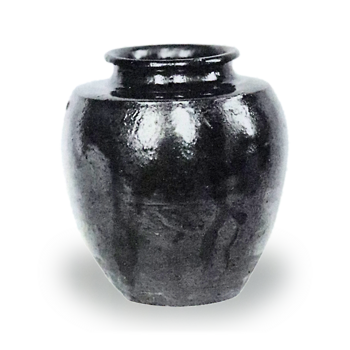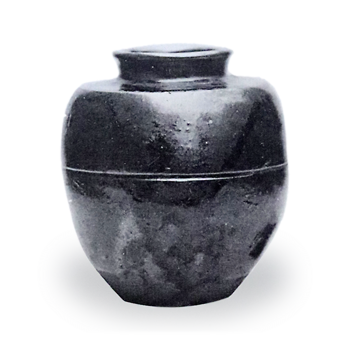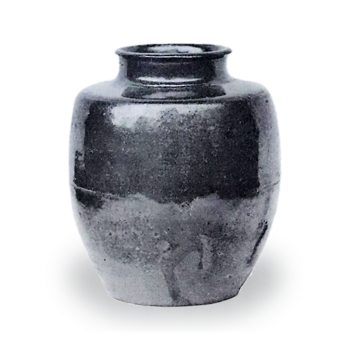
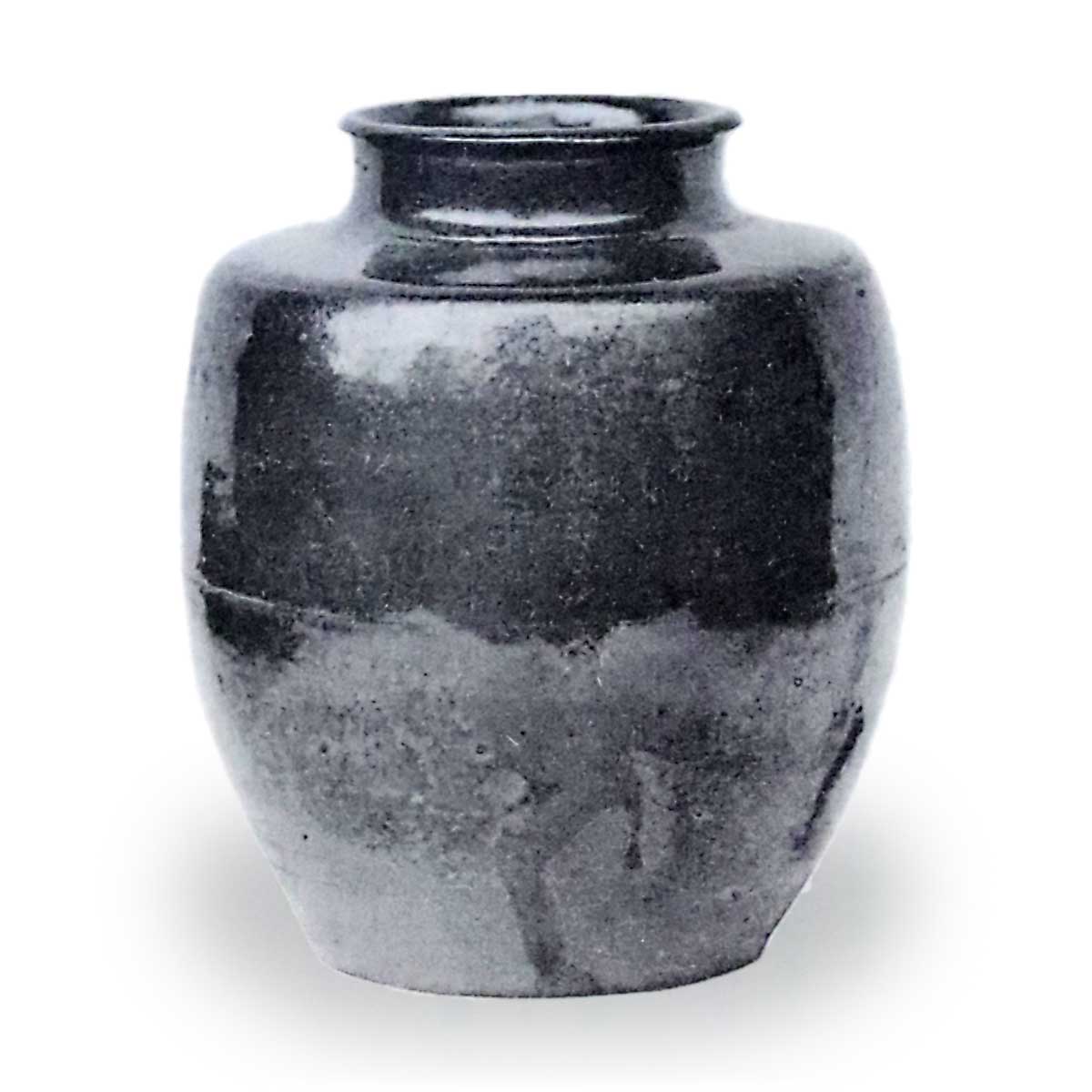
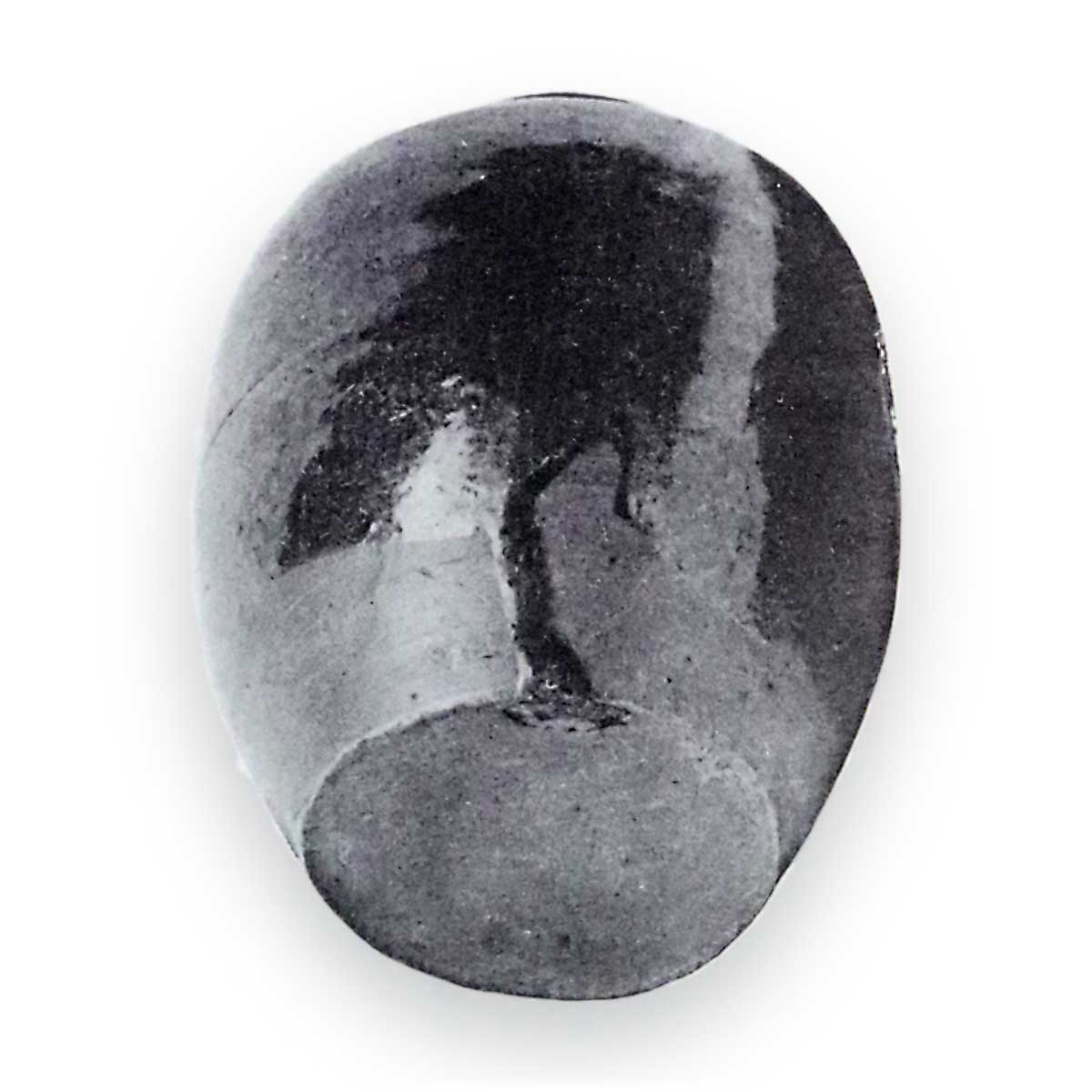
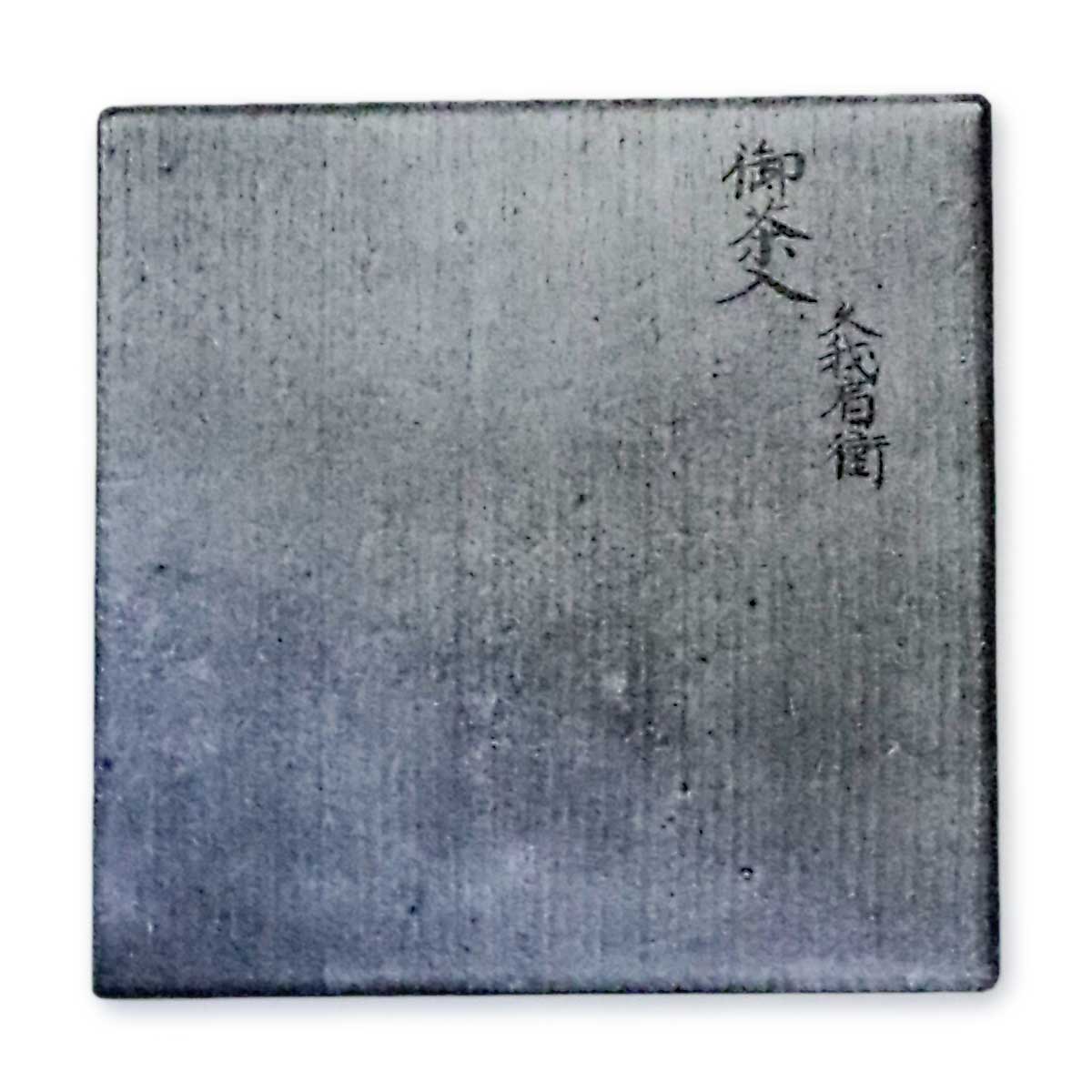
Made in China; Daimeibutsu (highest-grade tea utensils); Collection of Baron Atsushi Matsuura
Origin of the Name
Zen Master Dogen (son of Kuga Dainagon Michichika), the founder of Eiheiji, the head temple of the Soto Zen school, traveled to China (Song Dynasty) accompanied by Kato Shirozaemon Kagemasa (Toshiro), considered the founder of Japanese pottery. Upon returning to Japan in 1227 (the first year of the Ansei era), he brought this tea caddy back with him. It is said that he presented it to his family home, the residence of the Kuga Daikan, which is why it was named “Kuga.”
Dimensions
Height: Approx. 8.5 cm (2 sun 8 bu)
Body diameter: Approx. 7.5 cm at the widest point (2 sun 4 bu 7 rin)
Mouth diameter: approx. 4.1 cm (1 sun 3 bu 6 rin)
Base diameter: approx. 4.7 cm (1 sun 5 bu 5 rin)
Neck (kama) height: approx. 1 cm (3 bu 2 rin)
Shoulder width: approx. 1.4 cm (4 bu 5 rin)
Weight: approx. 133.5 g (35 monme 6 bu)
Accessories
・Lid: 1 (made of ivory)
・Storage pouch (for safe keeping): Purple habutae (smooth silk fabric)
・Shifuku (pouches for storing the tea caddy): 4
(Each is made from a different type of Meibutsu fabric—“Sasamatsu Donshu,” “Taishi Koto,” “Hino Koto,” and “Shimotsuma Donshu”—and the colors of the tying cords vary)
・Boxes for the pouches: 2 (one old paulownia box and one new paulownia box)
・Hikiya (wooden tube for storing the tea caddy): Lacquered black; a piece of paper bearing the character “Kuga” is affixed to the underside of the lid. Comes in a white habutae silk pouch.
・Inner box: Unfinished paulownia box (the writer is unknown, but it is inscribed with “Ocha-ire Kuga Katatsuki”)
・Outer box: Unvarnished paulownia box (author unknown, but inscribed with “Ocha-ire Kuga”)
・Master box: A box made of cedar with an iron lock
Miscellaneous Notes (Historical Records)
The Kuga Katatsuki passed from Hariya Shōchin in Kyoto to Oda Nobunaga, and later to the Owari Tokugawa family.
(From Meibutsu-chō and Onamebutsu Odoguki)
Descriptions of the “Kuga Katatsuki” in Historical Documents
・“The Kuga Katatsuki is in the possession of the Owari Chūnagon (the Owari Tokugawa family).” (From the Higashiyama Omonochi Bettei)
・“The Kuga Katatsuki is located in Bungo, Kyushu.” (From the Yamagami Sōji Ki)
・“The Kuga Katatsuki is in the possession of Sōetsu (Sōkō) of Bungo. It is approximately 8.6 cm tall, slightly over 7.3 cm wide, with a mouth diameter of about 4.5 cm, a neck height of about 0.9 cm, and a base diameter of about 4.5 cm.” (From Daimyō Chairi Gokihiden Shōzushiki)
・“Kuga is in the possession of the Lord of Owari.” (From Kokin Meibutsu Ruiju and Komeibutsu Ki)
・“Kuga is a Daimeibutsu made in China. It was once owned by the Lord of Owari, but is now in the possession of the Lord of Koshu (Yanagisawa Yoshiyasu). It is a magnificent piece produced by the Nabeya workshop.” (From Rinpō Kiryū)
・“Kuga is of Chinese origin. It dates from the same era as such Meibutsu tea caddies as Zangetsu, Kokushi Nasu, Kitano Katatsuki, and Matsuyama, and the application of the glaze and the craftsmanship are the same as those of Kitano Katatsuki and Matsuyama.” (From Seto Tōki Ranshō by Matsudaira Fumai, Lord of the Matsue Domain)
・“Kuga was owned by Sōkō of Bungo. There are detailed records regarding its size; the glaze on the lower part is a pale persimmon color, while the upper part features colors resembling ointment or brown, and patterns resembling snake scales (jasetsu) can also be seen. The clay is a pale vermilion color with a fine grain.” (From Manpō Zenshū)
・”On the afternoon of September 4, Eiroku 11 (1568), I saw a Kuga katatsuki for the first time at the home of Sōzuhikoemon. The shape was excellent, though it felt slightly smaller compared to the Kitano Katatsuki. The glaze was black, applied thinly even over the parts where the clay was visible. There was a single streak of glaze drips (tsuyu) that extended all the way to the base. Glaze was also applied to the inside of the pot; the rim felt thin, and the shoulder had a slightly sloping profile.” (From Tsuda Sōyuki’s Tea Ceremony Diary)
・“Record of a tea ceremony held on June 11, 1628 (Kan’ei 5), when Tokugawa Hidetada (former Shogun) visited the residence of the Owari Tokugawa family. The hanging scroll featured calligraphy by En’go Katsutoki, the flower vase was ‘Kine no Ore,’ and the tea caddy used was ‘Kuga.’” (From Tobu Jitsuroku)
・“On April 28, Genroku 6 (1693), at a gathering where the Owari Daikan presented items bestowed upon him by the Shogunate, the ‘Kuga Katatsuki’ is recorded alongside a Masamune sword and a calligraphic work by Enko.” (From Shoke Imon Tokumono Kensho Ki)
・“On March 11, Genroku 10 (1697), when the 5th Shogun Tokugawa Tsunayoshi visited the residence of Yanagisawa Yoshiyasu, he was presented with a sword by Norishige and the ‘Kuga Katatsuki.’” (From the Yanagisawa Documents)
・”The ‘Kuga Katatsuki’ is a tea utensil of the highest grade (a Daimeibutsu). It is said that Zen Master Dogen brought it back with him upon his return to Japan and presented it to the Kuga family. It later became a treasure of the Toyotomi family at Osaka Castle, but after the fall of Osaka, it passed to the Owari Tokugawa family, and from there was presented to the Shogunate. It was subsequently bestowed by the Shogun upon Yanagisawa Yoshiyasu and passed down through the generations, but around the time of the Meiji Restoration, it passed into the hands of a wealthy merchant in Fushimi. After passing through the hands of a samurai family in Obama, it was finally acquired by the Matsuura family through the mediation of Hashimoto Hōkaku. It is a historically significant piece that also appears in Tsuda Sōyuki’s diary.” (From the Matsuura Family Inventory)
Record of a Tea Ceremony (Meiji 34)
At noon on May 26, Meiji 34 (1901), at Shingetsuan (a three-mat room).
Host: Count Akira Matsuura
Guests: Susumu Sato, Kyohei Umakoshi, Kosetsu Maeda, Seihaku Osumi, Makkei Yamamoto
・Hanging scroll in the tokonoma: “Kan’ō on Horseback” by Ryōkai (with a colophon by Issan Inei)
・Tea caddy: Kuga Katatsuki (placed on a Wakasa tray and set before the hanging scroll)
Inscription on the tray box: by Kanamori Sōwa
Cover (bag): Taishi Kōtō
The Kuga Katatsuki is a tea caddy of the highest grade (a “Daimeibutsu”). It passed from Osaka Castle to the Owari Tokugawa family, was then presented to the shogunate, and during the Genroku era, was gifted by the 5th Shogun, Tokugawa Tsunayoshi, to Yanagisawa Yoshiyasu. According to the Yamagami Sōji Ki, it is recorded that for a time it was in Bungo, Kyushu (Oita Prefecture), and it is believed that the figure Sōzaburō, who appears in the Tsuda Sōyuki Nikki, was a native of Bungo. It is presumed that it was subsequently presented to Toyotomi Hideyoshi (His Highness the Taiko). Furthermore, in a record of Meibutsu from the Manji era, it is written that “the Lord of Owari possesses it,” and later, the phrase “bestowed upon Yanagisawa Yoshiyasu” was added in vermilion ink.
Incidentally, since this tea caddy was brought back by Zen Master Dōgen upon his return from China (Song Dynasty) in August of the first year of the Ansei era (1227), it is clear that it was a vessel crafted by Tōshirō, the founder of the Tō family, during his stay in China. Furthermore, since Zen Master Dōgen was a member of the Kuga family who entered the Buddhist priesthood, he likely named the vessel after his family’s name. (From Yamamoto Bakei’s Notes)
Summary of its History
Zen Master Dōgen brought it back from China and presented it to his family, the Kuga Daikan family. It subsequently passed through the hands of Sōzō Hikoemon, Hariya Shōchin of Kyoto, and Oda Nobunaga, before reaching Sōkō of Bungo, who then presented it to Toyotomi Hideyoshi. After the fall of Osaka Castle, it became the property of the Owari Tokugawa family, and on April 28, 1693 (Genroku 6), it was presented to the shogunate by the Owari Daikan. Then, on March 11, 1697 (Genroku 10), Shogun Tokugawa Tsunayoshi bestowed it upon Yanagisawa Yoshiyasu, and it remained in the Yanagisawa family for a long time thereafter. However, around the time of the Meiji Restoration, it passed into the hands of a wealthy merchant in Fushimi, then through a samurai family in Obama, and finally, through the mediation of Hashimoto Hōkaku, it became part of the Matsuura family’s collection.
Record of Actual Viewing
On October 21, 1919, I had the opportunity to view this piece in person at the residence of Count Atsushi Matsuura in Mukoyanagihara-cho, Asakusa Ward, Tokyo.
The rim is shallowly flared, and within the amber-colored glaze covering the entire vessel, small yellow dots are scattered like stars. Glaze of the same color flows down from two points (one from the shoulder and the other from the middle of the body), merging halfway to form a single line that extends all the way to the rim of the base. In the area where the glaze has pooled at the base, a faint blue-green hue is visible.
A recessed groove runs all the way around the body, though it is interrupted in some places. The lower section (below the rim) is unglazed, revealing the grayish-brown clay body. The foot ring is worn down, and the traces of handling and wear visible throughout the tea jar naturally speak to its age and the passage of time.
The interior of the rim and the entire surface of the neck (koshiki) are also glazed, with some areas where a single streak of glaze has cascaded down to the base.
The underside of the base is also partially glazed, and in some places, the glaze has become cracked and flaky.
The shape and glaze color are so elegant and beautiful that one can truly sense this is the very tea caddy that Zen Master Dōgen, together with the potter Tōshirō, selected from among the many tea caddies in China and brought back. I consider it a magnificent masterpiece, ranking among the very best of Chinese-made tea caddies (Han-saku chain).