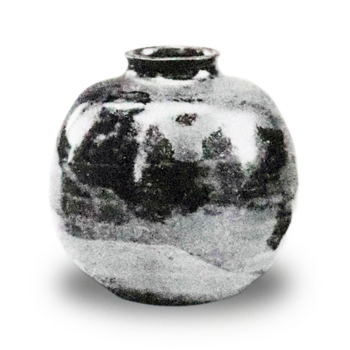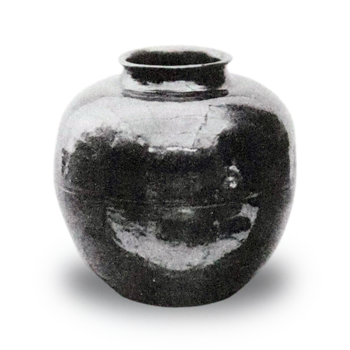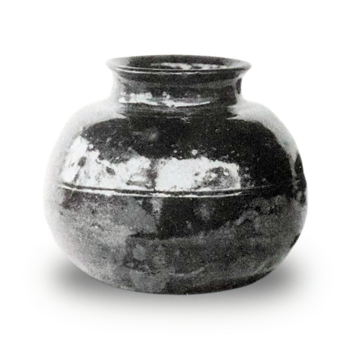


Made in China; Daimeibutsu; Collection of Count Tadamichi Sakai
Origin of the Name
It is now impossible to determine with certainty whether this piece was owned by someone with the surname “Hamuro,” or whether “Hamuro” is a phonetic transcription of “Hamuro,” and it was actually owned by the Hamuro Dainagon family.
Dimensions (converted using 1 sun ≈ 3.03 cm and 1 monme ≈ 3.75 g)
Height: Approx. 6.36 cm (2 sun 1 bu)
Body diameter: Approx. 7.51 cm (2 sun 4 bu 8 rin)
Mouth diameter: Approx. 4.24 cm (1 sun 4 bu)
Base diameter: approx. 3.64 cm (1 sun 2 bu)
Height of the koshiki (steamer): approx. 1.06 cm (3 bu 5 rin)
Weight: approx. 75.0 g (20 monme)
Accessories
・Lids: 3 (with indentations)
・Lid box: Made of untreated paulownia wood, with an inscription by Kobori Enshū (Sōfu)
“Hamuro Lid”
・Imperial Pouch (bag for holding the tea caddy): Round brown silk pouch with a brown cord
・Covering Pouches: 4
Satin with a bamboo vine pattern (lining: woven-colored “Umi-ki,” cord: light brown)
Indigo-ground Aoki Kanto weave (lining: dark pale yellow “Umi-ki,” cord: light purple) A truly one-of-a-kind item
Utsubaya satin (lined with dark pale yellow “Umi-ke,” purple cord)
Navy-blue ground with sword-tip dragon motif in Kinran (lined with iron-colored “Umi-ke,” purple cord)
・Storage box: Made of paulownia wood with karin wood lacquer finish; bears an inscription by Kobori Enshū
“Hamuro, Replacement Bag, Paulownia”
・Hikiya (a tube for storing the tea caddy): Made of tagayasan wood, with characters in gold powder
“Karin” on the lid, with an inscription by Kobori Enshū reading “Hamuro”
The pouch features a red-ground “Wai-gai” komon pattern (lining: white shu-tsu; cord: brown)
・Box: Unfinished paulownia wood, with an inscription by Kobori Enshū
“Hamuro Bunrin”
・Accompanying Tray: Square tray, made by Fujishige
Approx. 21.21 cm (7 sun) per side, rim width approx. 3.33 cm (1 sun 1 bu), side of the “mirror” (central recess) approx. 14.24 cm (4 sun 7 bu)
・Inner box of the accompanying tray: Made of natural paulownia wood, with an inscription by Kakukaku-sai
“Square Tray, Fujishige, Fujigan”
Front: “Tea caddy tray made by Fujishige, owned by Sen Sōtan”; Back: “Left (seal)”
・Outer box of the accompanying tray: Made of natural paulownia wood
“Box made by Fujishige, Square Tray, owned by Genpaku (Sen Sōtan), inscription by Kakukaku-sai”
・Accompanying Inscription: One document regarding the tray’s provenance
“Regarding the tray by Hamuro Bunrin, records of the Owari Tokugawa family’s decorative items from the Kan’ei era mention a ‘Hamuro Bunrin tray.’ While it is impossible to determine whether it was actually in the Owari family’s possession at that time, and since it is also unknown whether any trays that were originally paired with it still exist in the world, we have decided to include this tray by Fujishige for the time being.”
・Accompanying Note: 1 catalog
“The inscription for Hamuro Bunrin was written by Kobori Enshū (Sōfu).
The calligraphy on the lid cover is by Unshirō.
The two characters ‘Hamuro’ in gold powder on the top of the Hikiya were written by Kobori Enshū.
The four characters ‘Hamuro Bag Replacement’ were written by Kobori Enshū.
There are four bags.
One: Old Kinran fabric at the tip of the sword
One: Chōzan-an Kōtō woven fabric
One: Bamboo-vine satin
One: Sōgo satin
The box for the replacement lid bears the inscription ‘Hamuro Lid’ in the handwriting of Kobori Enshū.
End.
Sōchūki”
Miscellaneous Notes
Hamuro Bunrin—owned by Yakushi-in.
(From the Higashiyama Go-mono Naibetsuchō)
Hamuro Bunrin: Located in Sakai and owned by Yakushi-in.
(From Tenshō Meibutsu-ki)
The name “Bunrin” derives from the shape of the rim. Even if it has a curved rim, a Bunrin is defined as one with a thick rim and an interior that appears to have been hollowed out. The rim has a shape as if it were carved away. There is no fixed overall shape; as evidence of this, there are three Bunrin tea caddies—Tamagaki Bunrin, Jukō Bunrin, and Hamuro Bunrin—that are renowned throughout the land, yet their shapes are completely different from one another. The Jukō Bunrin is the same piece that belonged to Tennōjiya Sōtatsu and is now in the possession of the Shogun’s family (the Kōbō-sama). The Hamuro Bunrin is slightly shorter in height than the other two.
(From the Matsuya Nikki)
Hamuro Bunrin: 3 lids, 4 pouches (bamboo-vine satin, navy-ground Guangdong woven fabric, navy-ground Kinran with sword-tip dragon motif, and utsubaya fabric). The inscription on the pouch box is by Kobori Enshū; the case was crafted by Hikiya, and the pouch features a red-ground wheel-pattern komon design; the outer box is made of paulownia wood and bears an inscription by Kobori Enshū.
(From the Tsuchiya Storehouse Ledger)
Hamuro Bunrin: A Daimeibutsu of Chinese origin. The pouches are made of bamboo-vine-patterned satin, navy-ground Guangdong (Hantō) woven fabric, navy-ground Kinran-patterned fabric, and Utsubaya-style fabric. The handle is made of ironwood (Tagayasan), the pouches feature a red-ground “Wakigai” komon pattern, the outer box is made of natural-finished paulownia wood with an inscription by Lord Kobori Enshū, and the pouch box also bears an inscription by Lord Kobori Enshū. (Illustrations of the tea caddy and its base are included)
(From Rinpō-kuryū)
History
Originally housed at Yakushi-in Temple in Sakai, it later came into the possession of Tsuchiya Sagami-no-kami, lord of Tsuchiura in Hitachi Province (Ibaraki Prefecture), and was subsequently entrusted to the Sakai family of Wakasa Province (Fukui Prefecture).
Record of Actual Viewing
On April 25, Taisho 8 (1919), I had the opportunity to view this piece in person at the residence of Count Tadamichi Sakai in Yarai-cho, Ushigome Ward, Tokyo.
It is a thin-walled piece made in China; the luster of the black overglaze on the persimmon-colored base is exceptionally beautiful. The rim is somewhat wide, and the flared rim is exquisitely crafted. A single sunken line runs around the neck, and there is a similar sunken line on the body; however, the line is interrupted in about two places where it is covered by the glaze. A hint of blue-green appears around the neck, and the flow of the glaze on the front face descends nearly to the base, forming a pool.
From the lower rim down, the dark gray clay is exposed; a flat, circular thread-cutting mark is visible at the center of the base, and the rim has been scraped with a spatula, giving the piece a highly unique (unusual) appearance. The interior is entirely glazed, revealing deep wheel marks and a rounded depression in the center. Amid the dominant black glaze, persimmon-colored hues appear here and there, and the blue-lapis-lazuli-colored patterns around the lid make this a tea caddy with many points of interest.