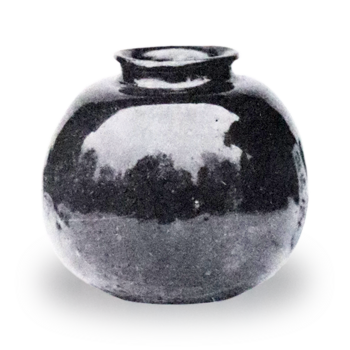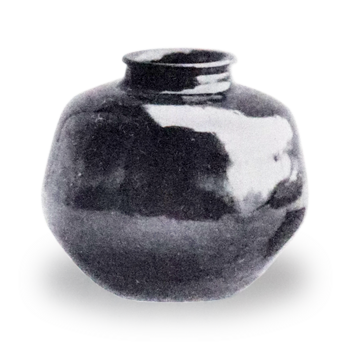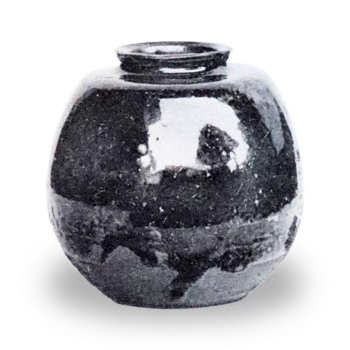
Bungo Eggplant: Kansaku (Chinese)
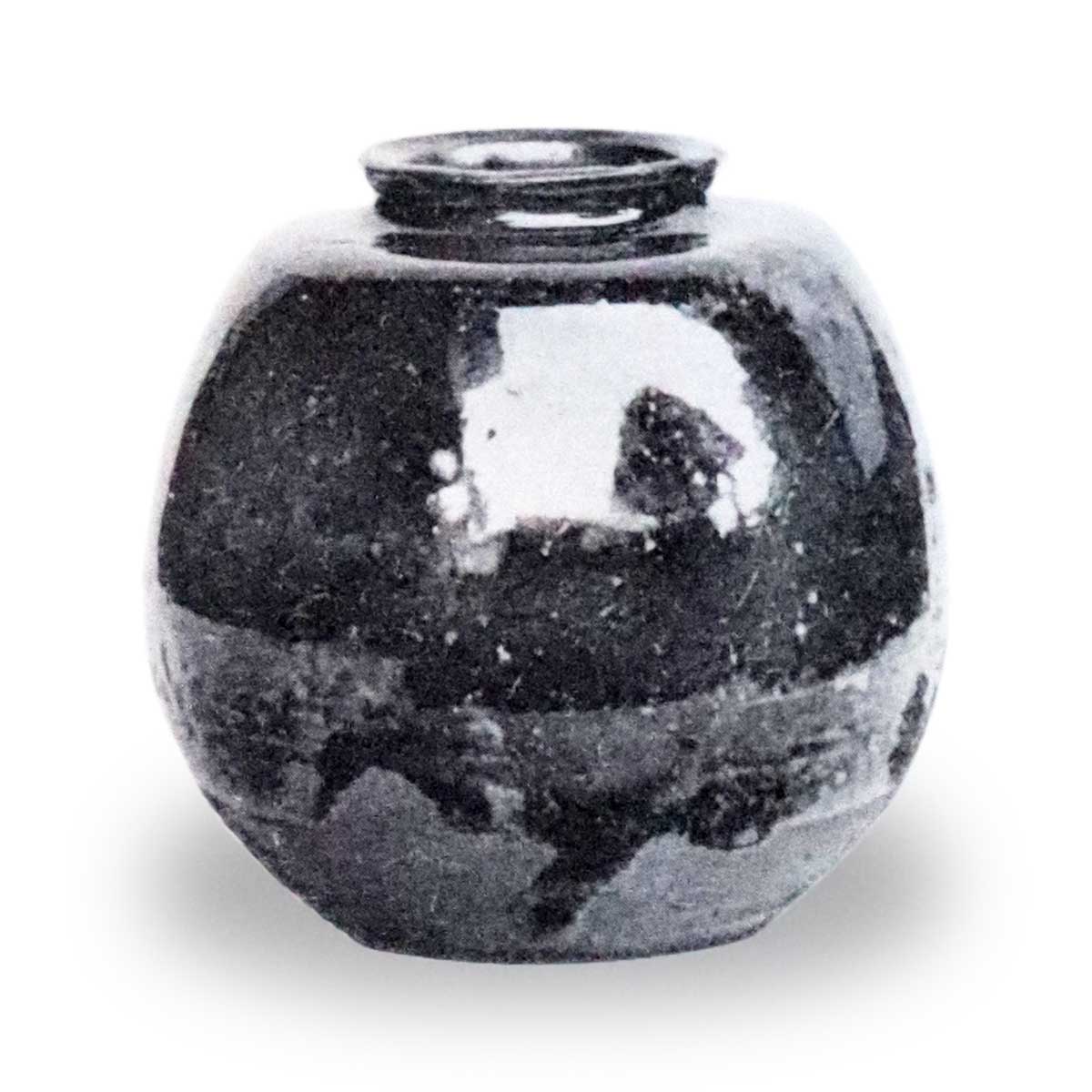
Rikyu Small Eggplant: Han-saku (Kara-mono)
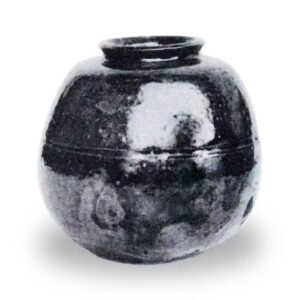
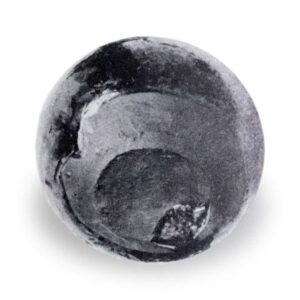
Collection of Marquis Toshiyuki Maeda
Name
The origin of the name “Bungo Eggplant” is unclear. Whether Nishida Sōyo, the owner of this tea caddy, was a native of Bungo (present-day Ōita Prefecture), or whether he acquired it in Bungo, there is no doubt that it has some connection to Bungo Province.
The “Rikyu Small Eggplant” refers to a small eggplant-shaped tea caddy that was once owned by Sen no Rikyu.
It is said that the decision to place these two eggplant tea caddies on the right, together with a Rikyu small konatsume made by Moriam, into a single box was entirely based on the preferences of Lord Toshitsune of the Myoho-in, the third head of the Maeda family.
Dimensions
Bungo Eggplant
Height: 1 sun 9 bu 5 rin (approx. 5.9 cm)
Body diameter: 2 sun (approx. 6.1 cm)
Mouth diameter: 9 bu (approx. 2.7 cm)
Base diameter: 1 sun (approx. 3.0 cm)
Height of the base (koshi): 1 bu 5 rin (approx. 0.5 cm)
Weight: 14 monme 1 bu (approx. 53 g)
Rikyu Small Eggplant
Height: 1 sun 8 bu 5 rin (approx. 5.6 cm)
Body diameter: 2 sun (approx. 6.1 cm)
Mouth diameter: 9 bu (approx. 2.7 cm)
Base diameter: 9 bu or 1 sun (approx. 2.7 cm or approx. 3.0 cm)
Koshiki height: 1 bu 3 rin (approx. 0.4 cm)
Weight: 16 monme 3 bu (approx. 61 g)
Accessories
Bungo Eggplant
Lid: 1 piece, ivory
Pouch: Light blue (asagi) satin with a wave pattern and a “treasure trove” crest; lining is damaged; cord fasteners are light brown
Outer Casing: Ivory; upper and lower edges are rounded; exterior features a gold-lacquered, flat-grained pear-skin finish; interior features a silver-lacquered, flat-grained pear-skin finish
Rikyu Small Eggplant
Lid: 1 piece, no window
Pouch: Guangdong weave; lining is severely damaged; cord fasteners are purple; wrapped in origami paper
Outer Case (Outer Cylinder): Ivory; top and bottom edges are rounded and punched; Shunkei lacquer finish
Inner Box: Black persimmon wood; chamfered gold-painted pear-skin finish
Interior is entirely gold-painted pear-skin finish; exterior features maki-e of the “Shinobu-gusa” (Japanese knotweed) motif; exterior bottom is gold pear-skin finish
(Diagram of box contents)
Front
Box lid
“Bungo Eggplant, Small Eggplant, Small Jujube—Rikyu”
Inscription
Back
Box contents
“Bungo Eggplant, Rikyu Small Eggplant, Small Jujube”
Sunken carving
Outer box: Paulownia, natural wood, inscription on attached paper
Front
Bungo Eggplant
Small Eggplant
Small Jujube: Rikyu
Back
Kan Bungo Eggplant (written in vermilion)
Owned by Nishida Sōyo and confiscated from the Ryōgata-ya in Kyoto
Kan Small Eggplant (written in vermilion)
Owned by Rikyu
Rikyu Small Jujube (written in vermilion)
Owned by Rikyu
Miscellaneous Notes
Bungo Nasu
The major varieties of the Meibutsu Nasu tea caddies known to the public are roughly:
Kitano Nasu, Daigo Nasu, Bungo Nasu, Sōgo Nasu, Kyōgoku Nasu, Shōō Nasu, Mitsukushi Nasu, Hyōgo Nasu
(From Chaji Hiroku by Hatsufū Yūjin)
Chinese eggplant-shaped tea caddies are considered the most prestigious among tea utensils, and during tea ceremonies using a Shinkō-style daisu (tea tray), thick tea is served in an eggplant-shaped tea caddy. For this reason, neither the host nor the guests place the eggplant-shaped tea caddy directly on the tatami mats during a tea gathering (omitted). Eggplant-shaped tea caddies are preferred when the shape of the eggplant is exceptionally good. Those with excellent form all the way down to the base (bon-tsuki) are considered particularly superior.
Sōgo Eggplant, Kitano Eggplant, Daigo Eggplant, Bungo Eggplant, Mitsukushi Eggplant, Kyōgoku Eggplant, Shōō Yellow Eggplant.
The items on the right are Meibutsu examples of eggplant-shaped tea caddies.
(From Shadō Shōdenshū)
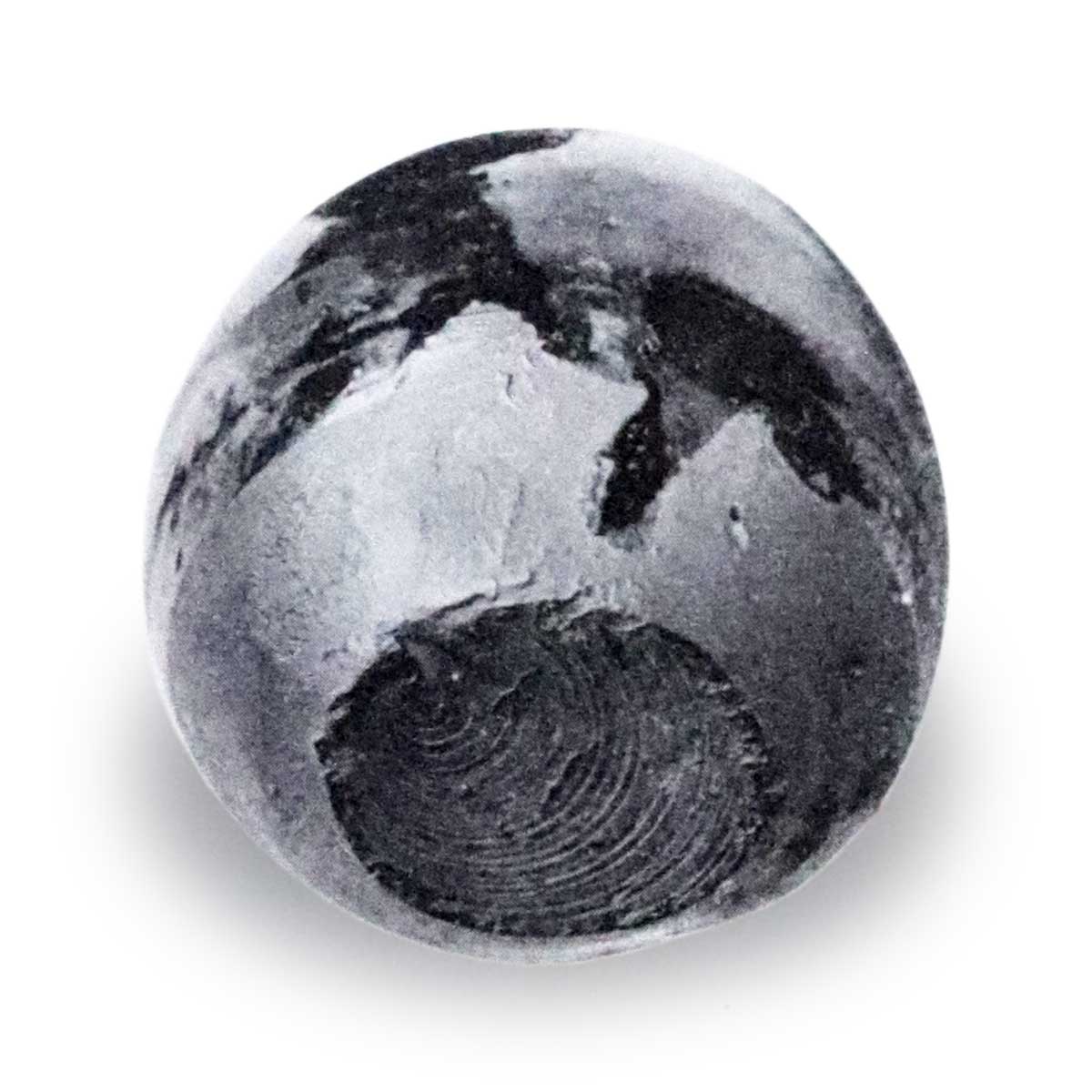
Bungo Eggplant: The clay is purple, the underglaze is amber, and the overglaze is black. The thread-cut pattern on the base (bottom) spirals counterclockwise, and the entire piece bears wheel marks. The rim shows traces of a spatula on the inside, and there is a slight indentation around the rim (the “rim world”).
(From The Marquess Maeda Family’s Register of Utensils)
Miscellaneous Notes
Small Eggplant
Morning of May 11, Eiroku 9 (1566) – Takeno Shingoro’s Tea Gathering
Tsuda Sōyuki, Imai Sōkyū
A Jōhira kettle on the furo, with the godoku placed beside the tatami mat. On the bag-shaped shelf: an inkstone, water, a Genchō brush rest, a water container, a narrow-mouthed flower vase, and white irises arranged in it. A small eggplant-shaped tea caddy, an ivory tea scoop, a Goryeo tea bowl, and a men-tsu (bowl for rinsing tea leaves) serving dish (hikikiri).
(From Excerpts from the Diary of Imai Sōkyū)
Hōsunsai Sōka (Shōō’s son, Shingorō) of Sakai sought out a small eggplant-shaped tea caddy, tucked it into the sleeve of his paper robe (made of washi), and went up to Lord Nobunaga’s castle. Although the outcome was tragic, he explained his intentions thus: “My father, Shōō, had long desired this, yet passed away without ever seeing it. Therefore, I sought to use it to serve tea in his memory, and I reduced myself to wearing nothing but a single paper garment to acquire it.” In all matters, one cannot fully fathom the intentions of the public authority (the government). The following is a record by Matsuya Hisashige of Nara.
(From Chaji Shuran)
Small Eggplant: Located in Sakai; owned by Sōka.
(From Tenshō Meibutsu-ki)
Morning of January 12, Tenshō 15 (1587) – Rikyū’s tea gathering in Osaka
Sōtan and Sōden
Regarding casual conversation
“Of the three ‘Kogasa’ tea caddies, the one on the outside is called that because it is slightly slimmer; it is by no means thin,” he remarked.
(From Sōtan Nikki)
November 14, Tenshō 20 (1592): Regarding the tea ceremony and decorations
(Tea was served to the daimyōs at the residence in the mountains of Nagoya.
From November 14 through the 17th
In the tokonoma: One hanging scroll depicting the evening bell
In front of it: The Small Eggplant tea caddy, placed on a square tray)
(From Sōtan Nikki)
April 29, 1629 (Kan’ei 6, Year of the Snake)
The Shogun’s family visited the villa of Matsudaira Hizen-no-kami Toshitsune
Attendants: Lord Mito Yorifusa, Todo Takatora, Tachibana Muneshige
Bag-style shelf
- Tea caddy: Small Eggplant—a gift from Lord Hideyoshi
(From Gokai-ki)
Rikyu Small Eggplant: The clay is vermilion, the lower glaze is persimmon-colored, and the upper glaze is black. The base (bottom) features a thread-cut design. The upper glaze drips down to the base, forming a single band (stripe). The rim is shaped with a spatula.
(From The Marquess Maeda Family’s Inventory of Utensils)
Provenance
As indicated by the note on the inside of the box lid, the Bungo Nasu was originally owned by Nishida Sōyo and was later acquired by the Maeda family from the Ryūgata-ya in Kyoto. However, it is now impossible to ascertain the details regarding the period during which Nishida Sōyo was active.
The provenance of the Rikyu Konasubi is also unclear, and it is uncertain whether this particular Konasubi is indeed the one that was owned by Sōga, the son of Takeno Jōō. Since the aforementioned Gokai-ki records that at Maeda Toshitsune’s tea gathering in the 6th year of Kan’ei (1629), there was a “small eggplant tea bowl bestowed by Lord Hideyoshi,” it is likely that this small eggplant tea bowl was presented by Rikyu to Hideyoshi and subsequently bestowed by Hideyoshi upon the Maeda family.
(Note) There is a story that Takigawa Kazumasu, despite wishing to receive the small eggplant tea caddy that Nobunaga had owned as a reward for his campaign in Koshu, was instead enfeoffed at Mayabashi in Joshu. Overcome with disappointment, he is said to have remarked, “My good fortune in the tea ceremony has come to an end.” Another legend recounts that Amago Yoshihisa spent a vast fortune in an attempt to acquire the small eggplant tea caddy, and his retainers lamented, “This marks the end of the Amago clan’s fate”—it appears that the Konasu was one of the oldest and most famous tea caddies. An entry in the Gokai-ki dated September 17, 1627, records that when Shogun Hidetada visited the residence of Takatora Todo, a Konasu was displayed on a bag-shaped shelf in the “Chain Room”; the name “Konasu” also appears in various other tea ceremony records. Therefore, there must have been several teapots of this type in existence, and there is, of course, no way of knowing whether this “Rikyu Konasu” is the same “Konasu” mentioned in the Imai Sōkyū Nikki and the Sōtan Nikki.
Record of Actual Observation
On November 25, 1919, I examined this piece in person at the residence of Marquis Toshiyuki Maeda in Honfuji-cho, Hongo Ward, Tokyo.
Bungo Nasu
The rim is tight, and the shoulders are chamfered to form a step. Against an overall amber-colored ground, a yellowish glaze cascades from the tips of the shoulders down the body, stopping at the hem. Furthermore, it is extremely rare to find a single, sunken line running along the very edge of the rim (where the glaze meets the unglazed clay). Below the rim, the grayish-brown clay is exposed, and the thread marks are fine and distinct. Inside, glaze covers the rim; below that, wheel marks run down the interior, converging in a tomoe (swastika) pattern at the center of the base.
Rikyu Small Eggplant
The rim is tight, and the flared rim (curvature) is sharp like a blade tip and exquisitely crafted. A black amber glaze is applied unevenly over a pale purple base color; a single line of sunken veins runs around the body, and the glaze flow (scenery) cascades down to one corner of the base. From the rim downward, the clay is a pale grayish-white, with a fine grain and a faint reddish tint; the thread-like cracks are fine and irregular. Furthermore, from the rim downward, there are areas where the glaze has lifted, revealing a persimmon-colored metallic sheen. As its name suggests, this is a compact tea caddy.
The two tea caddies on the right, along with a small black tea caddy by Moriamu bearing Rikyu’s calligraphic seal, are housed in a flat, pear-skin-textured box with a lid lining featuring a “black persimmon folding screen-style arabesque maki-e” design—a style favored by Lord Toshitsune of Myoboin—and adorned with a maki-e design of the “Ninja Grass” motif. This arrangement likely reflects Lord Tsunetada’s refined aesthetic sensibility, as he intended to store these two small eggplant-shaped tea caddies and the single small zō together in a single box.