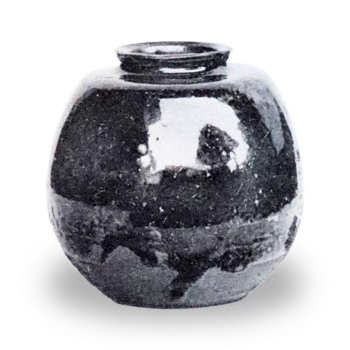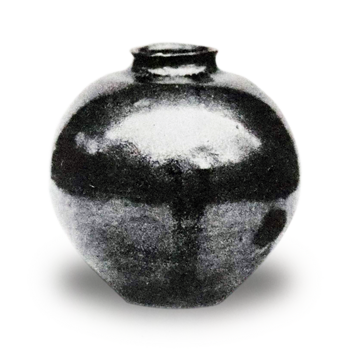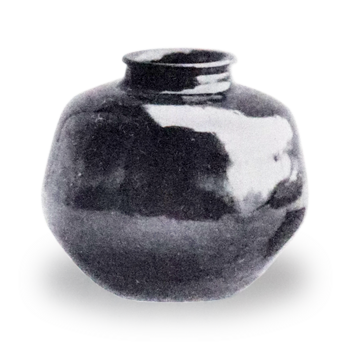
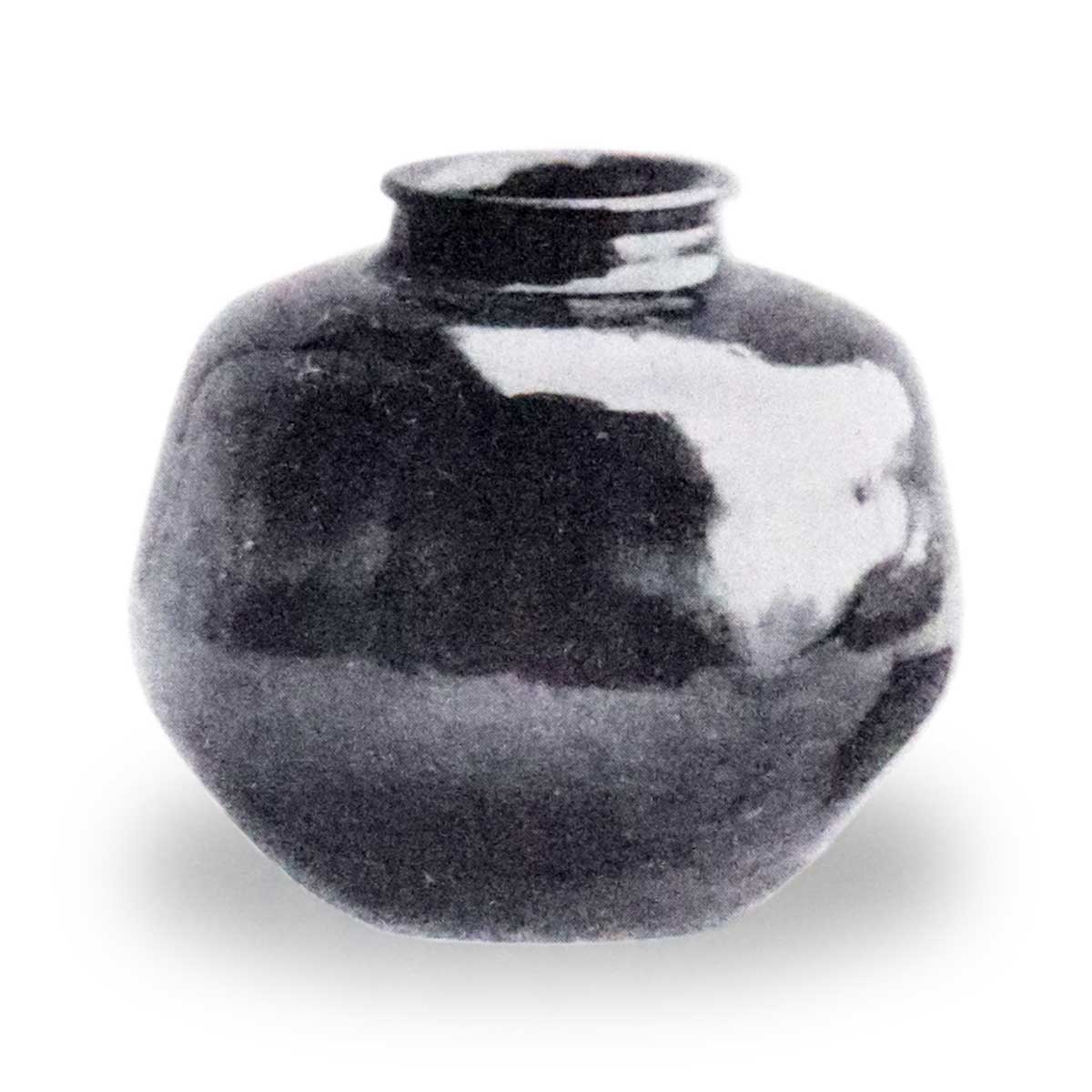
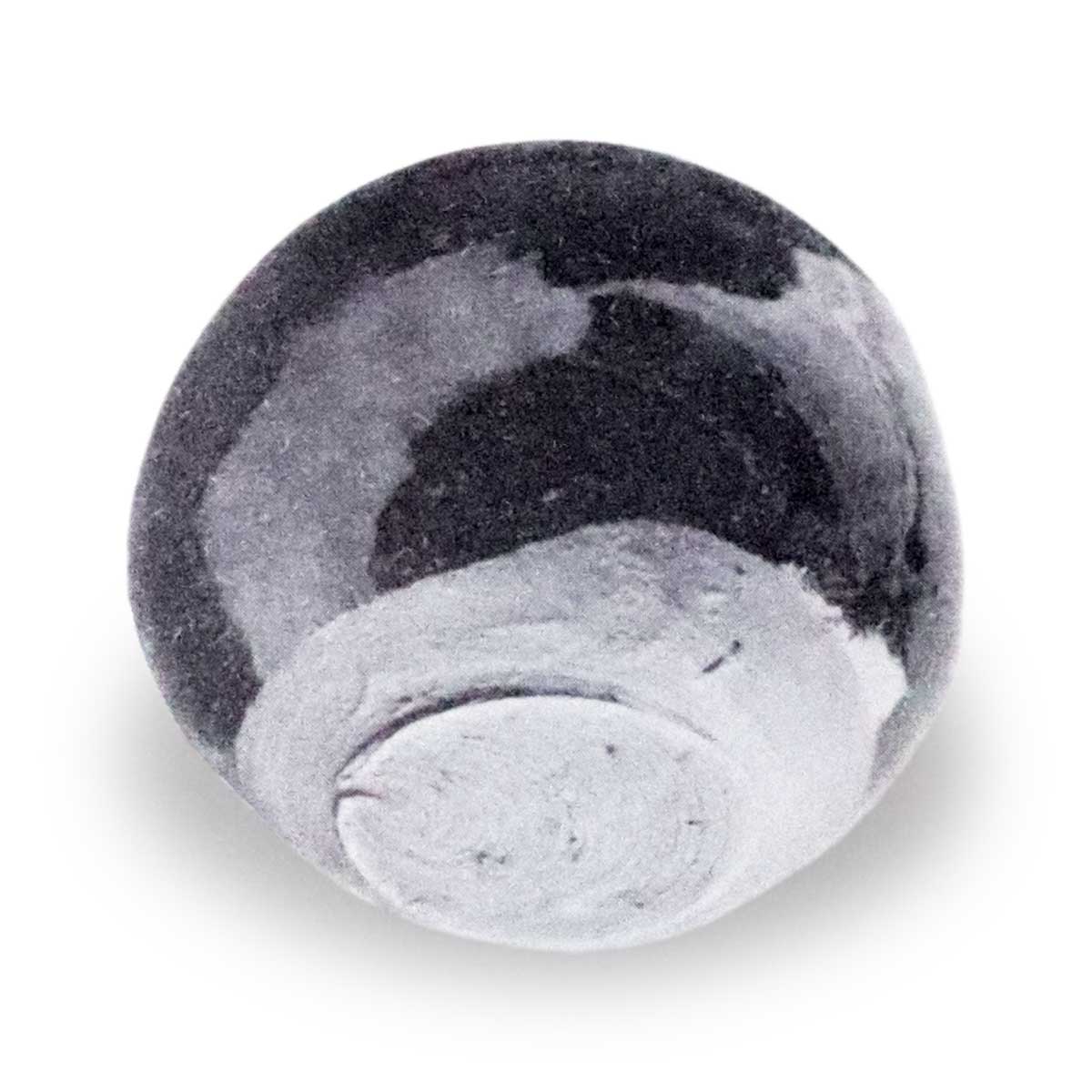
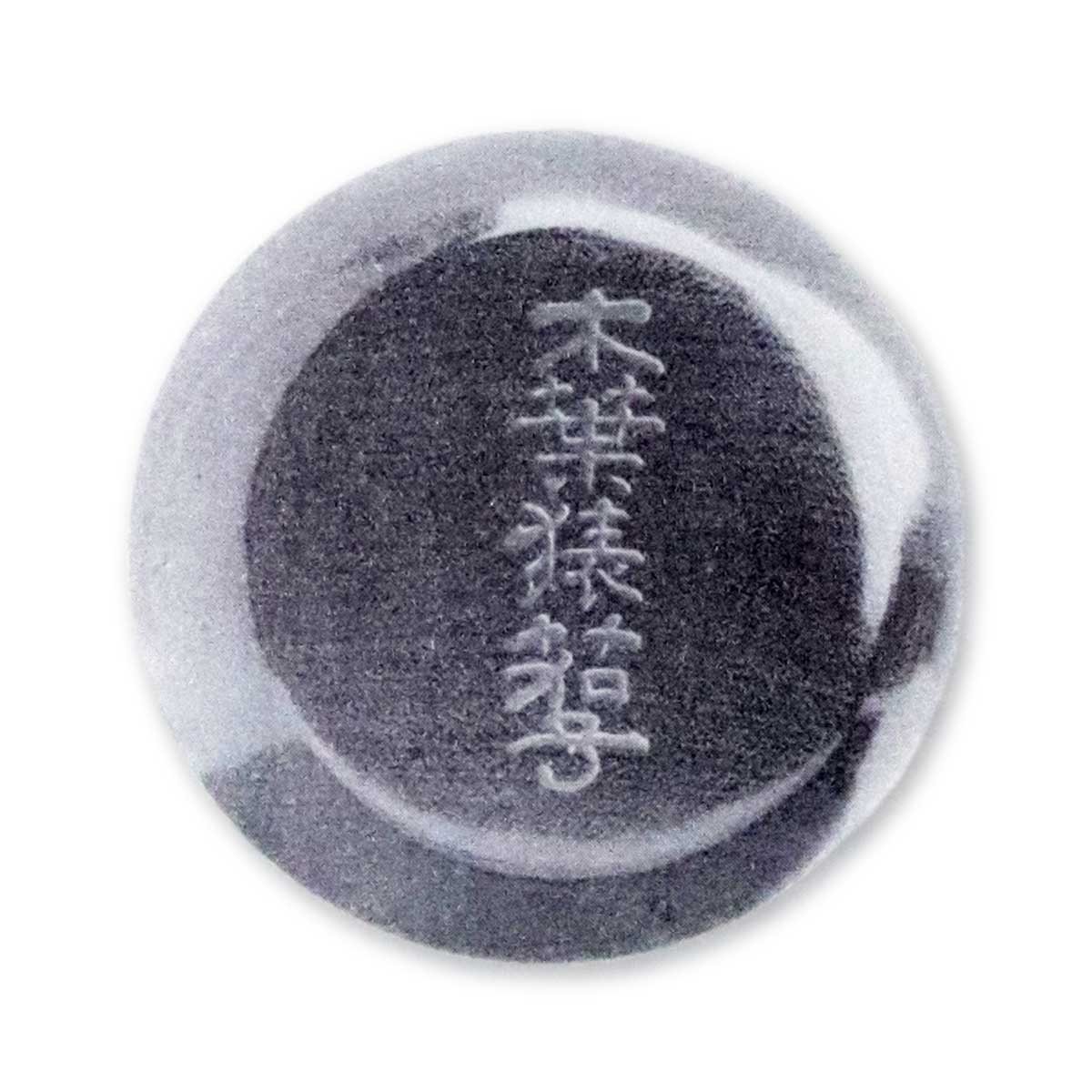
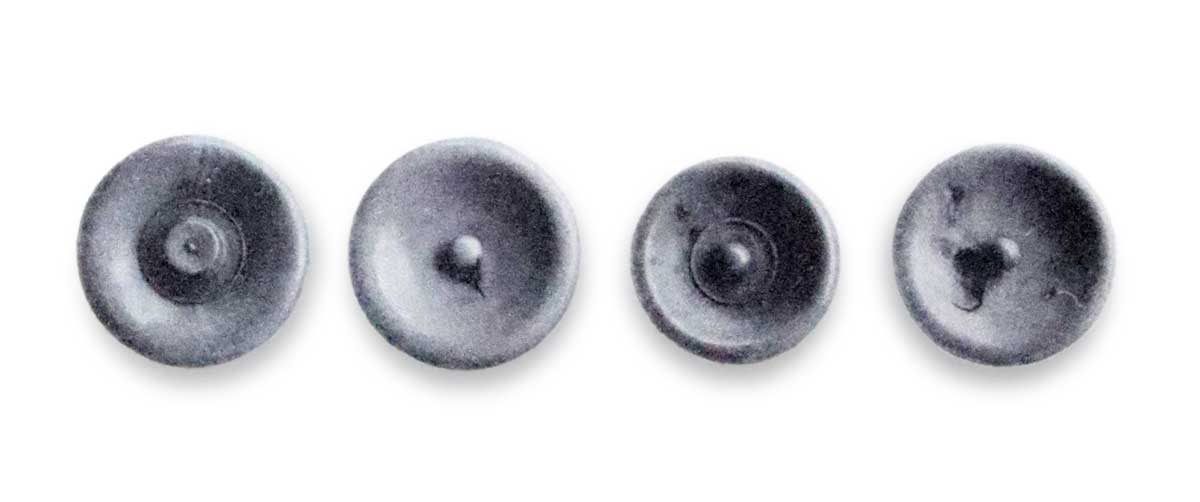
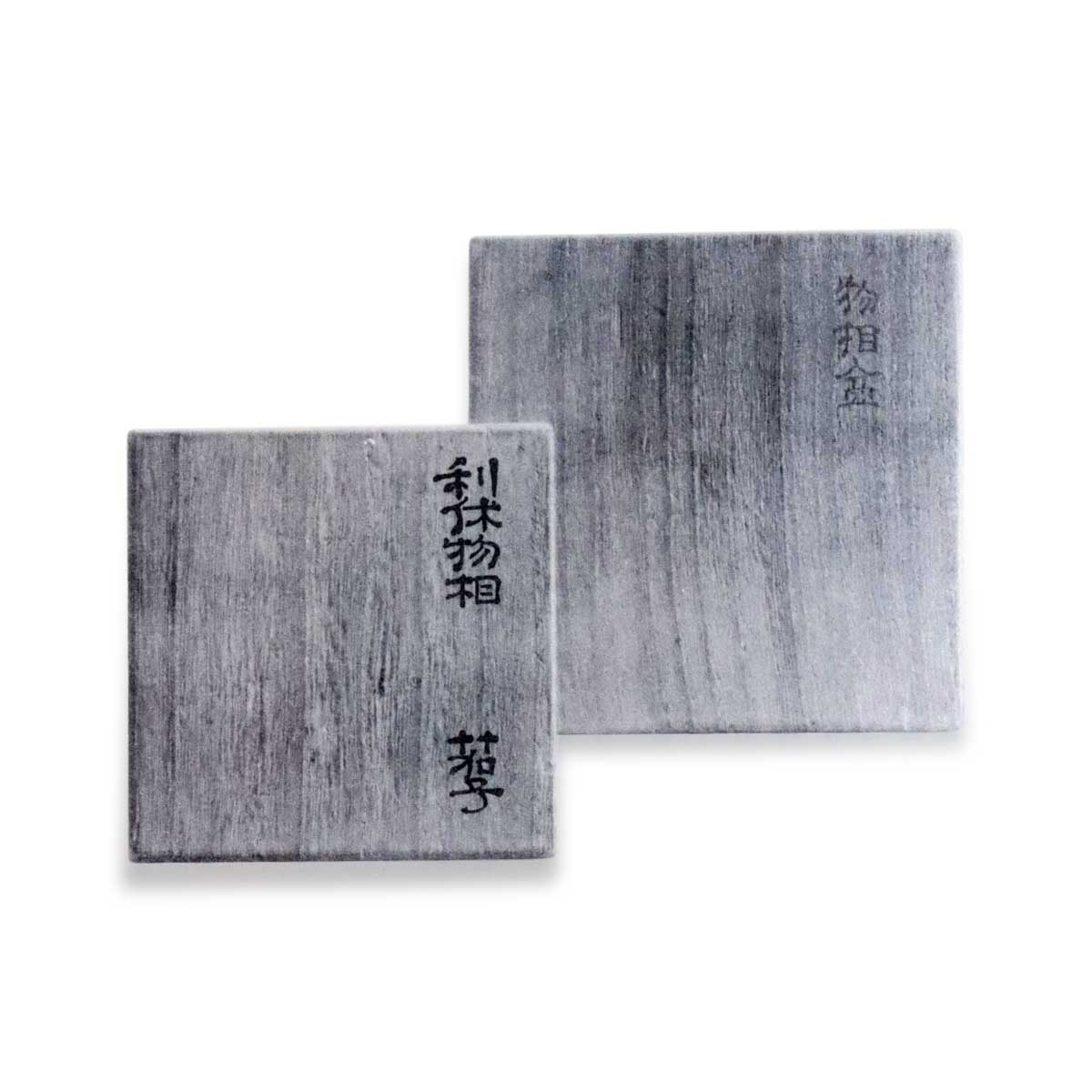
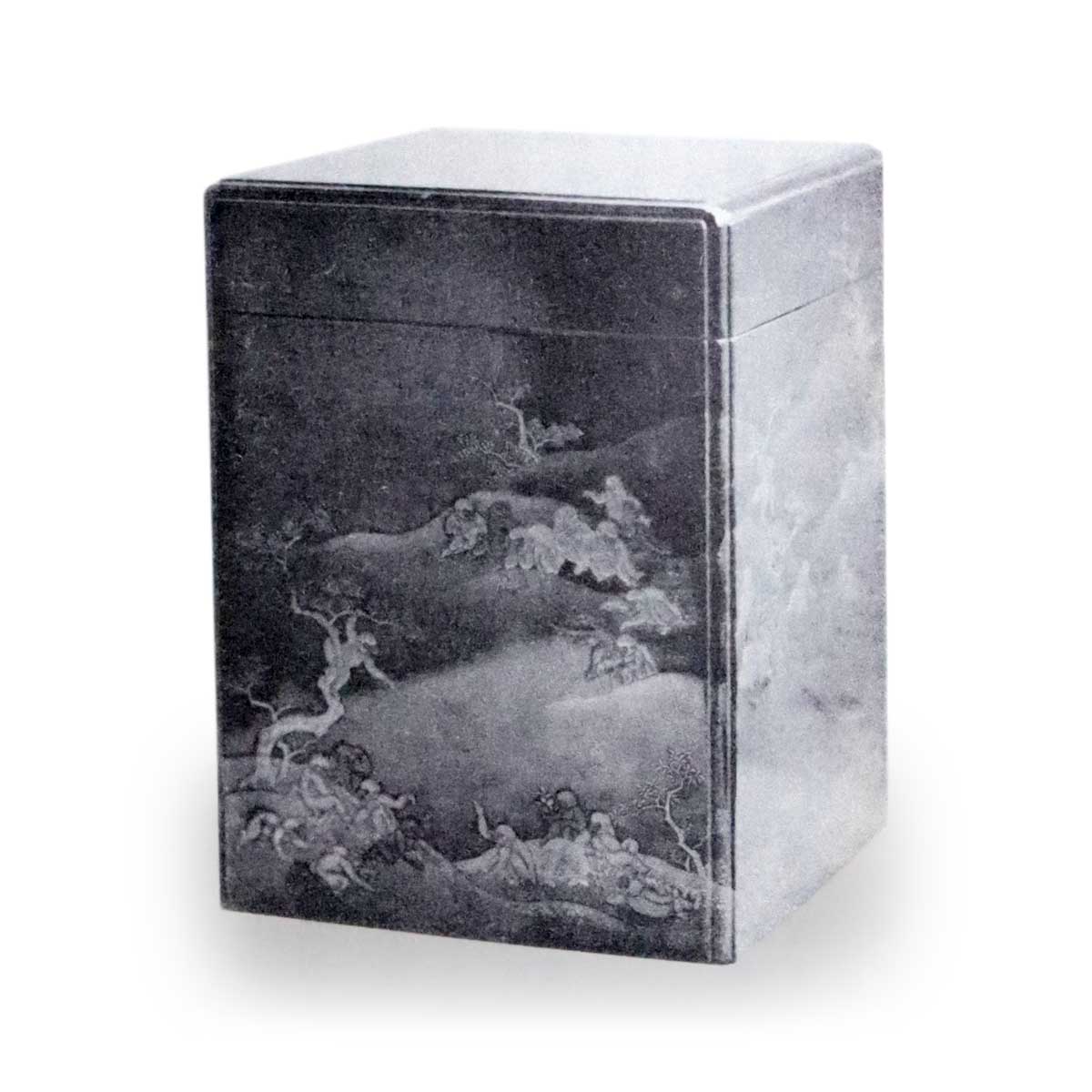
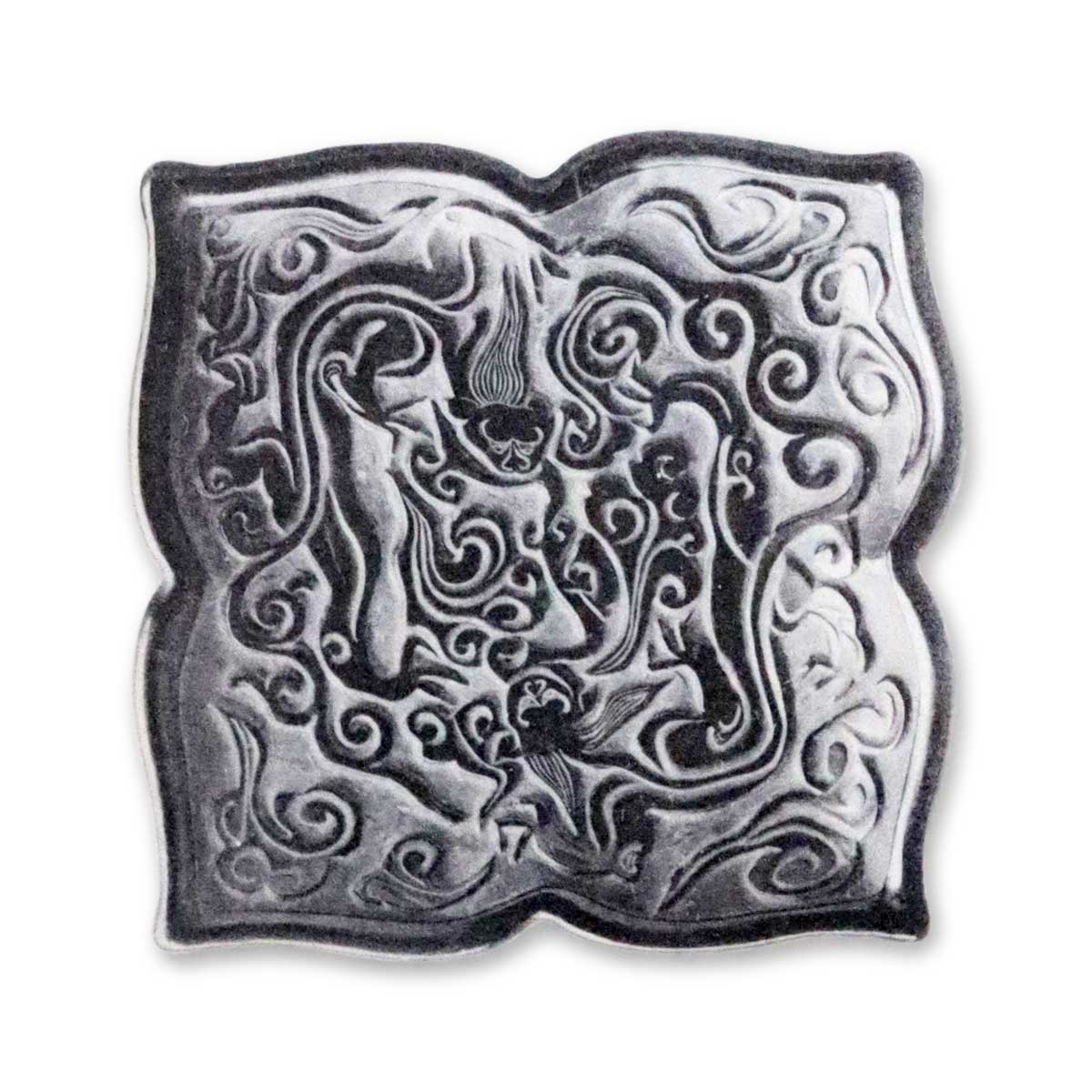
Chinese-made (Tang-style) Daimeibutsu; also known as “Kiba Saru”; Collection of Baron Iwasaki Koyata
Name
This is a tea caddy that belonged to Rikyu. It is called “Rikyu Monso” because its shape resembles a ‘monso’ (also known as “mori-so,” a bowl used for serving rice). There is a theory that the name “Kiba Saru” (Leaf Monkey) derives from the monkey maki-e design on the outer box; however, since the Rikyu Hyakukai-ki records it as “Teapot: Kiba Saru,” this name likely predates the creation of the outer box—which is said to have been a favorite of Date Masamune. It is thought that Rikyu rubbed the body of this tea caddy because he found it lacking in visual interest and somewhat dull. The name likely stems from the fact that the rubbed area resembles a monkey’s face, or perhaps it was named to suggest that the “Kiba Saru” is scratching its own face with its hand.
Dimensions
Height: 1 sun 8 bu (approx. 5.5 cm)
Body diameter: 2 sun 5 rin (at the bottom) (approx. 6.2 cm)
Mouth diameter: 8 bu (approx. 2.4 cm)
Base diameter: 9 bu or 1 sun (approx. 2.7 cm or 3.0 cm)
Koshiki (ring) height: 2 bu (approx. 0.6 cm)
Shoulder width: 4 bu 8 rin (approx. 1.5 cm)
Weight: 17 monme 2 bu (approx. 64.5 g)
Accessories
Lids: 4
Wooden Lid: Made by Hanzei, Rikyu style
Wooden Inlaid Lid: Made by Tachiko, Kenzan (Date Tsunamura) style
Body Window: Made by Insai, Enshu style
Lid with Colorless Inlay: Made by Insai, Enshu style
Replica in the Rikyu style
Storage Pouch: White chirimen (crepe silk), lined with light blue umi-ki (silk fabric); cord ends are brown
Bags: 5
Wani-gai Donsu (silk brocade), lined with Tamamushi-kaike (silk fabric), cord fasteners in wisteria color
Ro-ji Kaki-ji Karahana-nui (silk gauze with persimmon-colored floral embroidery), lined with Tamamushi-kabechoro (silk fabric), cord fasteners in purple
Sasa-kazu no Te-kiku Karakusa-mon Donsu (silk brocade with bamboo vine and chrysanthemum arabesque pattern), lined with Benikaike (silk fabric), cord fasteners in wisteria color
Shokkin; lining: iridescent sea-green; cord fasteners: pale yellow
Woolen fabric; lining: pale green sea-green; cord fasteners: pale yellow
Bag box: Paulownia; natural wood
“Monogatai Bag”
Handle: Tagayasan wood with gold-powder lettering
“Kiba Saru Nasu” (Leaf, Monkey, and Eggplant); inscription by Kobori Gonjuro
Inner box: Paulownia, natural wood. Inscription by Kobori Gonjuro
“Rikyu Monogata: Eggplant”
Outer box: Black lacquer, Senbiki Saru gold maki-e. Interior: Gold pear-skin ground
A strip-shaped design in the center of the lid’s maki-e, in the style favored by Lord Masamune
Accompanying tray: Diamond-shaped black lacquer tray, carved with a rain dragon pattern
Diameter: 6 sun 4 bu (approx. 19.4 cm), base diameter: 6 sun 4 bu (approx. 19.4 cm), with a vermilion lacquer “∴” mark in the center of the base.
Height: 7 bu 6 rin (approx. 2.3 cm)
Wrapping: Sarasa, purple sea mist pattern on the reverse
Box: Natural wood
“Monogata-bon”
Miscellaneous Notes
Monogata: Lord Matsudaira Mutsu-no-kami.
(From the Higashiyama Go-mono Uchi Betsucho and Ganka Meibutsu Ki)
Rikyu Monogata: Lord Matsudaira Mutsu-no-kami. This Chinese Monogata tea caddy was originally owned by Rikyu the Hermit. Because it was considered “dull” (lacking visual appeal), the body of the caddy was sanded down before being presented at a tea gathering. It is also known as “Kiba Saru” (Leaf Monkey). It is a renowned Meibutsu tea caddy.
(From Komeibutsu-ki)
Description: Chinese-style, Daimeibutsu, Matsudaira Mutsu-no-kami. Height: 1 sun 8 bu (approx. 5.5 cm), body: 2 sun (approx. 6.1 cm), mouth: 8 bu 4 rin (approx. 2.5 cm), base: 1 sun (approx. 3.0 cm). Four lids: one in the Rikyu style, one replica of this in the Enshu style. The lid is made of karuri; the lid bag is navy brocade with a pale yellow kaiki lining. The bag is made of Hikiya satin with a wisteria-colored cord; another is made of gauze with a persimmon-colored ground and Tang floral embroidery, with a purple cord and a jade-green kabechoro lining; a third is made of shokkin with a pale yellow kaiki lining and a purple cord (with vermilion inscription; this bag is in the Rikyu style), one in the Sasatsuru style with a chrysanthemum and arabesque pattern on satin, lined with crimson and tied with a white cord; one in Shokkin style, lined with pale yellow and tied with a long cord; and one in Hanairo Kinran style, tied with a pale yellow cord and lined with pale yellow. The Monosho tray is from Enshu. 6 sun 4 bu, a black lacquered tray with a design of a dragon in the rain and clouds, featuring vermilion inscriptions. The maki-e outer box is finished with a Kiba-saru (monkey among leaves) pattern in a polished lacquer finish, said to be to the taste of Lord Masamune (illustration of the tea caddy included).
(From Kokon Meibutsu Ruiju from the Kuan Bunko Collection)
Rikyu-style Monogatari: Owned by Matsudaira Mutsu-no-kami. It is said that at the time, it was entrusted to Masuya Heiemon in Osaka. The handle is made of rosewood with gold powder depicting “monkey leaves and eggplant”; the inscription is in the hand of Kobori Gonjuro. The outer box is made of paulownia wood with leather cords; the inscription, in black lacquer, reads “Rikyu-style Monogatari Eggplant” in the hand of Gonjuro. The inscription on the Monogatari tray is by Enshū, though this is uncertain. It is a tsukuro-shu tray featuring a rain dragon and cloud patterns. Additionally, one round tray with a vermilion interior is included; the exterior is tsukuro-shu. It is of the harinuki construction and features carvings on the back (other details regarding dimensions and accessories are the same as in Kokon Meibutsu Ruiju. Includes an illustration of the tea caddy).
(From Meibutsu-ki)
Rikyu’s “Mono-Aoi” (Chinese-style tea caddy). Owned by Matsudaira Mutsu-no-kami. (All dimensions and accessories are the same as in Meibutsu.) Includes a vermilion inscription. Kudo In’an inspected this tea caddy when he visited Sendai. Although it is a fine tea caddy, it lacks a natural landscape. He recounted a legend he had heard: Rikyu is said to have rubbed the front of the caddy to create a landscape in order to designate its proper viewing angle. (Omitted) He drew a diagram of the tea caddy, wrote “Sure” in one place on the side of the body, and wrote “Sure” again toward the bottom.
(From Kōan Bunko, Vol. 13)
In a registered letter from Sekiji-an, it is stated that the Tang-style Rikyu-style tea caddy, also known as the “Leaf-Monkey” or “Eggplant” Tang-style tea caddy, is in the possession of the Lord of Sendai (the Date clan). Furthermore, according to Kaku-kaku-sai, Meibutsu tea caddies generally have two names, and this has been the case since ancient times, and so on. Written by the Palace. There are two types of trays: round trays and diamond-shaped trays. The one said to have been placed there by Lord Enshū in the past is a tray with a vermilion interior and a tsuishu exterior.
(From Rikyū Hyakukai Kai)
The tea caddy known as “Kiba Saru” is a “shiribukura” (bulging-bottomed) style, also called “Motsusatsu.” It is currently in the possession of Lord Masamune.
(From Matsuya Nikki)
A tea caddy in the style of Matsudaira Mutsu-no-kami; the lid is shaped like a sake cup lid. This was a favorite of Enshu. It is a famous Meibutsu that holds a single serving of tea; reportedly, because the opening is narrow, it protrudes outward by about 2 bu (approx. 0.6 cm). This reflects Enshū’s eccentric tastes.
(From Sakurayama Ichiyu’s Notes)
Morning of December 6, 1560 (Eiroku 3, Year of the Monkey) – Sōeki (Rikyū)’s Tea Gathering
Sōchin, Sōtatsu, Sōkyū
Alkov: Calligraphy by En’u. It was hung there from the start; during the hand-washing ceremony, it was removed, and narcissus were arranged in a narrow-mouthed, unmarked flower vase. The tea caddy was a “mono-sō” style. The tea bowl, the counting stand, the Shigaraki water jar, the gōsu (small bowl), and the hikikiri (serving tray) were also present. For the first time, tea was prepared using a tea bowl. The Monosho tea caddy measured 1.8 sun (approx. 5.5 cm) in height, 2 sun (approx. 6.1 cm) in body diameter, 0.85 sun (approx. 2.6 cm) in mouth diameter, and 1 sun (approx. 3.0 cm) in base diameter. The pouch was made of floral-patterned Kinran, and the cord was light yellow.
(Excerpted from Imai Sōkyū Nikki Batsui)
The morning of June 13, Tenshō 15 (1587) (Year of the Boar) – A tea gathering hosted by Sōeki at the Samegaru residence
His Majesty (Hideyoshi) arrived; in attendance were Kuroda Kangeyu, Yūsai Rō (Hosokawa Fujitaka), and Sōkyū
In the tokonoma: A short poem composed and handwritten by His Majesty. It was left hanging until the very end; reportedly, it was a gift received the previous year.
Only by scraping the bottom and fathoming the heart
Is one recognized as a true tea master
The tea caddies were: Monosho, Tenmoku, Amagasaki-dai, Oritame, and Aiko.
After the tea, His Lordship went to the study, had some tea, and asked the two men to compose poems.
In this age of purity, perhaps even the murky
Water of Iwai will become clear—Yūsai
Even the voice of ten thousand generations seems purer from this day forward
I believe the clear stream has ceased to flow. — Sōkyū
(From Excerpts from the Diary of Imai Sōkyū)
The dates and guests for whom the Kiba Saru tea caddy was used, as recorded in Rikyu Hyakukai-ki, are as follows
Morning of September 22: Lord Furuta Oribe (alone)
Morning of the last day of November: Lord Arima Chūjō, Lord Kuroda Sakon
Noon of December 7: Sakai Yakushiin, Aburaya Tsuneza
Morning of December 18: Sakai Yoneya Yojirō, Mizutori Sōei, and Sen—two guests
Morning of December 19: Lord Ishida Mokukōdō, Lord Kihata Hansuke
Morning of December 21: Lord Hashiba Chikuzen, Sōmu
Noon of December 23: Lord Fukushiro, Lord Yōzō, Mon’ami, and an envoy from Sō
Noon of January 8: Sakai’s Aburaya Tsuneza (alone)
Evening of January 2: Lord Shōshō (Toyotomi Hideyoshi), Mozuya Sōan
The evening of the 13th day of the intercalary first month: Lord Yuraku (Oda Nagamasu), Tachi-ami
When ordered to present tea to Shogun Iemitsu, Sakuma Shōkan (Saneatsu) brought an item in a tea caddy box to the kitchen and said, “Please give this to Masamune. It is the Shogun’s command that you present tea using this caddy.”
I (Masamune) replied, “That is quite fine,” and pushed it back toward Shōkan. Even though Shōkan insisted repeatedly, I refused to accept it. Shōkan reported this to Lord Iemitsu. It is said that Lord Iemitsu remarked, “That is quite right; leave it there.” Afterward, he personally took a tea caddy called “Kiba Saru” from his own sleeve and bestowed it upon me. Having received it directly from his hand, I felt all the more grateful and humbly accepted it, saying, “Earlier, the Shōkan brought something, claiming it was the Shogun’s command; however, I felt it would be too presumptuous to accept an item belonging to the Shogun’s household on the tatami mats of the kitchen, so I did not accept it at first.” Lord Iemitsu appeared to be particularly impressed.
(From Meishō Genkōroku)
On the day Masamune served tea (it is unclear which of the three occasions—the 5th, 7th, or 12th year of the Kan’ei era—it was), while he was still waiting in the kitchen, Sakuma Shōkan Sanekatsu, acting on the Shogun’s orders, brought a tea caddy in a box and said, “You have been granted this, so please prepare some tea.” Masamune replied, “There is no need for that,” and refused to accept it. Since he would not accept it even after Jitsukatsu repeated his request several times, Jitsukatsu reported the matter to his superior. Lord Iemitsu issued an order stating, “That is reasonable,” and had the tea caddy taken back. When the Lord (Masamune) appeared before the Shogun, the Shogun took the tea caddy from his sleeve and presented it to him. Masamune accepted it with reverence, expressed his gratitude for the honor, and said, “Earlier, the Shogun’s Deputy brought something here, claiming it was by the Shogun’s command. However, I felt it would be inappropriate to accept such a precious item from His Highness in the kitchen (the tea preparation area), so I declined it.” It is said that the Shogun was particularly impressed by this. Muko Zaki
History
Originally owned by Sen no Rikyū, it later became part of the shogunate’s treasury (treasures). Shogun Iemitsu bestowed it upon Date Masamune. At that time, Masamune was displeased that Sakuma Shōkan Sanekatsu had brought it to the kitchen, so he received it directly from the shogun’s hands. From then on, it remained part of the Date family’s treasury, but was later entrusted to Masuya Heiemon of Osaka and eventually entered the Iwasaki family’s collection after the Meiji Restoration.
Record of Inspection
On November 4, 1920 (Taisho 9), I inspected this piece at the residence of Baron Iwasaki Koyata in Takanawa Minamicho, Shiba Ward, Tokyo.
The rim has a shallow outward curve, the body is on the shorter side, the shoulders protrude slightly, the middle bulges further, and the base tapers inward. Against an overall yellow glaze, there is a band of blue-green streaks extending about halfway around the neck, and on the body, the same color cascades down like a curtain. Around the waist, where the glaze has been rubbed off, there are two small black circles; perhaps it was called “Kiba-zaru” (Leaf Monkey) because they resemble a monkey’s face. From the hem downward, the vermilion-colored clay is exposed; one side of the base protrudes slightly, and several fingerprints are visible in the clay. The thread-cutting is extremely fine with misaligned starting points, and there are some jagged edges around the base. It is said that this name derives from the teapot’s soft, plump shape, which resembles a “mono-sō”—a bowl used for serving rice. From the neck to the shoulders, a slightly darker yellow glaze swirls in a spiral pattern, and at the base near the unglazed clay, a burnt glaze with a reddish-brown (ochre) hue is visible. Inside, the glaze covers the rim, while below that, wheel marks are visible, and the center of the base forms a distinct spiral pattern.
The yellow luster is beautiful, and the presence of a blue-green curtain pattern inside is intriguing; the quality and color of the glaze are extremely similar to those of the “Half-Moon Bunrin.” It is a work of great wabi-sabi (by Daota) and, at the same time, an exceptionally clever tea caddy.