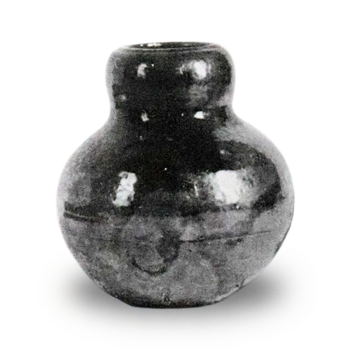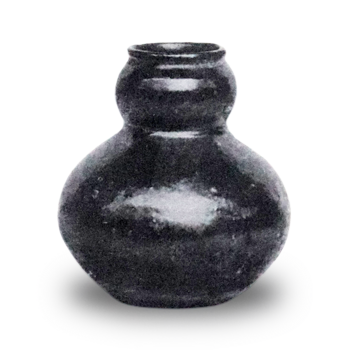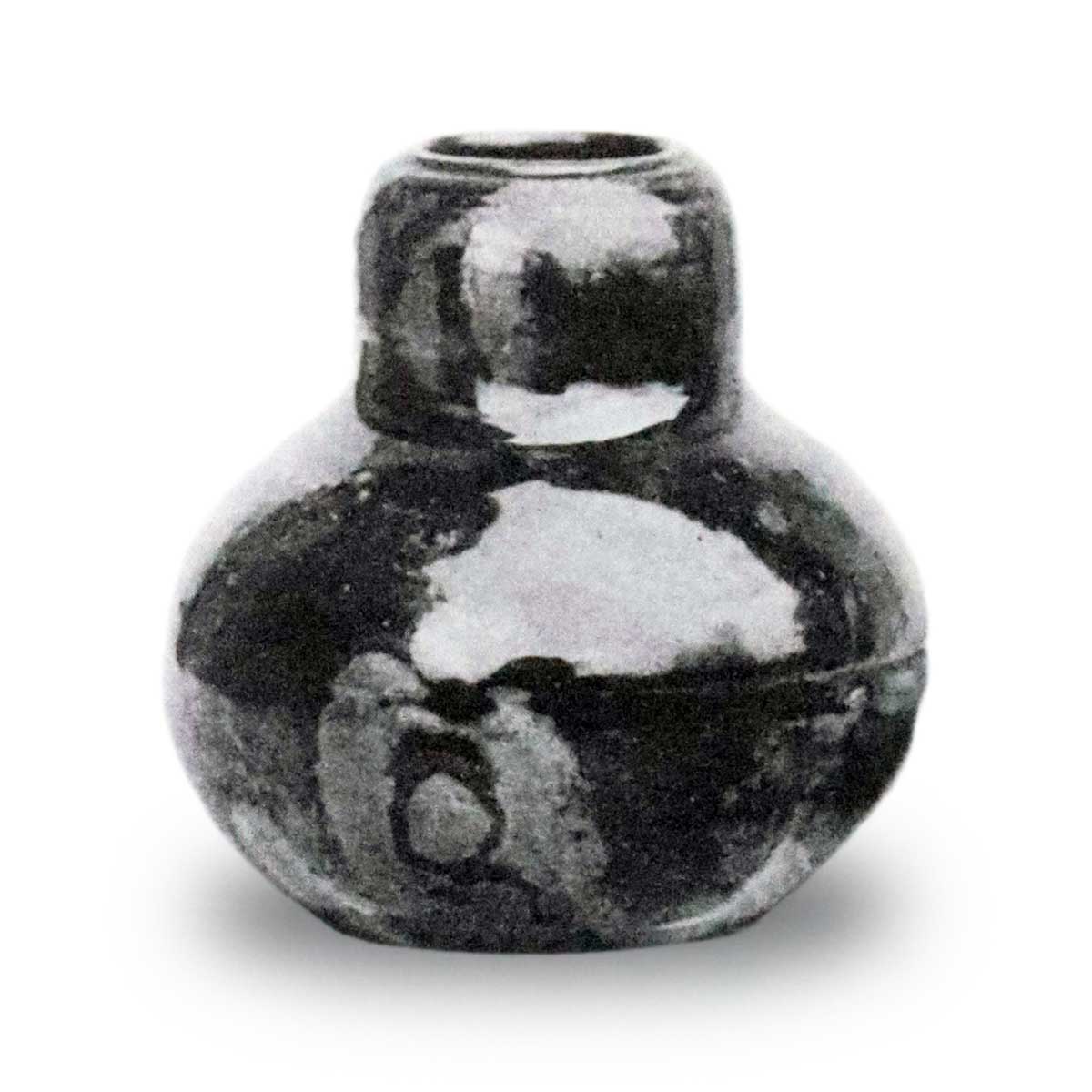
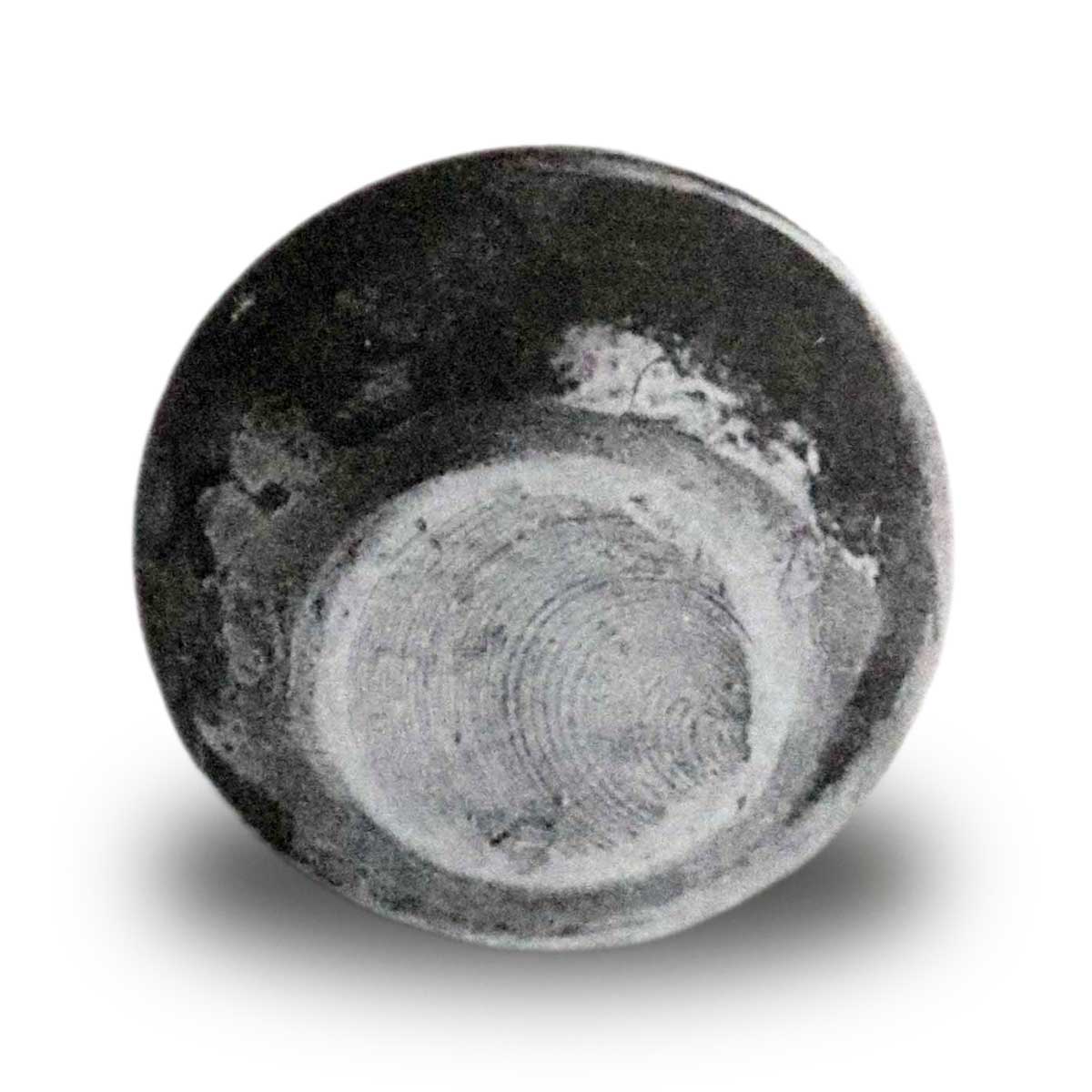


Made in China; Daimeibutsu; Collection of Baron Koyata Iwasaki
Origin of the Name
This name derives from the fact that it was once owned by Inaba Mino-no-kami Masanori.
Dimensions (Converted using 1 sun ≈ 3.03 cm and 1 monme ≈ 3.75 g)
Height: Approx. 6.36 cm (2 sun 1 bu)
Body Diameter: Upper bulge: Approx. 3.33 cm (1 sun 1 bu)
Lower bulge: Approx. 6.36 cm (2 sun 1 bu)
Mouth Diameter: Approx. 2.42 cm (8 bu)
Base diameter: approx. 3.33 cm (1 sun 1 bu)
Weight: approx. 67.1 g (17 monme 9 bu)
Accessories
・Lids: 2 (one with a depression, one colored at the depression)
・Storage pouch (for the tea caddy): white ha-niji, with a white cord
・Cover pouches: 3
Iyo bamboo blind (lining: light green Kai silk; cord: purple)
Graduated-pattern Guangdong woven fabric (lining: grayish-brown Kai silk; cord: floral pattern)
Antique Kinran with circular crest (lining: Kabe-dai; cord: purple)
・Pouch box: Made of natural paulownia wood
“Chinese Gourd-Shaped Tea Canister Pouch Box with Replacement Lid”
“Inaba Hyotan”
・Hikiya (cylinder for storing the tea caddy): Chinese-made foil-painted design
The lid features foil-painted depictions of figures, Buddhist statues, monkeys, and birds; the inside surface also features foil-painted designs.
The pouch features the Arisugawa pattern (lined with striped Kai silk, brown cord)
・Inner Box: Unfinished paulownia wood
“Gourd-Shaped Tea Caddy”
・Middle Box: Paulownia wood with Shunkei lacquer finish
・Outer Box: Black-lacquered paulownia wood, with a brass lock, designed for carrying by hand
・Accompanying Document: 1 copy. Excerpts from Tanpaku Shirōn.
“Ōuchi Yoshitaka, the Dazaifu Daini, was based in Suō and Nagato. Though he had inherited the legacy of his forefathers and was expanding his influence day by day, he became arrogant and neglectful of military affairs, amassing mountains of rare vessels and precious treasures. Among these, the one he treasured and loved most was a ‘hyōtan’—a small, low-sided porcelain vessel used for matcha.”
(The following is included in the entry for the “Uesugi Hyōtan”)
(Note) The text on the right pertains to the “Uesugi Hyotan” (also known as the “Otomo Hyotan”) in the collection of Marquis Tokugawa Yorimichi and has no connection to this “Inaba Hyotan.” However, it is unclear why this text is included here—whether it was due to a confusion between the two hyotan tea caddies or simply provided for reference.
Miscellaneous Notes
Hyotan: Owned by Inaba Mino-no-kami. It is one of the most renowned Meibutsu in the land.
(From Komeibuki)
Hyotan: Owned by Inaba Jūzaemon. Mentioned only in a variant text, where it is referred to as “Kamisa (Kanzaki?)”.
(From Gankō Meibuki)
This gourd is one of only six of its kind in the land. The Uesugi Gourd (reportedly bestowed upon Lord Tsunanori) is the foremost tea caddy, while the one owned by Inaba Mino-no-kami Masanori is said to be the second, and so on.
(From the inscription on the box of the Tamatsushima tea caddy, written by Katagiri Sekishū)
Chinese-made gourd-shaped tea caddy—owned by Lord Inaba Tango-no-kami. According to the provenance record, it was presented to Lord Hideyoshi by the Ōtomo clan in exchange for money; it was brought along when he visited his vassals, Kinoshita Miyauchi-dono and Shiro Tanba-dono, and subsequently passed down to the owner’s grandfather. Height: approx. 6.33 cm (2 sun 9 rin); body diameter: approx. 6.33 cm (2 sun 9 rin); diameter at the top: approx. 3.30 cm (1 sun 9 rin); mouth diameter: approx. 2.42 cm (8 bu); base diameter: approx. 3.64 cm (1 sun 2 bu) and a little more. There is a single ridge (rib) around the middle, and the rim of the base is worn. There is a thread cut. Overall, the body has a persimmon-colored base with an amber-colored glaze applied to the front (the side facing up when placed). The lid is a “Sakatsuki-kako” style. The pouch is made of Shokō brocade with a tea-colored ground featuring vertical stripes and a circular crest with staggered rings (the lining is velvet with a “Kaiki” pattern, and the cord is purple). Hikiya is finished with “tame-nuri” (translucent lacquer), and the pouch is woven in the “makahi” style (with a striped pattern on the lining). The outer box is made of paulownia wood with “Shunkei-nuri” lacquer and bears no inscriptions. (Illustration of the tea caddy available)
(From Katsu Kaishu’s Record of Notable Objects)
Chinese-made gourd tea caddy, owned by Inaba Tango-no-kami. Height: approx. 6.33 cm (2 sun 9 rin); body diameter: approx. 6.33 cm (2 sun 9 rin); diameter at top: approx. 3.27 cm (1 sun 8 rin); mouth diameter: approx. 2.42 cm (8 bu); bottom diameter: approx. 3.64 cm (1 sun 2 bu) and a little more. There is a single ridge (rib) along the side; the rim of the base is worn, and there is a thread-cut mark. (Illustration of the tea caddy included)
(From Illustrated Dimensions of Tea Utensils)
Chinese gourd-shaped tea caddy, owned by Inaba Tango-no-kami. Viewed on the 21st day of the 10th month of the year of the Water Dragon (Meiwa 9, 1772) in the main hall of Edo Castle. Height: approx. 6.33 cm (2 sun 9 rin); body diameter: approx. 6.33 cm (2 sun 9 rin); upper diameter: approx. 3.27 cm (1 sun 8 rin); features a single band (rib) at the waist; mouth diameter: approx. 2.42 cm (8 bu); base diameter: approx. 3.64 cm (1 sun 2 bu) and a little more. However, the rim of the base is worn, and there is a thread cut. The lid is a “sakasuki-kago” style. The pouch is made of Shokō brocade with a brown ground, vertical stripes, and a circular crest with staggered rings (the lining is velvet in the “Kaiki” pattern, and the cord is purple). (Note written in red ink: Three pouches—one made of Iyo bamboo blinds and two from Han-shima (Chinese island-style fabrics)—are all contained together in a paulownia box with a lacquered lid from Hikiya.) The carrying case is Chinese-made with a red lacquer finish, featuring maki-e designs of figures and horses; the interior is black, and the underside of the lid bears a figure motif.
The pouches feature the Arisugawa pattern; the lining has white vertical stripes on a black background with kasuri patterns in between, and the drawstring is brown. The upper box is made of paulownia wood with Shunkei lacquer and bears no inscriptions. The outermost outer box is black lacquered, has a lock, and features a flat lid. The tray appears to have a diameter of approximately 15.15 cm (5 sun). The interior is plain vermilion lacquer, while the exterior features a chōshu chrysanthemum pattern; it is said to be the work of Haruaki. The inside of the foot ring on the base is black lacquer, with the characters “Rakukō” written in vermilion lacquer in the center. The pouch is made of floral-patterned satin. The box is made of natural paulownia wood with a lid featuring four crossbars. The overall color is persimmon-colored, and an amber-colored glaze covers the front (display side). The glaze on the upper surface is black, and the entire piece has speckles reminiscent of Ko-Seto ware, with the speckles appearing very fine. The front features an amber-colored yellow glaze. The thread-cut pattern on the bottom is fine and made of white clay; the part of the bottom that rests on the tray (the tray-contact surface) is worn down. (Illustration of the tea caddy with description available)
(From Chōen Hiroku)
Provenance
It was owned by Inaba Mino-no-kami Masanori and has been passed down through the family for generations. It is said to be the second-ranked of the six Chinese gourd-shaped tea caddies known to exist in the world. In January of Meiji 31 (1898), due to circumstances within the Inaba family, it was entrusted to the Matsuura family, who were relatives and held the title of Count; however, on February 22 of the same year, Mr. Tsunenori Tanaka acted as an envoy, and the teapot was transferred to Baron Yanosuke Iwasaki for 5,000 yen.
Record of Actual Viewing
On November 4, Taisho 9 (1920), I had the privilege of viewing this piece in person at the residence of Baron Koyata Iwasaki in Takanawa Minami-cho, Shiba Ward, Tokyo.
The mouth is tight, with a single sunken ridge running around the rim. The body is rounded from the rim and does not narrow significantly until the second section (the lower bulge). The body of the second section is full, and the sunken groove—slightly thicker—runs around two-thirds of the tea jar. From the lower rim downward, a reddish water glaze is applied vertically and horizontally over a mouse-gray clay base, resembling the grain of a zelkova tree. The rim of the base is worn, the threading is extremely fine, and there are some kiln-adhesion marks or chips in the clay.
Overall, the black amber glaze has a beautiful luster. On the persimmon-colored base, the black glaze forms fine speckles, within which there are areas of unglazed persimmon-colored clay outlined in black amber glaze. There are three similar unglazed areas on the upper section (the upper bulge) as well.
From the edge of the shoulder on the second tier, a beautifully lustrous yellow glaze flows down and merges, forming a single line beneath the cord marks on the body, where the glaze has pooled slightly thicker. A stunning blue-lapis-lazuli color appears at the lower edge of this pool. On the left side when viewed from the front (as it sits), there is an area where black amber glaze has created a pattern of glaze loss against a persimmon-colored, metallic-luster (golden sheen) base.
Overall, the piece offers numerous visual highlights and exhibits superb craftsmanship; the splendor of the glaze colors is beyond words. Inside, the glaze extends to the rim of the mouth; below that, the wheel marks are fine and even, and the center of the base forms a swirl pattern. It is in pristine condition and is the tea caddy with the richest visual appeal among the Six Gourd Treasures of the World.