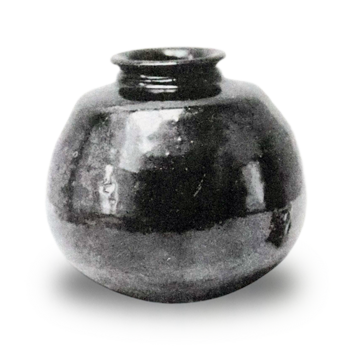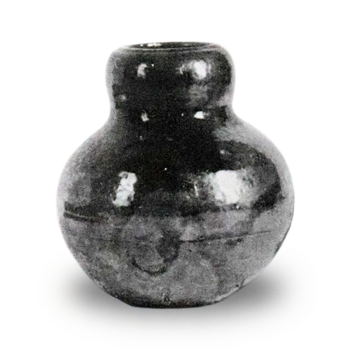


Made in China; Daimeibutsu; Former Name: Otomo Hyotan; Owned by: Tokugawa Yorinori, Marquis
Origin of the Name
It bears this name because Uesugi Kagekatsu kept it as a treasured possession. Its former name, “Otomo Hyotan,” derives from the fact that it was once owned by Otomo Sōrin. It is said to be the finest of the six most renowned gourd-shaped tea caddies in the land.
Dimensions (Converted using 1 sun ≈ 3.03 cm and 1 monme ≈ 3.75 g)
Height: Approx. 6.51 cm (2 sun 1 bu 5 rin)
Body Diameter: Upper bulge approx. 5.76 cm (1 sun 9 bu), lower bulge approx. 6.06 cm (2 sun)
Mouth Diameter: Approx. 2.73 cm (9 bu)
Base Diameter: Approx. 2.58 cm (8 bu 5 rin)
Weight: Approx. 54.0 g (14 monme 4 bu)
Accessories
・Lid: 1 (with a recessed center)
・Tea caddy pouch: White ha-ni-jū fabric; long cord is white
・Cover pouches: 2
Moe-gi-colored ground with a single vine pattern in Kinran (lining is asagi-colored umi-ki; cord is a thin, long white cord)
Aoki Koto-ori (lining: iridescent Kai silk; cord: purple)
・Storage box: Made of natural paulownia wood
“Gourd-shaped Tea Caddy—Kanjima (Chinese Island-style)”
“Inside of Bag No. 2—Kinran”
・Outer box for the bag: Black lacquered, with gold-powdered characters
“Gourd-shaped Tea Caddy”
“Pouch No. 2”
・Hikiya (a tube for storing the tea caddy): Black lacquer
The pouch is made of Konodo-ji (dark blue-green) Kinran with a diamond-and-dragon pattern (lined with brown habutae silk; cord is brown)
・Inner box: Made of natural-finish paulownia wood, with an inscription by Kobori Enshū
“Hyōtan”
・Outer box: Black lacquer, with gold-powdered characters
“Gourd”
Miscellaneous Notes
Tea Caddies: 1. Uesugi Gourd. (The term “Tea Caddy” refers to items owned by the shogunate. A red-ink inscription states, “Submitted as a relic of Matsudaira Hizen-no-kami and bestowed upon Lord Kii.”)
(From the Makuan Bunko edition of Ganka Meibutsu-ki)
Uesugi Gourd—Made in China. It is said to be the finest example among the dozens or even hundreds that Ashikaga Yoshimasa (Higashiyama-dono) ordered from China. Since then, it has passed through the hands of various daimyo dozens of times. Lord Nanryū-in (Tokugawa Yorinobu) received it directly from Lord Daiyū-in (Tokugawa Iemitsu; Note: “Yū-in” in the original text is an error) as a gift to celebrate his retirement. Since then, it has been in the possession of the Kishū Tokugawa family.
(From Kokin Chawa by Kanamori Tokusui)
Among Meibutsu tea caddies, there is one known as the “Uesugi Hyōtan” or “Kageshige Hyōtan.” This was a tea caddy that Uesugi Kagekatsu treasured above all others; it is said that even when going into battle, he would place it in a pouch and hang it around his neck. It is said to be in the possession of the Kishū Tokugawa family today. Sen no Rikyū originally attached a long cord (nagao) to the pouch of this tea caddy, but later remarked, “There is likely no tea caddy in the world superior to this one.” From then on, he cut the long cord and replaced it with a short one (tano), and it is said that Rikyū never again used a long cord throughout his life, relying solely on the short one.
Later, during the era of Kakukaku-sai (the 6th generation head of the Omotesenke school), he deemed it “regrettable that there were no tea caddies to which a nagao could be attached.” Consequently, he had tea caddies with split lids (lids that split in half) made from dead pine wood at Myoki-an in Yamazaki, and by placing them in bags designed for nagao, the practice of attaching nagao was revived.
(From Kokon Chawa by Kanamori Tokusui)
Uesugi Hyotan: Murata Jukō cut a “han-o” (a cord half the usual length) to use with it. The Uesugi Hyotan now has a long cord attached and is housed in Jukō’s pouch. It is made of old Kinran brocade on a light green ground, featuring a small vine-and-arabesque pattern. It is the property of the Kii Clan (the Tokugawa family). The ends of the cord (tonba-saki) are also two strands (two cords). It is said that since the time of Rikyu, the ends of the long cord have been joined together to form a single strand (one cord). However, since all types of half-cords have their ends joined to form a single strand, they can be used with either two strands or a single strand.
(From Sekkenso: A Guide to the Mysteries of the Tea Ceremony)
While the long cord is primarily suited for flat tea caddies (hira-chakin), it has also traditionally been used with tall tea caddies (tate-kō chakin). In Kishū, there is a Meibutsu known as the “Uesugi Hyōtan.” This tradition was passed down from Jukō and Shōō; it consists of an old Kinran pouch with a slightly shorter, light green long cord attached, and this is considered the standard form. Tea caddies are made in China. During the eras of Jukō and Shōō, all used long cords, and when the tradition was passed down to Rikyū, they were still using long cords. Later, Rikyū introduced the use of short cords, and long cords fell out of use thereafter; however, Gensō (the 6th generation of the Urasenke school) consulted with Sōsa (the 5th generation of the Omotesenke school) and Jōsō (the 4th generation of the Mushakōji Senke school), and the use of long cords was revived. The color is primarily reddish-purple. The natsume (a wooden, lacquered container for matcha) does not have a long cord.
(From “Senke Chaji Fuhaku-sai Monjo”: Regarding the Long Cord)
While satin is preferred for the pouches of Chinese-made tea caddies, the Uesugi Hyotan from Kishu is draped in an old Kinran with a pale green background. Since these tea caddies were passed down from Jukō and Shōō, Jushinsai (7th Generation of Omotesenke) stated that using them as a standard would be perfectly acceptable. However, as there are examples of Chinese tea caddies being covered with fabric containing gold thread (kin-ire), silk satin is generally preferred. For Tenmoku tea bowls, a gold-threaded bag is ideal, though there are also examples where silk satin is used.
(From “Senke Chaji: Fuhaku-sai Monogatari,” regarding tea caddy pouches)
Mori Motonari defeated Tō Seiken (Zen’an) at Itsukushima (omitted). In March of the following year, he moved his camp to Suzuma, defeated Naito Takayoshi, and advanced to attack the provincial capital of Nagato Province. Ōuchi Yoshichika, Tō Awa-no-kami, and Tō Gorō were defeated in a single battle and retreated to Chōfuku-ji Temple. Motonari surrounded them and sent an envoy to Ōtomo Sōrin in Bungo Province (Oita Prefecture), conveying the message: “We have cornered your younger brother, Yoshichika. If you wish to spare his life, we will send him to you.” Sōrin’s reply stated: “Since Yoshichika and I are at odds, please do as you see fit, Lord Motonari. However, the gourd-shaped tea caddy once owned by Takeno Jōō has passed from Ōuchi Yoshitaka into Yoshichika’s possession. It would be my greatest wish if you could seize this and send it to me.” Motonari immediately retrieved the tea caddy from Yoshichika and sent it to the Ōtomo clan.
On the 6th of the same month, Yoshichika committed suicide.
(This tea caddy was originally) a personal possession of Lord Ashikaga Yoshimasa; subsequently, Shōō purchased it and passed it on to the Ōtomo clan (※There is a chronological inconsistency here; this may be a confusion with another record), and it eventually reached the Shogun Higashiyama Jishōin (Yoshimasa), after which Motonari acquired it and sent it to the Ōtomo clan. In Tenshō 15 (1587), it was presented to Hideyoshi by Ōtomo Yoshitsuna and became his most prized possession. At the Jurakudai, Hideyoshi personally bestowed it upon Uesugi Chūnagon Kagekatsu, and it remained in the Uesugi family for 50 years, passing down to his son Sadakatsu. Because it remained in the family for such a long time, it came to be known as the “Uesugi Hyōtan.”
Upon Sadakatsu’s death, it was presented to the Shogun (Kōbō) as part of his estate. The Shogun then bestowed it upon Nagatake of Kaga (Maeda Toshitsune), and upon Toshitsune’s death, it was returned to the Shogun. When Kii Dainagon Yorinobu retired, the Shogun personally presented it to him. It is said to be currently in Kii, and is truly a rare treasure of a kind rarely seen.
(From the preface dated Kyōhō 15, Nankai Bunko edition, Zawha Nikki by Kanda Hakuryūshi)
The tea caddy known as the “Uesugi Hyōtan” was brought over from Ming China and became part of Lord Yoshimasa’s personal collection. It was subsequently owned by Shōō, then passed to Ōuchi Yoshitaka, and eventually reached Yoshinaga; Motonari then took it and sent it to the Ōtomo clan. In Tenshō 15 (1587), Ōtomo Yoshitsune presented it to Lord Hideyoshi, and it became his most prized possession. At the Juraku-dai, Lord Hideyoshi bestowed it upon Uesugi Chūnagon Kagekatsu, who held it for 50 years until it passed to his son, Danjō Sadakatsu. Hence, it is known as the “Uesugi Hyōtan.” After Sadakatsu’s death, it was passed down to Lord Toshitsune of Kaga, and it is said to be in Kishū today.
(From Chaji Shuran, Volume 4)
The Hyōtan. Ōuchi Yoshitaka, who held the rank of Dazaifu Daini, was based in Suō and Nagato (Yamaguchi Prefecture). He had inherited the legacy of his forefathers and was steadily expanding his influence, but he became arrogant and neglectful of military affairs, amassing mountains of rare vessels and precious treasures. Among these, the object he treasured and cherished most was a “Hiyodan”—a small, low-sided porcelain vessel used for matcha.
Eventually, his vassal, Tō Harukata, killed Yoshitaka, forced him to flee to Daineiji Temple, brought Hachirō (Ōtomo Yoshichika)—the younger brother of Ōtomo Sōrin—from Bungo to install him as commander, and formed an alliance with the Tadara clan. This was Ōtomo Yoshichika. Umatō Mōri Motonari denounced Harukata’s crimes, attacked him, and killed him. Yoshinaga’s power waned, and he sought reinforcements from Sōrin in Bungo. However, Sōrin was in the midst of a war with a neighboring country and was unable to send troops. Yoshinaga fled to Chōfuku-ji Temple. Upon hearing this, Motonari sent a messenger to Sōrin, saying, “Hachirō’s life hangs by a thread. Out of brotherly affection, you surely cannot bear to stand by and watch him die. If you send someone to fetch him, I will immediately lift the siege and withdraw my troops.” Sōrin flatly refused, saying, “I have long resented Yoshichō for failing to act like a younger brother, and I would be truly delighted if you were to kill him. I have heard that his family possesses a famous artifact called the ‘Hiyodori.’ I would very much like to receive it.” Motonari killed Yoshichō and handed only the Hōtan over to Sōrin. Sōrin was overjoyed to receive it.
During the Tenshō era, Sōrin fought against Shimazu Yoshihisa and suffered repeated defeats, resulting in a significant loss of territory. When Taikō Hideyoshi himself led his troops to subdue Yoshihisa, the various lords of Kyushu submitted to Hideyoshi as if following the wind.
Sōrin presented the gourd to curry favor with Hideyoshi, and it eventually became the Taikō’s property.
Hanpaku-sai (historian) remarks: “The gourd is merely a small jar. Yet it is tied to the rise and fall of a nation. Motonari regarded it as no better than rubble, while Sōrin valued it more than his own flesh and blood (his brothers). From this, one can clearly see that while one rose, the other fell. At that time, Motonari’s ambition lay in conquering the Sanyō region, and he had no time to contend with Sōrin. Therefore, he sent an envoy to inform Sōrin: if Sōrin wished to kill his younger brother, the fault lay with Sōrin, not with Motonari. If Sōrin did not wish to provoke a conflict with Motonari, Motonari used the gourd as bait to lure him out. It can truly be said that Motonari was deeply versed in the art of war. Sōrin killed his younger brother to seize his position, yet instead of regarding Motonari as an enemy, he felt indebted to him. In times of peace, he used a national treasure to entice others; in times of crisis, he offered it as a tribute to ensure his own survival. Could there be anything more unjust than seizing a small, provincial treasure like this?
(From Historical Essays of the Master of Simplicity)
Ōuchi Yoshichika was the younger brother of Ōtomo Sōrin. After being defeated by Mōri Motonari, he attempted to flee to Bungo (Oita Prefecture), but Motonari’s troops pursued him and surrounded Chōfuku-ji Temple, located in a mountain valley. Motonari sent an envoy to the Ōtomo clan, conveying the message: “If you feel pity for your younger brother, send someone to fetch him. We will help him.” Sōrin’s reply was: “Your kindness is most commendable, but since Yoshichika and I have a strained brotherly relationship and he is an unfilial son, let him commit suicide. I hold no grudge against him. However, the Ōuchi clan possesses a gourd-shaped tea caddy. If he is unharmed, I have long desired it and would like to receive it as a gift.” Upon hearing this, Motonari had Yoshichō commit suicide and sent the teapot to the Ōtomo clan. Motonari chose to inform the Ōtomo clan of Yoshichō’s fate rather than kill him himself, out of consideration for avoiding future resentment. The fact that the Ōtomo clan abandoned their younger brother and begged for the teapot must be described as unethical. This tea caddy was made in China and is a Meibutsu without equal in the land. (Excerpt omitted)
Ōuchi Yoshichō possessed a Meibutsu renowned throughout the land, yet his clan was destroyed. It did him no good whatsoever in providing support at that time. For Motonari’s clan, the true Meibutsus of the land were Yoshikawa, Kobayakawa, and Shishido (all influential Mōri warlords), and he eventually became the lord of thirteen provinces. Is this not precisely what makes an outstanding samurai a national treasure?
(From Asano Zatsurai, edited by Kaibara Toshiharu)
In October of Keichō 8 (1603), Lord Tokugawa Ieyasu issued an order through Honda Sado-no-kami (Masanobu): “Invite Lord Hidetada to the residence of Yonezawa Komon (Uesugi Kagekatsu). “Accordingly, make prompt arrangements for construction work and other preparations,” was the imperial decree. Upon hearing this, everyone—from daimyōs to minor lords—became suspicious. “Kageshige was the instigator of the great turmoil at Sekigahara a few years ago. It has not even been many years since he received forgiveness, so this visit is most puzzling. What could be his intentions?” they clamored.
Lord Ieyasu’s reasoning was as follows: Although the daimyo who had sided with Ishida Mitsunari and Uesugi Kagekatsu had been granted amnesty, they were all walking on thin ice, wondering, “What will become of us?” Their minds were unsettled, and it was said that the atmosphere in the realm was somewhat tense. Therefore, to dispel these doubts, he ordered the imperial visit. It is said that later on, everyone was deeply moved by this gesture.
Kageshige was overjoyed at the prospect of Lord Hidetada’s visit. He rushed the construction day and night, and by mid-November, the palace complex—including the study, the main hall, and the sukiya-style tea room—was completed. Consequently, he even went so far as to tell Honda Sado-no-kami, “The coming 28th is an auspicious day, so I humbly request that His Lordship make his visit on that day.” (Omitted)
On the day of the visit, Kagekatsu went out to greet him partway along the route, and once he entered the residence, a banquet was held for several hours, showcasing the utmost in hospitality and beauty. Afterward, when the Lord entered the sukiya, a hanging scroll depicting the “Eight Views of Xiao and Xiang” was displayed, along with treasures passed down through generations of the Uesugi family. Using the “Hyo-tan Tea Jar”—a treasure without equal in the realm bestowed by Taiko Hideyoshi—Kagesato personally served tea to the Lord. Furthermore, when the Taiko proceeded to the study, he bestowed upon Kagekatsu a sword by Sadamune, ten horses from Kurama, and one hundred gold ingots. A “Ichimonji” sword and one hundred silver ingots were bestowed upon Naoe Yamato-no-kami (Kanetsugu).
Kageshige also presented a Masamune tachi. This sword was exactly as his late father, Uesugi Kenshin, had worn it: it had a lightweight hilt with scarlet thread wrapped around the sewn-on scabbard, and the tip of the scabbard was inlaid with a gold-and-silver design featuring a wisteria circle and three cedar trees. Lord Hidetada personally took the sword in his hands to examine it, praised its refined and artistic craftsmanship, and was in high spirits. He also invited several of his personal sarugaku performers (Noh actors) to stage Noh performances throughout the day, and did not return home until after sunset.
By this time, everyone—from the daimyōs who had once been his enemies down to the minor lords—had their doubts dispelled; they felt relieved and shouted “Banzai,” and the world instantly became peaceful and tranquil, with all people universally obeying Lord Ieyasu’s commands.
(From Asano Zōsai, edited by Kaibara Tsunaharu)
Heutan (Hōtan) Kagekatsu.
(From the Kizuka edition of Koori Jihitsu Daimeibutsu-ki)
Uesugi Tsunakatsu (Harima-no-kami). Born in Yonezawa in the 15th year of Kan’ei (1638). On December 29, the 2nd year of Shōhō (1645), he succeeded to his late father’s domain. As a token of gratitude for inheriting the family headship (sūhō), he presented to the shogun a sword by Yoshihiro—a memento of his father (Danjō Shōhi Sadakatsu)—along with a gourd-shaped tea caddy and a hanging scroll by Mokkei depicting “Hirasuna Rakugan.” He died on the 7th day of the intercalary 5th month of Kanbun 4 (1664) at the age of 27.
(From Kansei Shūshū Shokafu)
Maeda Tsunanori (Kaga-no-kami; Hizen-no-kami after retirement; grandson of Toshitsune; posthumous name: Shōun-in). Born in the 20th year of Kan’ei (1643).
On August 21, Shōhō 2 (1645), upon expressing his gratitude for inheriting the family headship, he was granted a wakizashi by Shindo Gokuni by the Shogun. On that day, he presented to the Shogun an Akita Masamune sword—a memento of his father (Mitsutaka)—a calligraphy work by Mittan, and this “Mura Katatsuki” tea caddy. On the 10th day of the intercalary 12th month of Manji 1 (1658), he presented a Shuban Masamune wakizashi—a memento of his grandfather (Toshitsune)—along with a Chinese gourd-shaped tea caddy and a copy of The Tales of Ise written by Fujiwara no Teika.
(From Kansei Shūshū Shokafu)
Record of the Grant of a Tea Jar in the 3rd year of Jōkyō (1686)
- It was once presented by Lord Matsudaira Daizen-no-taifu (of the Mōri clan) to Lord Kii Chūnagon.
The red mesh bag was old, and during a tea ceremony, the “Uesugi Hōtan” tea caddy was brought out. The Senior Councilors passed it around to examine it and selected the mesh bag. On the journey to Senga.
(From Sakurayama Ichiyu’s Notes)
Uesugi Hyotan (gourd). It was presented to the Shogun as a relic of Matsudaira Hizen-no-kami (Maeda Tsunanori). In Kanbun 7 (1667), when Kii Yorinobu retired, he received it from the Shogun’s household.
(From Kishū Family Documents)
The origin of the gourd: it is one of the “Six Gourd Teapots” renowned throughout the land. It is said that the Uesugi Gourd was bestowed upon Lord Amaguni (this is likely an error; it should read “bestowed by Lord Tsunaki”). It is the foremost teapot.
(Inscription on the pouch box of the Tamatsushima Teapot, written by Katagiri Sekishū)
(Note) The “Six Hyōtan” refer to the Uesugi Hyōtan (also known as the Ōtomo Hyōtan), the Inaba Hyōtan, the Shinjuan Hyōtan, the Sakuma Hyōtan, the Chaya Hyōtan, and the Tamatsushima Hyōtan.
History
Originally owned by Ashikaga Yoshimasa, it passed through Murata Jukō and Takeno Jōō before reaching Ōuchi Yoshitaka, and was subsequently passed down to his adopted son, Yoshichika. In the first year of the Kōji era (1555), when Mōri Motonari defeated Sō Seiken at Itsukushima, Yoshichika was defeated in battle and fled to Chōfuku-ji Temple. Motonari sent an envoy to Ōtomo Sōrin, Yoshinaga’s older brother, asking whether he should spare Yoshinaga’s life. Sōrin flatly refused, saying, “I detest Yoshinaga for failing to act like a younger brother. You may kill him if you wish. However, his family possesses a gourd-shaped tea caddy made in Chūgoku. I would very much like to acquire it.” Motonari immediately had Yoshinaga executed and presented this tea caddy to Sōrin.
In Tenshō 15 (1587), when Toyotomi Hideyoshi set out to subjugate Kyushu, Ōtomo Yoshitsune—Sōrin’s son—presented the teapot to Hideyoshi as a gift to curry his favor. Later, at Jurakudai, Hideyoshi himself bestowed it upon Uesugi Kagekatsu. Kagekatsu is said to have cherished it exceptionally, even carrying it around his neck while on military campaigns.
In October of Keichō 8 (1603), Tokugawa Ieyasu ordered Uesugi Kagekatsu to host a banquet for Shogun Hidetada. Upon hearing that this was intended to calm the unrest in the country—as it was shortly after the Battle of Sekigahara—Kagekatsu was overjoyed and made all necessary preparations, including the construction of a new building.
Then, on November 28, upon the arrival of the retired shogun Ieyasu and Shogun Hidetada, he personally prepared tea using the gourd-shaped tea caddy and presented it to them.
Since this tea caddy remained in the possession of the Uesugi family for 50 years, from Kagekatsu to Sadakatsu, it came to be known in the world as the “Uesugi Hyotan.” After Sadakatsu’s death, his son Tsunakatsu inherited the domain, and on December 29, Shōhō 2 (1645), as a token of gratitude for the inheritance, he presented this item—a memento of his father—to the shogunate.
It was subsequently bestowed by the shogunate upon Maeda Toshitsune, the lord of the Kaga Domain; however, on the 10th day of the intercalary 12th month of Manji 1 (1658), Toshitsune’s grandson, Tsunanori, once again presented it to the shogunate as a memento of his grandfather. In the first month of Kanbun 7 (1667), when Tokugawa Yorinobu, the Kii Daikan, was about to retire, the shogunate bestowed this item upon him. Since then, it has been passed down through the generations to the present day and is considered the most treasured artifact of the Kishū family.
Record of Actual Viewing
On October 9, Taishō 8 (1919), I had the privilege of viewing this piece in person at the residence of Marquis Tokugawa Yorimichi in Iikura-chō, Azabu Ward, Tokyo.
It is thin-walled and exquisitely crafted, with a single recessed groove running around the rim to form a step. The body features two lines: the upper line is short, while the lower line is slightly longer, extending to more than two-thirds of the tea caddy’s height. On a persimmon-colored base with a metallic luster (kinki), a blackish amber glaze forms a pattern resembling quail spots (junban). When viewed from the front, the black amber glaze flows thickly from the rim of the mouth down to the shoulder, stopping near the base where it meets the tray.
Within the persimmon-colored, metallic-luster base glaze, areas of glaze absence (unglazed sections) of the same color form a pattern, and several black amber glazes of varying sizes are scattered haphazardly throughout. Around the rim, the unglazed clay of vermilion-brown (reddish-brown) color is exposed at irregular heights, and the thread-cut finish is somewhat coarse.
The glaze is thick and soft, and the shape, slightly resembling a gourd, is graceful and dignified. It feels light in the hand, has a beautiful luster, and its visual variations are beyond words. It is by no means a coincidence that it has long been regarded as the foremost of the “Six Gourd Vases of the World.”