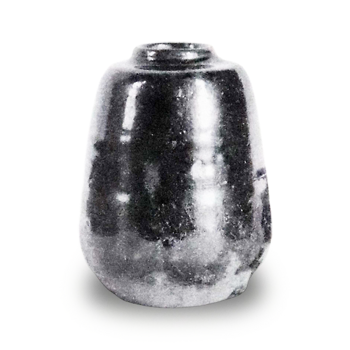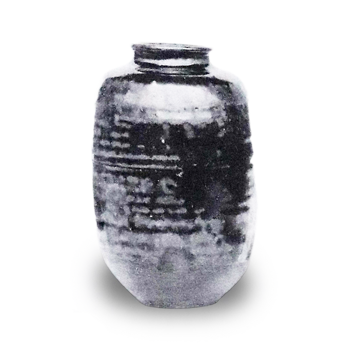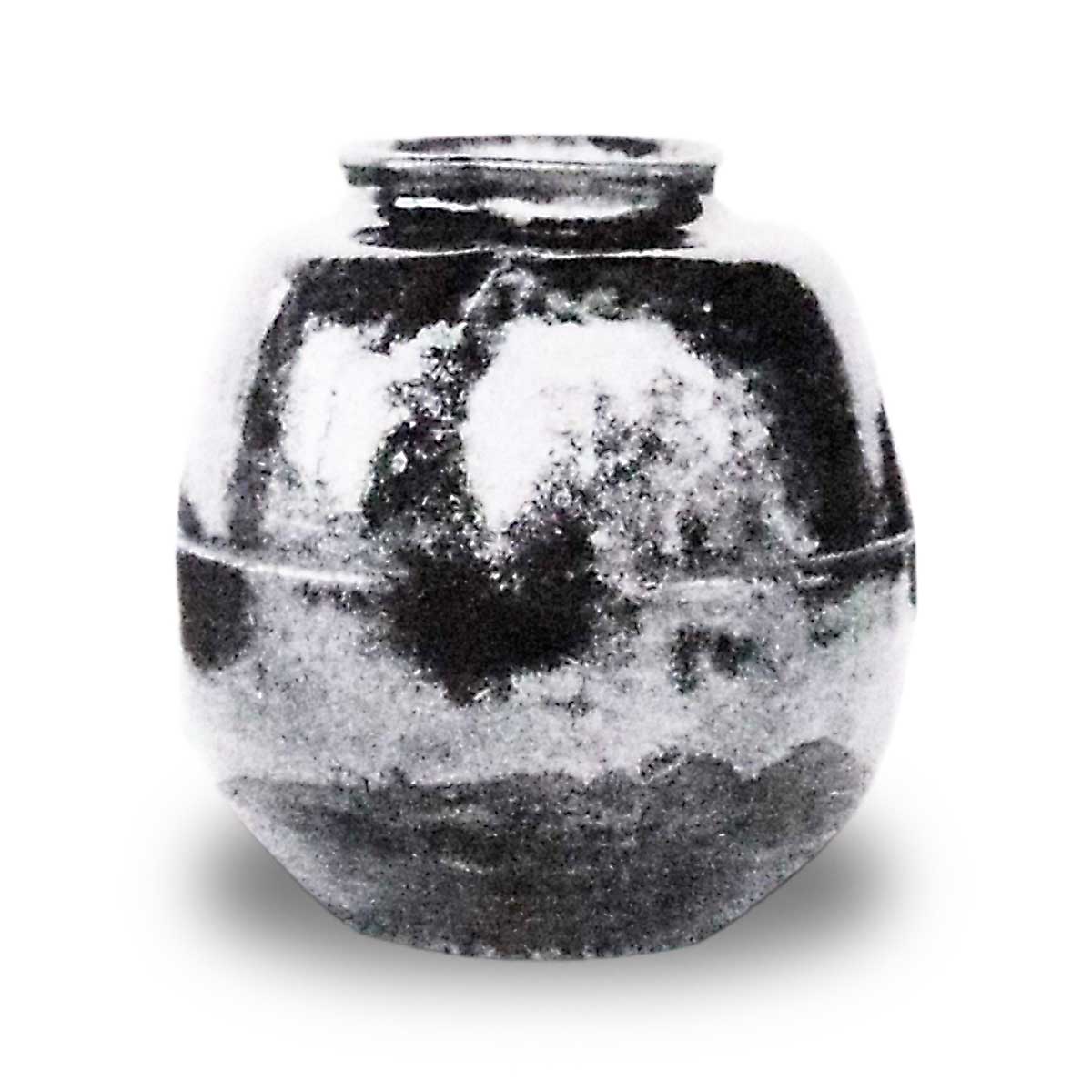
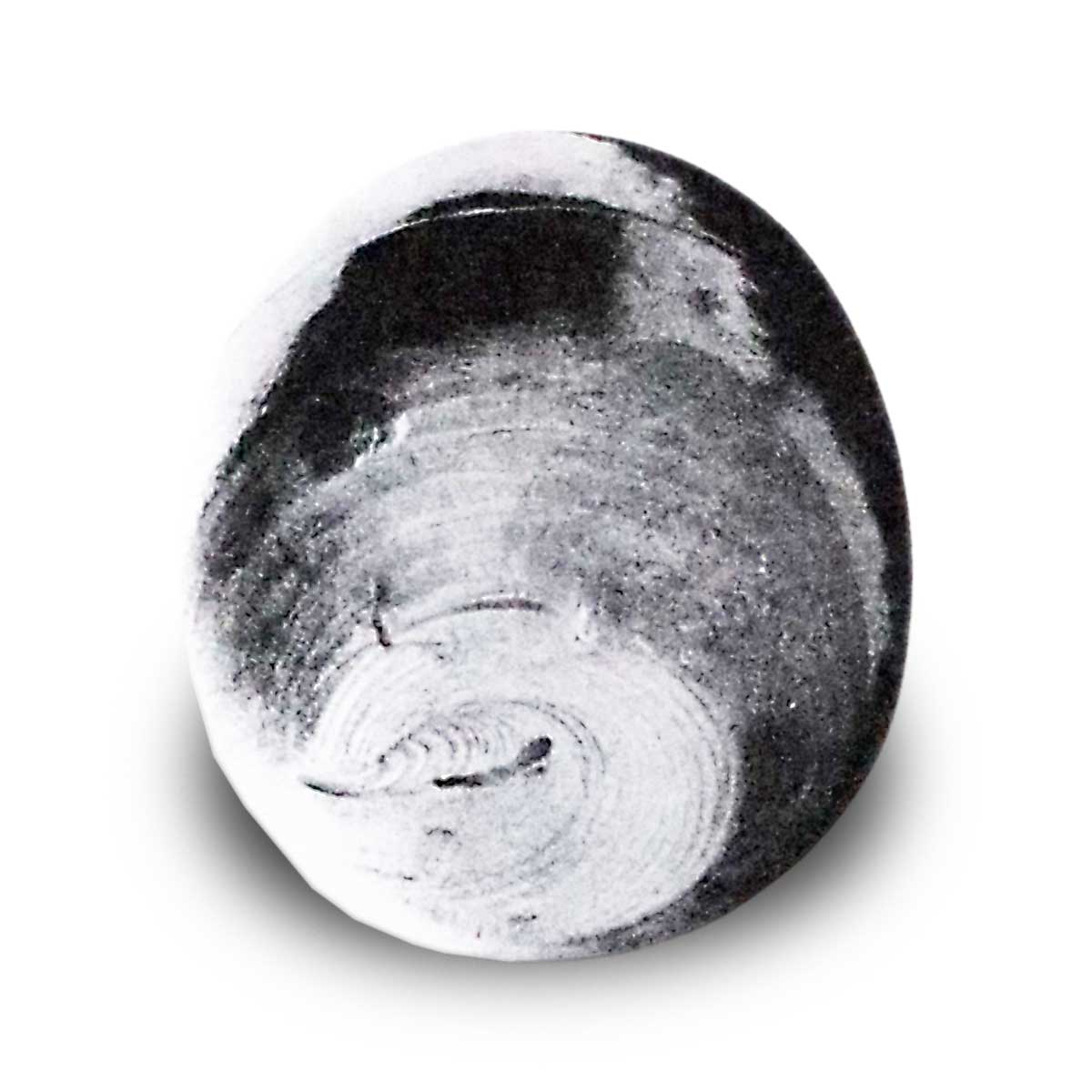
Old Seto, Daimeibutsu, Collection of Count Tadamichi Sakai
Name
This name derives from the fact that it was treasured by the Yamauchi family, lords of the Tosa Domain.
Dimensions
Height: Approx. 7.1 cm (2 sun 3 bu 5 ri)
Body diameter: Approx. 6.8 cm (2 sun 2 bu 5 ri)
Mouth diameter: approx. 3.6 cm (1 sun 2 bu)
Base diameter: approx. 3.6 cm (1 sun 2 bu)
Koshiki (rim) height: approx. 0.6 cm (2 bu)
Shoulder width: approx. 0.63 cm (2 bu 1 rin)
Weight: approx. 120.8 g (32 monme 2 bu)
Accessories
・Lids: 3 pieces (nest)
・Storage pouch: Round pouch made of white chirimen silk; white cord
・Pouches: 3 pieces
- Keitō-gire pattern; cord: dark brown; lining: hanada blue
- Shimizu-gire pattern with bird-and-paulownia motif; cord: Enshū brown; lining: persimmon color
- Karamono Asagi-Donshu pattern; cord: purple; lining: moegi-kaiki green
・Pouch box: Black-lacquered kichōmen style, rings in gold-plated red copper, purple cord
Interior lining: White karabirudo (Chinese swan velvet)
Inscribed “Yamauchi Katatsuki”
(Note) The tea ceremony text in Hōan Bunko Series A, No. 17 states that this pouch box is believed to date from the Higashiyama period.
・Antique Pouch: 1 piece
White-ground antique Kinran
・Pouch Box: Black lacquer; a “kakego” (nested) style box containing two lids
The inscription on the front of the box lid reads as follows
“To Lord Kamio of Wakasa
Pouch for a used Seto tea caddy lid
Presented by Yamauchi Magoshirō”
The inscription on the underside of the box lid reads as follows
“White-ground Kinran pouch. The outer layer is an old pouch. A cord is attached to the underside. The lining has been replaced with pale yellow fabric; there is one lid. The interior lining features a small shiba (pattern) in gold paper.
This was made according to the order (goshikiyose) of Lord Kamio Wakasa-no-kami; the pouch’s lining has been replaced, and the lid is newly made.
July 4, Enpō 4 (1676)”
・Hikiya: Black lacquer
Pouch: Pale yellow ground with a broken white hollyhock pattern (Donshu); purple cord; lining in “Umi-ki”
・Inner box: Natural white paulownia wood
Inscribed: “Seto Tea Caddy, Yamauchi”
・Outer box: Black lacquer with gold-powder lettering
Inscribed: “Seto, Katatsuki, Yamauchi”
・Accompanying documents: 2 letters
Receipt
- 250 ryō in gold. However, in the form of banknotes.
Additionally, 20 ryō in gold as a reward.
Seto Yamauchi tea caddy.
Three pouches, enclosed in two boxes.
As stated above, I have indeed received the payment for the sale.
Honya Heizo
December 27, Year of the Horse (Meiji 3)
To Mr. Narita Kiichi
To Mr. Ueda Tetsuji
(Note) Narita Kiichi and Ueda Tetsuji were both stewards of the Sakai family of the Wakasa-Obama Domain (Wakashū).
This is an antique Seto tea caddy that had been passed down through generations in the Yamauchi family of Tosa-Kōchi. Lord Yōdō Toyonobu (Yamauchi Yōdō), the retired head of the family, recently sold it, and we were able to purchase it.
Meiji 3, Year of the Horse (1870), December 29
Miscellaneous Notes
“Yamauchi Katatsuki, Matsudaira Tosa-no-kami”: (From Kobutsuki)
“Yamauchi, Seto Katatsuki, Matsudaira Tosa-dono”: (From Gankō Meibutsu-ki)
“Yamauchi, Seto Katatsuki, Daimeibutsu, Matsudaira Tosa-no-kami”: (From Kokin Meibutsu Ruiju)
Yamauchi Tea Caddy: A masterpiece by Fujishiro. Viewed on March 22, Meiji 4 (1871), Year of the Goat, at the residence of Count Sakai in Yarai-chō, Ushigome Ward, Tokyo. There is an inconspicuous chamfer on the shoulder. A thick band resembling black clouds is applied against a persimmon-colored ground, creating a magnificent effect. The “okitsuchi” (base) is visible. The carrying case is a black-lacquered folding box; the ring is either gold-plated red copper or has a purple cord. It is believed to date from the Higashiyama period. The interior lining is white Chinese velvet. The box is designed to hold three pouches. The handle is black-lacquered, and the pouch for the tea caddy is made of white chirimen silk. The lid is a single, thick piece with a slight indentation.
(Illustration of the tea caddy included)
(Hōan Bunko, Series A, No. 17)
History of Ownership
It is unclear exactly when the Yamauchi Katatsuki entered the Yamauchi family’s possession; however, since it is recorded as belonging to “Matsudaira Tosa-no-kami” in the Kobimono-ki and Ganka-bimono-ki, it is evident that it was already in the family’s possession prior to the Manji era (1658–1661).
Now, according to an account from someone who knows the circumstances under which this tea caddy came into the possession of Lord Sakai Wakushū (of the Sakai family, lords of the Obama Domain) at the end of Meiji 3, sencha utensils were very much in vogue at the time, and items such as matcha utensils were largely ignored. Lord Yamauchi Yodo also favored sencha, so his residence was frequently visited by literati and antique dealers. One day, while they were chatting casually in Lord Yodo’s presence, they were persistently disparaging matcha utensils. Upon hearing this, Lord Yodo remarked, “Even among matcha utensils, items like the Yamauchi Katatsuki passed down in my family are an exception. Come and see for yourselves,” he said, proudly displaying the tea caddy. However, the antique dealers replied, “Even for such a Meibutsu tea caddy, it surely wouldn’t fetch more than 100 yen in today’s market.” A man named “Honya Heizo,” who had long been a connoisseur of matcha sets and was renowned for his discerning eye, was standing nearby and overheard this. Outraged, he blurted out, “I’ll take it for 300 yen.” He immediately ran to the residence of Lord Sakai Wakushū and recounted the entire story. The lord (Onryō-in), who had devoted himself to acquiring matcha utensils since before the Meiji Restoration, agreed to purchase it at the price offered. Although Lord Yōdō had no intention of selling it in the first place, given the circumstances, he found himself unable to back down and ultimately had to part with it.
Record of Actual Viewing
On April 25, Taisho 8 (1919), I viewed this piece in person at the residence of Count Tadamichi Sakai in Yarai-cho, Ushigome Ward, Tokyo.
The rim is somewhat thick, and the fold on the inner edge of the rim is shallow. The shoulder is slightly rounded, and the overall shape is round, resembling that of Bunrin ware. It has a purple hue with a light brown or metallic sheen (golden luster), and a thick layer of black glaze covers the area from the rim to the shoulder. There is a single horizontal groove on the body, and above it are two areas of persimmon-colored glaze where the metallic sheen has faded. The glaze drips (decoration) stop approximately 0.9 cm (3 bu) below the groove on the body, where the black glaze ends at the shoulder. The glaze coverage around the rim is uneven in height, creating a “missing frame” effect, with areas where the unglazed clay body is visible through the glaze. From the waist down, the wheel marks are deep, and there are traces of the modeling spatula. The thread cut (mark on the base) is slightly irregular, giving it a distinctive charm, and in its center is a small, horizontally elongated hole resembling a wormhole. There is one instance of a stone crack (a mark where a stone within the clay has burst) around the base. Additionally, there is a single spot of persimmon-gold-colored spatter glaze within the clay at the rim. Inside, the glaze extends up to the shoulder area; below that, the unglazed clay body is fully exposed, and there is some glaze weathering on the bottom. This tea jar offers many points of interest and fully embodies the aesthetic of wabi-sabi.