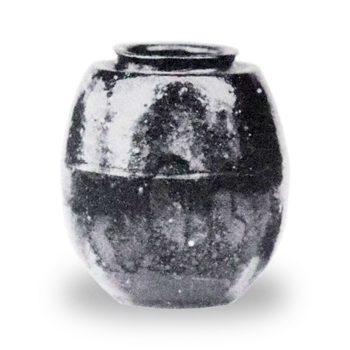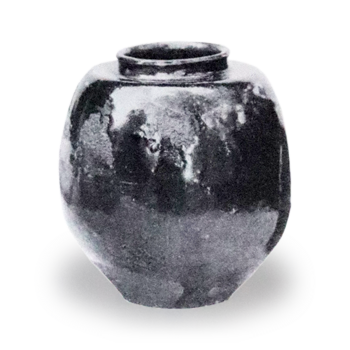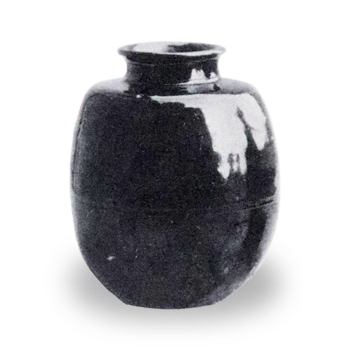

Daimeibutsu; Collection of Baron Iwasaki Koyata
Regarding the Name
Named for its compact size as a katatsuki tea caddy.
Dimensions
Height: 2 sun 3 bu (approx. 6.97 cm)
Body diameter: 1 sun 9 bu 3 rin (approx. 5.85 cm)
Mouth diameter: 9 bu (approx. 2.73 cm)
Base diameter: 1 sun (approx. 3.03 cm)
Height of the koshiki (the raised rim around the mouth): 2 bu 8 rin (approx. 0.85 cm)
Shoulder width: 3 bu (approx. 0.91 cm)
Weight: 16 monme 5 bu (approx. 61.9 g)
Accessories
Lids: 2 (stored in the inner box of the pouch)
Suba-kabuse lid: Made by Kyumi, in the style preferred by Furuta Oribe
Wooden lid: Made by Tachiko, in the style preferred by Lord Kenzan (Date Tsunamura)
(Note) Lord Kenzan is the posthumous name given to Date Tsunamura. He passed away on October 1, 1719 (Kyōhō 4), at the age of 60.
One storage pouch: White chirimen silk; white braided cord
One pouch (cover): 4 pieces
Navy ground with Kinran tortoise shell pattern: Lining is yellow Kai silk; braided cord is purple
Guangdong-woven fabric: Lining is iridescent, braided cord is purple
Mouru: Lining is red Kai silk, braided cord is purple
Brown-ground antique Kinran: Lining is patterned kabedai, braided cord is wisteria-colored
One storage box: Unfinished paulownia wood
Inscribed: “Four small katatoki bags, one lid”
One Hikiya: Made of Karin wood, with characters in gold powder
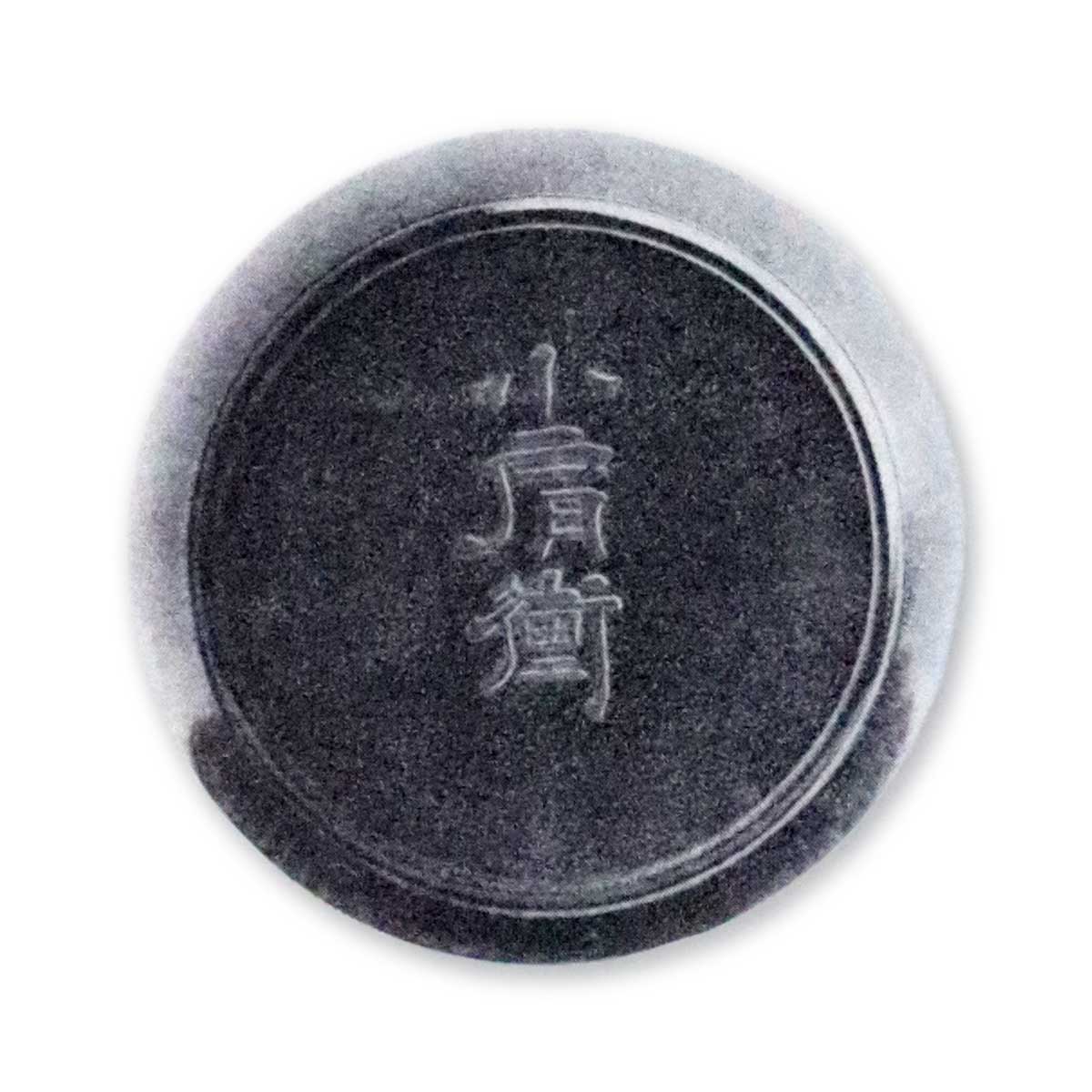
“Small Katatsuki”
Inscription by Kobori Gonjuro
Bag (cover): Gold-threaded satin, lining is brown with a striped pattern, braided cord is brown
One inner box: Paulownia wood, with an inscription in black lacquer, written by Kobori Gonjuro
“Small Shoulder-Strike”
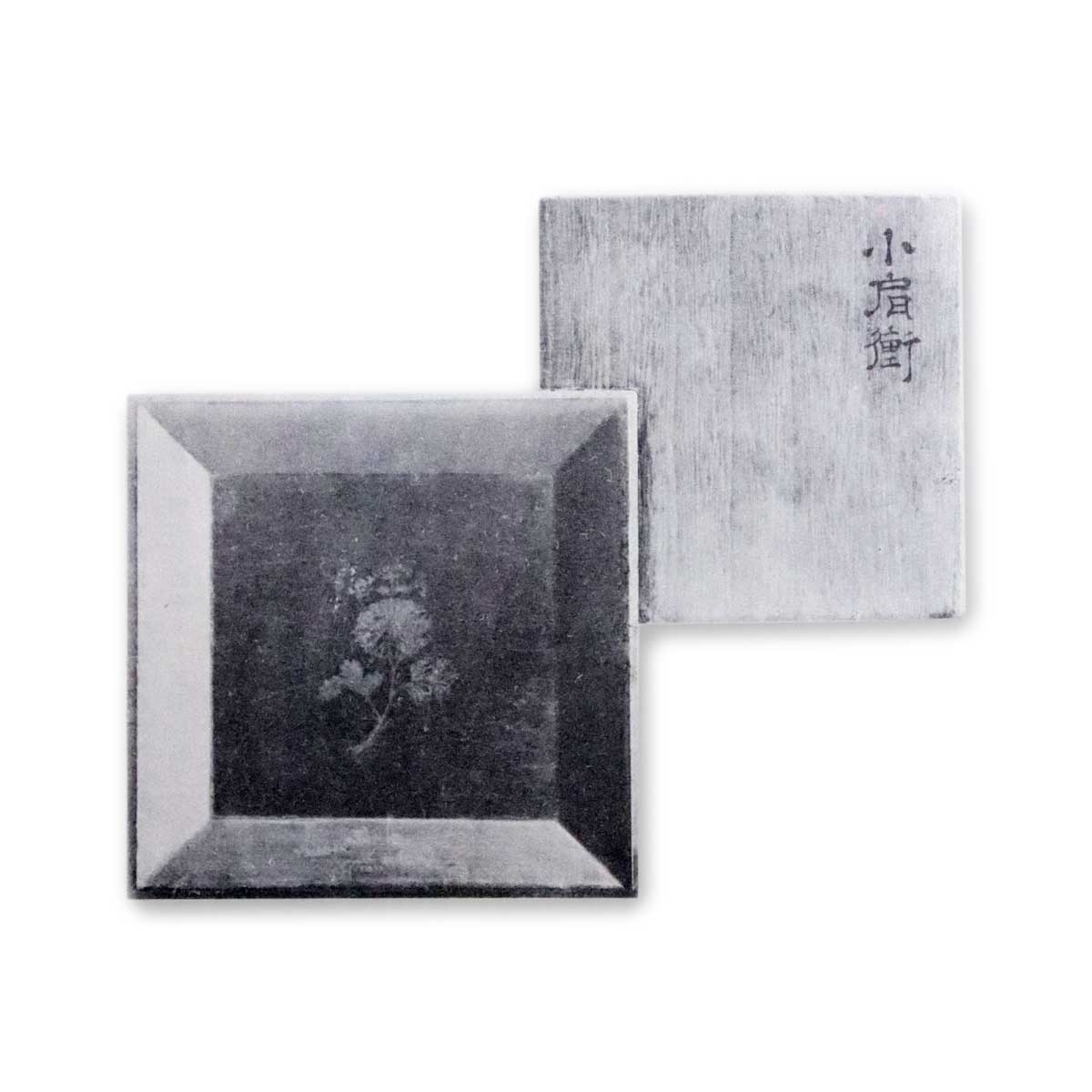
One accompanying tray: A square tray with a black lacquer finish and a pattern of chrysanthemum branches
Diameter 5 sun 5 bu (approx. 16.7 cm), diameter of the mirror (flat inner surface) 3 sun 9 bu (approx. 11.8 cm), base diameter 4 sun 7 bu (approx. 14.2 cm), height 6 bu 2 rin (approx. 1.9 cm)
Wrapping: Dutch cotton; lining is brown-ground umi-ki
Box: Untreated paulownia wood
“Kogatatsumi Bowl with Chrysanthemum Branches”
Single-compartment box: Paulownia wood with Shunkei lacquer; features characters in gold powder
“Kogatatsumi”
Miscellaneous Notes
Small Shoulder-Strike: Chinese import; Daimeibutsu owned by Matsudaira Mutsu-no-kami (Date clan). It comes with three pouches: one with a navy ground and Kinran brocade tortoiseshell crest, lined with iridescent “kaiki”; one with a ‘kamuto’ (Guangdong) woven fabric, lined with iridescent fabric; and another lined with “kabedai” (wall-patterned fabric). Hikiya is named after Karin, with an inscription by Kobori Gonjuro; the pouch is made of satin with gold thread, and the lining features a striped pattern with the character “cha” (tea). The outer box is made of paulownia wood, accompanied by a square tray with a black lacquer finish and Chinese-style chrysanthemum maki-e (illustration of a tea caddy included).
(From Kokin Meibutsu Ruiju)
Small shoulder-rest. Owned by Matsudaira Mutsu-no-kami (of the Date clan). Borrowed and inspected on July 2, 1739 (Genbun 4, the Year of the Goat). It comes with four pouches: one with a navy blue ground and Kinran brocade tortoise-shell pattern, lined with iridescent silk; one woven in the Kantō (Guangdong) style, lined with a brown circular pattern; one lined with kakemono; and one lined with Shokkin, likely in iridescent silk. The descriptions of other accessories are the same as in the Meibutsu Ruiju. An illustration of the tea caddy is included.
(From Meibutsu Ki)
Small Shoulder-Rest Tea Caddy: Chinese import. Owned by Lord Matsudaira Mutsu-no-kami.
(From Ganka Meibutsu-ki and Komeibutsu-ki)
Date Masamune. Matsudaira Mutsu-no-kami. In Keichō 4 (1599), he received the small shoulder-rest tea caddy as a gift from Tōshōgū (Tokugawa Ieyasu).
(From Kansei Shūshū Shokke-fu)
History
This item was bestowed upon Date Masamune, the first lord of the Sendai Domain, by Tokugawa Ieyasu in Keichō 4 (1599). During the Tenpō era (1830–1844), it was entrusted to Sumiya Honosuke (Sumiya), a merchant (kinkata) serving the Sendai Domain in Osaka, along with other Meibutsu such as the Higuchi Katatsuki, Kiba Saru, and Hai-kabe. However, it is said that every year during the period for airing out the items (exposure to fresh air), an envoy from the Sendai Domain would travel to Sumiho’s residence. After the Meiji Restoration, it came into the possession of the Iwasaki family, along with the Higuchi Katatsuki.
Record of Actual Viewing
On November 4, 1920 (Taisho 9), I had the opportunity to view this item in person at the residence of Baron Koyata Iwasaki in Takanawa Minamicho, Shiba Ward, Tokyo.
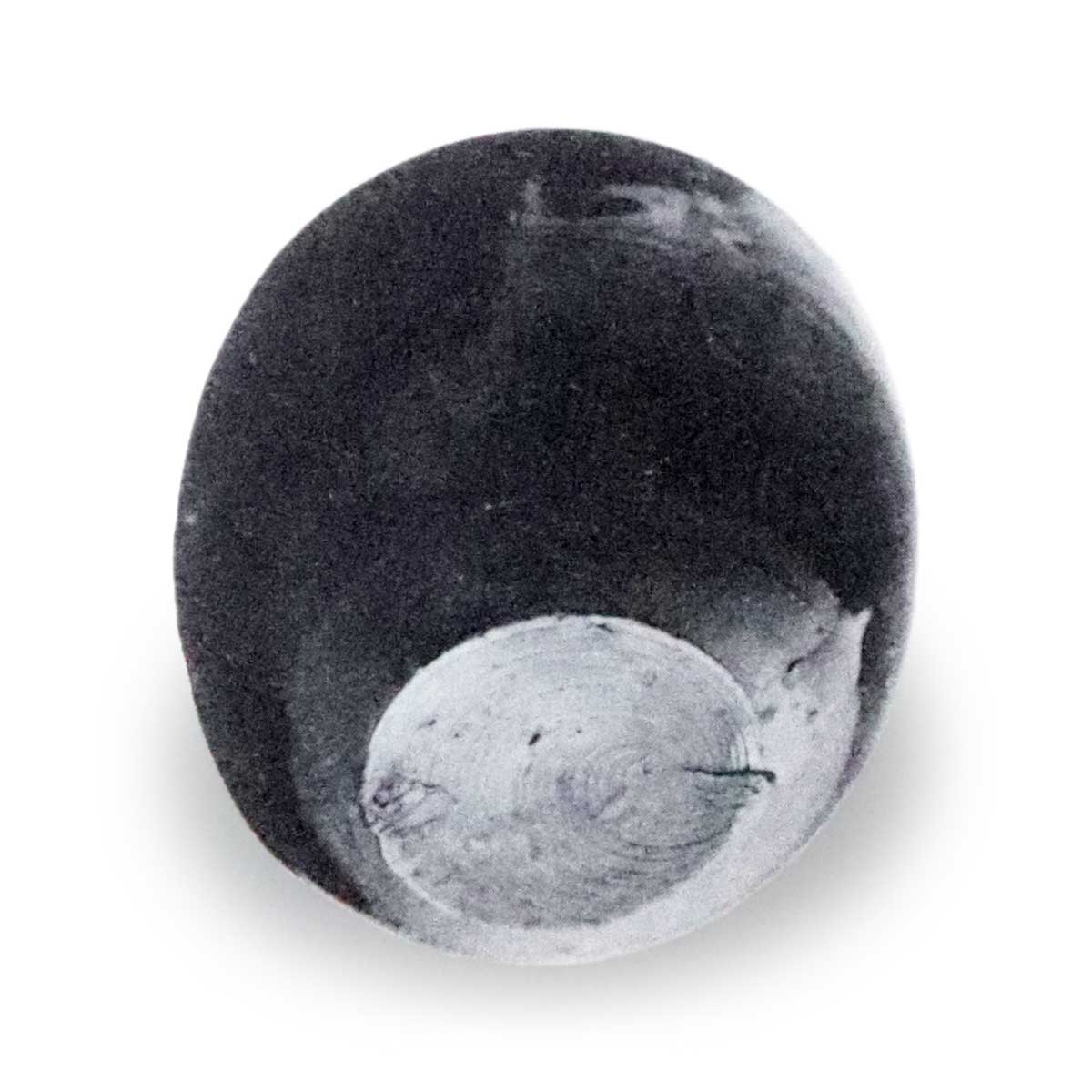
The rim is folded inward somewhat deeply; there is a single sunken groove around the rim (the raised part of the mouth), and the shoulders protrude distinctly. The body gradually expands from the middle to the lower section, and from the hem downward, it tapers with a plump, rounded shape. The clay is mouse-gray in color, and the thread-cutting marks on the bottom are fine, with slight misalignment at the starting points. Additionally, there is one small chip and one instance of clay adhesion.
Overall, the gloss of the dark amber glaze is beautiful, and shallow wheel marks run around the body. Near the front view, there is a single yellowish glaze run that flows down from both sides of the shoulder, merging and stopping at the base. To the left of this run, there is another similar run. Additionally, the body features a slightly thick, sunken line extending across two-thirds of the tea caddy. On the right side of the front view, a persimmon-colored glaze with a metallic luster (a hint of gold) extends from the tip of the shoulder to the rim. Below the cord-like streak on the body, there is an area where the blue glaze has not adhered, outlined in a dark amber color, which adds a further touch of charm (a scenic element) to this tea caddy.
Inside, the rim is glazed, while below it, wheel marks run around the interior, and the center of the base features a swirl pattern. The amber-colored glaze covering the entire piece is so lustrous that it reflects objects, and the intermingling of yellow, blue, and persimmon-colored glazes creates a visual variation that is beyond description.
Small-shouldered Tang-style tea caddies are extremely rare, but among them, this tea caddy is exceptional in both form and glaze color, standing shoulder-to-shoulder with the Meibutsu “Fuji-san Katatsuki.” There is a single fine crack (kiln damage) running from the rim to the base of the body, but otherwise, it is flawless.