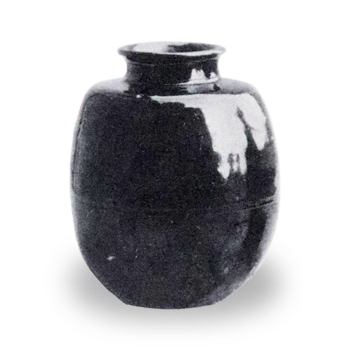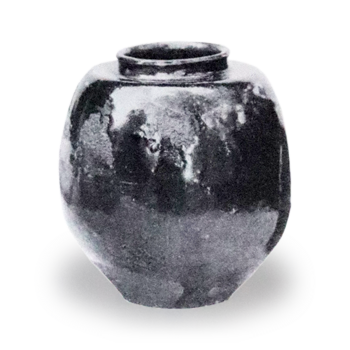


Chinese Import; Hachiman Meibutsu; Collection of Baron Takashi Masuda
Regarding the Name
Since the shape of this tea caddy vaguely resembles a frog, it was likely named after the following poem by former Grand Counselor Tadayoshi, which was among the 100 poems he dedicated in the “Miscellaneous Songs” section of the Shin Kokin Wakashū:
“When the time comes, even this is, as expected, touching
The evening chorus of the frogs in the rice fields”
(When the season calls for it, this too is truly poignant. The evening call of the frog in the rice fields)
It was likely named after this poem. Furthermore, while the Japanese kun’yomi reading of “kaeru” (frog) is “kahasu,” the inscription on the box reads “kahazu,” so we will not change it at this time.
Dimensions
Height: 2 sun (approx. 6.06 cm)
Body diameter: 1 sun 9 bu (approx. 5.76 cm)
Mouth diameter: 9 bu (approx. 2.73 cm) or 8 bu
Base diameter: 9 bu (approx. 2.73 cm)
Shoulder width: 2 bu (approx. 0.6 cm)
Koshiki (the raised rim of the mouth) height: 1 bu 5 rin (approx. 0.45 cm)
Weight: 17 monme 2 bu (approx. 64.5 g)
Accessories
One lid: 1 piece, made of ivory
Two pouches (covering bags): 2 pieces
Donshu Junko’s floral-patterned bag: Lining is iridescent, braided cord is purple
Yasaburo Koto’s single-sided bag: Lining is iridescent, braided cord is wisteria-colored
Shitagasane (inner pouch): Donshu
One pouch box: Paulownia wood, newly made
Inscribed: “Kahazu Pouch No. 2 (2 pieces)”
One inner box: Unfinished Paulownia wood, with an inscription by Kobori Enshu
Front: “Kahazu”
Back: “Shinkokin: If I were to encounter it, this too would surely be poignant—the evening call of the Oda kahazu”
One medium box: Untreated paulownia wood, with an inscription by Murakoshi Choseisai
Front: “Kahazu”
Back: “Bag No. 2, Donshu Kozaemon, assembled by Yasaburo Koto, substitute for the body, Choseisai (with seal)”
One outer box: Paulownia wood with Shunkei lacquer finish
One master box: Untreated paulownia wood
Accompanying Tray: A small Wakasa-nuri lacquered tray; the rim is coated in blue lacquer; the interior and exterior are coated in black lacquer
5 sun 6 bu (approx. 17 cm) square; the mirror (the flat inner surface) is 4 sun 1 bu (approx. 12.4 cm) square; the base is 4 sun 1 bu square; height 7 bu 5 rin (approx. 2.3 cm)
Bag: Donshu Junko; lining is vermilion-striped Kai silk; braided cord is brown
Miscellaneous Notes
Donshu Katatsuki (Hazu). Height 2 sun, body diameter 1 sun 9 bu, shoulder width 1 sun 4 bu, mouth diameter 9 bu 1 rin, base diameter 9 bu 5 rin, shoulder width 2 bu. The glaze is a pale amber color with a slightly blackish tint; the clay has a poor texture and is red clay. There are glaze splatters on the thread-cut sections. There are two pouches: the Kosazaemon Donshu features arabesques, birds, and a “lost sheep” (an unidentified pattern) on a floral background. The other is a Katamigae (a piece made by joining two different fabrics) by Yazaemon Kanto and Shirogoku Donshu. The box is in excellent condition. A lid shaped like a medicine box. It bears the inscription “Kahazu” in the handwriting of the Lord of Enshū, and on the reverse side reads: “In the Shin Kokin Wakashū, when I happen upon this verse, I cannot help but feel its poignancy: ‘The evening call of the frog at Oda.’” The pouch inside the box is made of striped velvet. The box containing the pouch is said to have been made later and is new (illustration of the tea caddy and box included).
(From Takimoto-bo’s Record of Meibutsu)
Frog (Kahazu). Formerly owned by Shokado. A Chinese import. The black glaze has a cascading pattern. A small tea caddy. It bears an inscription by Lord Soho (Kobori Enshu) that reads: “If one happens to encounter this, it is indeed touching—the evening croak of the frog in Oda.” (Illustration of the tea caddy included).
(From Meibutsu-shū)
Frog. The front view features black glazing with a cascading effect; the body is dark amber in color and bears traces of a “hon-ito-kiri” (formal thread-cutting). “When encountered at the right moment, this too is truly poignant: the evening croak of the frog in Oda” (Illustration of the tea caddy included).
(From Meibutsu Mekiri Monogatari)
June 3, 1775 (An’ei 4, Year of the Goat)
At Kitano, Osaka (Naniwa): A tea gathering hosted by Takimoto-bo
Guests: Kano Sohaku, Hosoya Sohyu, Hosoya Mataemon, Hosoya Hikojiro, Doya Kahei
One hanging scroll: Jointly inscribed by Priest Kogetsu and Priest Sawan
One flower vase: Flying celadon; the flower is a white feather-cloak (possibly a type of camellia)
One tea bowl: Tamago-de style, inscribed “Hakusei”
One tea caddy: Chinese-style katamuki, inscribed “Kahazu” by Enshu
“If I happen to hear it, this too is truly poignant: The evening call of the frogs by the Oda River”
Tray: Seikai (possibly Aomi-bon), black lacquer on the outside and vermilion lacquer on the inside
(From the book by Miki Sōgi, “Shokke Kaiseki Tsuki”)
Provenance
Originally owned by Shokado (Shōjō), it was later passed down to Iseya, a ticket broker in Kuramae, Edo—specifically to Murakoshi Shirojirō (pen name: Choseisai)—and subsequently became the property of the Masuda family.
Visual Inspection Record
On July 18, 1920 (Taisho 9), I had the opportunity to view the items in person at the residence of Baron Takao Masuda in Gotenyama, Shinagawa, Tokyo Prefecture.
The rim is rounded, with a shallow inward fold, and the vessel is thinly made. The foot (the raised portion at the rim) is low, and while the shoulders protrude, they gradually round out from the tips of the shoulders to the waist, and the body tapers sharply from the waist downward.
The entire piece is covered in a dark amber glaze, and the body features a single thick, sunken groove extending over two-thirds of the tea caddy. Above this groove, there are two spots of clay adhesion about the size of a fingertip; additionally, there is one spot on the groove itself and two spots below it, making a total of three spots of adhesion of varying sizes.
From the hem downward, the reddish-brown clay is visible; the thread-cutting marks are fine and distinct, though there is a splash of black glaze midway along them. On the front, there is a single dark amber-colored glaze run that stops at the base (the part in contact with the surface), where the glaze has pooled thickly.
There are two lacquer repairs on the rim, and from there to the tip of the shoulder, there are two additional repairs for cracks. Inside, the glaze covers the rim, and below that, shallow wheel marks run around the interior, with a swirl pattern in the center of the base.
The entire piece has a beautiful, glossy black-brown luster and a compact form; it was likely named for its vague resemblance to a frog. Although this tea caddy is a solid black-brown and appears to have very few visual highlights, the glaze adhesion visible beneath the cord-like lines on the body compensates for this and adds great charm—a fact that could be called a miracle (a rare charm) in itself.