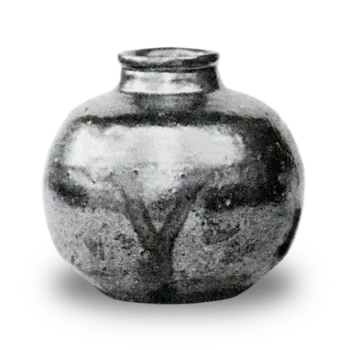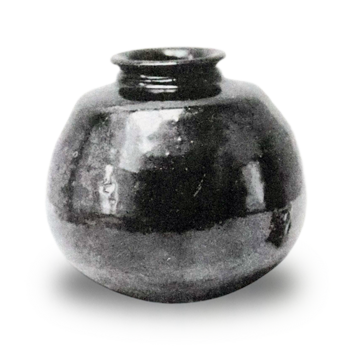


Made in China; Daimeibutsu; Collection of Viscount Hidenobu Koide
Origin of the Name
It is said that this tea caddy was named “Bunka” because its shape is difficult to distinguish as either “Bunrin” or “eggplant.” There is no consensus on who named it; some say it was Toyotomi Hideyoshi (Lord Toyo), others say it was Takeno Jōō or Sen no Rikyū, and still others say it was Sakuma Fukansai.
Dimensions (converted using 1 sun ≈ 3.03 cm and 1 monme ≈ 3.75 g)
Height: Approx. 6.88 cm (2 sun 2 bu 7 rin)
Body diameter: approx. 7.42 cm (2 sun 4 bu 5 rin)
Mouth diameter: approx. 3.33 cm (1 sun 1 bu)
Base diameter: approx. 3.33 cm (1 sun 1 bu) or approx. 4.55 cm (1 sun 5 bu)
Shoulder width: Approx. 1.21 cm (4 bu)
Height of the koshiki (neck ring): Approx. 0.76 cm (2 bu 5 rin)
Weight: Approx. 87.0 g (23 monme 2 bu)
Accessories
・Lids: 2 (with indentations; in the styles preferred by Furuta Oribe and Kobori Enshū)
・Storage pouches (for the tea caddy): 2
White chirimen (with white cord): For holding the genuine “Bun-nasu”
White chirimen (with brown cord): For holding the replica “Bun-nasu”
・Cover pouches: 4
Azuma Guangdong weave (lining: light brown “Umi-ki,” cord: brown): Sen no Rikyū style
Tea-colored arabesque satin (lining: brown “kaiki,” cord: pale yellow): in the style of Furuta Oribe
Pale yellow maru-ryū satin (Shigiya satin) (lining: “kakidai,” cord: purple): in the style of Kanamori Sōwa
Scaled-pattern satin (lining: “kakidai,” cord: purple): in the style of Kobori Enshū
・Pouch box: Made of natural paulownia wood, with a hanging compartment (inner box) featuring four dividers
“Bunka”
・Hikiya (a tube for storing the tea caddy): Black lacquered, with large chamfered edges
Pouch made of iris-patterned leather; cord in Onado color
・Box: Made of natural paulownia wood
Pouch made of iris-patterned leather
・Outer box: Made of paulownia wood, with a lock
“Bunka”
・Accompanying tray: Ajiro-style tray. Black lacquered with a tiered interior and a pine, bamboo, and plum motif.
The sides are vermilion, and the rim is tin.
Length: approx. 20.91 cm (6 sun 9 bu), Width: approx. 18.79 cm (6 sun 2 bu), Height: approx. 1.21 cm (4 bu)
The inner box is made of natural-finish paulownia wood
“Bunka”
Front
Tray
曾 belonged to Sakuma Shōgan (Fukansai)
曾 belonged to Matsudaira Sakon Shōgan
Back: Designated as a “Bunka” tray due to its exceptional quality, which surpassed even those from the Izumi-no-kami era
As it was a tray of exceptional quality, it was designated as a “Bunka” tray
Hōreki 8 (1758), Year of the Wood Tiger, March: Arrived from Izumi-no-kami Norimura
Pouch: Cotton with a checkered pattern (lining: pale green Kai silk); peony clasp
Outer box: Unfinished paulownia wood
“Pine, Bamboo, and Plum Ajiro-style Tray—Sakuma”
・Accompanying note: 1 letter, included with the accompanying tray. Written by Matsuhei Izumi-no-kami.
“Regarding the tray for the tea caddy, I am sending you a ‘kumimono’ tray that was once owned by Sakuma Shōgan (Fukansai) for your inspection. Kumimono trays were originally prized because the bottom of the tea caddy rests softly on them, producing no clattering sound. While such trays were once common accompaniments to Meibutsu, they have become rare in recent times. The tray by Hamuro Bunrin in your possession is also of this type. Thinking it might bring you some pleasure, and since I happened to have one on hand, I have brought it for your viewing. I have others as well, but since they are either severely damaged or made in Japan, I am showing you this one. I shall write to you again on another day.”
・Accompanying Note: 1 letter, written by Ikeshima Tatsusa, an expert appraiser
“Notes
- Bunka: Tea jars
4 pouches
Guangdong weave (in the style of Sen no Rikyū)
Tea-colored satin (in the style of Furuta Oribe)
Scaled-pattern satin (in the style of Kobori Enshū)
Shigiya satin (in the style of Kanamori Sōwa)
Lids: 2
In the style of Furuta Oribe and Kobori Enshū
I consider the lid in the Oribe style to be exceptionally old and magnificent. The artist is unknown. - Replica (copy) of the “Bun-nasu” teapot, Seto ware—1 piece
“I am told this was shown instead when someone previously requested to view the original ‘Bun-nasu’ teapot.”
Miscellaneous Notes
The teapot named “Bun-nasu” by Yi (referring to Sen no Rikyū) was given this name because it was difficult to distinguish whether the pattern depicted “Bunrin” or an eggplant.
(From the Matsuya Diary)
The “Bun-nasu” tea caddy, which Lord Hideyoshi kept as a treasured possession, was originally confiscated from Hariya Muneharu of Kyoto. Since it was difficult to determine whether it resembled “Bunrin” or an “eggplant,” Sakuma Fukansai suggested, “Why not name it ‘Bun-nasu’?” and thus it came to be called “Bun-nasu.” It is said to be the only one of its kind in the entire realm, with no other like it.
(From Chaji Hiroku and Chayū Kojidan)
The “Bun-nasu” tea caddy was one that Taikō Hideyoshi confiscated from Hariya Muneharu of Kamigyō. Since it was difficult to distinguish whether the design depicted an eggplant or a “Bunrin” pattern, Hideyoshi remarked, “In that case, it would be fitting to name it ‘Bun-nasu,’” and thus it came to be known by that name. It is also said that the name “Bun-nasu” was coined by Sakuma Fukansai. This name is used exclusively for this single item.
(From Chayū Shōden Shū and Chadō Take no Shizuku)
Long ago, a tea caddy owned by Sōmu became the subject of a debate because no one could decide on a name for it. Takeno Jōō offered his critique, saying, “It looks like both an eggplant and Bunrin, making it quite difficult to settle on a name. From now on, as an alternative name, it would be best to take the first characters from ‘Bunrin’ and ‘Eggplant’ and call it ‘Bun-nasu.’” This tea caddy is still regarded as a Meibutsu and is currently in the possession of Koide Tsushima-no-kami.
(From Kan’ya Chawa by Ii Naosuke)
Bunka: Owned by Lord Koide of Shinano.
(From Higashiyama Go-mono Uchi Betsuchō)
Bunka: (With an inscription by Hariya Muneharu) In the possession of Lord Koide of Shinano.
(From the Kizuka edition of Koori Daimeibutsu Buki)
Bunka: From Hariya Muneharu to Lord Koide of Ise.
(From Ko Meibutsu Ki)
Bunka: A small jar made in China. Owned by Lord Koide of Ise.
(From Ganka Meibutsu Ki)
Bunka: Made in China. Daimeibutsu. Owned by Lord Koide of Ise.
(From Rinpō Kiryū)
Bunka: Made in China.
Owned by Sen no Rikyū and Koide Ise-no-kami. Borrowed and viewed on December 8, Genroku 14 (1701). (Note in red ink: Borrowed and viewed on the 13th day of the intercalary 7th month of Genbun 5, the Year of the Monkey (1740); the note in red ink was also written on the same day. Revised. Height: approx. 6.97 cm (2 sun 3 bu), slightly recessed inward. Mouth diameter: approx. 3.33 cm (1 sun 1 bu and a little more); body diameter: approx. 7.58 cm (2 sun 5 bu); base diameter: approx. 3.52 cm (1 sun 1 bu 6 rin). One pouch: thick Guangdong-style woven fabric in the style preferred by Sen no Rikyū (purple cord). One pouch: tea-colored satin in the style preferred by Furuta Oribe (light green cord). One is a scale-patterned satin in the style of Kobori Enshū (lined with iridescent Kai silk; cord is wisteria-colored). One is a brown-ground satin with a round “Rain Dragon” crest in the style of Kanamori Sōwa (lined with pale yellow Kai silk; cord is purple). The cords on all four of these pouches have been recently replaced. The case is black lacquered with no inscriptions. There is a leather pouch.
(From Meibutsu-ki)
Bun-nasu: Made in China; Daimeibutsu. Owned by Koide Ise-no-kami. Height approx. 6.97 cm (2 sun 3 bu), body diameter approx. 7.58 cm (2 sun 5 bu), mouth diameter approx. 3.33 cm (just over 1 sun 1 bu); slightly warped. Base diameter: approx. 3.64 cm (1 sun 2 bu). The pouch is made of thick Cantonese fabric (lined with “Kaiki,” with a purple cord). The handle is lacquered black with no inscriptions.
(From Kokin Meibutsu Ruiju)
Bun-nasu. Since it is neither “Bunrin” nor “Nasu,” Lord Hideyoshi took characters from both to name it “Bun-nasu,” making it the only one of its kind in the country. The owner is a townsman from Sakai. This shape is extremely rare. Height: approx. 7.58 cm (2 sun 2 bu 5), circumference: approx. 20.45 cm (6 sun 7 bu 5), mouth diameter: approx. 2.73 cm (9 bu), base diameter: approx. 4.55 cm (1 sun 1 bu 5). The clay is a pale white with a slight bluish tint, and the rim and the outward curve (warp) are well-crafted. The thread-cutting is coarse. The glaze on the body is a pale black with a silvery pear-skin texture, and the glaze runs feature pale-colored “dakatsu” (glaze ripples). However, the glaze
at the tips of the glaze runs appears darker in color. The glaze pools are black. According to one theory, this shape is based on a Chinese tea caddy called “Sakura-ita”; it is said that Shunkei of Sakai (a lacquer artisan) merely shaved it down slightly to shape the interior, and that the rest of the piece is of poor quality.
(From Manpō Zenshū and Bengyoku-shū)
History
It was originally owned by Hariya Muneharu of Kyoto. The Kokon Chajin Keifu states: “Hariya Muneharu lived in Kamitachibana, Kyoto. When Toyotomi Hideyoshi was at Jurakudai, he summoned Sen no Rikyū on a snowy night and asked, ‘Is there anyone who should perform the tea ceremony in this night’s snow?’ Rikyū replied, ‘There is a man named Hariya Muneharu.’ He was then ordered, ‘Then you must guide me there,’ and upon summoning him, he was granted a fief.” It appears that Muneharu presented this tea caddy to his teacher, Rikyū, and many books on the tea ceremony record that it passed from Muneharu into Rikyū’s possession.
It subsequently came into the possession of Koide Ise-no-kami Yoshichika and has been passed down within the Koide family ever since, becoming renowned throughout the land as the “Koide Bunka” and remaining so to this day.
Yoshichika was the founder of the Sonobe Domain in Tamba Province (Kyoto Prefecture). He distinguished himself during the Siege of Osaka and was enfeoffed with 26,700 koku in Sonobe in Genna 5 (1619). He passed away on March 11, Kanbun 8 (1668), at the age of 81, and was posthumously known by the name Ikkan.
Firsthand Account (Record of Actual Observation)
On April 15, Taisho 10 (1921), I had the opportunity to view this piece in person at the residence of Viscount Hidenobu Koide in Yakuoji-cho, Ushigome Ward, Tokyo.
One side of the rim is chamfered, and it has a deep outward curve; the neck is not very tall. A single raised ridge runs around the base of the neck; the body gradually bulges outward from the tips of the shoulders and then tapers further around the waist. At the waist, there is a single thick, sunken ridge that encircles half of the tea caddy. It is said to have been given this name because it is a hybrid (intermediate form) between the Bunrin and Nasu styles.
Within the overall black amber glaze, which has a purplish tint, the flow of the glaze—which appears as if scattered with brown lines—extends from below the shoulders down the body, creating a pattern. Shallow wheel marks run around the body, and there is a single circular mark where the lacquer has been repaired (urushi-zuri) around the waist. Additionally, there is one spot of glaze loss (an area not covered by glaze) below the ridge (rib) at the waist.
From the rim downward, the vermilion-clay (reddish-brown) body is exposed, and the rim of the base is chamfered. The thread-cut decoration is fine, but there are areas where it has been flattened, causing the pattern to be interrupted. Inside, the glaze covers the rim; below that, wheel marks run so gently as to be barely noticeable, and the center of the base forms a swirl pattern.
The overall color and luster of the glaze are so reflective that they can mirror objects; while numerous glaze colors—including black, brown, purple, and a metallic sheen—are intermingled, the black base glaze predominates. Consequently, when viewed from a slight distance, only a uniform black glaze is discernible.
The form is refined, and the craftsmanship is elegant. It is by no means without reason that, as a tea caddy combining the “Bunrin” style with the “eggplant” motif, the name “Koide Bunka” has long been held in the highest regard.