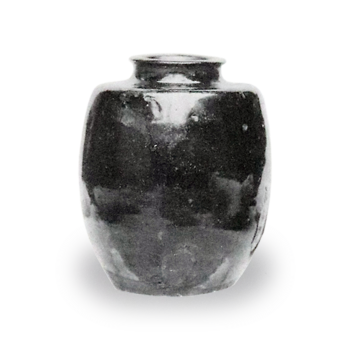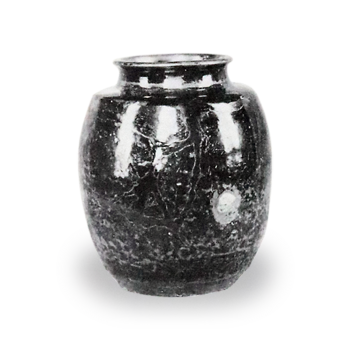
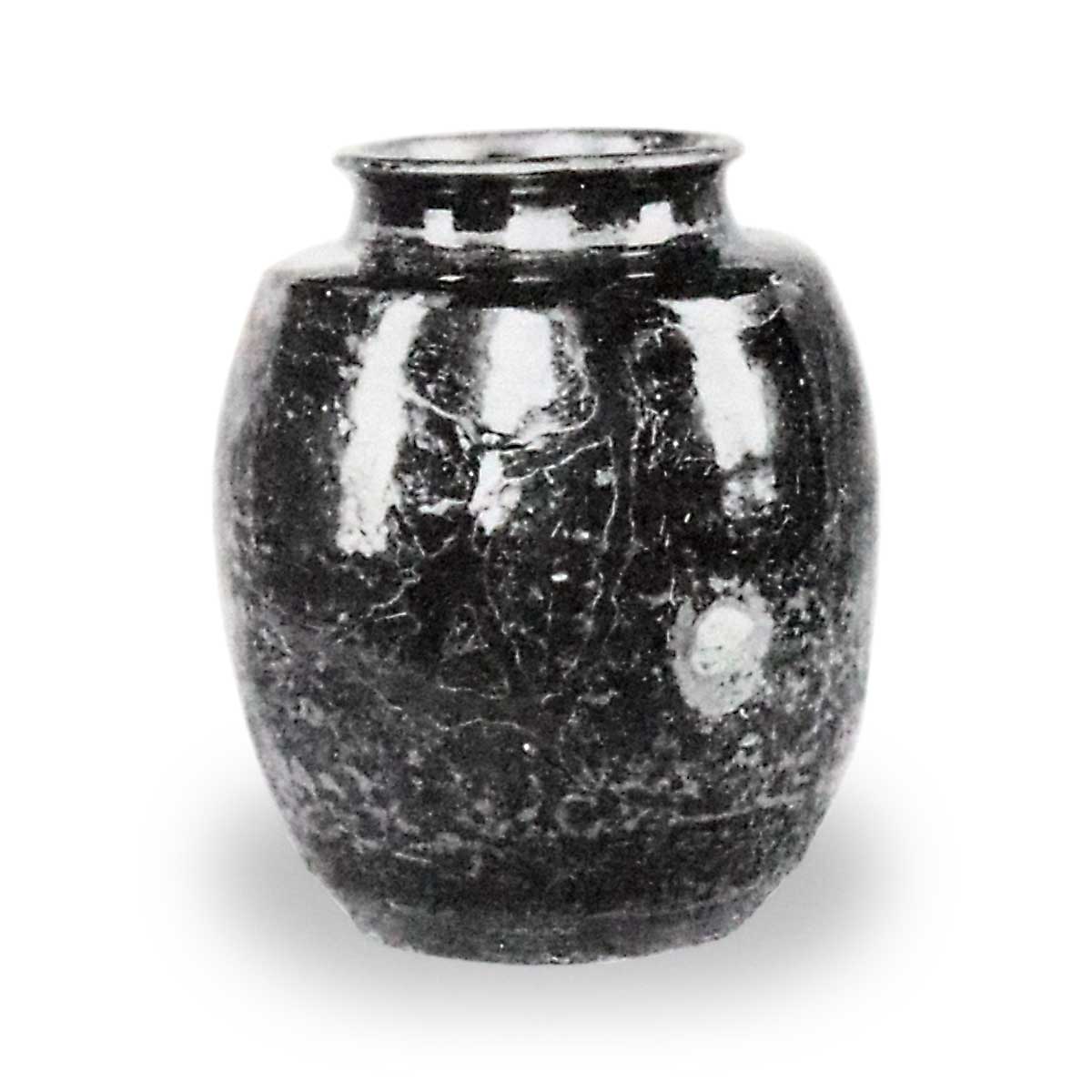
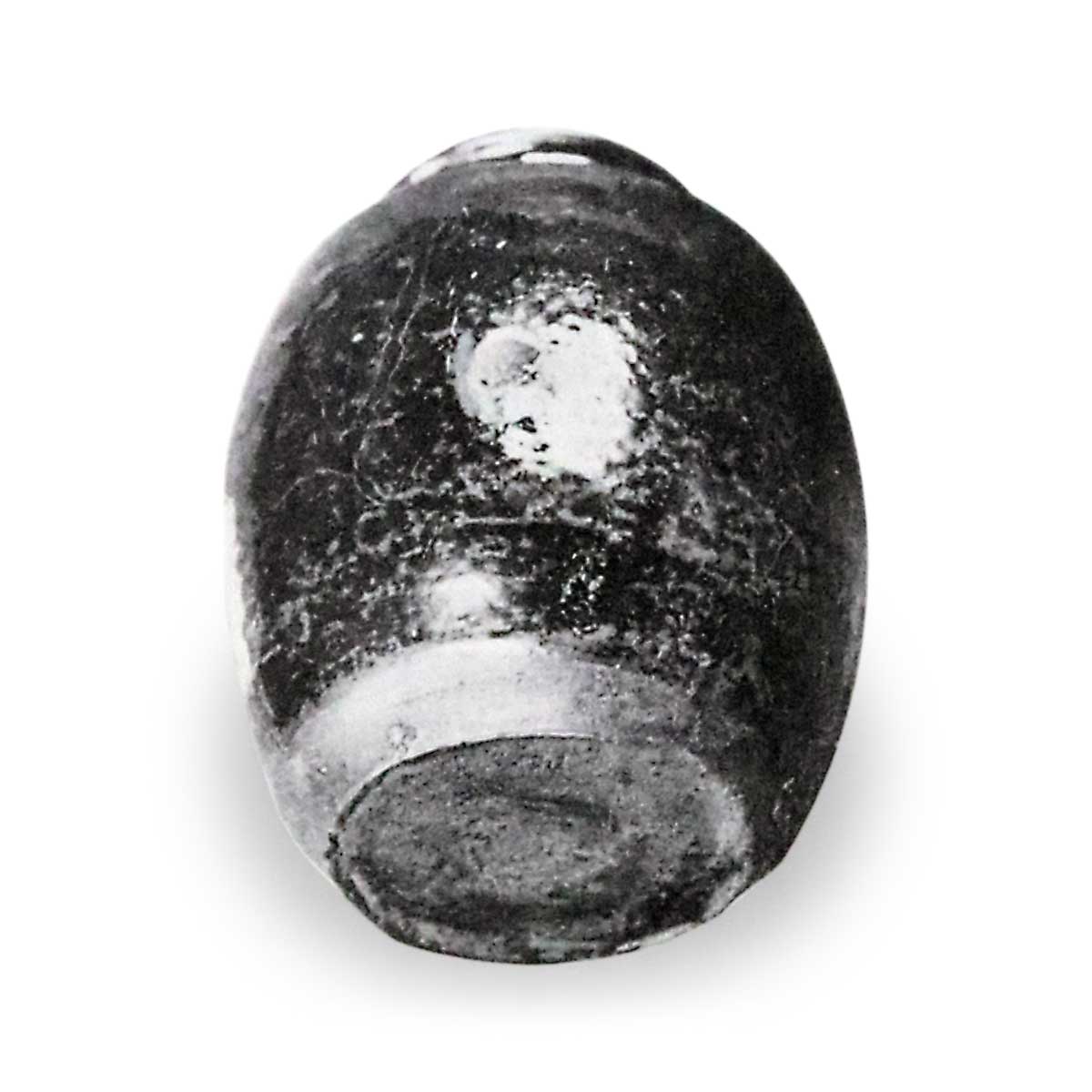
A Daimeibutsu tea caddy made in China (Han-saku), currently in the collection of Duke Tokugawa Ietatsu.
Origin of the Name
In “Shigeyuki Katatsuki Ki,” written by the Edo-period Confucian scholar Hayashi Razan, it is stated: “This small tea caddy was named Shigeyuki Katatsuki because it was owned by a tea master from Izumi Province (southern Osaka Prefecture) named ‘Shigeyuki,’ who was a disciple of Takeno Jōō.” On the other hand, the Tokugawa Family Catalog of Artifacts and Paintings states, “It was named by Lord Ashikaga Yoshimasa because the tea caddy features a scene (pattern) resembling snow falling heavily,” but this is likely a later conjecture.
Modern Equivalents of Dimensions and Weight
Height: Approx. 9.1 cm (3 sun)
Body diameter: approx. 7.7 cm (2.55 inches)
Mouth diameter: approx. 4.8 cm (1.57 inches)
Base diameter: approx. 4.8 cm (1.6 inches)
Koshiki (rim) height: approx. 1.1 cm (0.35 inches)
Weight: approx. 153 g (40 monme 8 bu)
List of Accessories
The lid is an ivory lid in the style preferred by Kanamori Sōwa. There are two types of pouches (shifuku): “Sasazuru Donshu” and “Cha-ji Unkaku Donshu.” The handle (Hikiya) is made of ironwood (tagayasan), with the characters “Shansetsu” carved on the front and filled with gold powder. It comes with a paulownia inner box and a black lacquered outer box; the outer box is inscribed with “Relics of the Owari Chūnagon (heirlooms from the Owari Tokugawa family).”
Miscellaneous Notes and Restoration Records
According to the “Rinpō-kiyū” and the Tokugawa family catalog, this tea caddy is of ancient origin, featuring a black glaze with mottled patterns resembling a kite’s feathers overlaid on a persimmon-colored base. Around the middle of the body, there is an unglazed area known as “hima.”
Furthermore, according to a note added in vermilion to the catalog, it states, “This tea caddy was damaged in the past, and looking at the inside, there are numerous traces of repair,” indicating that it has a history of having been broken and repaired.
A Gift from the Shogun to Itakura Shigemune (Kansei Revised Genealogy of Various Families)
When Itakura Shigemune (Shūshū-no-kami), who served as the Kyoto Shoshidai, submitted his resignation to take up his post in Kyoto in Keian 3 (1650), he was entertained by the third shogun, Tokugawa Iemitsu, in the Ninomaru of Edo Castle. The shogun personally prepared tea for him, and on that day, he bestowed this “Shansetsu Katatsuki” upon him.
Hayashi Razan’s Account of the “Shigyoku Katatsuki”
This is a record written in Classical Chinese by the Confucian scholar Hayashi Razan (Nobukatsu, Dōzen) regarding the Meibutsu.
“In the autumn of the third year of Keian, when Shigemune Itakura requested leave, he was summoned to a resting hall within Edo Castle and was served a meal and tea. Flowers adorned the tokonoma, arranged by the Shogun himself. Shigemune received instructions regarding administrative affairs in Kyoto, and present at the gathering were the Rōjū Tadamasa Sakai and Masamori Hotta.
When the katatsuki tea caddy, placed on a shihō-bon tray, was bestowed upon Shigemune, he prostrated himself to receive it, overwhelmed by the honor that was far beyond his station and unable to contain his gratitude.
This tea caddy is called the ‘Shansetsu Katatsuki’ because it had been owned by Shansetsu, a tea master from Izumi Province. Even the finest jewels in the world cannot compare to it. Its value is equal to that of the Three Thousand Worlds. Though it had long been a treasure of the shogunate, bestowing it now upon a loyal vassal was likely intended to delight his heart with this rare treasure. Everyone was envious. If he were to pass this down to his descendants as a family treasure, it would serve as a testament to his lord’s courtesy and his own loyalty. Truly, it was a beautiful thing. Thus, he composed a Chinese poem to offer his congratulations, weaving the tea caddy’s name into the verses.”
Shogunate Tea Ceremonies and Gifts as Heirlooms
During the Kanbun era, this “Shansetsu Katatsuki” was used at a tea ceremony hosted by Tokugawa Ietsuna, to which Sakai Gakudō and Abe Bungo-no-kami were invited.
In Kanbun 13 (1673), it was also used when the Kii Chūnagon (of the Kishū Tokugawa family) was entertained at the Kuro-shōin.
In Enpō 8 (1680), upon the death of the fourth shogun, Tokugawa Ietsuna (Ganyū-in), this “Shansetsu Katatsuki,” along with the famous sword “Masamune” and a hanging scroll, was presented as a memento (heirloom) to the next shogun, Kōfu-dono (Tokugawa Tsunatoyo, later Ienobu).
Summary of Gift Exchanges Among Daimyo and Its Intriguing History
This tea caddy was originally owned by “Shansetsu,” a disciple of Takeno Jōō, and later became the property of the Tokugawa Shogunate. In the third year of Keian, it was bestowed by Shogun Iemitsu (incorrectly recorded as Ietsuna in the explanatory text) upon Itakura Shigemune, the Kyoto Shoshidai, but it appears to have been returned from the Itakura family to the Shogunate shortly thereafter.
It was used at Shogunate tea ceremonies during the Kanbun era, and in the eighth year of Enpō, it was presented to Tokugawa Tsunanobu (Tokugawa Ienobu) as a memento of the fourth Shogun, Ietsuna. Tsunanobu presented it back to the shogunate, and in Genroku 11 (1698), the fifth shogun, Tsunayoshi, bestowed it upon the Owari Tokugawa family; however, in Shōtoku 3 (1713), the Owari family returned it to the shogunate as part of Tsunayoshi’s estate. Since then, it has never left the treasury of the Tokugawa shogunate and has been preserved until the present day (the Taisho era).
Academic Inspection Report (Appraisal Record) from the Taisho Era
On November 8, 1918 (Taisho 7), this tea caddy was physically examined at the residence of Duke Ietatsu Tokugawa in Sendagaya, Tokyo.
The rim is shaped in the “ame-sogi” style, and the twist is not deep. While the shoulders are slightly more pronounced compared to other similar tea caddies, the fact that the section from the waist down does not taper very narrowly gives it a somewhat distinctive shape.
Similar to the famed “Nitta Katatsuki”—considered the finest in the land—there are traces suggesting it was once damaged by fire, and there are signs of repairs made to a large crack in the body. Nevertheless, the glaze’s luster is exceptionally beautiful; the amber-colored glaze covers the entire surface of the shoulders, and the “glaze loss” around the waist, resembling a knot hole, actually adds to the tea caddy’s wonderful charm.
The entire surface is marked with speckles resembling a kite’s feathers, and within the black amber glaze, there is a scene that looks “as if snowflakes are fluttering and falling.” There is even a theory that the name “Shigeyuki” (Heavy Snow) was given specifically because of this snowy scene. This snowy pattern is particularly frequent around the waist.
The grayish-brown clay body is visible from the lower rim down, and the base is raised. Overall, the piece is solidly crafted and of an ancient period; the color and luster of the glaze are magnificent, making it an exceptionally outstanding teapot even among Chinese “Han-style” teapots.