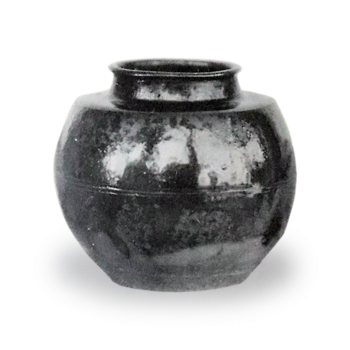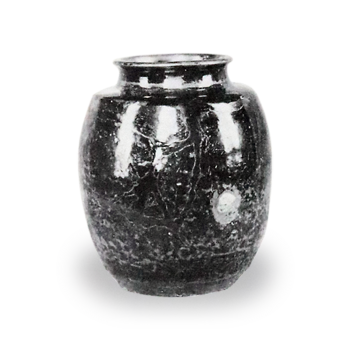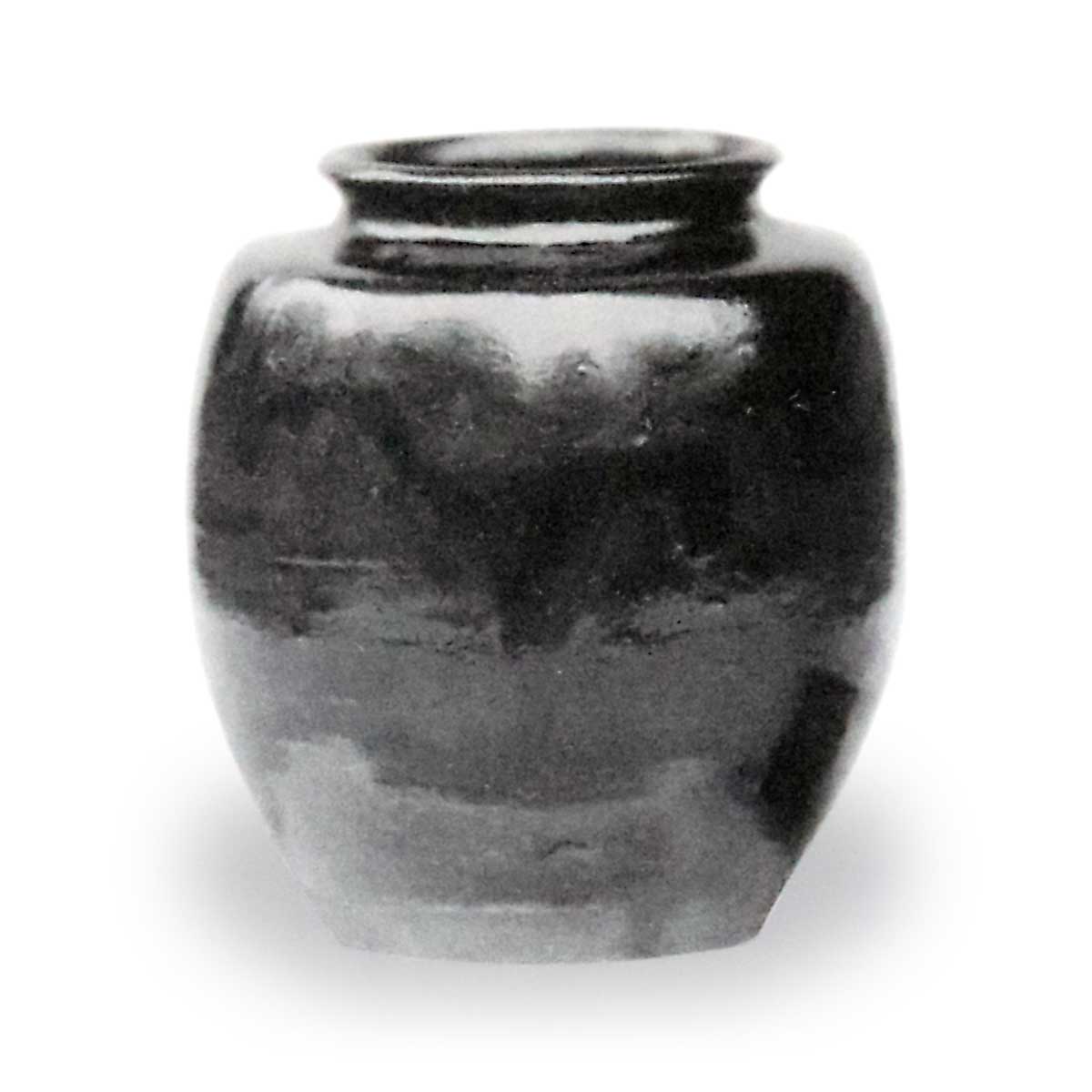

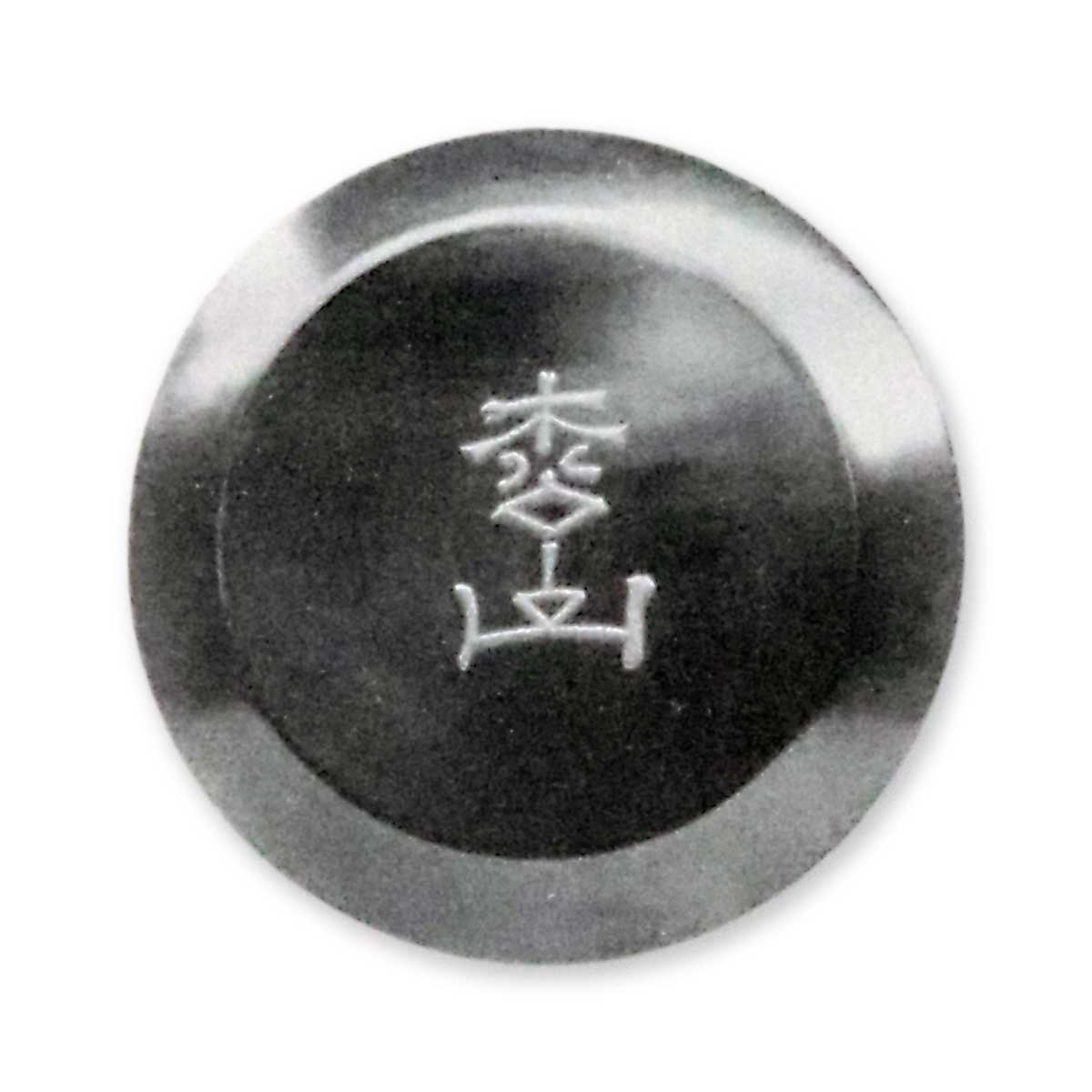

A Daimeibutsu tea caddy made in China (Han-style), from the collection of Viscount Masatoshi Okochi
[Origin of the Name]
An ancient record titled Kobutsuki states, “It is also known as Seizan Makie Dōkyō Katatsuki.” The name “Seizan” appears in other texts such as Ganka Meibutsu Ki and Kokon Meibutsu Ruiju, but the exact origin of the name remains unknown.
[Modern Measurement Conversion]
Height: Approx. 8.2 cm (2 sun 7 bu)
Body Diameter: Approx. 7.6 cm (2 sun 5 bu 2 rin)
Mouth Diameter: Approx. 4.5 cm (1 sun 5 bu)
Base Diameter: Approx. 4.5 cm (1 sun 5 bu)
Koshiki Height: Approx. 0.8 cm (2 bu 5 rin)
Shoulder width: approx. 0.8 cm (2 bu 7 rin)
Weight: approx. 116.2 g (31 monme)
[List of Accessories and Dramatic History of Fire Damage and Restoration]
Lid: 1 piece, without an ivory indentation (kaku).
Carrying pouch: White chirimen (crepe silk) with a white cord.
Hikiya: Black lacquered with gold-leaf lettering. It bears an inscription by Kobori Sōchū (a descendant of Kobori Enshū). The pouch is brocade, the lining is iridescent, and the cord is brown.
Inner box: Unfinished paulownia wood box. It bears an inscription by Kobori Sōchū and a red seal on the underside of the lid.
Middle Box: Paulownia wood with Shunkei lacquer finish. Features an inscription in red lacquer.
(Modern translation of the shocking record written in red lacquer on both sides of the middle box)
“This Matsuyama Katatsuki had been in the possession of the wealthy Edo merchant Naraya Genjirō for many years, but unfortunately, it was destroyed in the Great Fire of Edo on March 21, Bunsei 12 (1829). I managed to find fragments of the tea caddy among the ruins, but about 40% of the whole piece was missing.
On a recent trip to Tokyo, I took these fragments with me to Kyoto and consulted with the tea ware dealer Tanimatsuya Sōchō. In fact, long ago, when the daimyo and tea master Matsudaira Fumai requested to see this tea caddy, Sōchō was present and remembered its appearance well; furthermore, he had meticulously recorded even the glaze patterns on both the front and back in a detailed sketch.
So, I asked this elder Socho for his guidance (instructions) and ordered the restoration, instructing the master lacquerer “Kinsa” to employ every skill at his disposal. He pieced the fragments together, filled in the missing parts with wood carvings, and recreated everything exactly as it was originally—from the glaze’s “yakinadare” texture and the tea caddy’s weight down to the lacquered label and outer box—before bringing it back to Edo.
I then commissioned Kobori Sōchū to inscribe the box and the Hikiya carrying case, and had the gold characters “Matsuyama Katatsuki” on the Hikiya carrying case created by the maki-e artist Nakayama Komi, finally achieving a perfect restoration. My sole wish is to pass this down to the descendants of Nara-ya for all eternity.
May 1847 (Kōka 4) — Kohitsu Ryōhan (Calligraphy Appraiser)
[Record of Dimensions and Accessories Before the Fire]
This is a record of the detailed dimensions and accessories of the “Matsuyama Katatsuki” prior to the fire. Height: 2.7 sun; base (bottom): 1.5 sun; weight: 30 monme 8 bu.
The box, pouch, and tray box all bore inscriptions by Sōfu (Kobori Enshū). There were three ivory lids, all featuring “su” (indentations), and the paper wrapping two of them also bore inscriptions by Kobori Enshu.
There were four protective covers (pouch-like cases), made from famous textiles (Meibutsu) featuring patterns such as mandarin ducks, bamboo vines, and lotus flowers with water ripples.
The accompanying tray featured sword-tip-like carvings on the inside and peony carvings on the outside; the bottom panel was woven in a basket-weave pattern, and the reverse side bore the inscription “Taikō” in vermilion.
These details are recorded from the time the item was held in the collection of the “Yurinjuku” in the 7th year of Tenpō (1836).
[Accompanying Document: The Origin of the Matsuyama Katatsuki and Various Families’ Famous Daimeibutsu Tea Caddies (Record from Keiō 2)]
“This Matsuyama Katatsuki is one of the famous Daimeibutsu tea caddies and was originally owned by Matsudaira Uemon. There was a receipt from when it was sold, but that too was lost in a fire. The price was listed as ‘7,000 ryō,’ but I have heard that the actual cash payment was ‘4,000 ryō’ (equivalent to several hundred million yen today). I have forgotten the exact era, but I believe it was around the Genroku or Hōei period.
It is said that there are about 12 to 13 Daimeibutsu Chinese tea caddies in existence. The Shogunate (the Government) possesses two tea caddies called “Hatsuhana” and “Motome,” but there are rumors that these were also destroyed in the treasury fire a few years ago; however, the truth of the matter is unknown.
In addition, Lord Matsudaira Dewa-no-kami owns two: the “Nabeya Katatsuki” and the “Aburaya Katatsuki.” The Nabeya Katatsuki was originally owned by the Fuyuki clan but was purchased by the great tea master Matsudaira Fumai.
Furthermore, Matsuya Genzaburō of Yamato Province owned the “Matsuya Katatsuki,” which was accompanied by a letter from Matsunaga Hisahide stating, “I will burn Nara to the ground tomorrow, so take this tea caddy and Xu Xi’s painting of a heron and flee by tonight.” This is a testament to a deep affection for these objects, quite uncharacteristic of a military commander. However, I have heard that this Matsuya Katatsuki was recently sold at auction in Osaka and is now in the possession of the Satsuma Domain (the Lord of Satsushu).
Other Meibutsu tea caddies are listed in a book titled Meibuki, but I recall that my family’s (my own) Matsuyama Katatsuki was not included in this book. However, I have heard that few tea caddies from any daimyo family have survived intact.
The text on the right is a record of what I heard in September of Keiō 2 (1866).”
[Attached Scroll: Record of Proceeds from the Sale of Tea Utensils during the Genroku to Shōtoku Periods]
This is a ledger recording the proceeds from the sale of tea utensils by Matsudaira Bizen-no-kami, the former lord of the Otaki Domain, between Genroku 9 (1696) and Shōtoku 4 (1714).
4,000 ryō: To Kanda Ankyū (This is the sale price for the Matsuyama Katatsuki tea caddy)
52 ryō 2 bu: Through the mediation of Yamada Ryōji (Price for the Sokiroku tea caddy)
247 ryō 3 bu: To Lord Akimoto Tajima-no-kami (Price for the Uchidashi tea caddy)
100 ryō: To Lord Tsuchiya Sagami-no-kami (Price for the Hirosawa tea caddy)
140 ryō: To Lord Tsuchiya Sagami-no-kami (payment for the Maru Katatsuki tea caddy)
175 ryō: To Lord Abe Bungo-no-kami (payment for the Senkuzu tea caddy; brokered by Ikeshima Tatsusa)
[Miscellaneous Notes: Records of the “Matsuyama Katatsuki” in Various Tea Books]
Kobimotsuki: Seizan (Matsuyama). Also known as “Makie Dōkō Katatsuki.” Owned by Matsudaira Uemon-dayu.
Bai’an Bunko-bon Ganka Meibutsu-ki: Seuzan. Lord Matsudaira Uemon-dayu. A red inscription reads: “Formerly owned by Dōkō, now owned by Nara-ya Genji.”
Kokin Meibutsu Ruiju: Seuzan. A Daimeibutsu Chinese-style katatsuki. Owned by Matsudaira Uemon-dayu.
Fushimiya Memoirs: Seuzan. A Daimeibutsu Chinese-style katatsuki. Originally owned by Matsudaira Izumino-no-kami, it later passed to the Edo merchant “Naraya Genji” and was destroyed in a fire.
*Detailed record in *Rinpōkiryū*:
Matsuyama. It passed from Matsudaira Uemon-no-taifu to the Edo merchant Naraya Genji, and was destroyed in the great fire of March 21, Bunsei 12 (1829).
Before its destruction, its dimensions were: mouth 1.6 sun, body 2.5 sun, height 2.75 sun, and base 1.55 sun. The entire piece is beautifully glazed in persimmon and black, with a strong metallic luster. The body bears wheel marks, and the shoulder features a white, blurred pattern. There is a “kinohima” (a gap-like feature) at the front, and the rounded shoulder contains angular sections. The overall craftsmanship is refined; the clay is grayish-brown, the base is formed by pressing a board, with a bulge in the center, and there are signs of wear around the rim.
It comes with two lids. The wrapping paper bears an inscription by Kobori Enshu (Sohu). Detailed descriptions of the design elements—including the bag (shifuku), box, Hikiya, and lacquered accompanying tray (taikobon)—are recorded. (Includes an illustration of the tea caddy).
*『Matsumoto Kenkyu Manpōshū』: It came with four pouches made from Meibutsu textiles such as “Shirakeito” and “Donshu”; the inscriptions on the box and the Hikiya carrying case were by Kobori Enshū. The accompanying tray was a Chinese-style square tray.
*『Mitsui Family Documents』: The inventory ledger of Nara Shigeru (Nara-ya Shichiro = Kanda Ankyu)’s former collection contains entries regarding the lids, tray, and four pouches.
- Sekkan-sō: A Guide to the Mysteries of the Tea Ceremony: It bears an inscription by Kobori Enshū on the box and is currently in the possession of Kanda Ankyū in Edo. I had the opportunity to view it a few years ago.
- Sekishū-ryū Kagenroku: In Kyōhō 18 (1733), I saw it brought by the manager and clerk of Kanda Genjirō (Nara-ya).
- Seto Toki Ranshō by Fumai: The body is of Han-style (Chinese-made) origin. It was produced during the same period as such Meibutsu as Zangetsu, Kokushi Nasu, and Kitano Katatsuki; in particular, it is a tea caddy akin to a sibling of the Kitano Katatsuki and Kuga Katatsuki, having been crafted by the same potter in the same kiln.
*『Bian Bunko, Volume 7, Part A』: Overall, the rim is solidly constructed, and there are bands (ridges) on the lid and body. A yellowish-brown glaze is visible through the body, surrounded by a glaze with a fine speckled pattern. There are illustrations of the tea caddy, which is slightly misshapen, and of its base.
【Historical Transmission and an Unusual Fate】
It was originally owned by Dōkyō, a maki-e artist of the Muromachi period, and was later passed down to Matsudaira Uemon-no-taifu Masatsuna, a senior councilor of the Edo Shogunate.
According to Hankanfu, a genealogical record of daimyō families, “Masatsuna was actually the second son of Ōkochi Hidetuna and became the successor to Matsudaira Masatsugu by order of Lord Tokugawa Ieyasu. From the age of 17, he served closely by Lord Ieyasu’s side and participated in the Battle of Sekigahara and the Siege of Osaka. Even after Lord Ieyasu’s death, he served the second and third shoguns, dedicating himself wholeheartedly to his duties day and night, for which he was frequently granted vast territories as rewards.” Based on this, it is believed that this Daimeibutsu, the “Matsuyama Katatsuki,” was also bestowed upon Masatsuna by the shogunate (the shogun’s family) in recognition of his achievements.
Masatsuna’s adopted son, Matsudaira Izumino-no-kami Nobutsuna—known as “Chie-Izu”—became the founder of the Yoshida Domain in Mikawa, while Masatsuna’s biological son, Matsudaira Bizen-no-kami Masanobu, became the founder of the Otaki Domain in Kazusa. During the Meiji era, this branch of the family reverted to their original surname, “Ōkochi,” and were granted the title of Viscount.
During the Shimabara Rebellion in 1638 (Kan’ei 15), Matsudaira Nobutsuna and others used their own funds to cover the military expenses for suppressing the rebellion. As a result, the Ōkochi main family fell into extreme financial distress, becoming so impoverished that they could not even afford to erect the traditional New Year’s kadomatsu decorations. It is said they managed to survive only with assistance from a branch family. At that time, to raise funds to aid the clan, it was decided to sell this Meibutsu tea caddy, and Naraya Shichiro (Kanda Ankyu), a wealthy merchant in Edo who had financial dealings with the Matsudaira family, purchased it for the enormous sum of “4,000 ryō (several hundred million yen).”
However, in 1829 (Bunsei 12), Naraya’s store was engulfed in the Great Fire of Edo, and this tea caddy was also caught in the blaze, suffering severe damage. However, since Tanimatsuya Sōchō, a tea utensil dealer in Kyoto, had previously made a detailed sketch (illustrated catalog) of this tea caddy, he had Chikasa, a master lacquer artisan, piece together the fragments based on that sketch and restore it with lacquer to look exactly as it did originally.
It subsequently passed into the hands of Arai Hanbee of Nihonbashi, a relative of the Naraya family. However, in February 1916, when it was offered at an auction held by the Tokyo Art Club, the Viscount Okochi family—its original owners—won the bid, and after many years, the tea caddy finally returned to its original home with the Okochi family.
[Academic Field Report from the Taisho Era (Post-Restoration Appearance)]
On May 10, 1921, this tea caddy was examined in person at the residence of Viscount Masatoshi Okochi in Yanaka, Tokyo.
The rim is slightly flared, the body swells plumply from the shoulders, and the lower section tapers slightly. This tea caddy was severely damaged in a fire during the Bunsei era but was restored using lacquerwork, relying on sketches by Tanimatsuya Sōchō, to recreate its original decorative features (scenic motifs) on the surface. Originally, it was a tea caddy with a rich, scenic design featuring a persimmon-colored ground with cascading black glaze.
Despite the fire, the original glaze miraculously survived intact in some areas, still radiating a beautiful luster, allowing one to imagine the undamaged, pristine beauty of its era. The grayish-brown clay body from the hem downward remains entirely original, and the flat-bottomed base shows slight signs of wear. As the interior has been restored with lacquer (urushi-zuri), the original wheel marks and other details cannot be discerned.
Although this tea caddy has lost its former artistic and monetary value due to the fire, it has long been renowned throughout the land as a Daimeibutsu. Furthermore, since it retains some fragments of the original clay and glaze, we have decided to include it in this collection as a valuable historical document that conveys the “remnants of a famous antique vessel” from days gone by.