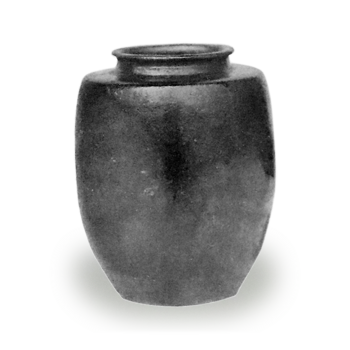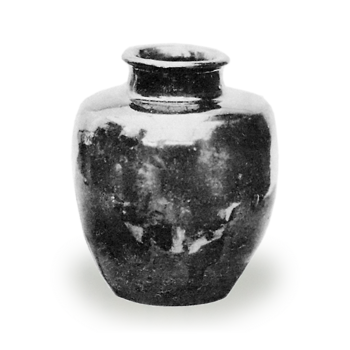
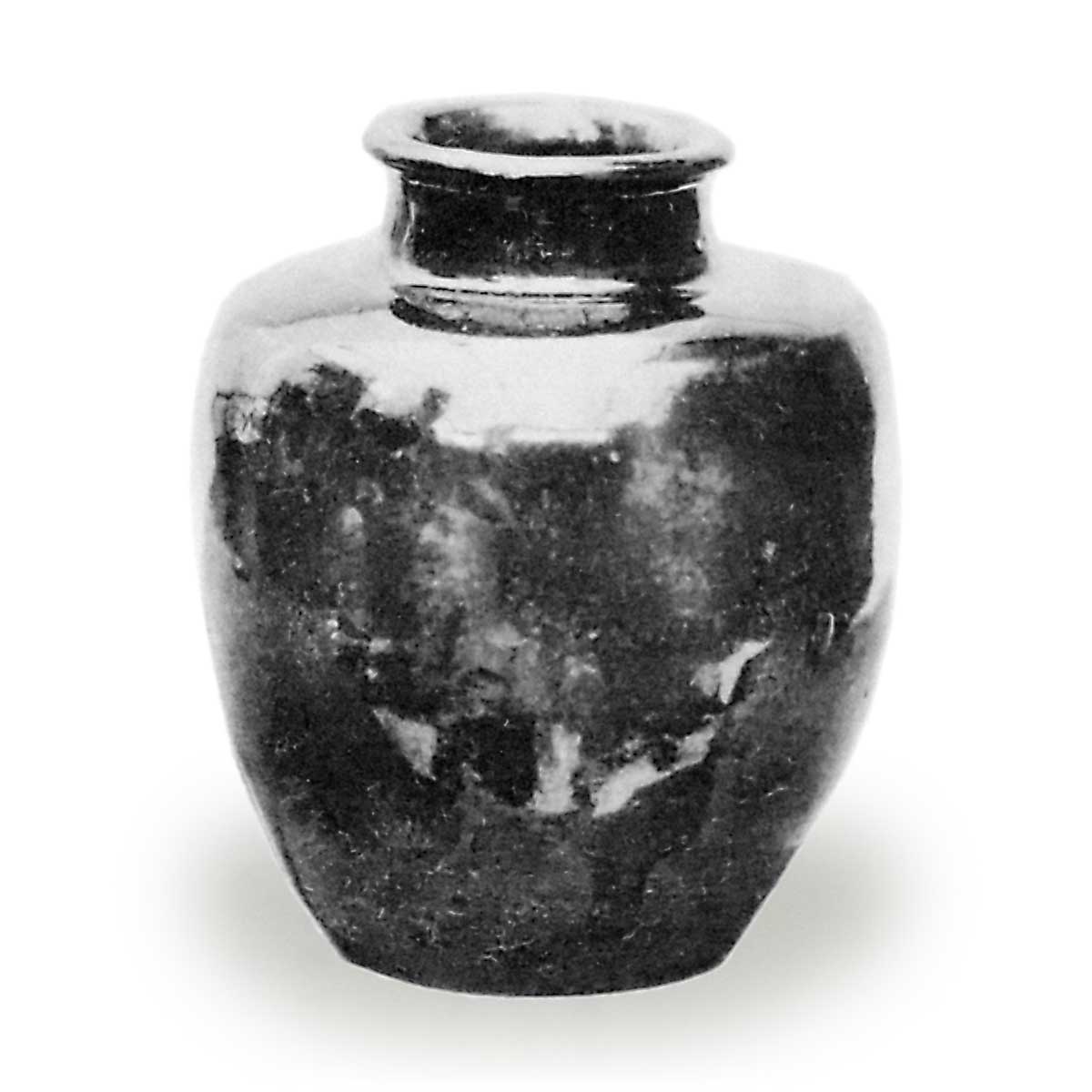

Chinese-made (Made in China) Daimeibutsu; Collection of Count Matsudaira Naoaki
[Origin of the Name]
The name derives from the fact that it originally belonged to the Hino Daikan family (court nobles). The Chajin Taikeizu (Comprehensive Genealogy of Tea Masters) states: “The katatsuki tea caddy and Guangdong silk passed down in the family of Lord Hino Suketoki (Provisional Grand Counselor, Second Rank, Upper Grade) are known in the world as the ‘Hino Katatsuki’ and ‘Hino Guangdong.’ Suketoki entered the priesthood on May 20, Keichō 12 (1607) and studied the Way of Tea under Sen no Rikyū.”
[Dimensions]
Height: Approx. 8.7 cm (2 sun 8 bu 9 rin)
Body diameter: Approx. 7.2 cm (2 sun 4 bu)
Mouth diameter: Approx. 3.8 cm (1 sun 2 bu 5 rin)
Base diameter: Approx. 4.2 cm (1 sun 4 bu)
Height of the neck: Approx. 1.4 cm (4 bu 5 rin)
Weight: Approx. 123 g (33 monme)
【Accessories】
・Lids: 3 pieces
Ryōkaku (in the style of Kobori Enshū), Hosokaku (in the style of Katagiri Sekishū), Sakakaku (in the style of Furuta Oribe)
(Wrapping: Purple crepe-weave double-layered Japanese hand towel)
・Wrapping: Light yellow ha-niwa (cotton-padded) Japanese hand towel
Black velvet pouch, 2 small white ha-niwa cushions
・Storage pouches: 4
(1) Tortoiseshell-patterned Fursu (lining: iron-colored kaiki, cord: tsugari purple) – Enshū style
(2) Cloud and crane Donshu (lining: iridescent kaiki, cord: tsugari purple) – Oribe style
*The above two items are housed in a black-lacquered Hikiya box. However, the lid is made with a hammered lacquer finish and features black-boiled metal fittings.
(3) Flower-patterned ground with rabbit-motif Kinran (lining: sea-green with a pale yellow pattern; cord: diagonal Enshu purple)
(4) Yazaemon Koto (lining: iridescent sea-green; cord: diagonal Enshu purple)
*The above two items are housed in a white paulownia wood box. The box bears a calligraphic inscription by Matsudaira Fumai.
(Contents: A double-layered Japanese handkerchief made of purple crepe)
・Hikiya (box): Black lacquer
(Pouch: Moe-green Donshu fabric, lined with moe-green Kaiki, cord in Hatsugari Enshu purple)
(Contents: A double-layered Japanese handkerchief made of moe-green Donshu fabric)
・Inner Box: Shunkei lacquer
・Outer Box: Tame lacquer, kichō-men style (with rounded corners), featuring a black-boiled metal lock
・Yakigata (a mold shaped like a tea caddy): Made by applying clay over a wooden mold and firing it. By Nonomura Ninsei.
(Contents: A double-layered Japanese hand towel made of purple ha-ni-bu-e silk)
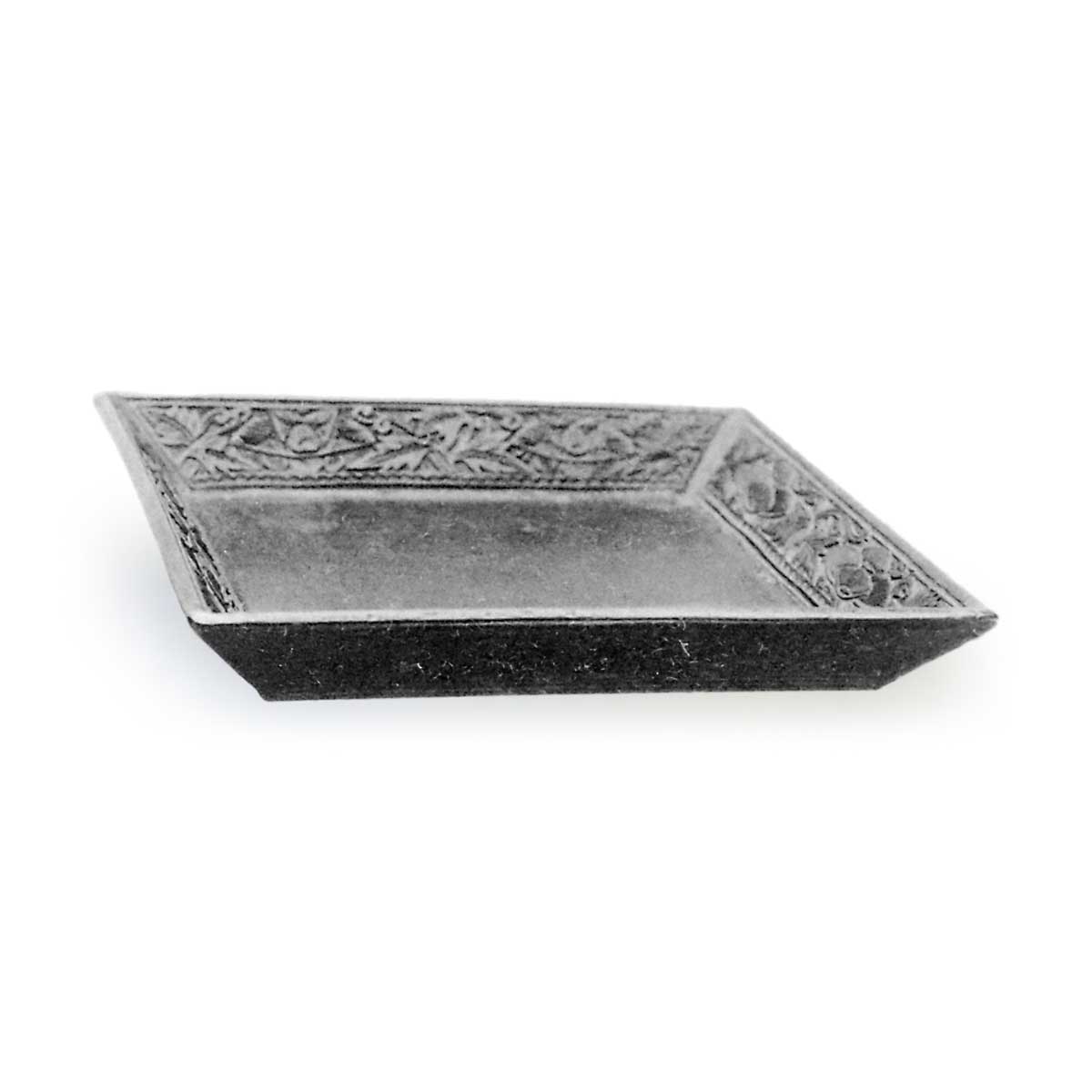
・Accompanying Tray: A square tray with carved edges
(Approx. 19 cm square; width of the ring at the bottom is approx. 14.5 cm)
(Bag: Brown Donshu silk; lining is scarlet kaiki silk; cord is light yellow tsugari silk)
(Box: Untreated paulownia wood; inscription by Kobori Gonjuro: “All sides of the square tray are chestnut brown”)
(Wrapping: Floral cloth; lining is onodo-brown ha-ni-bu silk)
・Accompanying letters: 2 (addressed to Lord Hino)
“…If it is not too much trouble, I would ask that you take out the tea caddy and allow Hōki-no-kami alone to view it. That is why I have written this letter.
P.S.: Hōki-no-kami is a person with ties to our family (the Hino family), and moreover, he is a lover of the tea ceremony, so I earnestly request this.”
8th (Seal)
To Lord Zenroku
“I was greatly pleased to view the Hino Katatsuki tea caddy. I am sending a letter written by Lord Hino Yuishin (Mototeru); perhaps you might include it with this item.
(Waka) Passed down through the ages, the light that polishes it—like a drop of jewel—fades in a small bottle; thus I know our bond
December 7 (Hino) Motoe, transcribed
To Lord Zenroku”
[Miscellaneous Notes]
The “Hino Katatsuki” is in the Mitsui family. It was formerly owned by Ōmonjiya Sōtei of Kyoto.
(From Kobutsuki)
The “Hino Katatsuki” was owned by Ōmonjiya Sōtei of Kyoto.
(From Gankabutsuki)
“Hino Katatsuki” was owned by Ōmonjiya Yōsei.
(From Higashiyama Gomono Uchibetsuchō)
“Hino Katatsuki (Katatsuki)”: Owned by the Mitsui family. Height: 2 sun 8 bu 9 rin; mouth diameter: 1 sun 2 bu 5 rin; body diameter: 2 sun 4 bu; base (with tray): 1 sun 4 bu.
Hikiya has a black-lacquered kichōmen (a box with rounded corners), the pouch is a Tang-style bag with a dragon motif, the lining is pale yellow kaiki silk, and the cord is deep purple. The tea caddy is housed in a black velvet pouch, accompanied by a pale yellow Japanese hand towel. The wrapping for the Hikiya is a light green Donshu-style Japanese hand towel. The inner box is Shunkei-lacquered, and the outer box is Tame-lacquered. There are two spare covers: one is a Donshu-style cover with a bird-and-sash pattern on a navy background (lined with sea-green silk, cord in deep purple). The Hikiya is black-lacquered in the style of Furuta Oribe, and the pouch has a brown background (unlined, cord in deep purple). The other Hikiya is similar, in the style of Kobori Enshū. There are three lids: one in the style of Katagiri Sekishū, one in the style of Furuta Oribe, and one in the style of Kobori Enshū. The box for storing the pouch is a black-lacquered nested set, and all the lids fit inside the incense container. There is a replica made by Nonomura Ninsei, housed in a natural wood box. Two hanging scrolls (letters) are included. (Illustration of the tea caddy available)
(From Kokon Meibutsu Ruiju)
“Hino”: Formerly owned by Ōmonjiya Sōtei; currently owned by the Lord of Unshū (Matsudaira Fumai). A thick layer of black glaze covers the persimmon-colored base, making the underlying persimmon color appear faint. The shoulders are well-formed, the clay is white, and it is of an older period. Numerous traces of restoration are visible in various places. (Dimensions, list of accessories, and illustration of the tea caddy included)
(From Rinpō Kiryū)
When Hino Yuishin (Sukiteru) attempted to sell this to Ōmonjiya, he summoned an elderly man and said, “I have promised to sell this tea caddy for 50 pieces of gold (ryō). “However, I have some reservations. Even if I reduce the price by 50 kan to 45 pieces, if Lord Mimasaka (likely referring to Mori Mimasaka-no-kami, whom the author, Emura Sensai, served) or someone like him were to purchase it, that would be a fine and fitting act for the Way of Tea. Take it with you and show it to him,” he said. The old man went to show it to him, but the deal fell through due to a lack of funds, and in the end, it passed into the hands of the Dainimoniya merchant.
(From Emura Sensai’s Rōjin Zawa)
When Kobori Enshū was invited to a tea gathering where the “Hino Katatsuki” tea caddy—owned by Ōmonjiya Sōtei of Kyoto—was to be used, he instructed that the caddy be used without placing it in a bag. There is a profound reason for this, which I shall explain by word of mouth.
Later, Ōmonjiya presented Enshū with a Chinese silk bag made from Donshu fabric, and to this day, the tea caddy is displayed alongside that bag and two others.
(From Kissa Meigetsu-shū by Hayami Sōtatsu)
The “Hino Katatsuki” was sold by Hino Yūshin to Ōmonjiya for 50 gold pieces.
(From Hōan Bunko, Vol. 16)
It passed through the Karasuma family and then Miki Gontai before being acquired by the Mitsui family. “Hino Katatsuki” was purchased from the Hino family by a man named Hikita of the Ōmonjiya. It is said that Hikita presented “Hatsuhana Katatsuki” to Oda Nobunaga and purchased the Hino Katatsuki in exchange. The intermediary at that time was Furuta Oribe.
(From Wakashū Sakai Family Documents)
The morning of October 30, 1631 (Kan’ei 8) (*Note: The Matsuya Notes state the morning of April 30)
A tea gathering hosted by Ōmonjiya Munemi in Kyoto (Location: Nishinotoin Shitadachi)
Guests: Five people—Tsuji Shichiemon, the physician Isaku, Mizuguchi Gorōemon, Yokota Gohei, and Matsuya Hisashige (Genzaburō)
・Tokonoma: Calligraphy by Kyodo Chigu (“The path of the world is fraught with peril…”; currently in the Matsudaira family of Unshu)
・Tea caddy: Hino Katatsuki (in a pouch; not placed on a tray)
(Pouch: Karairo [Korean red] satin. Embroidered with two continuous patterns of phoenixes and arabesques. The cord is navy blue.)
The glaze on the upper part of the Katatsuki is black, appearing in places to be moegi-iro (dark green). The glaze on the lower part is persimmon-colored. The neck (mouth) is tall, and the clay is thick, a reddish-white, scraped clay (hegi-tsuchi).
(From the *Hisashige Nikki* and Matsuya Hikki)
Hino Katatsuki: A Chinese import. It was owned by Hino Dainagon (Aso), and later passed to a man named Yukawa Zenroku in Kyoto. It was subsequently presented to Komatsu Komon, Lord Maeda Toshinaaga, but was later bestowed upon Yukawa Zenroku as a grant to assist him. He sold it to Mitsui Saburōsuke for a large sum, and while it was in the possession of the Mitsui family, around the Bunka era (1804–1818), I (Fushimiya Jinbei) acted as an intermediary, and it was purchased by Lord Matsudaira Fumai. Although this tea caddy is slightly younger in age than the “Aburaya Katatsuki,” it is a masterpiece second only to the Aburaya Katatsuki.
(From Fushimiya Tekoro and Hōan Bunko, Series B, No. 3)
Hino Katatsuki: Fushimiya Jinbei acted as an intermediary, selling it to Lord Matsudaira Fumai for 200 ryō. In exchange, two items were provided: a Kumagawa tea bowl and a Shigaraki-yaki tea caddy (inscribed “Kongō” by Jōshinsai).
(From Mitsui Family Documents)
Hino Katatsuki: Although this tea caddy is slightly younger in age than the “Aburaya” tea caddy, it is a piece of the highest quality. It is such a magnificent tea caddy that one might say the Aburaya tea caddy ranks first and the Hino tea caddy second; it has long been said to be worth about 10,000 ryō.
(From Unshū Hōbutsu Densai-sho)
Hino Katatsuki: Height 2 sun 9 bu, body diameter 4 sun 2 rin, mouth diameter 1 sun 3 bu. The lids reflect the respective tastes of Katagiri Sekishu, Furuta Oribe, and Kobori Enshu, each with slight variations. After belonging to Daimonji-ya, it was acquired by Yukawa Zenroku for 500 kan of silver. The inward curve of the rim (twist) is much more pronounced than usual.
The overall base glaze is a persimmon red. Two streaks of pale amber glaze flow down from just above the shoulder. Additionally, there are two streaks of black glaze in the areas where the glaze has pooled. The finish is austere and subdued (rust-like). The interior is also glazed, though the glaze is thin. The base appears to be slightly recessed, and the glaze is thickly applied there. The clay has a purplish tint and shows traces of having been scraped with a spatula. The base appears to have various patterns.
(From “Sekkenso Chado Wakuge”)
Hino Katatsuki: The overall base has fine black speckles in the glaze. The rim is exceptionally well-crafted. The clay of the base is white, the rim is thickly flared, and there is a ridge below the neck (kama). The shoulders are flared like a eave, and the base is flat, as if cut from a slab (ita-okoshi). On the front (the side facing up), two streaks of amber-colored glaze flow, surrounded by black glaze. The base is made of grayish-brown clay. The underglaze is persimmon-colored, and it is believed to be older than the “Tanemura Katatsuki.” (Includes descriptions of the pouch and lid)
(From Chainomeibutsu and Hōan Bunko, No. 9)
Hino Katatsuki: The overall underglaze is persimmon-colored, with a clean and crisp finish. The clay is lead-colored (namari-tsuchi). There are marks where a spatula was used on the rim and the base where it meets the surface. The front (the part meant to be placed on a surface) has an amber-colored glaze, over which a slightly blackish glaze is applied. The amber color is clearly visible where the clay is exposed. The shoulders protrude like an eave, and the body is plump and rounded.
(From Hōan Bunko, No. 3)
The elderly Hosokawa Sansai (Tadaoki) remarked, “The two—the Kuwa-jin Katatsuki and the Hino Katatsuki—are utterly terrible (poorly made).”
(From the “Matsuya Notes,” section on Lord Sansai, and “Soryu Sekishu-ryu Chasho”)
Hino: Made in China (Han-saku). It is said to share the same glazing technique and period as the “Aburaya Katatsuki,” but its age is slightly younger (newer).
(From “The Origins of Seto Pottery” by Matsudaira Fumai)
Hino Katatsuki: A Tang-style piece. It was owned by Lord Hino, the Daikan, and later passed to Mitsui Saburōemon; it was sold by the main store around the Bunka era. The price was 500 ryō, and it came with a square tray featuring carvings on the rim.
(From “Fushimiya Handwritten Notes”)
[History]
Originally belonging to the court noble Hino Dainagon family, during the reign of Hino Suketeru, they attempted to sell it for 50 gold ingots. They sent Emura Sensai (author of Rojin Zawa) as a messenger to Mori Mimasaka-no-kami, proposing, “If you would be so kind as to purchase it, we will reduce the price by 50 kan and sell it to you for 45 gold ingots.” However, he declined, stating he could not raise the funds.
Around that time, Mōmonjiya Sōkan of Kyoto, having previously presented the Meibutsu “Hatsuhana Katatsuki” to Oda Nobunaga, was seeking a Chinese tea caddy to replace it. Consequently, through the mediation of Furuta Oribe, he purchased this tea caddy for 50 pieces of gold, as the Hino family had requested. It is recorded in the Kushige Nikki and the Matsuya Hoki that this tea caddy was used at a tea gathering hosted by Ōmonjiya Sōmi in Nishinotoin Shimotachibana, Kyoto, on the last day of October in the 8th year of the Kan’ei era (1631).
Subsequently, it was sold by Ōmonjiya to Yugawa Zenroku for 500 kan of silver; it was likely around this time that the court noble Hino Motosue sent Zenroku a letter of introduction (the aforementioned letter) requesting to view the tea caddy. Zenroku then presented it to Maeda Toshinaaga, the lord of the Kaga domain. However, in later years, because Zenroku had rendered great service to the Maeda family, the Maeda family subsequently gifted the tea caddy back to him.
Subsequently, Mitsui Saburōsuke of the Mitsui family purchased it from the Yukawa family for a large sum, and it remained in the Mitsui family’s possession for a long time. However, around the Bunka era (1804–1818), through the mediation of the tea utensil dealer Fushimiya Jinbei, it was sold to Lord Matsudaira Fumai, the lord of the Matsue Domain, for 500 ryō. Lord Fumai designated this “Hino Katatsuki” teapot, along with the “Zangetsu” and “Tanemura” teapots, as his Third Treasure (the First Treasure being the “Aburaya Katatsuki” and the Second Treasure the “Kanroku” teapot), and reportedly bequeathed it to his heir, Lord Gettan, with the instruction to “preserve it carefully for all eternity.”
On April 28, 1917 (Taisho 6), on the occasion of Lord Fumai’s 100th anniversary, the current head of the family, Count Matsudaira, exhibited this piece at Kōunkaku in Matsue City and opened it to the public.
[Record of Actual Viewing]
On May 27, 1918 (Taisho 7), I had the opportunity to view this piece in person at the office of the House of Count Matsudaira Naoaki in Matsue City.
The inward curve (twist) of the rim is deep, and the edge is pointed, demonstrating extremely precise craftsmanship. From the neck (koshiki) to the shoulders, a blue-lapis-lazuli glaze covers about half the surface. The overall base is amber-colored, with the blue-lapis-lazuli glaze appearing in uneven patches, and persimmon-colored glaze scattered sporadically; the overall appearance is extremely varied.
There are traces of lacquer repairs around the body. On the front (the display side), a single streak of glaze beautifully reveals the blue lapis lazuli glaze, stopping near the base. From the hem downward, the clay is grayish-brown, and the entire surface of the flat, slab-cut (ita-okoshi) base is covered with a dry, cracked black glaze (kase).
This tea caddy bears several traces of repairs to large cracks, as if it had once suffered a fire; however, its overall shape is plump and well-proportioned (harmonious and full-bodied), and it possesses a high degree of elegance. The abundance of blue-lapis glaze and the richness of its visual appeal are unparalleled. The name “Higurashi” (meaning “one could gaze at it all day without growing weary”) seems truly fitting for a tea caddy such as this.