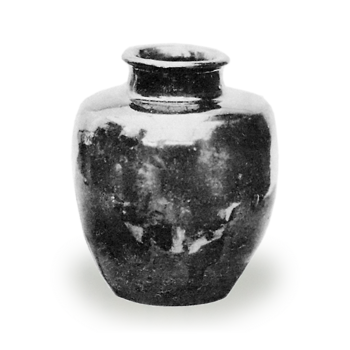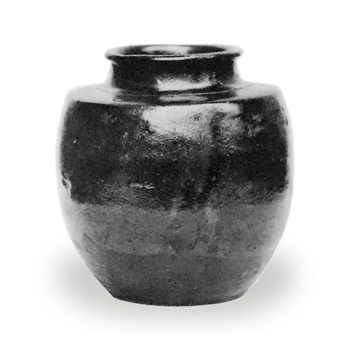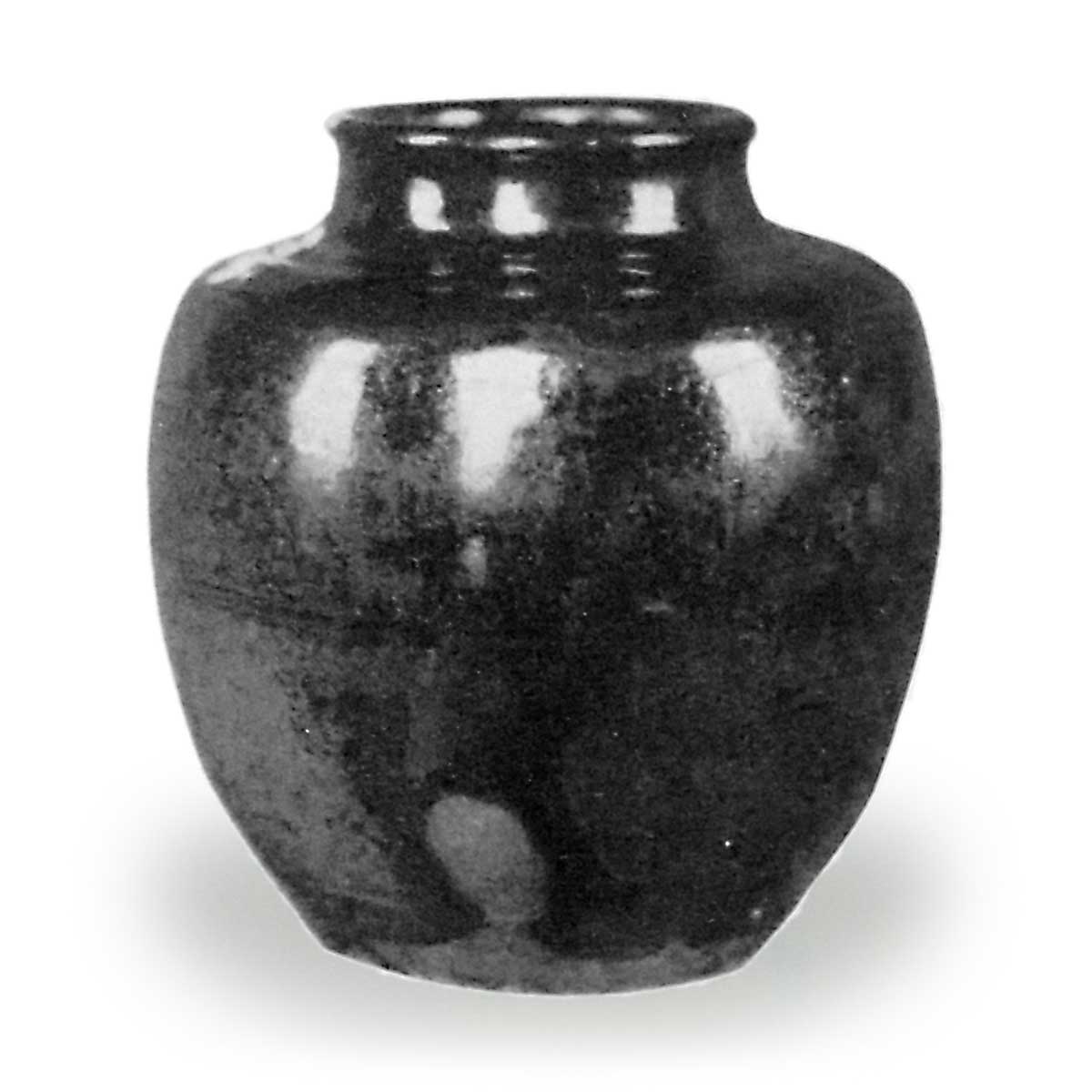
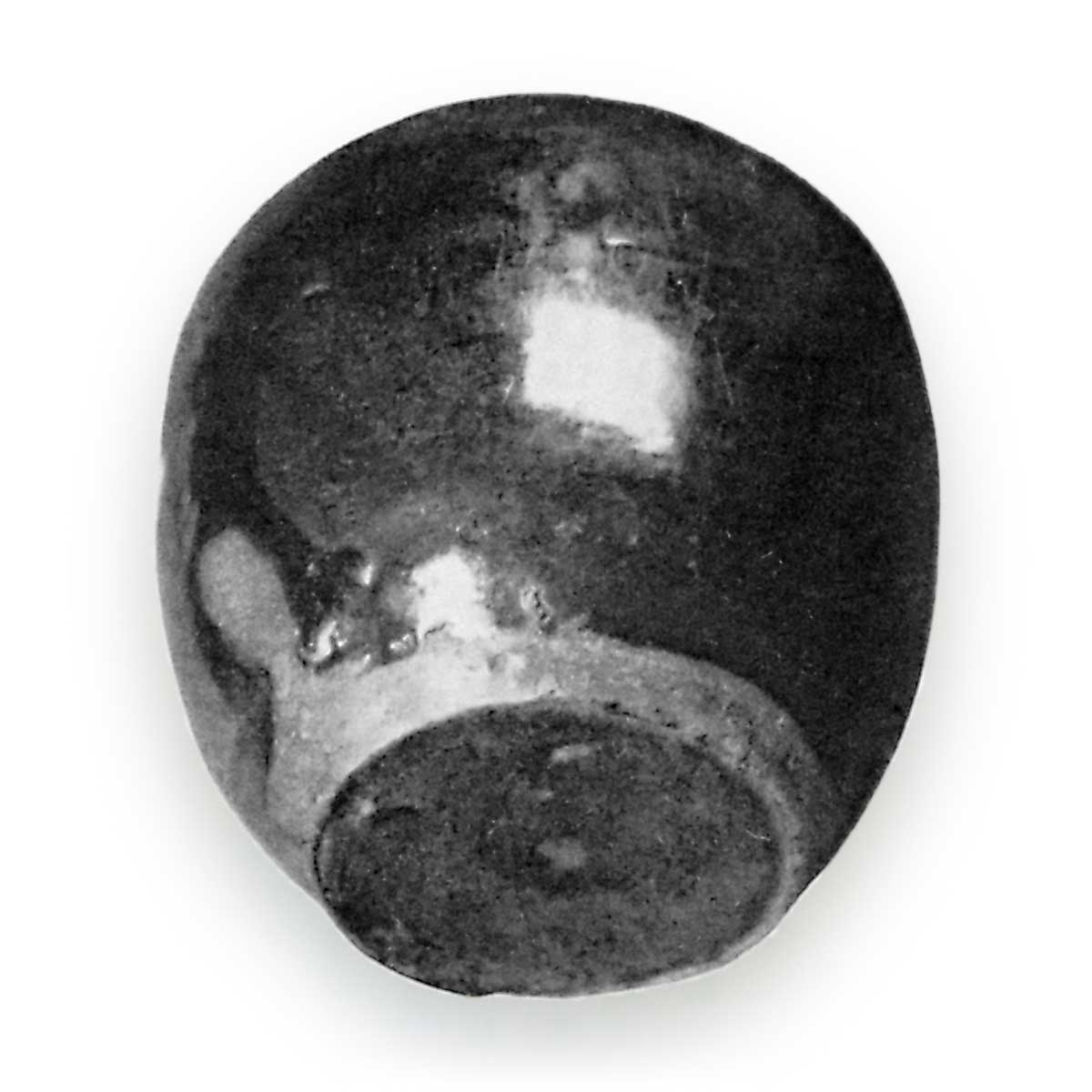
Chinese-made (manufactured in China) Daimeibutsu; owned by Duke Ietatsu Tokugawa
[Origin of the Name]
This name derives from the fact that it was once owned by Nakamura Hoki-no-kami Tadakatsu. Tadakatsu was the son of Nakamura Shikibu-no-suke Kazuji. After his father’s death, at the age of just 10, he was granted an audience with Shogun Hidetada to undergo the coming-of-age ceremony. He was then granted 175,000 koku in Hoki Province and became the lord of Yonago Castle. He married the adopted daughter of Tokugawa Ieyasu as his principal wife. Later, a rebellion broke out led by his senior retainer, Yokota Naizen, but with the aid of reinforcements from Horio Yamashiro-no-kami, the lord of Izumo Province, he finally quelled the uprising. However, on May 11, 1609 (Keichō 14), he died at the young age of 20. As he had no heir, the Nakamura family line came to an end.
[Dimensions]
Height: Approx. 8.3 cm (2 sun 7 bu 5 rin)
Body diameter: Approx. 7.9 cm (2 sun 6 bu 2 rin)
Mouth diameter: Slightly less than approx. 4.2 cm (slightly less than 1 sun 4 bu)
Base diameter: Approx. 4.5 cm (1 sun 5 bu)
Height of the neck: Approx. 1.2 cm (4 bu)
Shoulder width: approx. 1.2 cm (4 bu)
Weight: approx. 146 g (39 monme)
【Accessories】
・Lids: 3 (1 is an old ivory lid; 2 are newly made)
・Storage pouch: white silk, with a white cord
・Storage pouches: 2
(1) Donshu Junko (satin) (lining: light green silk, cord: dark purple)
(2) Aoki Koto (lining: brown silk, cord: dark purple)
・Carrying case: Black lacquer, with gold-leaf lettering reading “Hoki Katatsuki, 2 pouches, 1 lid”
・Hikiya: Black lacquered, with gold-powdered characters reading “Hakusha.” Pouch is velvet, lining is iridescent sea-green, cord is dark brown.
・Inner Box: Beveled edges, gold-leaf ground with powder-dust finish, arabesque maki-e, rim is ikake. Gold-powdered characters reading “Hōki Katatsuki”
・Outer Box: Black lacquer with gold-powdered characters reading “Hōki Katatsuki”
[Miscellaneous Notes]
“Hōki Katatsuki, Chinese-style. Presented to the Shogunate by the Mito Chancellor (Tokugawa Tsunanori) on September 25, Genroku 13 (1700). Height: 2 sun 7 bu 6 rin; Shoulder width: 2 sun 3 bu; Body diameter: 2 sun 6 bu 2 rin; Base diameter: 1 sun 5 bu; Mouth diameter: 1 sun 4 bu. The base (tray) is raised, and the bottom is flat, cut away from the body (ita-okashi). The overall base glaze is black, resembling a Tenmoku tea bowl, and the amber-colored glaze that creates the texture is thin. The storage pouches are made of white silk, with white cords. There are two pouches: one is made of bamboo-patterned satin with a light green kaiki lining and a deep purple cord; the other is made of blue-green Kanto silk with a brown kaiki lining and a deep purple cord. There are two lids, both made of ivory. Hikiya is lacquered black with a pear-skin finish on the inside, and the lids feature gold-leaf lettering. The case for the Hikiya is made of black velvet, lined with navy silk, and has a purple cord. The box is lacquered black with gold-leaf characters, and the outer box is also lacquered black. (Illustration of the tea caddy included.)”
(From the Tokugawa Family Collection, Catalog of Imperial Artifacts and Paintings)
Hōki Kan (Made in China): A Daimeibutsu and an imperial artifact of the Shogunate. The base is flat (cut from a single board).
(From Rinpō-kuryū)
Tea caddy formerly owned by Nakamura Hōki: Currently in the possession of Lord Tori no Ukyō.
(From Higashiyama Go-mono Uchi-betsuchō)
Hakusha (Ki): Owned by Lord Matsudaira Izu.
(From Ganka Meibutsu-ki)
Hakusha (Ki): Owned by Nakamura Hoki, and later by Matsudaira Izumino-no-kami.
(From Komeibuki)
Hōki: Chinese-style katatsuki: Daimeibutsu, owned by Matsudaira Izumino-no-kami.
(From Kokin Meibutsu Ruiju)
Hōki katatsuki: Daimeibutsu; a Chinese item, owned by Matsudaira Uemon.
(From Hōan Bunko, Series B, No. 12)
On August 3, 1642 (Kan’ei 19), Matsudaira Nobutsuna (Izunomori) presented a banquet at the Ninomaru of Edo Castle to celebrate the birthday of Ganyū-in (the 4th Shogun Ietsuna). On that occasion, he received from the Shogun a sword inscribed with the character “ichi-monji-kichi” and a Hōki Katatsuki tea caddy.
(From Kansei Shoshu Shokafu)
On May 10, 1662 (Kanbun 2), Matsudaira Terutsuna (Kai-no-kami) visited the castle to express his gratitude for inheriting the family headship and presented to the Shogunate a sword by Sadamune—a memento of his father (Nobutsuna)—and a Hoki Katatsuki tea caddy.
(From Kansei Shoshu Shokafu)
March 6, Kanbun 10 (1670) | Responsible: Munekiyo
In the Oku-Garden of Edo Castle, the Shogun personally performed the tea ceremony and bestowed tea upon Aoyama Inaba-no-kami alone, served by attendants of the Gokono-do-shu. On this day, he received his farewell audience prior to his transfer to Osaka, and was subsequently bestowed a hanging scroll by Kisoseki in the garden. It is said he received it by the Shogun’s command.
・Hanging Scroll: Kisoseki
・Flower Vase: Celadon, without a base (flowers: Japanese goldenbell and red camellia)
・Tea Caddy: Hoki Katatsuki
・Tea bowl: Warikodai
(From Records of the Tokugawa Family Tea Gatherings)
July 23, Enpō 4 (1676)
In the Furo tea room of the Oku-Gosho within Edo Castle, the Shogun personally performed the tea ceremony and bestowed tea upon Toda Echizen-no-kami alone. The meal was prepared in the Kinkishoga room. On this day, a farewell ceremony was held in connection with his transfer to Kyoto.
・Hanging Scroll: “Tsukubane” by Fujiwara no Teika
・Flower Vase: Large Sorori
・Tea Caddy: Hakusha (Ki) Katatsuki
・Tea Bowl: Mishima, Hake-me
(From Records of the Tokugawa Family Tea Gatherings and Sakurayama Ichiyu’s Notes)
March 28, Enpō 5 (1677)
A meal was served to Lord Owari Chūjō (Tokugawa Tsunanori) in the Seiko Room of the Kuro-shōin at Edo Castle.
(As alternate tea utensils)
・Tea caddy: Hakusha (Ki) Katatsuki
・Tea bowl: Ido-chawan
(From Records of the Tokugawa Family Tea Gatherings)
April 11, 1677
A meal was served to Lord Mito (Tokugawa Tsunanori) in the Seiko Room of the Kuro-shoin at Edo Castle. After the Rōjū Sakai Gagaku-no-kami (Tadakiyo) delivered his greetings, flowers were arranged in the tea room of the Omote-Garden, water was heated, and the Shogun himself performed the tea ceremony. In the Imperial Garden as well, Sakai Gakudō concluded his address and gave his farewell remarks in the reception room. Afterward, the Shogun proceeded to the Kuro-shoin, where Lord Mito’s retainers paid their respects.
March 28, Enpō 7 (1679)
In the Saiko Room of the Kuro Shoin, a meal was served to Lord Kii Chūnagon (Tokugawa Mitsusada). (Omitted; see the section on Master Bō Katatsuki)
(As replacement tea utensils)
・Tea caddy: Hakusha (Ki) Katatsuki
・Tea bowl: Waritakadai
(From Records of the Tokugawa Family Tea Gatherings)
Around 6:00 p.m. on May 14, 1680 (Enpō 8), the remains of the 4th Shogun, Ietsuna, were carried out of Edo Castle via the Kita-Hibashi Bridge and interred at Tōei-zan (Kan’ei-ji).
The following items were presented to Lord Mito as mementos:
・Waist sword: Sadamune (valued at 200 gold coins)
・Tea caddy: Hakusha (Ki) Katatsuki
(From Awai Zoku-hen)
List of Relics of Ganyu-in (Ietsuna)
To Lord Mito
・Tea caddy: Hakusha (Ki) Katatsuki (with two pouches)
・Wakizashi: Sadamune (valued at 200 gold coins)
(From Bokutei Rensan)
On June 29, Enpō 8 (1680), these heirlooms were presented by an imperial envoy (the Shogun’s messenger). To Lord Mito (Tokugawa Mitsukuni): the Sada-mune wakizashi (valued at 200 pieces) and the Hakusha (Ki) Katatsuki tea caddy. To Lord Mito Shōshō (Tokugawa Tsunetada): the Tama (valued at 100 ryō).
(From Gyokuro-sō)
Hakusha Katatsuki (though the silk pouch is damaged): From Lord Mito, the Chancellor, on September 25, Genroku 13 (1700). There are two pouches; the older one features a bamboo vine pattern (lined with pale green seaweed-patterned fabric). There are three lids: two newly made and one old. The tea caddy on the right was presented during the Shogun’s visit.
(From Jōgodo)
On September 25, 1700 (Genroku 13), the Shogun paid a visit to the residence of the Mito Chancellor (Tsunanori). He departed around 10:00 a.m. (the upper hour of the Snake) and returned around noon (the middle hour of the Horse). Privately, the Shogun bestowed the tea caddy “Gyokudo,” and privately, the Mito Chancellor presented the tea caddy “Hakusha Katatsuki.”
(From Godaidai by Tsukita Shosui)
[Provenance]
Originally owned by Nakamura Hōki-no-kami Tadaichi, it likely reverted to the shogunate’s possession when the Nakamura family line died out in Keichō 14 (1609). Subsequently, the Higashiyama Gomono Naibetsuchō lists it as “in the possession of Lord Tori-i Ukyō,” which is believed to refer to Tori-i Sakyō-no-suke Tadamasa, the son of Tori-i Mototada.
Since the Torii family had no heir to succeed Tadamasa’s son, Tadahisa, and the family line ended in 1636 (Kan’ei 13), this tea caddy likely returned to the shogunate thereafter.
According to the Kansei Shūshū Shokafu, on August 3, 1642 (Kan’ei 19), Matsudaira Nobutsuna (Chie-izu) received this item as a gift from the shogun, and on May 10, 1662 (Kanbun 2), his son Terutsuna presented it back to the shogunate upon inheriting the family headship.
Having thus become the property of the shogunate, this tea caddy was presented to Aoyama Inaba-no-kami in March of Kanbun 10 (1670), to Toda Echizen-no-kami in July of Enpō 4 (1676), to Lord Mito (Tokugawa Tsunatomo) at the same Kuro Shoin the following month, and to Lord Kii (Tokugawa Mitsusada) in March of Enpō 7 (1679). In other words, the heads of all three branches of the Tokugawa family received this hospitality from the shogunate using this Katatsuki tea caddy.
On June 29, 1680 (Enpō 8), it was bestowed upon the Lord of Mito (Mitsukuni) as a memento of the 4th Shogun Ietsuna, but on September 25, 1700 (Genroku 13), when the 5th Shogun Tsunayoshi paid a visit to the Mito domain residence, Tsuneda, the 3rd head of the Mito family, presented it back to the shogunate.
[Record of Actual Observation]
On November 8, 1918, I had the opportunity to view this item in person at the residence of Duke Ietatsu Tokugawa in Sendagaya, Tokyo Prefecture.
The rim is rounded, with a shallow inward curve (twist), and there are faint traces of lacquer repairs (mending) along the rim. From the base of the neck (kama) to the shoulder, two raised ridges run around the vessel. The shoulder’s projection (okita) is gentle, and the underglaze, which appears to have a bluish-gray hue, bears a striking resemblance to the Meibutsu “Nitta Okita.” A single raised ridge also runs around the body. The front (face) features a cascade of amber-colored glaze, which contains patches of dark blue-green glaze.
Below the hem, the color of the iron-rich clay is visible, and at the lower edge of the front, the glaze has cracked, revealing the underlying clay (a “dō-iri” effect). The base is flat, having been cut from a slab (ita-okoshi), and its rim is slightly worn; for some reason, there are many signs of wear (scratches from use) visible throughout the piece. For a Chinese-made (Han-style) tea caddy, the glaze is applied thickly, giving it a solid, substantial feel (kanme).