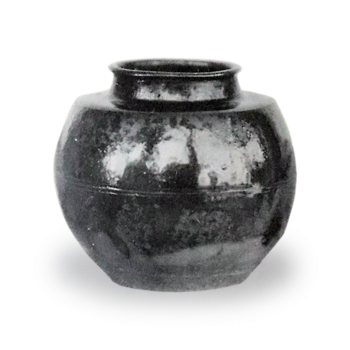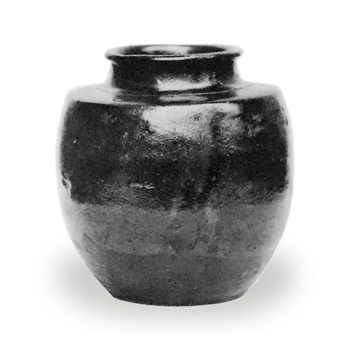


Chinese Antique · Daimeibutsu · Collection of Marquis Toshiyuki Maeda
[Origin of the Name]
This name derives from the fact that it was once a treasure housed in the Shishōbō hall within Tōdai-ji Temple in Nara. Shishōbō was originally located within the grounds of the Shōsō-in. Since it is a temple enshrining the four sacred figures—Emperor Shōmu, who founded Tōdai-ji; the Monk Ryōben; the Bodhisattva Gyōki; and Bodaisena—it is technically correct to call it “Shishō” (Four Saints). However, it has long been commonly written and referred to as “Shishōbō” or “Shishō.”
[Dimensions]
Height: Approx. 8.4 cm (2 sun 7 bu 7 rin)
Body diameter: Approx. 8.2 cm (2 sun 7 bu 2 rin)
Mouth diameter: Approx. 4.6 cm (1 sun 5 bu 2 rin)
Base diameter: Approx. 4.8 cm (1 sun 6 bu)
Height of the neck: Approx. 1.1 cm (3 bu 8 rin)
Shoulder width: Approx. 1.2 cm (slightly over 4 bu)
Weight: Approx. 132 g (35 monme 2 bu)
[Accessories]
・Lids: 2 (one of which is ivory)
・Storage pouch: White chirimen silk, with a white twisted cord
・Cover (pouch):
(1) Pale yellow chirimen with Donshu water grass and wild goose pattern (lining is sea mist pattern, cord is purple twisted cord)
(2) Guangdong-woven fabric (lining damaged, cord: purple twisted cord)
・Boxes for storing the pouch and lids: Two white paulownia wood boxes
(The inscription on the front of the lid of one of these boxes reads as follows)
“Master’s Shoulder-Strike: Two lids, one pouch”
・Hikiya: Plum wood, Nakatsugi Fubuki style
“Shishōbō” (inscription in gold powder; author unknown)
Bag: Brown Donshu silk, plum, bamboo, and nightingale pattern (lining is brown ha-niwa silk; cord is brown twisted cord)
・Inner box: Paulownia wood, karado-men style (chamfered corners)
“Shishōbō Katatsuki”
“Shishōbō Tea Caddy (with vermilion inscription) Received as a Gift” (inscription in gold powder)
・Outer box: Paulownia wood, natural finish
[Miscellaneous Notes]
“Eshōbō (Shiseibō)”: Located in the Shiseibō of Tōdai-ji Temple in Nara.
(From the records of Yamagami Sōji and the Chaden)
“Shishōbō”: Possessed by Shishōbō at Tōdai-ji Temple in Nara; later possessed by Sakai Sanukimori.
(From the Kominomono-ki)
“Shiseibō Katatsuki”: Located in the Shiseiden Hall at Tōdai-ji Temple in Nara.
(From the Gunshū Ruijū Hon Chaki Meibutsu-shū)
“Eshōbō”: Possessed by Lord Tōdō Izumi.
(From the Higashiyama Go-mono Uchi Betsuchō)
“Shiseibō”: Located in Nara. Height: just over 2 sun 8 bu; width: just over 2 sun 7 bu; circumference: 8 sun 5 bu 5; base: 1 sun 6 bu; mouth diameter: 1 sun 6 bu; height of the lid: 4 bu; body bulge: 8 bu. The overall glaze is thick and smooth; the underglaze is a pale persimmon color, while the overglaze has a slight bluish tint. The clay is a pale purple, and there is a stain on the upper part (illustration of the tea caddy included).
(From the Manpō Zenshū)
“Shiseibō”: A Tang-style Daimeibutsu. Owned by Sakai Sanuki-no-kami.
(From the Kokin Meibutsu Ruiju and Rinpō Kiryū)
“Shiseibō”: Owned by Shiseibō of Nara, later passed to Lord Sakai of Sanuki. (The following is written in red ink) Long ago, it was owned by Shiseibō of Nara and presented to the Shogun’s family. Subsequently, Lord Kii (Tokugawa Yorinobu) received it; upon his retirement, it was presented once more to the Shogun’s family, and Matsudaira Kagamori (of the Maeda family) received it.
(From the Hōan Bunko Edition of Gankō Meibutsu-ki)
“Shiseibō”: Owned by Sakai Sanuki-no-kami. Height: just over 2 sun 8 bu; width: just over 2 sun 7 bu; mouth diameter: 1 sun 6 bu; kettle height: 4 bu; base diameter: 1 sun 6 bu (illustration of the tea caddy included).
(From Daimeibutsu Chajiru Gokuhi-den Seizushiki)
In October of Eiroku 3 (1560), at the first tea ceremony (Hatsugama) of the monk Eisuke of Shiseibō
Guests: Yamajun, Toshiya, Sōrin, Shōsa, Matsuyoshichi, Hisamasa
・Tokonoma: A painting of a melon by Bokei
・Katatsuki (Shiseibō): In a white-ground Kinran bag
・Yūhi Tenmoku
(From the Matsuya Notes)
February 29, 1576 (Tenshō 4), at noon: Tea gathering at Shiseibō in Nara
Guests: Sōnō, Tsuda Sōyuki
・Daisi, Ise kettle, Tsubaguchi, and Kankoguchi lid rests
・A painting of a melon by Mokkei hung in the tokonoma of the hand-washing room.
・The Katatsuki (Shiseibō) and the Yūhi Tenmoku were placed side by side on a round tray with a dragon design.
It was the first time I had ever seen a Katatsuki. It was also the first time I had ever seen the custom of displaying a Tenmoku tea bowl on a stand. The teapot (tea caddy) had a relatively low body, a wide mouth, and was made of fine clay. The glaze was a subdued color, with some areas showing unevenness.
(From Tsuda Sōyū’s Tea Ceremony Diary)
Morning of December 18, Tenshō 13 (1585): Shiseibō’s tea gathering
Guests: Hosokawa Yūsai, Imai Sōkyū, Sakuma Fukansai
・A genuine arare kettle by Rurori was hanging.
・Alacove: A calligraphy scroll by Muju was displayed.
The katatsuki (Shiseibō) was placed in a Kinran pouch and set upon a shihō-bon tray.
We proceeded to the hand-washing area, where the tea was prepared using an Ise tenmoku bowl, a dragon-patterned stand, a gold water jug, and a Goryeo tea bowl.
(Excerpt from the Diary of Imai Sōkyū)
The morning of March 26, Tenshō 15 (1587), in Nara
Shiseibō’s tea gathering: Guest: Kamiya Sōtan (one person)
A four-and-a-half-mat tea room. A painting of a hibiscus had been hanging in the tokonoma from the start.
The katatsuki (Shiseibō) was placed in a bag and set on a shihō-bon tray.
The total height of the kanten-chō was 2 sun 7 bu, the mouth diameter 1 sun 6 bu, the height of the kōzō 4 bu, and the base diameter 1 sun 6 bu. The clay was reddish-black, with a single streak at the rim; there was no horizontal band on the body. The glaze was amber-colored, and the area around the shoulder appeared smooth. There were no distinct glaze runs, and it was placed with the section where the glaze ran thinly and yellowish facing forward.
(From Sōtan’s Diary)
At noon on the 9th day of the intercalary 3rd month of Keichō 4 (1599), in Fushimi
Tea gathering hosted by the Chūnagon of Chikuzen (Hideaki Kobayakawa) Guest: Sōtan Kamiya (alone)
A four-mat room with a “Rurori” hanging on the wall. A “Kata-tsuki” (Shiseibō) was placed in a bag and set on a square tray in the tokonoma.
This shoulder-rest bowl was presented (given) by Shiseibō. The glaze is thin and appears slightly chipped where it hangs high on the wall. There is a single ridge between the shoulder and the rim, and no horizontal band around the body. There is also no ridge at the rim. The shoulder is flared, the clay has a reddish hue, and there is a thread-cut mark (the trace of where it was cut from the potter’s wheel) on the bottom.
(From Sōtan’s Diary)
Regarding Yamauchi Kazutoyo (Governor of Tosa). When the Five Commissioners of Osaka secretly sent a letter from Kazutoyo’s wife along with a palindrome, Kazutoyo became greatly enraged and, without opening the seal, presented the letter to Tokugawa Ieyasu (for his perusal). Ieyasu was deeply impressed by this, and in recognition of his achievements at the Battle of Sekigahara, granted him 202,600 koku in Tosa Province. On March 25, Keichō 8 (1603), he was appointed to the rank of Junior Fourth Rank, Lower Grade, and his title was changed to Governor of Tosa. At this time, he was presented with a tea caddy by Shiseibō.
(From the Kansei Revised Genealogies of Various Families)
Yamauchi Tadayoshi (Governor of Tosa) was born in Kakegawa, Totomi Province, in the first year of Bunroku (1592). On November 13, 1605 (Keichō 10), he inherited his late father’s (Kazutoyo) domain and presented the Shiseibō tea caddy—a memento of his father—to the Shogunate.
(From the Kansei Revised Genealogies of Various Families)
Regarding Tōdō Takatora. In February of the second year of Genna (1616), when Tōshōgū (Tokugawa Ieyasu) fell ill, Takatora traveled to Suruga and attended to him day and night at his sickbed. At that time, Ieyasu instructed him, “Should a major crisis befall the nation, I decree that Takatora shall be the first to take the initiative, and Ii Naotaka the second.” Believing that “this may be my final moments,” he bestowed a cup of sake upon Takatora, and at that time, took Takatora’s hand and spoke to him in a faint voice. After Ieyasu’s passing, in accordance with his final wishes, Takatora was granted the Shiseibō tea caddy.
(From the Kansei Revised Genealogies)
When the Deity (Tokugawa Ieyasu) fell ill and, showing no signs of recovery, gradually grew gravely ill, Lord Takatora was summoned to the Deity’s bedchamber and called to his side. (Omitted) When Takatora stated, “From today onward, let us abandon the Nichiren sect and adopt the Tendai sect,” it is said that a decree was issued indicating that the Lord was satisfied with this proposal. At that time, he was presented with a hanging scroll by Kitoyo and a shoulder-rest by Shoseibo. This tea caddy was one of the personal items of Lord Higashiyama (Yoshimasa Ashikaga) and is a Chinese-made shoulder-rest.
(From the Imperial University Historical Materials: Biography of Todo Takatora)
September 23, Genna 5 (1619), at noon
Lord Todo Izumi-no-kami (Takatora) was a guest at the residence of Seki Saiji.
Accompanying him were Lord Nakabo Sakon and Matsuya Hisayoshi.
In the tokonoma
・Late Cherry Blossom shoulder ornament, Saeki shoulder ornament
・Shiseibo shoulder ornament
Above
・Seto shoulder ornament
These four items were displayed on the right, and tea was served.
(From the notes of Sakurayama Ichiyu)
In October of Genna 7 (1621), Todo Takatsugu (Daigakuto) presented to Daio-in-den (the 3rd Shogun Iemitsu) his father’s (Takatora’s) heirlooms: the Shiseibo katatsuki, a Sadamune wakizashi, and a Kitoyo hanging scroll.
(From the Kansei Revised Genealogies of Various Families)
On November 8, 1629 (Kan’ei 6), a tea ceremony was held under the direction of Katagiri Iwami-no-kami
・Tea caddy: Shiseibō, mounted on a Wakasa tray
・Tea bowl: Warikadate
・Flower vase: Kinuta (with winter chrysanthemums)
・Charcoal container: Fukube (gourd)
(From Sakurayama Ichiyu’s Notes)
Sakai Tadakatsu (pen name: Kūin). On August 22, 1635 (Kan’ei 12), the Shogun (Iemitsu) paid a visit to Tadakatsu’s residence.
He was presented with a Shiseibō tea caddy and a Sadamune sword.
(From the Kansei Revised Genealogies)
On August 22, 1635 (Kan’ei 12), the Shogun paid a visit to the upper residence of Sakai Sanukimori. He partook of a meal in the White Study, and afterward, he went out into the garden and enjoyed tea.
Tea Ceremony Utensils
・Hanging Scroll: Shiba Reisei (possibly by his hand)
・Flower Vase: Unhama
・Tea Caddy: Shishobo
・Tea Bowl: Zeze-yaki
(From the notes of Yamamoto Dōku, based on the manuscript of Honzen Sōgi)
Shiseibō: Presented to the Shogunate by Sakai Sanukimori.
(From the Kishū Clan Documents)
November 8, Kanbun 5 (1665), clear. As the retired abbots of Shōkō-in and Shōgo-in were to travel to this place (Edo), Sakai Gagaku-no-kami and Kira Wakasa-no-kami were dispatched as envoys. Today, a tea ceremony was ordered, and the utensils brought to the garden were as follows.
・Hanging Scroll: “Kiyū” (painted by Muju)
・Flower Vase: Celadon stone-ground (flowers: winter chrysanthemums)
・Tea Caddy: Shiseibō (tea name: “Hatsune”)
Placed in a Donshu bag and set on a Wakasa tray.
・Tea Bowl: Goryeo-style high-footed bowl
The tea ceremony was conducted on a tray, and the tea master was Katagiri Iwami-no-kami.
(From the Minami-Aoi Bunko Collection, Record of the Tea Gathering)
On June 3, 1670 (Kanbun 10), the Shogun personally performed the tea ceremony in the Inner Garden and bestowed tea upon Nagai Iga-no-kami.
The meal was also served in the Inner Next Room. This was a farewell gathering marking his transfer from Edo to Kyoto.
・Hanging Scroll: Gottan
・Tea Caddy: Shisei-bo
・Tea Bowl: Kiri-takadai
・Flower Vase: Celadon, Kinuta
(From Records of the Tokugawa Family Tea Ceremonies)
On March 23, 1674 (Enpō 2), during the reign of Lord Ganyū-in (the 4th Shogun Ietsuna), tea was bestowed upon Lord Owari in connection with his farewell ceremony upon returning to his home province. He was entertained in the Nishi-tame room; Lord Ii Sōbe-no-kami delivered a farewell address, while other Rōjū stood in attendance, and the service was performed by the Nakau-shū.
・Hanging Scroll: Seven Waka Poems by Fujiwara no Teika
・Incense Box: Tsuishu lacquer, Hotei
・Flower Vase: Celadon, Kaburanashi (without turnip)
・Tea Caddy: Shoseibo
・Tea Bowl: Mishima, Hake-me
・Tea Scoop: Sen no Rikyū
(From Gyokuro-so and Records of Ancient Tea Ceremonies)
On March 28, 1677 (Enpō 5), a banquet was held for Lord Owari Chūjō (Tokugawa Tsunanori) in the Seiko-no-ma room of the Kuro-shōin. Sakai Gagaku-no-kami delivered a greeting, after which flowers were arranged in the Omote-osono, and the Shogun himself performed the tea ceremony. In the Gozen-osono as well, Sakai Gagaku-no-kami and the other Rōjū concluded their greetings and offered their farewells in the Seiza-no-ma. Afterward, the Shogun proceeded to the Kuro Shoin, where Lord Owari’s retainers paid their respects.
・Hanging Scroll: Chizetsu
・Tea Caddy: Shoseibo
・Flower Vase: Celadon, Kaburanashi (flowers: red and white double camellias)
・Tea Bowl: Warikodai
Alternative Tea Utensils
・Tea Caddy: Hakusha (Ki) Katatsuki
・Tea Bowl: Ido
(From Records of the Tokugawa Family Tea Ceremonies)
March 28, Enpō 7 (1679)
In the Seiko-no-ma room of the Kuro-shoin, a meal was served to Lord Kii Chūnagon (Tokugawa Mitsusada). The Rōjū, including Sakai Gagaku-no-kami, offered their greetings, and afterward, in the Omote-Garden, the Shogun (Ietsuna) personally performed the tea ceremony. While viewing Shiseibō’s tea caddy in the garden before the Shogun, the Shogun presented both the caddy and the tea, which Lord Kii accepted. In the garden as well, the Rōjū, including Sakai Gakudō, concluded their greetings and offered their farewells in the reception room. Afterward, the Shogun proceeded to the Kuro-shōin, where Lord Kii’s retainers paid their respects, and the proceedings concluded without incident.
・Hanging Scroll: Seven waka poems by Fujiwara no Teika
・Tea Caddy: Shisei-bo
・Flower Vase: O-sorori (arranged solely with irises)
・Tea Bowl: Myojo
Alternative Tea Utensils
・Tea Caddy: Hakusha (Ki) Katatsuki
・Tea Bowl: Waritakadai
(From Records of the Tokugawa Family Tea Ceremony)
Shiseibō: Bestowed upon Kii-dono (Tokugawa Mitsusada), who presented it to the Shogunate upon his retirement; it was subsequently bestowed upon Matsudaira Kaga-no-kami (of the Maeda family).
(From the Kishū Documents)
Regarding Maeda Tsunaki (grandson of Maeda Toshitsune, known as Lord Shōun). On April 26, Genroku 15 (1702), Shogun Tsunayoshi paid a visit to Maeda Tsunaki’s residence and had him give a lecture on Buddhist scriptures. His son Yoshitoku and other members of the family stood in attendance before the Shogun, while retainers and others listened to the lecture. On this day, he was granted a sword by Kunimune, a sword by Masamune, a wakizashi by Yoshimitsu, a tea caddy by Shishobo, 100 sets of seasonal clothing, 100 rolls of rare indigo-dyed fabric, 50 rolls of velvet, and 30 silver ingots.
(From the Kansei Revised Genealogies of Various Families)
On April 26, Genroku 15 (1702), the Shogun paid a visit to the residence of Kaga-no-kami (Maeda Tsunanori). As a private gift, Kaga-no-kami received the tea caddy “Shishobō Katatsuki.” The hanging scroll (painted by Sotsuō, with a preface by Chizetsu) was received by Matazaemon (Kaga-no-kami’s heir, Yoshitoku).
(From Godaidai-ki by Tsukita Shosui)
Shosho-bo: Chinese ware. The clay is purple; the underglaze is persimmon-colored, as is the overglaze. The base (where it rests on a tray) is flat. The front (display side) features dripping glaze. There are cracks (crackle patterns). The glaze appears smooth.
(From the Maeda Marquis Family Inventory)
Shiseibo Katatsuki: Presented by the Tokugawa family. No pouch; two lids. The lower lid is made of plum wood and inscribed with “Shosho-bo” in gold powder. The upper box is made of paulownia wood with chamfered edges and inscribed with “Shiseibo Katatsuki” in gold powder. The authors of the two on the right are unknown.
(From the Maeda Family Collection Records)
[History]
Originally housed at Shiseibō within Tōdai-ji Temple in Nara, records in the Matsuya Hoki and Tsuda Sōyuki Chayū Nikki indicate that it was used at tea ceremonies hosted by Priest Eisuke of that temple. It later came into the possession of Tokugawa Ieyasu, who bestowed it upon Yamauchi Tosa-no-kami Kazutoyo in Keichō 8 (1603). However, when his son, Tadayoshi, inherited the estate in Keichō 10 (1605), he presented it to the shogunate. In Genna 2 (1616), in accordance with Ieyasu’s will, it was bestowed upon Tōdō Takatora, and in October of Genna 7 (1621), Takatora’s son, Takatsugu, presented it once again to Shogun Iemitsu.
On August 22, 1635, when Shogun Iemitsu visited the residence of Sakai Gagaku-no-kami Tadakatsu, he bestowed the tea caddy upon Tadakatsu. Subsequently, it was presented by the Sakai family to the shogunate, and this tea caddy was frequently used at shogunate tea ceremonies during the Kanbun and Enpō eras (1660s–1680s). On March 28, 1679 (Enpō 7), Shogun Ietsuna bestowed it upon Tokugawa Mitsusada, the second lord of the Kishū domain, but Mitsusada returned it to the shogunate upon his retirement.
On April 26, 1702 (Genroku 15), Shogun Tsunayoshi visited the residence of Maeda Tsunaki, the lord of the Kaga domain, and presented this tea caddy to him. It is believed that the frequent exchange of Meibutsu tea utensils as gifts between the shogunate and the daimyo (feudal lords) took place over a period of about 70 years, from Genna (1615) to Genroku (1704), after which this custom gradually fell into disuse. Unlike many other tea caddies that changed hands frequently before the Genroku era, this one has remained in the treasury of the Kaga Maeda family since the time Tsunanori received it, and has remained there to this day.
[Record of Actual Inspection]
On December 1, 1919 (Taisho 8), I inspected this item in person at the residence of Marquis Toshiyuki Maeda in Honfuji-cho, Hongo Ward, Tokyo.
The rim is rounded, with one spot where the wall is slightly thinner. The inward curvature (twist) is shallow, and the recessed groove (sunuki-suji) at the base of the neck (kama) is partially interrupted in some places. The overall base is chestnut brown, over which a reddish-brown metallic glaze (kakinuki) with a bluish tint is applied unevenly in patches. In addition to two areas where the same glaze has run down in a dark amber color, there is one area where the reddish-brown metallic glaze has run down.
The unglazed clay at the rim is vermilion-colored (reddish clay), and the unglazed portion extends quite high up; the base is flat, having been cut from a slab (slab-built). There are two firing cracks (firing cracks) running from the edge of the unglazed clay into the glazed area, and there is a small, worm-eaten-like chip (hotsure).
On the interior, the rim is glazed, and below that, shallow wheel marks are visible. The center of the base is slightly raised and shaped like a tomoe (swastika). Because the body color is very dark, the variations in the glaze (keiki) are not clearly visible, but the teapot has an extremely calm and serene appearance.