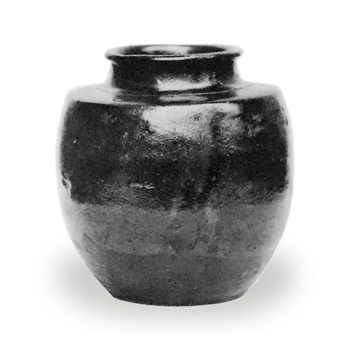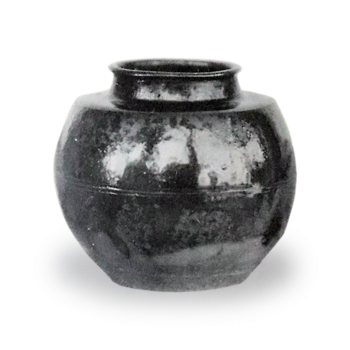
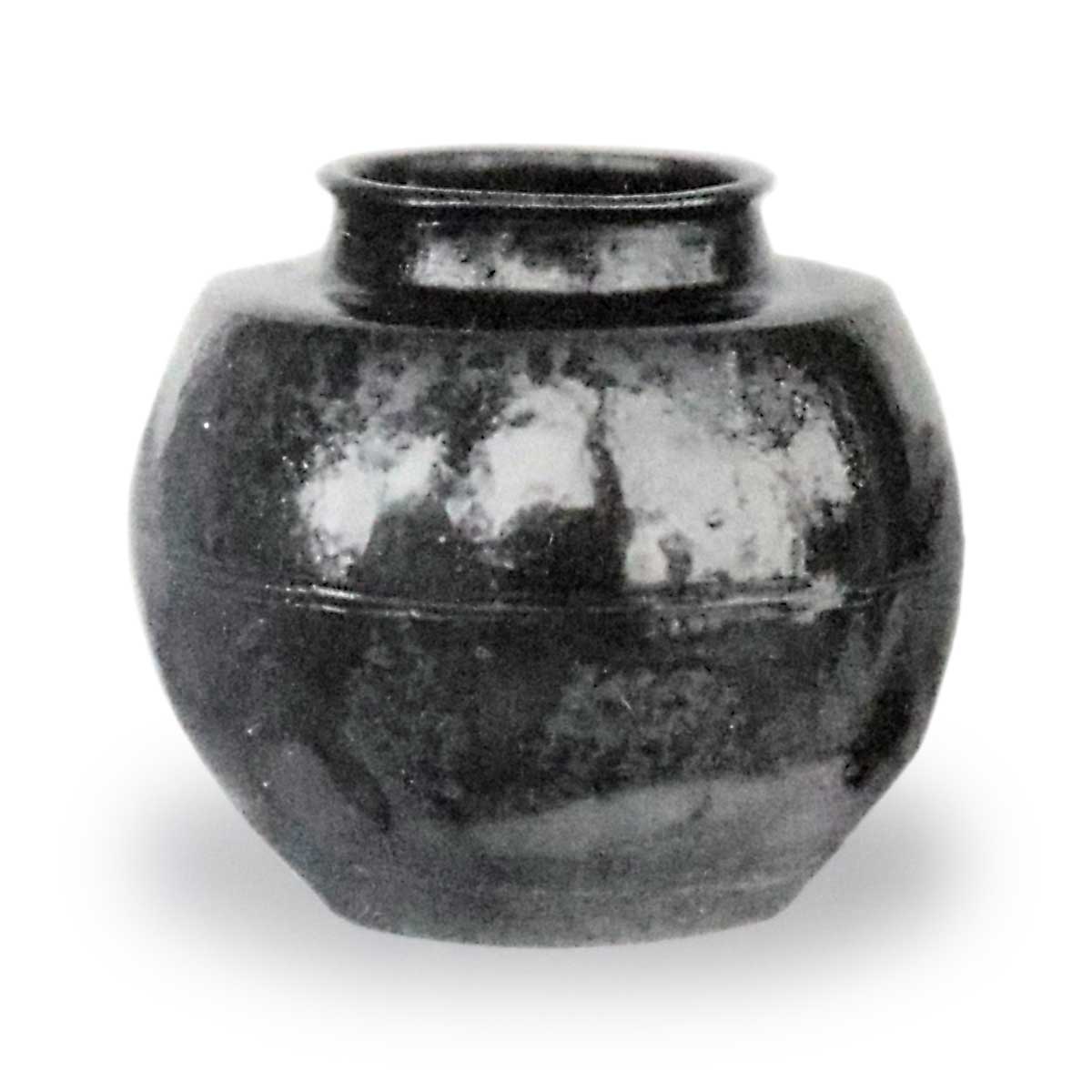
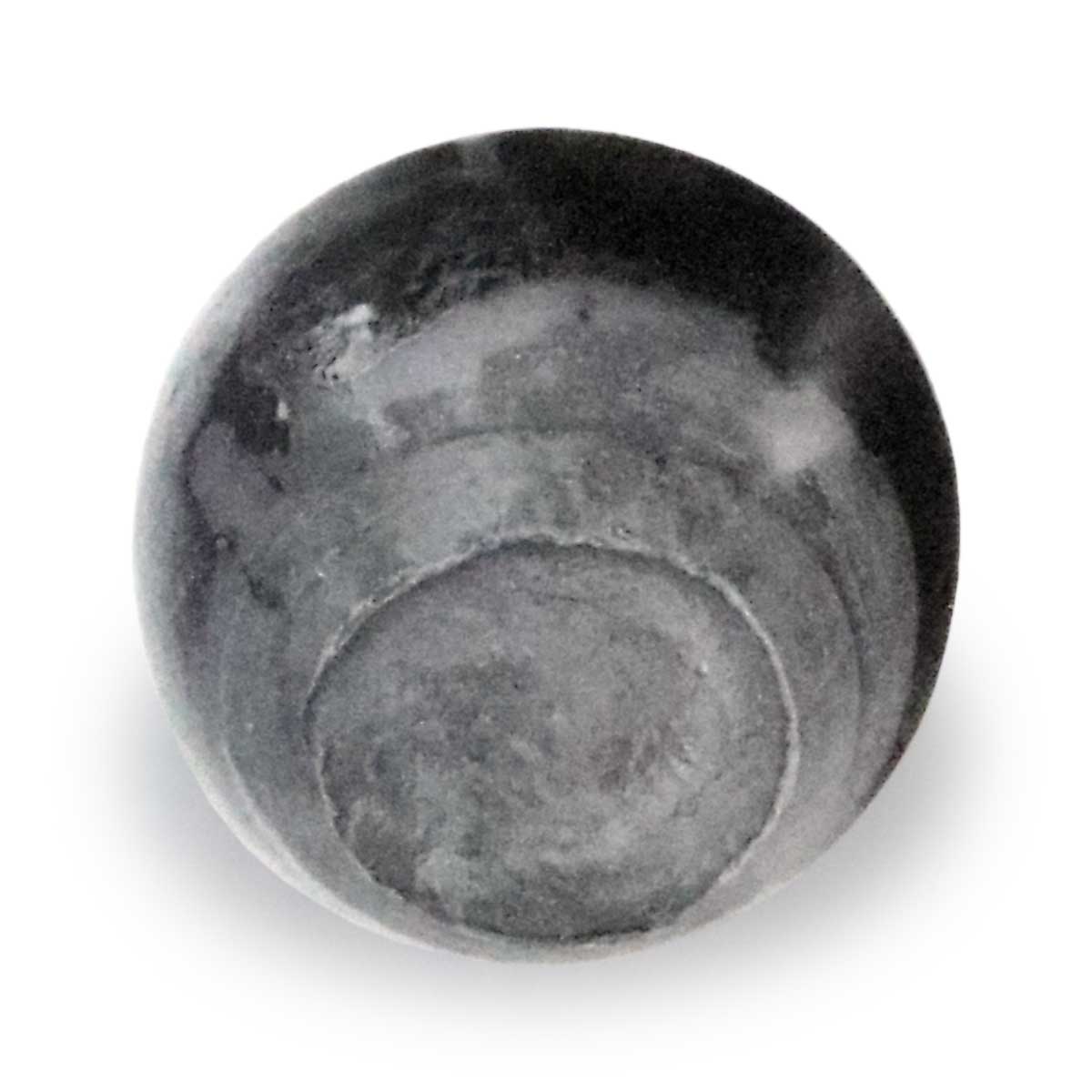
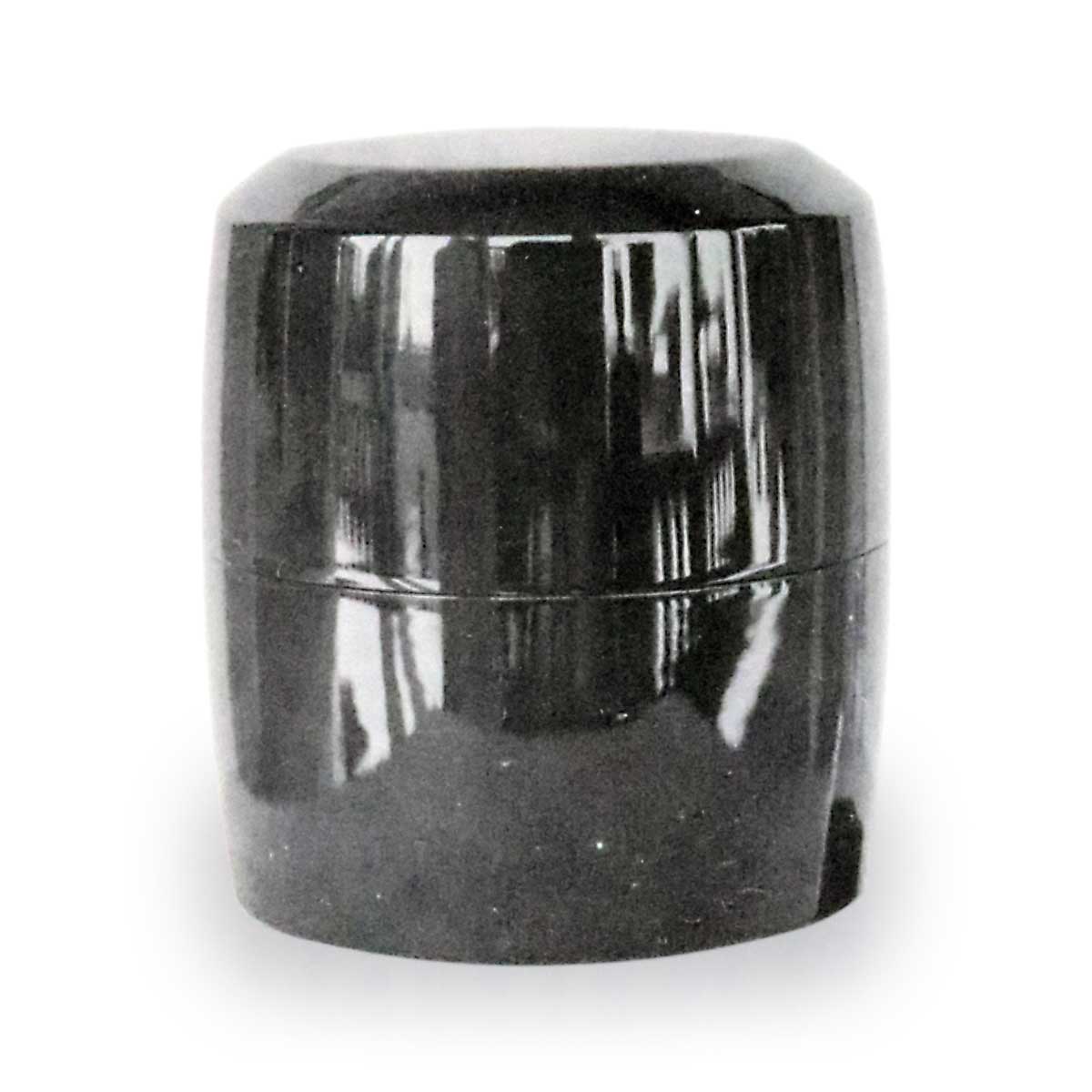
A Daimeibutsu tea caddy made in China (Han-saku) (Former name: Matsumoto Katatsuki. Formerly owned by Duke Tadashige Shimazu)
[Origin of the Name]
It was originally called “Matsumoto Katatsuki” because it was owned by Matsumoto Shushitsu (or Matsumoto Tamaki, according to other sources). Later, it passed to Matsuya Genzaburo, a merchant in Kyoto (of the Domon family, a lineage that has used the name Genzaburo for generations), and came to be known as “Matsuya Katatsuki.”
[Modern Equivalents of Dimensions and Weight]
Height: Approx. 7.7 cm – 7.8 cm (2 sun 5 bu 5 rin – 7 rin)
Body diameter: Approx. 8.8 cm (2 sun 9 bu 2 rin)
Mouth diameter: Approx. 4.8 cm (1 sun 6 bu)
Base diameter: Approx. 4.8 cm (1 sun 6 bu)
Rim height: Approx. 1.0 cm (3 bu 2 rin)
Shoulder width: Approx. 1.1 cm (3 bu 5 rin)
Weight: Approx. 116.6 g (31 monme 1 bu)
[List of Accessories]
Lid: 1 piece, made to the taste of Hosokawa Sansai (Tadaoki), crafted from ivory. (Old records mention three additional lids, but they are currently missing.)
Storage pouch: Made of white habutae silk fabric, with white cords.
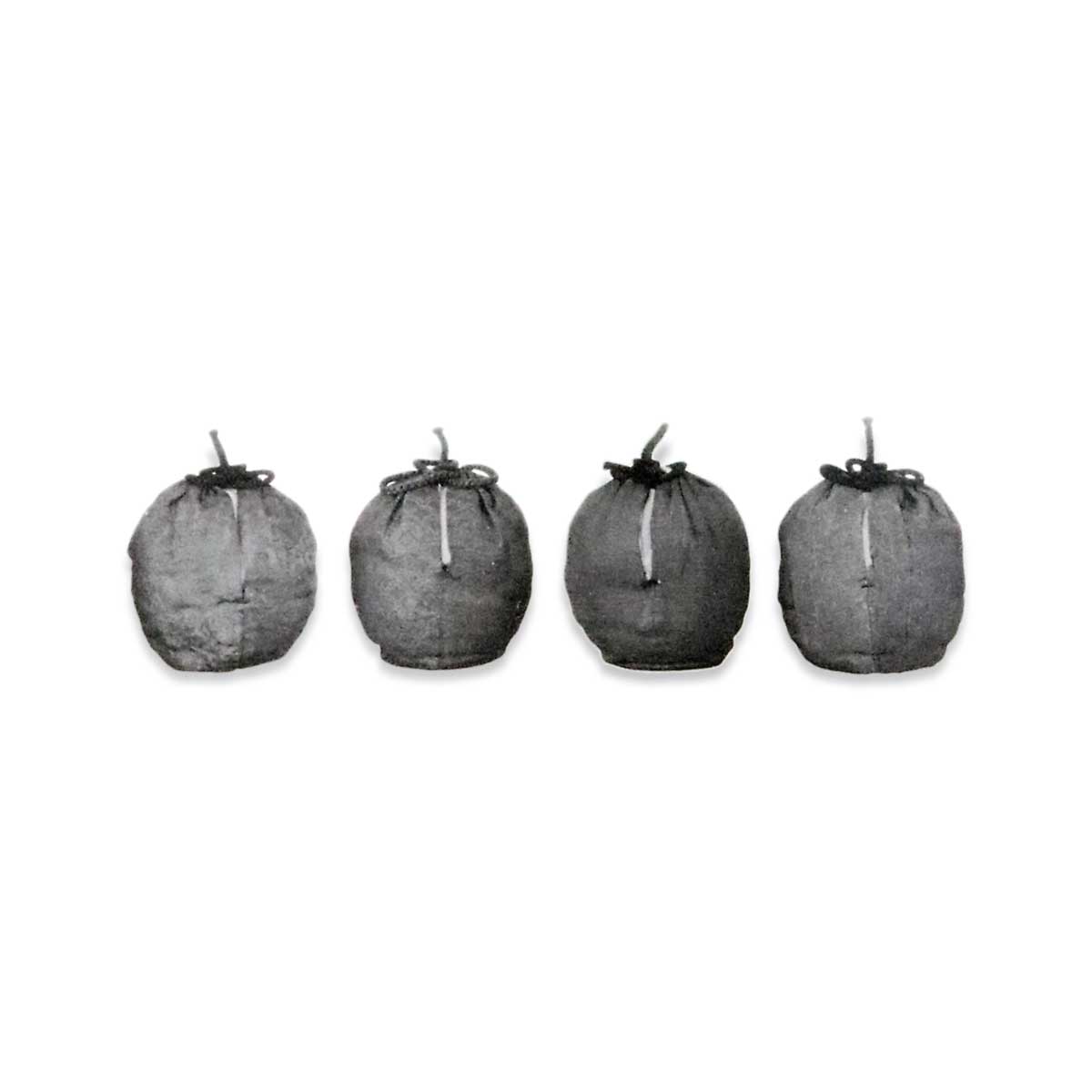
Four types of protective covers (listed from right to left in the photo):
- Ryu Sanshu Donshu: Lining is Tamamushi Kaiki, cord is purple. — In the style of Murata Juko.
- Cotton Kanton: Lining is Tamamushi Kaiki, cord is brown. — In the style of Sen no Rikyu.
3. Nami-ume-Donshu: Lining is Tamamushi Kaiki, cord is purple. — In the style of Furuta Oribe. - Neji-ume-karakusa-Donshu: Lining is Tamamushi Kaiki, cord is purple. — In the style of Kobori Enshu. (Each of the pouches on the right comes with a round-holed paulownia box.)
Hikiya (wooden container): Black lacquered, made by Fujishige. The pouch is made of leather and has a long purple cord attached.
Inner box: A white paulownia wood box.
Outer box: Black lacquered, with characters written in gold powder on the front of the lid.
(These three items—the Matsuya Katatsuki tea caddy, the ivory lid by Hosokawa Sansai, the black-lacquered Hikiya by Fujishige, the leather pouch with a purple cord, and the white paulownia wood box with a Sanada cord—were donated by Hosokawa Sansai.)
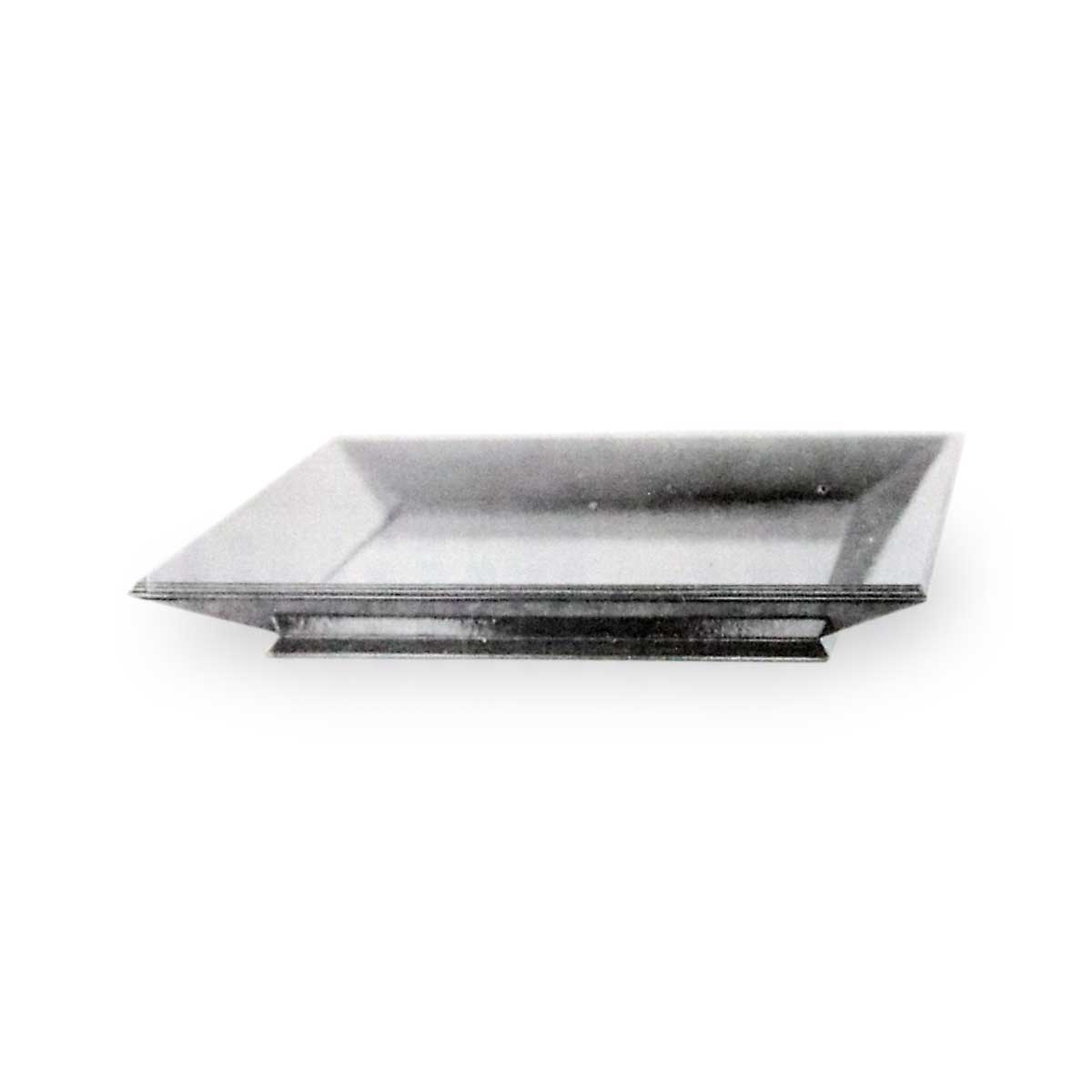
Accompanying Tray (Soe-bon): Haneda Tray
(Dimensions: approx. 24 cm (length x width); the flat inner surface is approx. 16.6 cm; the base is approx. 17.8 cm; height is approx. 3.5 cm. The inner box housing the tray is a plain cedar box.)
Shihō-bon: The outer box of the tray is coated in black lacquer and features inscriptions in gold leaf.
[Miscellaneous Notes: Shape and Characteristics of the Tea Jar]
Regarding the Matsuya Katatsuki tea jar, its dimensions are as follows: the outer height is 2.5 sun (approx. 7.7 cm), the body width is 2.85 sun (approx. 8.6 cm), the mouth diameter is 1.55 sun (approx. 4.7 cm), the rim height is 0.35 sun (approx. 1 cm), and the base diameter is 1.6 sun (approx. 4.8 cm). The rim has a “twisted” shape, and the base plate is slightly raised in a “raised plate” style. There are two horizontal lines running down the center of the body. There are three notable features (scenic highlights). The entire piece is covered in a persimmon- or chestnut-colored glaze (nadare), within which the horizontal lines are visible. The texture of this glaze resembles that of Amelaku. As shown in the diagram, the rim of the base has a raised section where the clay is about 5 rin (approx. 1.5 mm) higher.
[Origin of the Lids and Storage Bags]
This tea caddy has four lids: three are heirlooms passed down through the generations, and the fourth was a gift from Hosokawa Sansai. The lid knobs were crafted by Hosokawa Sansai himself and are made of a special type of ivory used exclusively for the highest-grade Meibutsu tea caddies.
There are also four traditional storage bags (shifuku). The fabric for these bags is Donshu, a pure silk with patterns favored by Murata Jukō, such as three-clawed dragons or centipede-like designs, and the cords are purple. Sen no Rikyū’s bag is made of cotton Canton fabric, with a purple cord. Furuta Oribe’s bag features a plum blossom pattern on a brown background, with a purple cord. Kobori Enshu’s bag features a flower-colored (blue) ground with a ironwire flower pattern, and the cord is purple.
[The Kitano Daichado and the History of Its Transmission]
The star-shaped tray (Zonsei-bon) in the outer box (Hikiya) is a black lacquered piece by Fujishige, and the pouch is known as a “Sekusa” (it has a long cord said to have been made for a kotatsu; it was a gift from Hosokawa Sansai to be worn around the neck) . The surface of this Zonsei-bon is carved to resemble a cloth weave, and it is undoubtedly a magnificent Chinese artifact. Sen no Rikyū and Oda Nagamasu (Yurakusai) also praised it, saying, “It is a masterpiece, the only tray of its kind in the world.”
This tea caddy was originally a treasured possession (Imperial artifact) of Ashikaga Yoshimasa (Higashiyama-dono) and was subsequently bestowed upon Matsudaira Shushitsu. This is why it came to be passed down within the Matsuya family. When Sen no Rikyū hosted a tea ceremony, he requested this Matsuya Katatsuki from Hisamasa, an ancestor of the Matsuya family. During the Kitano Daichajō in the 15th year of the Tenshō era (1587), the three Meibutsu of the Matsuya family—Xu Xi’s painting of a heron, the Matsuya Katatsuki, and the Haneda tray—were presented to Lord Toyotomi Hideyoshi for his viewing. Lord Hideyoshi was deeply moved. Later, an ancestor named Hisashige brought it to Fushimi, where Lord Doi Daishu (Toshikatsu), a senior retainer of the Tokugawa clan, inspected it before requesting that it be presented to the Shogun for his viewing. Regarding the design of this katatsuki tea caddy, since Rikyu, Enshu, and Oribe each preferred their own unique “front view,” the covers (shibukuro) were also crafted to suit their respective tastes (the three diagrams illustrating the front views of the tea caddy have been omitted).
The details of the four pouches are as follows: Jukō’s pouch consists of 12 pieces of fabric sewn together vertically, with six pieces on each side of the front, and the lining is Tamamushi Kaiki. Rikyū’s pouch lining is Tamamushi Kaiki. Enshū’s pouch lining is light blue silk. Oribe’s pouch lining is Tamamushi Kaiki (diagrams of the four pouches are omitted).
[Other Treasures and Letters]
The Zonsei-style long tray by Chosei features an overall fabric-like ground pattern, with mountains, pine trees, clouds, and figures all exquisitely carved. While resembling Tsuishu lacquer, the surface has a yellowish tint. It bears a written record of its provenance. The rim of the tray is carved with an arabesque pattern resembling Kurin (a type of lacquer finish), with flashes of red and blue visible between the carvings, giving the entire piece the appearance of Kurin-nuri lacquer. With lacquerwork featuring designs such as the “Karamatsu” (Chinese pine), the surface of the tray possesses a unique charm. In addition to these three items, a Shihō-bon (Four-sided Tray) by Haneda Gorō (made by Kaimon; illustration omitted) has been added to the collection and is passed down in the Domon family. This is a replica of a hanging scroll by Lord Matsudaira Fumai, the feudal lord of Unshū.
(Modern translation of the letter):
“Yesterday, I had the opportunity to view two famous Meibutsu for the first time in a long while, and it was a joy beyond measure. In particular, I feel that such a Daimeibutsu as this Matsuya Katatsuki is not an item that people like us should lightly admire or keep in our possession (it is a supreme treasure so awe-inspiring). Sincerely,
October 14th, Matsudaira Dewa-no-kami Fumai (Seal)
To Lord Domon Genzaburo”
(From Kissa Yoroku by Masashige Fukada)
[Records of Origin and Form Found in Various Texts]
Matsuya Hisashige’s Diary: Xu Xi’s painting of a white heron, the Matsuya Katatsuki tea caddy, and the Zonsei tray—these three items (the “Three Meibutsu of Matsuya”) were bestowed upon Murata Jukō by Ashikaga Yoshimasa (Lord Higashiyama) of the Muromachi Shogunate. They were passed down from Jukō to Furuichi Harima-no-kami (Sumitane), and from Furuichi to Genzaburō Hisashige, an ancestor of the Matsuya family. During the Kansei era, Genzaburō was the 13th generation descendant, counting from the first generation.
“Meibutsu Mekiri Monogatari”: The Matsuya Katatsuki is a tea caddy made in China (Tang-style). Each time tea masters of the past requested to view it in turn, a new cover (bag) was added. The bags bear the names of Mandaiya Donshu, Shōō Donshu, Enshū Donshu, Rikyū Kōtō, Wawa Donshu, Hosokawa Donshu, Furukinsuki, and Yasaburō Kōtō, among others; I have forgotten the rest (there is an illustration of the tea caddy with explanations).
“Shadō Shōdenshū”: A low-backed Katatsuki tea caddy is called a “Hankatatsuki.” The tea caddy owned by Genzaburō (Matsuya Katatsuki), which features a painting of a white heron from Nara, is precisely this type of Hankatatsuki, and the Hankatatsuki once owned by Shino Sōon is also known as a Meibutsu.
Sekimakusa Chadō Wakugai: The Matsumoto Katatsuki (Matsuya Katatsuki) is in the collection of Domon Sabun of Nara. It was once owned by the Matsumoto family, and has since been passed down through the Domon family from Furuichi Harima. Its dimensions are approximately 2.75 sun (about 8.3 cm) in height and 2.8 sun (about 8.5 cm) in body diameter. The base is flat, the lid reflects the taste of Hosokawa Sansai, and the bag features designs such as Ryuzume Donshu’s “Rokumegaki” (six-panel) and Shōō Kōtō; the accompanying tray is also said to reflect Hosokawa Sansai’s taste.
“Setsumankusa Chado Wakugei (Alternative Account)”: Domon Genzaburo of Nara, whose family name was Matsuya, was also known as “Urushiya.” The second-generation master was named Domon Hisayuki, and he was a disciple of Furuichi Harima-no-kami Hōin Sumitane (Sumitane was a disciple of Jukō). The three items—a single-hanging scroll of a white heron, a Matsuya katatsuki, and a Zonsei long tray—were passed down from Harima-no-kami and are still in his possession.
“Kokin Meibutsu Ruiju”: The Matsuya Katatsuki is a Daimeibutsu. It is owned by Matsuya Genzaburo of Nara. Its dimensions are: height 2.6 sun (approx. 7.9 cm), body diameter 2.9 sun (approx. 8.8 cm), mouth diameter 1.6 sun (approx. 4.8 cm), and base diameter 1.6 sun (approx. 4.8 cm). The entire surface, from the shoulder down, features an amber-colored glaze (ame-yaku). The base is raised, and there are traces of the spatula (residual clay) on the bottom. There are four pouches: one in Rikyu’s preferred style featuring a cotton Guangdong pattern (flower-colored with brown twisted chrysanthemum motifs); one in Enshu’s preferred style featuring a single-layer arabesque pattern (beige with brown Seigaiha wave motifs); one in Oribe’s preferred style featuring a plum blossom bowl pattern (flower-colored with white small peony arabesque motifs); and a three-clawed dragon cover. The trays include a Zonsei-style long tray and a square tray made by Haneda Goro.
From “The Origins of Seto Pottery” by Fumai: The Matsuya Katatsuki is of Chinese origin (Han-style).
From “Rinpō-kuryū: The Yamazumi Family Tea Jar Register”: Matsuya is a Daimeibutsu, also known as “Matsumoto.” Owned by a merchant of Nara. The bag is a six-panel patchwork bag made from a Jukō donzu. It comes with a tea caddy and tray in the Sansai style.
“Yamasumi Family Tea Caddy Register (Alternative Account)”: All Chinese tea caddies are modeled after the two Meibutsu, the Aburaya Katatsuki and the Matsuya Katatsuki. Having endured a thousand years since their creation, they are truly the finest Han-style works.
[Rikyu’s Interpretation of the Lid and Scenery (from the “Matsuya Diary”)]
We have owned the Matsuya Katatsuki since our ancestors’ time, and when we showed it to Sen no Rikyu (Yaku), he praised it beyond measure. (Excerpt) At the tea ceremony on the 21st, the lid of the tea caddy was different from usual—it had been replaced with a magnificent “enomi” (a lid with an ivory knob). Previously, a flat lid designed for the Katatsuki style had been used. Although it was customary not to use an enomi lid with this Katatsuki tea caddy, because the lid was so (omitted) magnificent, Rikyu remarked, “From now on, you should use this wonderful, traditional lid.” Incidentally, the flat lid used previously had been commissioned by his ancestor Hisamasa when he traveled to Kyoto; it was modeled after the lid of the “Nitta Katatsuki,” considered the finest tea caddy in the land. Furthermore, regarding the three decorative motifs on the body of the tea caddy known as “Matsuya Nadare,” the central motif had traditionally been treated as the front (omote). However, Rikyu remarked, “It would be more refined and appropriate to treat one of the ends as the front,” so it was revised accordingly.
The Matsuya Katatsuki has four “placement styles” (how to position it and which side is the focal point). 1. The traditional placement style. 2. Rikyu’s designated placement style. 3. Oribe’s designated placement style. 4. Enshu’s designated placement style. (These four placement styles are illustrated in the diagram). Overall, both the shoulder and body have a texture similar to Amakura ware, with silver-colored luster (ginmu) appearing in places.
[Detailed Description of the Tea Jar and Zonsei Tray]
The shape of the tea jar features yellow glaze retained at the upper edge, giving it a metallic luster (kinki). The clay (base) is a grayish-brown with a hint of vermilion mixed in, and the shoulder and are amber-colored. On the inside of the base (where the tray attaches), a single speck of metallic luster (kinki) can be seen, and the rim of the base is slightly raised in the center. It was made using the board-forming technique and has no wrinkles (shibo) on the base.
(Illustration of the tea caddy omitted). The accompanying “Zonsei-bori Nagabon” is a lacquerware piece measuring approximately 36.4 cm in length, 4.2 cm in height, and 17 cm in width. It is coated entirely with a translucent vermilion lacquer and features fine, basket-weave-like carvings covering the entire surface. Black lacquer is inlaid into the recesses of the carvings in a manner reminiscent of chinkin, and the gold-leaf decoration (haku-e) is truly magnificent. It is called “Zonsei” because the patterns are carved over a background dotted with star-like marks. The arabesque pattern on the rim is also decorated with gold leaf, revealing the plain black rim beneath, which features fine craquelure. The entire exterior is coated in black lacquer, featuring a sumi-e (ink wash) illustration of the tea caddy, its dimensions, a list of accessories, and a description of Xu Xi’s painting of a white heron.
(From Fushimi-an Meibutsu Chaki-zu and Yuki)
[Record of Actual Observation at a Tea Ceremony (from Ka’an Bunko)]
The Matsumoto Katatsuki (Matsuya Katatsuki) was owned by Tōmon Sabun of Nara. It was originally a personal possession of Ashikaga Yoshimasa (Jishōin-dono), and because it was bestowed upon Matsumoto Shūshitsu, it was named “Matsumoto Katatsuki.” It later came into the possession of Matsuya Hisayuki. The entire body is covered in an amber-colored glaze, but it is mixed with mottled and black glaze. The body is made of white clay with a slight reddish tint, and in some places, the glaze pools have turned a vermilion hue. The dark, amber-like texture around the rim is magnificent. The base is formed using a board-molding technique, creating a unique style with a Nanban (South Barbarian) aesthetic. The horizontal bands (obi) on the body appear as single lines in some places and as overlapping double lines in others.
In the clay beneath these glaze pools, one can see patterns resembling a straw mat (odori-mats) and wheel marks. It is a masterpiece of rare and exquisite craftsmanship, seldom seen throughout history. I had the privilege of viewing it on February 16, 1801 (Kansei 13), at Seki-an (a four-and-a-half-mat tea room) in Kakuburi-cho, Nara. It was a thin tea ceremony, and in attendance were Lord Hashii Riyemon of Nanto, myself, Tanbayaya Katsusuke, and Takenamaya Kichiichi. A hanging scroll depicting a pine tree was displayed in the tokonoma, and to the left of it, a katatsuki tea caddy and a Haneda tray were placed at the end of the scroll.
(From Ka’an Bunko, Volume 6, Sixth Selection)
[National Prestige and Viewing by Successive Shoguns and Daimyo]
The three tea utensils—Xu Xi’s painting of a white heron, the Matsumoto katatsuki tea caddy, and the Zonsei tray—were treasured by the Shogunate for several years as possessions of Ashikaga Yoshimasa (Higashiyama-dono, Sōshōin-dono), and were cherished by the Shogunate for several years before being bestowed upon Murata Jukō, a member of the same circle of tea masters. They were passed down from Jukō to his foremost disciple, Furuichi Harima-no-kami Sumitane, and from Sumitane, they were bequeathed to my ancestor, Genzaburō Hisayuki, who was a disciple of the school. Since then, our family has inherited and possessed them from generation to generation up to the present day; counting from Hisayuki, this spans ten generations and over 300 years.
When Lord Toyotomi Hideyoshi (Taiko) stopped by Matsuya accompanied by Lord Tokugawa Ieyasu (Toshogu Gongen), these three items were presented to him for his inspection.
They were also presented for his viewing in Kyoto when the Second Shogun, Lord Tokugawa Hidetada (Taito-in), visited the capital.
At the request of Lord Maeda Toshitsune (Saishō), the lord of the Kaga Domain, my ancestor traveled to Kaga (Kanazawa) to present them to him.
At the request of Lord Takatora Todo (Daigakuto), the lord of the Kishu Domain, my ancestor Hisashige traveled to Ise to present the three types of tea utensils to him.
During the tenure of Lord Chikashige Makino (Kawachi-no-kami), the Kyoto Shoshidai, we presented these three Meibutsu tea utensils at his residence in Kyoto at his request.
In particular, Lord Hosokawa Sansai, a daimyo renowned as a tea master, visited Matsuya three times to view Meibutsu. When Lord Sansai appeared wearing “nagabakama” (long hakama), the highest form of ceremonial attire, the owner at the time said, “I am humbled that such a noble daimyo would come wearing nagabakama; I am at a loss as to how I should respond.” Lord Sansai is said to have replied, “This is not a matter of etiquette toward the Emperor (His Majesty). Today, I am beholding the finest Meibutsu in the land for the very first time, so this is the highest form of respect I can show toward this Meibutsu,” and he continued to wear the nagabakama.
This Matsumoto Katatsuki tea caddy is counted among the Three Great Katatsuki of the Realm (Narashiba Katatsuki, Nitta Katatsuki, Matsumoto Katatsuki), and among the common people (the lower classes), it was rumored that “the Matsumoto Katatsuki is truly the finest tea caddy in the land.” The original lining is “Ryū no Tsume Donshu” (the dragon’s claw pattern is used on the robes of Chinese emperors, making it an extremely rare and expensive fabric.
[Omitted] The lining reflects the tastes of Lord Hosokawa Sansai. There are three replacement pouches: one in cotton Guangdong style favored by Rikyu, one in plum-bowl persimmon-colored Donshu favored by Furuta Oribe, and one in arabesque floral-colored Donshu favored by Kobori Enshu.
Regarding these three tea utensils, my ancestor Hisayuki had two sons. He bequeathed the “White Heron Painting” and the “Zonsei Tray” to his eldest son, Hisae (who inherited the name of the main family line), and divided the “Matsuya Katatsuki Tea Caddy” and the “Haneda Tray” to be passed down to his second son, Hisamori (who inherited the retired head’s position and took the name Matsuya Genzaburo).
[Agreement Between the Main and Branch Families (from the “Bian Bunko”)]
(Continued from the previous page: Although the three Meibutsu were divided and inherited,) whenever a high-ranking noble visited, or when another guest requested the hanging scroll (the “White Heron Painting”), the eldest and second sons would both be present in the main family’s tea room to perform the tea ceremony. They would consult and make arrangements for all matters together, leaving behind a testament (a pledge of sincerity) to ensure that neither one acts improperly or unfairly toward the other. To this day, this agreement has been upheld and passed down through the generations. End.
(From “Bai’an Bunko, Volume A, Fourth Scroll”)
[Traces of Matsuya Katatsuki in Historical Tea Ceremony Records]
“Tsuda Sōyuki’s Tea Ceremony Diary” (Morning of February 14, 1562 [Eiroku 5], tea gathering hosted by Urushiya Genzaburō; attendees included Kan’un):
A flat kettle was placed on a small board, and a water jar with a tuber-shaped lid was set directly on the tatami mat. A painting of a white heron was hung in the tokonoma; just before preparing the tea, the “katatsuki tea caddy” was taken out, and tea was prepared using a tenmoku tea bowl and a black tea bowl.
From Excerpts from Imai Sōkyū’s Tea Diary (February 28, 1570 [Eiroku 13], tea gathering hosted by Matsuya Genzaburō):
A painting of a white heron was hung in the tokonoma until the end of the tea gathering, and the katatsuki tea caddy was displayed on a shihō-bon tray. The water jar was from Shigaraki, and the tea bowls were a black bowl and a men-tsū (face-through) bowl. The dimensions of the katatsuki were: height 2.55 sun (approx. 7.7 cm), body diameter 2.8 sun (approx. 8.5 cm), mouth diameter slightly over 1.5 sun (approx. 4.5 cm), and base diameter 1.6 sun (approx. 4.8 cm). The bag was plain (muku) Donshu silk, and the cord was purple. An illustration of the tea caddy is included.
“Matsuya Diary” (Tenshō 13 [1585], May 28, around 8:00 a.m.; a record of the tea ceremony). Lord Furuta Sasuke (Oribe) and Lord Setada Samanosuke traveled to Nara, eager to experience Matsuya Hisamasa’s tea ceremony. Bō Haruta Matazaemon was dispatched to guide them. At the gathering, a hanging scroll of a white heron, a Matsuya katatsuki, a tenmoku bowl, a lid with a small turtle design, and for the thin tea, a large Goryeo tea bowl and an authentic hand-dipping bucket were used):
“Matsuya Diary” (Morning of March 27, 1587 [Tenshō 15], in Nara, at a tea gathering hosted by “Nushiya (Matsuya) Genzaburō”): A Matsuya katatsuki was used.
[Eyewitness account by the wealthy Hakata merchant Kamiya Sōtan (from the Sōtan Diary)]
(Attendees at the tea gathering: a man named Mizo and one other person)
The host, Matsuya Genzaburō, was a white-haired man who appeared to be about 70 years old; he was slender and a very wise man. The tea room was four and a half tatami mats in size, and a painting of a white heron hung in the six-shaku-wide tokonoma from start to finish. The katazuki tea caddy was magnificent; it was carefully taken from the shelf and placed upright. Its dimensions were: total height 2.7 sun (approx. 8.2 cm), mouth diameter 1.4 sun (approx. 4.2 cm), rim height 0.35 sun (approx. 1 cm), and body diameter about 2.4 sun (approx. 7.3 cm) . It features three areas of “nadareglaze,” where the glaze is thickly raised. The clay (body) is whitish with a slight bluish tint, and there are spatula marks (hege-tsuchi) on the bottom. The lid fits the tea caddy perfectly and is round in shape.
(From the “Sōtan Nikki”)
[Repairs during the Kanei era and high praise from Hosokawa Sansai and others (from Matsuya Hoki)]
On October 22, Kanei 2 (1625), I had the opportunity to view the “Donshu Hishitachikiri,” the carrying case (bag) for the Matsuya Katatsuki. It had been re-sewn by Kubo Gonta and a carpenter, and the cord is a deep wisteria purple.
In August of Kan’ei 7 (1630), Lord Kobori Enshū ordered the repair and adjustment of the lid of the Matsuya Katatsuki. Lord Enshū personally applied the lining paper to the inside of the lid. The lid handle (futa-hiki) was crafted by Hansei. At that time, the cords of the aforementioned diamond-patterned bag were replaced with purple ones. Three letters from Lord Enshū remain.
Records from Kan’ei 12–14 (1637): At the Karasuma residence in Kyoto, a request was made to have a new lid made for the Matsumoto Katatsuki. According to a note dated June 7 of the same year (1637), a tea gathering was held in the Yoshida area, attended by a total of seven guests: the renowned monk Seigan, Hosokawa Kyumyō (a monk from the temple below Atago), Kyusai, Hagiwara, and Hisashige. During the gathering, the Matsuya Katatsuki was praised to the skies, and the words of gratitude and admiration offered by each guest were beyond description. The group was in an uproar, exclaiming, “This tea caddy is far more magnificent than we had heard through rumors. It is an even more splendid vessel than the famous ‘Nakayama Katatsuki’.” Lord Hosokawa Sansai also agreed, saying, “That is absolutely correct.” When the group remarked, “It is in a different class from the ‘Daimonji-ya Katatsuki’ and should not be placed alongside it at the same gathering,” Lord Sansai also “That is correct. It appears even more magnificent now than when I saw it in the past.”
(Continued from the previous page: The fact that Lord Sansai bestowed the highest praise was) due to the excellent discernment (insight) of the people of that time.
(From The Tale of Sansai and Matsuya Notes)
[The Miraculous Report from Matsunaga Hisahide (from Matsuyama Fu Han Zensho)]
In Yamato Province (Nara), there lived a man named Matsuya Genzaburō, who possessed a tea caddy known as the “Matsuya Katatsuki.” It is said that this caddy is accompanied by a letter from the Sengoku-period warlord Matsunaga Danjō Hisahide. The reason for this is that on the eve of Hisahide’s burning of Nara (the Nanto Yaki-tō), he sent a letter to Genzaburō,
“Since I plan to burn Nanto to the ground tomorrow, you must take those two items and evacuate as quickly as possible before midnight.” The “two items” referred to were the Matsuya Katatsuki tea caddy and a painting of a white heron by Xu Xi. It is said that even for a ruthless warlord like Hisahide, showing such thoughtful consideration for the finest tea utensils was a noble gesture truly unbecoming of a warrior. However, I have heard that in recent years, due to the decline of the Matsuya family, this tea caddy found its way onto the Osaka market and is currently in the collection of the Satsuma Domain (the Lord of Satsushu, the Shimazu family).
(From Matsuyama-fu Han Zensho, in the collection of Viscount Okochi)
[Lord Matsudaira Fumai’s Rejection via the “Thousand-Ryo Box” (“The Life of Matsudaira Fumai”)]
One year, while Lord Matsudaira Fumai, the lord of the Matsue Domain, was staying at an inn in Fushimi during his sankin-kotai (alternate attendance) journey, he sent a messenger to Matsuya in Nara to request a viewing of the Matsuya Katatsuki. The head of the Matsuya family brought the tea caddy before Lord Fumai and presented it to him. Lord Fumai was deeply moved and pleaded, “Please, I must have this tea caddy.” However, Matsuya refused. One of Lord Fumai’s retainers said, “My lord’s plea is earnest,” and opened a sliding door nearby, revealing three choryo boxes (equivalent to several hundred million yen today) stacked one on top of the other. Even so, the head of the Matsuya household would not agree, saying, “If you could exchange it for a rare tea utensil of the highest caliber, comparable to those in Lord Fumai’s collection, then I would part with it. “However, these are not utensils I would part with in exchange for mere gold and silver,” he declared, and the discussion of the sale finally came to an end. The following day, Lord Fumai wrote a letter and gave it to Genzaburō (as mentioned in the aforementioned Kissa Yoroku). Later, as the Matsuya family’s fortunes declined, this letter from Lord Fumai passed into the hands of Mr. Masamasa Nakamura of Nara. The accompanying note reads: “This is a letter given to me by Lord Fumai, who held our family’s treasured katatsuki tea caddy in particularly high esteem. Matsuya Genzaburō (seal).”
(From The Life of Matsudaira Fumai)
[Summary of its History]
It was originally owned by Matsudaira Shushitsu and presented to Ashikaga Yoshimasa of the Muromachi Shogunate (or, it is said, Matsumoto received it after it had been in Yoshimasa’s possession). Subsequently, it was received by Murata Jukō, the founder of the tea ceremony, who passed it on to his disciple, Furuichi Harima-no-kami Sumitane; Sumitane then ceded it to Matsuya Genzaburō Hisayuki of Nara. From that time onward, it was passed down through the Matsuya family for generations until the end of the Edo period. The Tsuda Sōyū Chayū Nikki records that this item was used at a tea gathering hosted by Genzaburō in February of the 5th year of the Eiroku era. It is said that “in May of the 8th year of Eiroku, when Matsunaga Hisahide set fire to Nara, he had secretly informed the Matsuya family in advance and ordered them to remove Xu Xi’s painting of the White Heron and the Matsuya Katatsuki.” Subsequently, it was exhibited at the Kitano Grand Tea Gathering on October 1, 1587, and was also presented for the viewing of Emperor Reigen and the second shogun, Tokugawa Hidetada. It garnered the highest praise from successive generations of great tea masters, including Hosokawa Sansai, Furuta Oribe, Kobori Enshu, and Katagiri Sekishu. Rikyu donated a storage bag for it, and Sansai, after viewing it while wearing his finest ceremonial robes, donated an ivory lid, a black lacquered Hikiya, a leather bag, and a paulownia wood box. Matsuya Hisayuki bequeathed two of the three Meibutsu—“Xu Xi’s Painting of a White Heron” and the “Zonsei Long Tray”—to his eldest son, Hisae, and the “Matsuya Katatsuki” to his second son, Hisamori. He left instructions that whenever a person of noble rank wished to view them, the two sons should consult with one another regarding their handling.
Years later, Lord Matsudaira Fumai caught a glimpse of these items and, while in Fushimi, expressed such fervent desire for them that he stacked three “thousand-ryo chests” to demonstrate his earnestness; however, as the Matsuya family showed no sign of yielding, he sent a letter the following day stating, “These were not items that someone of my standing should lightly admire or possess.” However, by the end of the Edo period, the Matsuya family’s fortunes had declined, and the items were pawned in Osaka. It is said among the elders that Lord Shimazu (of the Satsuma Domain) purchased it in Osaka—along with a scroll painting passed down from the Shokado school—for the extraordinary sum of “10,000 ryō” through the mediation of “Michikatsu,” a tea utensil dealer who was very famous at the time. However, during the Satsuma Rebellion (the Battle of Kagoshima) in 1877 (Meiji 10), the town of Kagoshima was engulfed in the flames of war , and everyone rumored that “this supreme tea caddy was also destroyed in the fire,” leading to widespread despair. However, the fact that it has actually survived to this day, perfectly preserved down to its box and protective cover, is truly a cause for immense celebration for the nation. Of the three Meibutsu, the “Zonsei Chōbon” was purchased by Lord Sakai Chūroku, the lord of the Wakasa-Obama domain who served as a contemporary (in an honorary capacity) at the Kyoto City Hall at the time, and it remains in his family’s possession today. However, “Xu Xi’s Painting of a White Heron” passed into the hands of another person at that time and has since gone missing; it is truly regrettable that its current status remains uncertain.
[Academic Record of Actual Observation from the Taisho Era]
On September 20, 1921 (Taisho 10), this tea caddy was examined and observed firsthand at the residence of Lord Tadashige Shimazu in Osaki-cho, Ebara District, Tokyo Prefecture. The rim is thin, and the turned-back edge is shallow. The area below the koshiki (flange) protrudes slightly, and the shoulder extends powerfully in a straight line (as if the rim had been pushed out). The horizontal grooves running around the body consist of two sections and one section; there is a point where the line misaligns (misaligned). Around the rim, slightly deep horizontal spatula marks (horizontal spatula grooves) are visible. The area below the rim reveals the grayish-brown clay body, and the base was made using the “ita-okoshi” technique. The rim of the base is slightly raised, and the surface has been scraped with a spatula to create a jagged, uneven texture, resulting in a difference in height; the base surface itself is also uneven.
As for the overall appearance of the tea caddy, a pattern resembling torn “flying clouds” (hiun) vividly emerges from the yellow glaze (ki-yu) against a deep, glossy chestnut-brown base. Alternatively, there are areas where fine yellow dots are scattered like specks, and when viewed from a certain angle, one can interpret the design as a “yellow dragon leaping powerfully through the clouds.” Furthermore, where the brown glaze cascades down to the rim, the “glaze drips” (clumps of glaze) reveal faint traces of “snake and scorpion” color (complex, scaly kiln changes) in some places.
Given that the appearance changes endlessly and is extremely multifaceted depending on the viewing angle (from various directions), it is understandable that since ancient times, great tea masters such as Sen no Rikyū and Kobori Enshū differed in their opinions regarding which side to present as the front (omote) when selecting the placement (each establishing their own unique arrangement).
The interior of the tea caddy is glazed up to the rim, with the wheel marks gradually fading downward from there, and the center of the base is slightly raised.
Despite its overall low height, the body is firmly rounded and plump, making it a dignified tea caddy with a “fukusō” (auspicious appearance) that seems to embody abundant good fortune. In particular, the richness of this yellow glaze is a beauty rarely seen even among Chinese “Han-style tea caddies.” The text concludes with the highest praise, stating that its fame resounded throughout the land and it was highly esteemed among tea masters of old—a fact that was by no means a coincidence, but rather a result of the overwhelming dignity and quality inherent in this vessel itself.