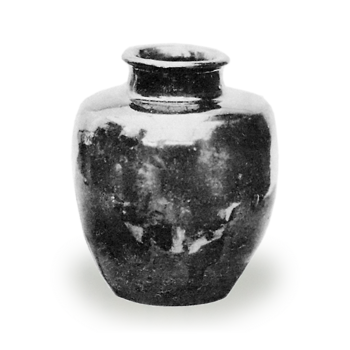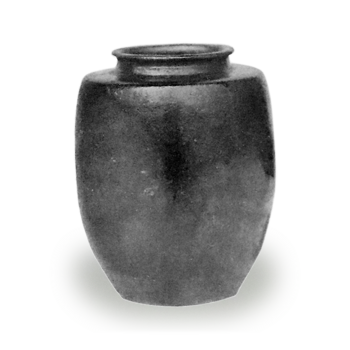
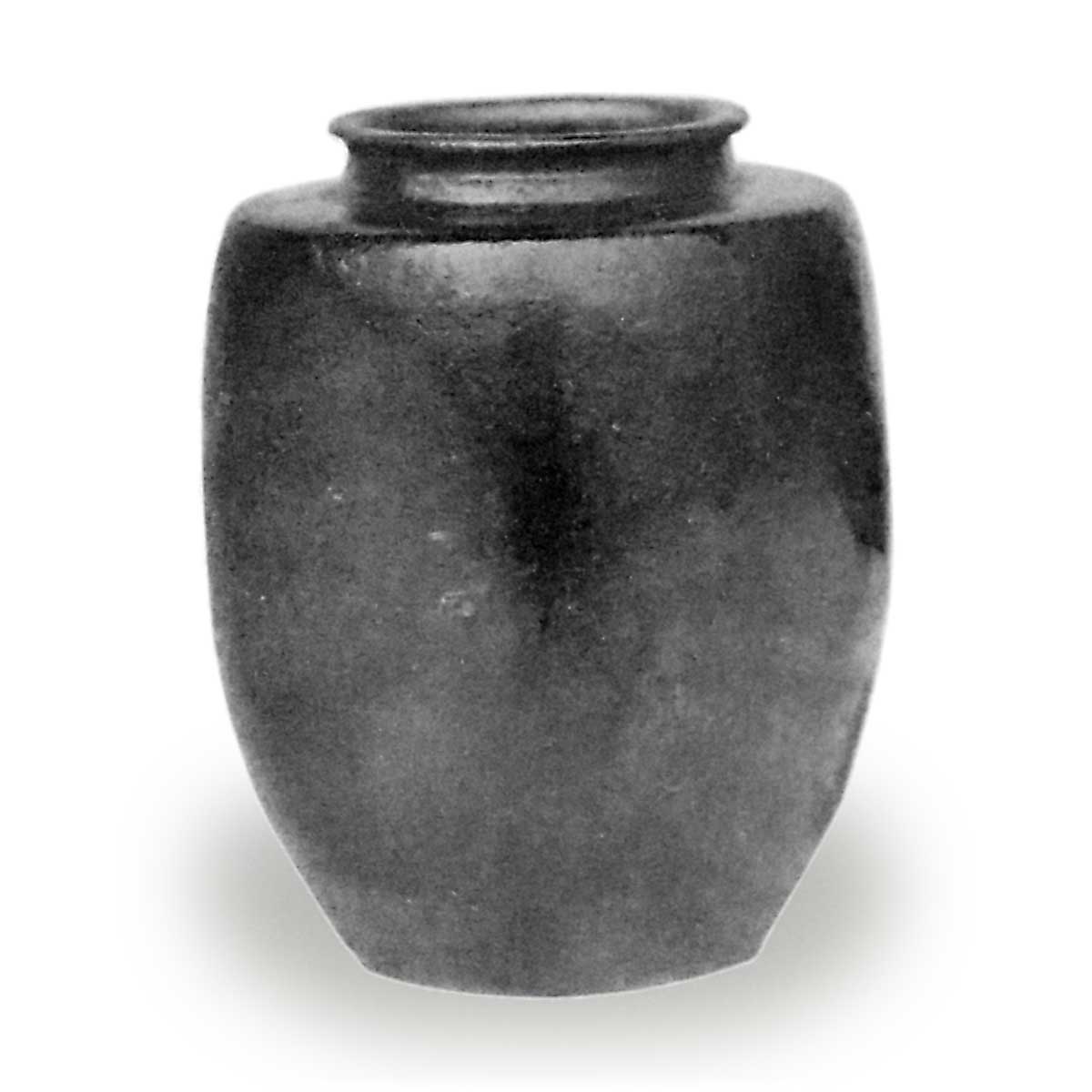
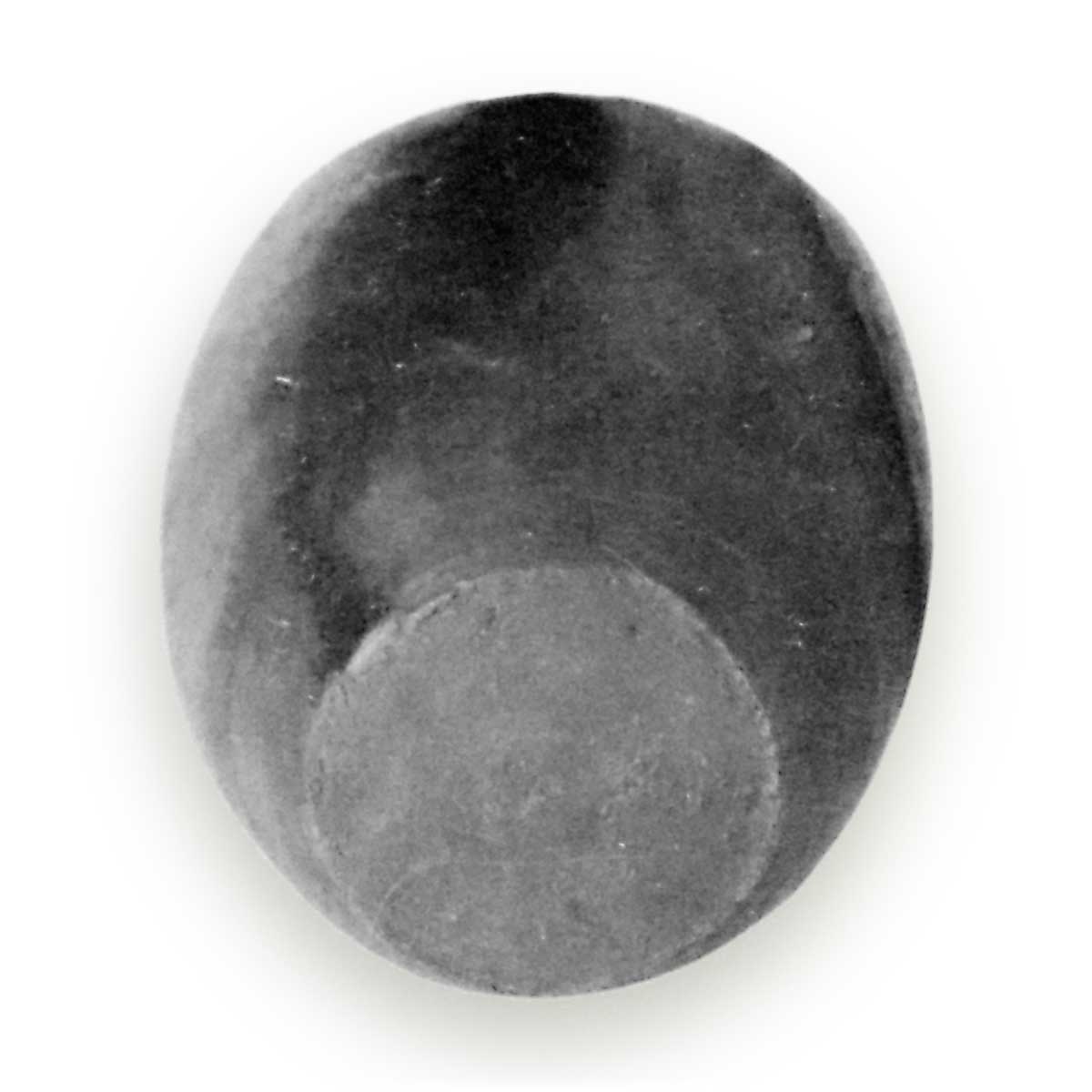
Made in China (Han-saku) | Daimeibutsu | Collection of Baron Heitaro Fujita
[Origin of the Name]
The name “Seitaka” likely derives from the teapot’s tall stature.
[Dimensions]
Height: Approx. 8.8 cm (2 sun 9 bu 2 rin)
Body diameter: Approx. 7.1 cm (2 sun 3 bu 6 rin)
Mouth diameter: Approx. 4.2 cm (1 sun 4 bu)
Base diameter: Approx. 4.2 cm (1 sun 4 bu), or approx. 4.1 cm (1 sun 3 bu 5 rin)
Neck height: Approx. 0.6 cm (2 bu)
Shoulder width: approx. 0.9 cm (3 bu)
Weight: approx. 110 g (29 monme 4 bu)
【Accessories】
・Lid: 1 (made of ivory)
・Storage pouch: Habutae silk (marked “Seitaka”)
・Covers (pouches): 2
(1) Vermilion-painted fabric (lining: iridescent, cord: deep purple)
(2) White-brown Guangdong silk (lining: iridescent, cord: deep purple)
・Hikiya: Black lacquer, made by Fujishige. Case: Black velvet, lining: iridescent, cord: deep purple.
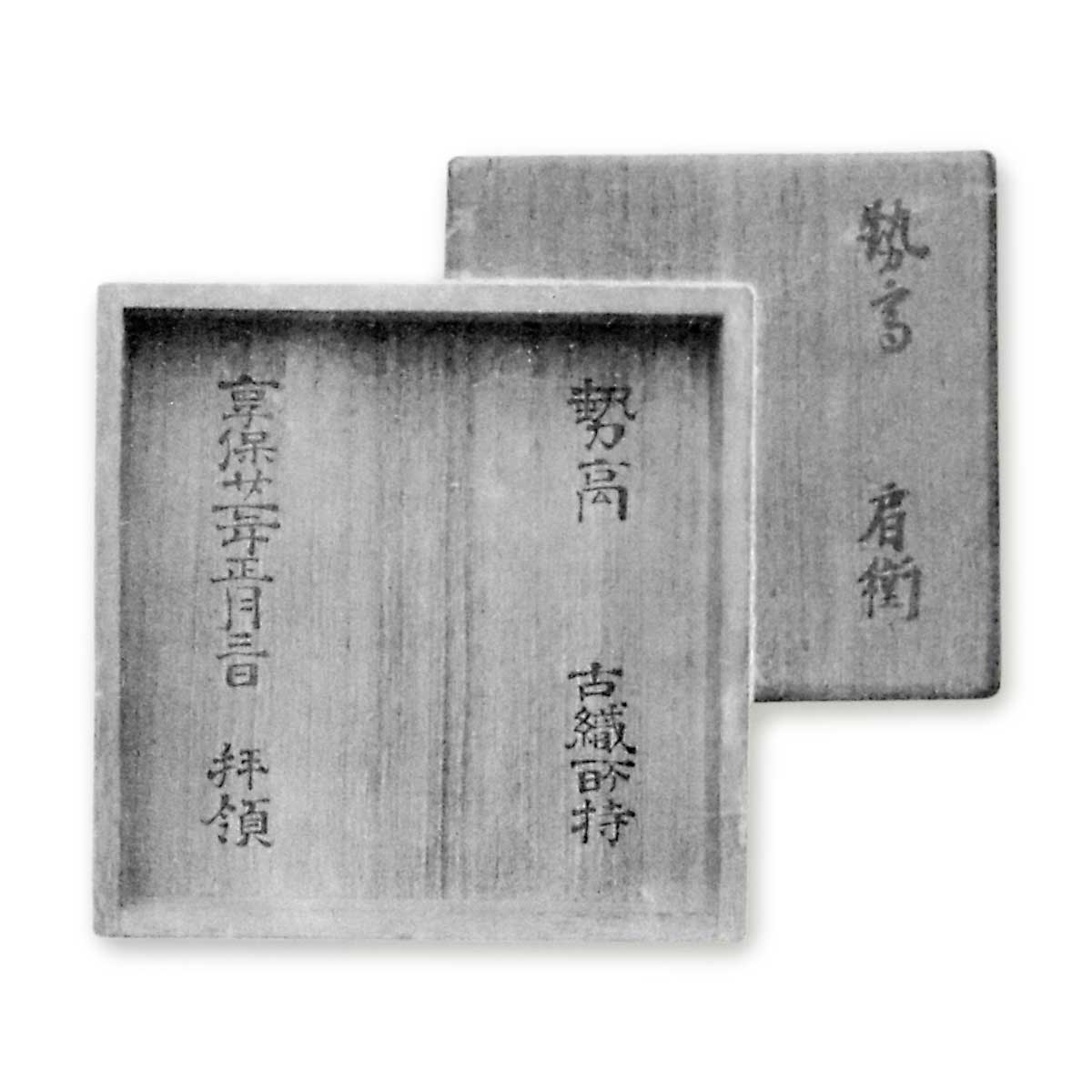
・Inner box: Unfinished paulownia wood, with an inscription by Honda Airan (Tadasumi) reading “Seitaka, Katatsuki.”
・Middle Box: Unfinished paulownia wood, with an inscription by Honda Munenori.
The front reads “Sekitaka,” and the back reads “Sekitaka, owned by Furui (Furuta Oribe), received on the 3rd day of the 1st month of the 21st year of Kyōhō.”
・Outer Box: Unfinished paulownia wood. It reads “Sekitaka” and comes in a brown leather pouch.
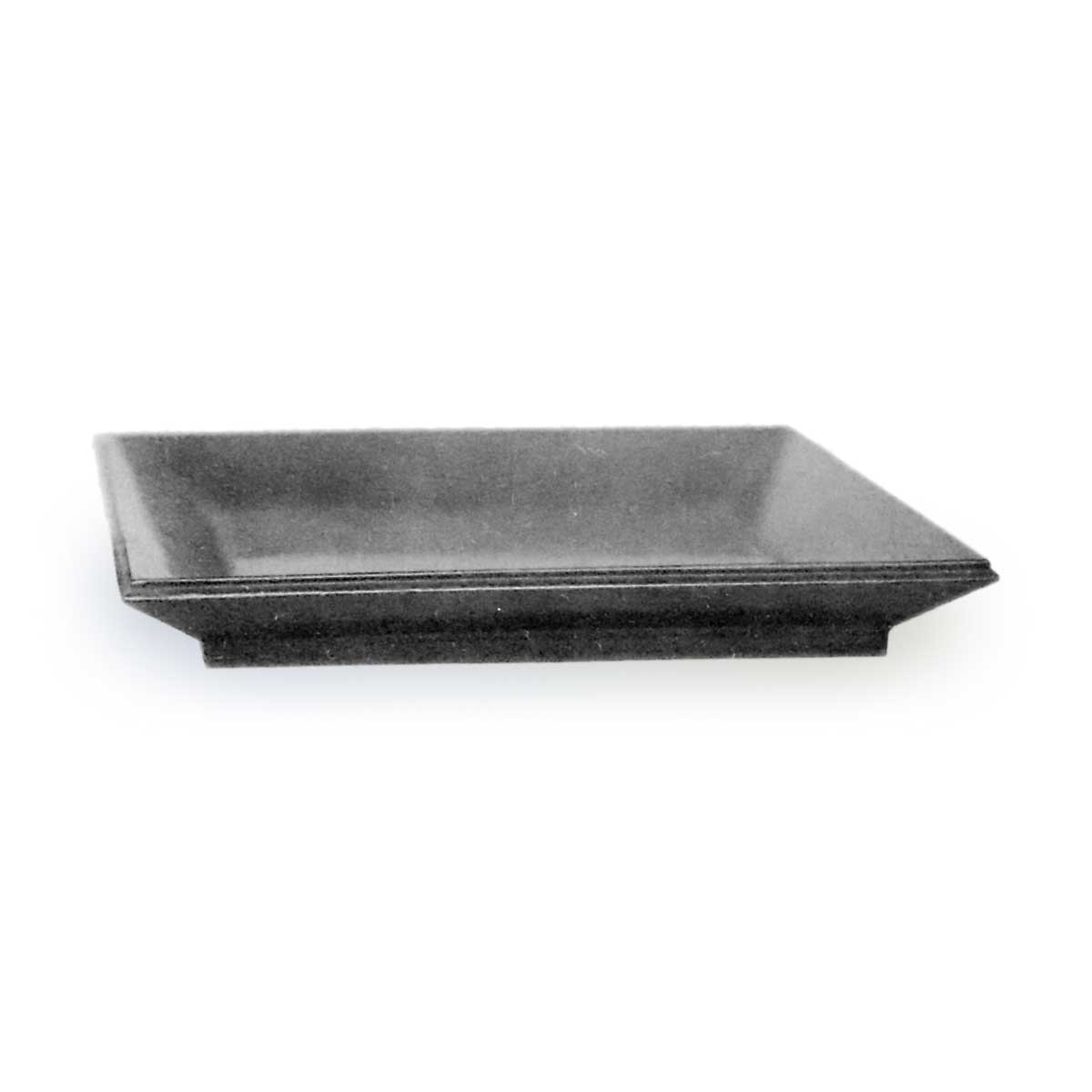
・Accompanying Tray: Square tray. The interior is vermilion, the rim is green, and the exterior is coated in blue lacquer. Approximately 19.7 cm square (6.5 sun square), with a base of approximately 15.8 cm square (5.2 sun square). The characters “Ryuhō Senzai” (Fame Enduring for a Thousand Generations) are inscribed in vermilion lacquer on the base. The box for this tray is made of untreated paulownia wood and bears an inscription by Honda Airan reading: “Interior vermilion, green rim, Seitaka, square tray.”
・Accompanying item: 1 scroll, a letter by Sen Sōtan. Dated April 17 and addressed to Sōju. The text mentions “owned by Seitaka Oribe” among the list of items.
・Outer box: A Chinese-style (Tang-style) sandwich-type box. The lid is painted vermilion, and the body is painted black.
[Miscellaneous Notes]
Yamaoka Sōmu was a man named Sumiyoshiya Kichizaemon of Sakai, and was in fact the son of the warlord Matsunaga Hisahide. He served Toyotomi Hideyoshi (the Taikō) and held a fief of 400 koku; he was well-versed in the tea ceremony and was held in equal esteem alongside Sen no Rikyū, Imai Sōkyū, and Tsuda Sōyuki. He founded Shisen-ji Temple at his base and invited Priest Haruya to serve as its first head priest. Furthermore, Priest Amuro of Daitoku-ji (Murasaki-no) was Sōmu’s son. His family possesses a renowned tea caddy known as “Setaka.”
(From The Comprehensive Genealogy of Tea Masters)
Morning of January 9, Eiroku 10 (1567) — Sumiyoshiya Sōmu’s Tea Gathering
Guest: Tsuda Sōyuki (one person)
・ Furo (charcoal brazier): A small plate with a small hook. Water was drawn from a hand bucket when preparing tea.
・Tokonoma (alcove): A single “Seitaka Katatsuki” was displayed in a bag on a long tray.
“I had the opportunity to view the Seitaka Katatsuki. It is a tall specimen even among Katatsuki. There are two streaks of glaze flow (nadare); the one on the left side of the pot extends all the way to the bottom, and the color changes toward the lower part. Between the two glaze runs is red glaze, and the glaze appears coarse overall. The clay does not appear to have a purplish tint. The rim is thin and slightly turned inward (twisted), with glaze extending onto the inside of the rim. The glaze on the shoulder and the front is black, while the glaze on the lower part is lighter in color. Overall, the back of the jar looks particularly beautiful, and the glaze runs are slightly distorted.
(From “Tsuda Sōyuki’s Tea Ceremony Diary”)
Seikō: Owned by Sumiyoshiya Sōmu. Height: 2 sun 9 bu; width: just over 2 sun 3 bu; circumference: 7 sun 4 bu; base: 1 sun 4 bu; rim: 1 sun 4 bu 5; neck height: 2 bu 5; body bulge: 1 sun 5. An illustration of the tea caddy is available.
(From Manpō Zenshū)
Seitaka: Owned by Lord Oda Nobunaga, Minister of the Right.
(From Tenshō Meibutsu Ki)
Seitaka Katatsuki: Lost in the fire at Honno-ji Temple at the time of Oda Nobunaga’s (Sōken-in) death.
(From the Zoku Gunshū Ruijū, volume “Collection of Meibutsu Tea Utensils”)
Seitaka Katatsuki: Lost in the fire at Honno-ji Temple at the time of Lord Oda Nobunaga’s death.
(From the Yamagami Sōji Ki)
A document written in the hand of Niwa Nagashige (Gorōzaemon) states: “When I attended the Kuchikiri (a tea ceremony to open the new tea) at Furuta Oribe’s residence on October 4, the tea utensils displayed were an Ashiya kettle, a white wooden hearth rim, and a ‘Seitaka’ tea caddy, which was displayed without a bag.”
(From Kissa Meigetsu-shū by Hayami Sōtatsu)
Noon, November 20, Keichō 6 (1601) — Tea Gathering at Lord Furuta Oribe’s Residence
Guests: Saifukuin, Seki Saiji, Hisayoshi (three persons)
Unveiling of the “Seitaka (Seitaka) Katatsuki.” In a three-mat tea room, the pillar of the main platform was made of chestnut wood.
In the tokonoma, there was a letter from Sen no Rikyū, and beside the hanging scroll, the “Ikitaka” was placed on a shihō-bon (square tray) and housed in a tortoiseshell-patterned Donshu bag (with a dark brown cord). The letter on the hanging scroll read something to the effect of, “I shed tears, but I cannot part with the jar.” The “Ikitaka” had three cascading patterns, with the central one flowing the longest. There are two horizontal bands, made of clay the color of wall plaster. It is approximately 2.9 sun in height, 7.4 to 7.5 sun in circumference, and 1.4 to 1.5 sun at the rim and base.
(From the “Matsuya Diary”)
February 23, Keichō 8 (1603) — Furuta Oribe’s Tea Gathering
Guests: Hōjō Mino, Hijikata Tamba, Bessho Bungo
・Tokonoma: A Karatsu hibiscus flower vase containing white peach and quince blossoms
・Tea caddy: Seikō (in a bag of wood-shade color)
・Tea bowl: Imakuro-yaki
(From Furuta Oribe Chakai-ki)
May 24, Keichō 8 (1603) — Furuta Oribe’s Tea Gathering
Guests: Yamamoto Shingozaemon, Satō Suruga, Makino Sukeeemon
・Tokonoma: Calligraphy by Issan Ichinei
・Tea caddy: Seikō (in a Donshu-style pouch)
・Tea bowl: Karatsu ware
(From Furuta Oribe’s Record of Tea Gatherings)
Morning of October 4, Keichō 8 (1603)
Guests: Kanamori Hōin, Danjō-dono, Funakoshi-dono, Ikai-dono
The meal consisted of grilled salmon topped with yuzu miso, namasu, and pickles. Tea snacks included chestnut flour mochi, shiitake mushrooms, and pounded burdock root. A persimmon soup served in a vermilion-lacquered bowl was served, with stem vegetables added later.
・Tokonoma: Calligraphy by Priest Haruya; a chain and a feather broom on the shelf
(Chōzui)
・Tokonoma: Plum blossoms in an earthenware vase
・Mizuhashi: Karatsu ware
・Chakin: Seikō (in a tortoiseshell-patterned pouch)
・Chawan: Karatsu ware
・Usucha: Natsume belonging to Lord Sōbe
(From the Imperial Household Agency’s Kogochayō Nikki)
December 18, Keichō 8 (1603) — Furuta Oribe’s Tea Gathering
Guests: Kanamori Izumo-no-kami, Ito Sōbe, Okuyama Daizen, Nomura Sanjirō
・Tokonoma: A wicker vase with narcissus and plum blossoms
・Tea caddy: Seikō (in a pale green pouch)
・Water jar: Bizen ware
(From Furuta Oribe Chakai-ki)
Regarding the origin of the tea caddy named “Yama-no-i,” according to Kanamori Izumo-no-kami (Nagachika), there is a story that “while gathering small pots throughout Hida Province, he came across a magnificent Seto-yaki katatsuki and kept it as a treasured possession.” This tea caddy is currently in the possession of Etchu-dono and is called the “Izumo Katatsuki.” In the midst of this story, it is written, “When searching for small pots throughout the province of Buzen… (omitted; see the section on the Yama-no-i shoulder-shaped teapot),” and this teapot was named “Jinsei” (Life). The name was chosen in reference to the ancient saying, “It is rare for a person to live to seventy,” but it is currently called “Yama-no-i.” It is said that the name was chosen in reference to a waka poem: “Even if it is shallow, even if others draw from it, the water of Yama-no-i is enough for me.”
The mindset of “this is enough for me” stems from the idea that simply hoarding Seto ware without owning any Chinese tea caddies is unsatisfying; therefore, acquiring a Chinese piece and then treasuring this Seto ware even more would be truly admirable. So, he asked Furuta Oribe to part with his “Ikitaka (Setaka).” Oribe replied, “I will give it to you if you offer me 2,000 ryō of gold.” When Kanamori said, “I have never heard of such a price as 2,000 ryō,” Oribe said, “Then I will part with it if you give me 1,000 ryō of gold and consider that ‘Yama-no-i’ to be worth another 1,000 ryō.” Kanamori refused, saying, “I cannot accept that. After all, the reason I wanted the Seiko Katatsuki was ultimately for ‘Yama-no-i,’ so such a deal is out of the question,” and refused. There are various such anecdotes.
(From the ‘Matsuya Nikki’ and ‘Matsuya Hoki’)
When Furuta Oribe (Shigekatsu) committed seppuku and his property was confiscated, the Shogun personally inspected the tea utensils. There were calligraphy by both Fujiwara no Toshishige and Teika, a single-line calligraphy piece by Issan Inei, a portrait of Nampu Shomei, and many other magnificent paintings and calligraphic works. Among the tea utensils Oribe had treasured, the “Sekitaka Katatsuki” was presented to the Shogun’s family, while the hanging scroll inscribed with the single line “Shobogenzo: Nirvana Myoshin” by Issan Inei was bestowed upon Tokugawa Yorinobu (Lord of the Kishu Domain). The mounting of this hanging scroll featured light yellow paper at the top and bottom, an Ouchi-hishi pattern on the inner lining, and bare wood at the ends.
It is also said that “after Sen no Rikyū’s death, Furuta Oribe enjoyed a reputation as the greatest in the tea ceremony. (omitted)
The hanging scroll was a single-line work by Issan Inei titled Shobogenzo: Nirvana and the Wonderful Mind; the tea caddy was a Seto-style caddy from Tsujido; and the water jar was made of Shinmi Iga ware. He did not mix and match utensils indiscriminately. He would merely bring out two or three tea caddies and pouches and swap them out. Later, he gave the Tsujido tea caddy to another person and conducted tea ceremonies using only a Chinese katatsuki (shoulder-rest) called Seiko. After Oribe committed seppuku and his property was confiscated, both Issan Ichinei’s hanging scroll and the Seiko tea caddy were presented to Taito-in (Tokugawa Hidetada). Issan Ichinei’s calligraphy was gifted to Nanryu-in (Yorishige, founder of the Kishu Domain), and from Nanryu-in, it was gifted to Sakyo-no-daibu Yorizumi.”
(From Buken Monogatari)
“Lord Furuta Oribe had as many as 23 lids made to accompany the ‘Seitaka’ (Seitaka). This was because it is not unusual for a tea caddy to have only one or two lids.”
(From Matsuya Nikki)
Record dated June 20, Keichō 20 (1615; later renamed Genna 1)
The Great Elder (Tokugawa Ieyasu) visited Nijo Castle and held a private conversation with the Emperor for some time. Afterward, a shoulder-rest tea caddy named “Seiko,” which had been in the possession of Furuta Oribe, was presented to the Great Elder.
(From Sunpu Seijiroku by Goto Shozaburo)
Sekitaka: The bag is made of Jukō satin with a chrysanthemum and arabesque pattern. It is housed in the first nagamochi (storage box).
(From Gosuki Godō Taichō)
June 25, 1627 (Kan’ei 4) At the Yamazato tea room in the Nishinomaru of Edo Castle
Tea was served to Owari Dainagon Yoshinori and Mito Chūnagon Yorifusa. The host was Todo Izuminomori Takatora.
・Hanging scroll: Hokubai
・Tea caddy: Setaka
・Tea bowl: Sōkōdai (presented by Todo Takatora)
・Flower vase: Miyako-kaeri
(From Tōbu Jitsuroku)
March 22, 1628 (Kan’ei 5) Tea was served in the tea room of the Nishinomaru.
(Guests) Hachisuka Hōan, Tanba Nagashige, Katō Yoshiaki, Katō Akinari, Matsudaira Tadakatsu, Matsudaira Naomasa, Matsudaira Naoki, Matsudaira Naohisa, Enju-in
・Hanging scroll: Kan’ō
・Tea caddy: Setaka
・Tea bowl: Kimiidera
・Flower vase: Miyako-kaeri (flowers: wisteria and camellia)
(From Tōbu Jitsuroku)
November 8, 1641 (Kan’ei 18). Funakoshi Iyo-no-kami, and later Katagiri Iwami-no-kami, were commissioned to perform the tea ceremony over two days.
・Hanging scroll: The two characters “Kiyun” (Returning Clouds) in the hand of Mujun
・Tea caddy: Seiko (in a bag from Guangdong)
・Tea bowl: Chikan, Mishima
・Flower vase: O-sorori
(From Sakurayama Ichiyu Nikki)
During a seasonal airing of tea utensils at Edo Castle, Hotta Kagamori asked the tea master Sōfu, “If you could receive anything you desired from among the tea caddies, what would you wish to receive?” Sōfu replied, “I would like a Seitaka.” Later, when Sakuma Shōkan arrived, Hotta Kagamori asked him the same question, and Sakuma Shōkan gave exactly the same answer as Sōfu. This is the account as heard by Mizuno Yōshū, who was present at the time.
(From Sōyūki)
November 8, Kanbun 5 (1665) — Today, a tea ceremony was ordered in the tea room of the Gosho-in. The tea master was Funakoshi Iyo-no-kami.
・Hanging scroll: The two characters “Kiyun” (Return of the Clouds), written by Musun
・Flower vase: Osorori (flowers: quince)
・Tea caddy: Seitaka (in a Kanto-style pouch; not placed on the tray)
・Tea bowl: Kogane-me Koryo
(From Tokugawa-ke Ocha-kai no Ki)
Sekitaka: Tea caddy (owned by the Shogunate). A note in red ink states: “Owned by Furuta Oribe. Transferred from the Great Retired Shogun (Ieyasu) to the Shogun (Hidetada) on June 20, Genna 1 (1615). Around the Kanbun era, it was bestowed upon Honda Munenori, lord of the Ise-Kobe domain.”
(From Ganka Meibutsu)
Seitaka: It has been damaged by fire. The clay is blackened, with a dark gray-black glaze; there are marks on the bottom where it was scraped with a spatula. Weight: 29 monme 3 bu; Height: 2 sun 9 bu 3 rin; Width: 2 sun 3 bu 8 rin; Mouth: 1 sun 4 bu 5 rin; Bottom: 1 sun 3 bu 6 rin; Neck height: 2 bu 5 rin (illustration of the tea caddy included).
(From Meibutsu)
Sekitaka: Weight 29 monme 3 bu; width 2 sun 3 bu 8 rin; mouth 1 sun 4 bu 5 rin; base 1 sun 3 bu 6 rin; neck height 2 bu 5 rin. It has suffered fire damage. There are marks on the base where a spatula was used, the clay is blackened, and black glaze is visible at the four corners.
(From Hōan Bunko, No. 13)
Sekitaka: Made in China (Han-saku). It is from the same period as the “Nitta Katatsuki,” “Fudō Katatsuki,” “Gyokudō,” and “Tanamura.” Furthermore, the maker and the method of applying the glaze are the same as those of the Nitta and Fudō pieces. The method of applying the glaze is also the same as that of the Seto ware pieces “Hirano,” “Yama-no-i,” and “Ikoma.”
(From The Origins of Seto Pottery by Matsudaira Fumai)
Daimeibutsu Sekitaka Katatsuki: Viewed on April 22, 1890 (Meiji 23), at the residence of Marquis Honda in Aoyama. It is said to have been in the collection of the Honda family, former lords of the Ise and Kobe domains. There are marks on the bottom where it was lifted with a spatula; the clay has darkened, and it is covered with a dark gray-black glaze, but it has suffered fire damage. The rim is very well-made, and because the entire piece has been fired with a black finish, the glaze has shrunk, the clay has dried out, and there are traces of repairs to cracks. The dimensions are as recorded in the “Three-Volume Book (Shomotsu).” The carrying pouch is made of white silk with a drawstring; the spare pouch is a single-panel Hino Koto-ori fabric with an Amber-ori lining. The Hikiya is lacquered black and comes in a velvet pouch. The lid of the inner box bears the inscription “Setaka Katatsuki,” though the calligrapher is unknown. The outer box is inscribed by Honda Munenori; the front reads “Setaka,” and the back reads “Setaka, formerly owned by Furuta Oribe, received on the 3rd day of the 1st month of the 21st year of Kyōhō” (with an illustration of the tea caddy).
(From Ihon Meibutsu-ki [Collection of Variant Accounts of Famous Tea Utensils], Hachian Bunko Collection)
[History]
It is said to have originally been owned by Yamaoka Sōmu of Sumiyoshiya in Sakai, and later passed to Oda Nobunaga, where it was reportedly destroyed in a fire during the Honno-ji Incident. Subsequently, while in the possession of Furuta Oribe, Hosokawa Sansai (Tadaoki) sought to acquire it and negotiated for it, but the deal fell through, as recorded in the Matsuya Nikki and other sources.
However, in June of Genna 1 (1615), Furuta Oribe committed seppuku, and this tea caddy became the property of the shogunate. As detailed in the aforementioned miscellaneous notes, it was subsequently used frequently at tea ceremonies of the shogun’s household.
Furthermore, the Sōyūki records an anecdote: during the shogunate’s annual airing of tea utensils, when Hotta Kagamori asked Kobori Enshū, “If you could have any item from these utensils, which would you choose?” Enshū replied, “The Sekitaka.” When Kagamori then asked Sakuma Shōkan the same question, he gave exactly the same answer.
In any case, if this tea caddy had been charred by the fire at the Incident at Honno-ji, as it appears to be today, such an exchange (expressing a desire for such a beautiful tea caddy) would not have taken place. Considering this, it seems likely that the damage to this tea caddy from a fire occurred at a later date (such as the Great Fire of Meireki).
On January 3, 1736 (Kyōhō 21), Honda Tadasumi (pen name: Airan), lord of the castle in Kobe, Ise Province, received this item as a gift from the 8th Shogun, Tokugawa Yoshimune. Since then, it has been passed down through the Honda family for generations, but in recent years, it left the family and came into the possession of Baron Fujita.
[Record of Actual Inspection]
On May 17, 1920 (Taisho 9), I had the opportunity to view this piece in person at the residence of Baron Heitaro Fujita in Amijima, Kita Ward, Osaka City.
The rim curves deeply inward, the edge is pointed, the neck (koshiki) is low, the shoulders are high, and the body tapers slightly from the waist down. The color of the iron-rich clay is visible at the rim, and the base is flat, having been cut from a slab (ita-okoshi). The entire piece is covered in a dark amber glaze, but it appears to have been fired once; traces of lacquer repairs on a large damaged area form a crisscross pattern. Consequently, the underlying glaze has crumbled, and the pattern is not distinct; however, the dark amber glaze that flowed down from the shoulder tips stops at the base’s contact surface (bon-tsuki), and the bluish-gray glaze remaining around the rim resembles the “Nitta Katatsuki” that was damaged in a fire at Osaka Castle. The interior features glaze on the rim, with coarse wheel marks, and a thin line resembling a thread cut (the mark left when the piece is separated from the wheel) visible around the swirl in the center of the base—a rare feature not found in other tea caddies.