

Chinese Ware—From the Collection of Count Tokugawa Tatsutaka
Name
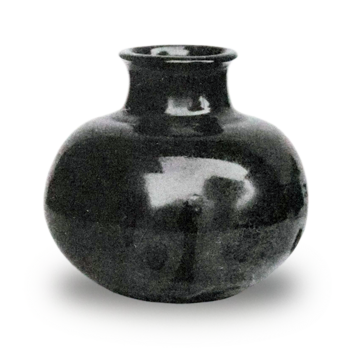
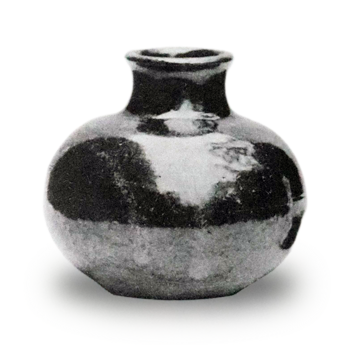
This round vase was bestowed upon Aoyama Harima-no-kami Tadanari by the second shogun, Hidetada.
Dimensions
Height: approx. 6.08 cm
Body diameter: approx. 7.03 cm
Mouth diameter: approx. 2.73 cm
Base Diameter: Approx. 3.48 cm
Lid Height: Approx. 1.45 cm
Weight: Approx. 64.5 grams (17 monme 2 bu)
Accessories
One set of two lids; one has a recess and fits into the hanging compartment of the pouch.
One imperial pouch made of white chirimen
Two pouches
Moe-green ground with clouds and cranes in satin; lining features a family crest pattern; cord tied in a purple tsugari knot
Guangdong striped woven fabric; lining is moe-green with a family crest pattern; cord tied in a brown tsugari knot
One pouch box: natural paulownia wood; characters inscribed in gold powder
Lid
Pouch
One outer box for the pouch box: natural paulownia wood; inscription as follows
Lid
Two pouches: Funakoshi Kandou (Hando)
Clouds and Cranes (Repaired in April of the Year of the Snake, Kōka 2)
September 23, Kyōhō 16, Year of the Boar (1731)
Upon moving to the Ta-an family residence
Granted by His Majesty Yutoku-in (Eighth Shogun Yoshimune)
Takahashi Jitsuzō
(Note) Takahashi Jitsuzō refers to the Ta-an family’s storehouse located in the Takahashi district of Fukagawa, Edo.
One: Hikiya—Black lacquer
Pouch: Brown-ground Wanli satin; lining is solid navy blue; cord is tied in a brown tsugari knot
One: Inner Box—Unfinished paulownia wood; Ryoei-style box (a box unique to the Shogun’s family)
Aoyama-maru Vase—Characters inscribed in gold powder
One: Outer Box—Black lacquer; exterior inlaid with gold; interior with a gold-painted pear-skin finish
Aoyama-maru Vase
- Outer Case: Natural-finish paulownia wood; the inscription reads as follows
On September 23, the Year of the Boar, Kyōhō 16, upon moving to the Tayasu residence
Granted by Her Highness Yutoku-in
Miscellaneous Notes
Aoyama Maru Vase
Aoyama Tadanari served as Hitachi-no-suke and Harima-no-kami. Born in Okazaki in Tenbun 20 (1551), he served Tōshō-gū (Tokugawa Ieyasu) from a young age. In June of Keichō 8 (1603), when Princess Sen was to be married to Toyotomi Hideyori, Sōgen-in (O-E-no-kata) accompanied Princess Sen to Tadanari’s residence as part of the “katagagae” (ceremonial separation). On that day, Taito-in (Tokugawa Hidetada) also paid a visit, and a banquet was held, at which he bestowed upon him a round teapot and an inkstone screen bearing the family crest.
(Kansei Revised Genealogies of Various Families)
Aoyama Tadao held the title of Izumi-no-kami. Born in Shinano in the 4th year of Keian (1651), he succeeded to his late father’s domain on April 9 of the 7th year of Enpō (1679). On the 15th, when he presented his gratitude for inheriting the family headship, he offered a Bizen Kanemitsu tachi—a memento of his father (Muneyoshi)—and a round-bodied tea caddy.
Genealogy of the Aoyama Family: Harima-no-kami Tadanari — Hōki-no-kami Tadatosi — Inaba-no-kami Munetoshi — Izumi-no-kami Tadao
(Kansei Revised Genealogies of Various Families)
On April 26, Enpō 7, Aoyama Izumi-no-kami presented 20 gold pieces and 100 bundles of cotton as a token of gratitude for his succession to the family headship; he also presented a round-pot tea caddy and a sword (a Kanemitsu valued at 25 gold pieces) as heirlooms of Inaba-no-kami.
(Gyokuro Sō)
April 15, Enpō 7: Belongings of Aoyama Inaba-no-kami
A Bizen Kanemitsu sword (valued at 25 gold pieces)
A round tea caddy
(Imperial University Historical Materials Collection: Record of Dedications of Family Heirlooms and Acquired Items)
On December 23, Hōei 6 (1709), the belongings of Kyōhaku-den (Chūnagon of Mito) were presented through Yamabe Chūsu-no-shō.
Imperial Wakizashi (value: 100 coins), Imperial Tea Caddy (Aoyama Marutubo)
To the Imperial Lady-in-Waiting: the Kokin Wakashū in the handwriting of Reizei Tameie
(Imperial University Historical Materials Collection: Bunro-sō)
(Note) Kyōhaku was the heir apparent (successor) of Shukō (Tokugawa Tsunanori), the third head of the Mito clan, but he died young and did not succeed to the headship. He married the Shogun’s daughter and had one daughter; the fourth head of the Mito clan, Narikimi (Tokugawa Munetaka), married into the Takamatsu family and became this daughter’s husband. Kyōhaku held the ranks of Junior Third Rank and Provisional Lieutenant General.
December 25, Hōei 6: Relics of Lord Mito
A wakizashi by Mitsukane (valued at 100 coins), Aoyama-maru-tsubo tea caddy
To the Lady of the House: The Collection of Ancient and Modern Japanese Poetry written by Reizei Tameie
(Imperial University Historical Materials Collection: Record of Donated and Acquired Artifacts from Various Families)
Aoyama-maru Pot: The pouch is by Takagi Kōtō, featuring a gold plum-bowl pattern, and there is also a moegi-green ground satin with a cloud-and-crane design. A single thin ridge protrudes from the shoulder, and the area below it is slightly chamfered. The rim is less than half its original width. The glaze is generally amber in color, with the “nadare” (drip pattern) featuring a light brown glaze. Two lines run from the front, with the glaze pooling and stopping slightly darker toward the tips. The rest appears as if lightly smudged with a brush. The clay is purple. The rim is exquisitely crafted, with a single gap alongside the “nadare” pattern. The base shows signs of having been rubbed against a tray, and the sides of the thread-cut edge are stepped. (Illustration of the tea caddy included)
(Makuan Collection, No. 17-A)
History
Prior to her marriage to Toyotomi Hideyori, Princess Senhime, daughter of Tokugawa Hidetada, moved to the residence of Aoyama Harima-no-kami Tadanari as part of the “hōchigai” (pre-wedding ritual). At that time, Hidetada also visited and joined the gathering, presenting this Maru-tsubo tea caddy to Tadanari as a gift. Since then, it became a treasured possession of the Aoyama family, passed down to Hōki-no-kami Tadanobu and then to Inaba-no-kami Munetoshi, and was known as the “Aoyama Marutubo.” However, in April of Enpō 7, when Aoyama Izumi-no-kami Tadao inherited his father’s estate, he presented it to the shogunate as a memento of his father, Inaba-no-kami Munetoshi. It was subsequently bestowed by the shogunate upon the Mito family; however, in December of the 6th year of Hōei, it was once again presented to Shogun Tokugawa Tsunayoshi as a memento of Kyōhaku, the heir apparent to the third Lord of Mito, Shukō, and thus this tea caddy once more became a treasure of the shogunate. On September 23, Kyōhō 16, when Munetake—the third son of Shogun Yoshimune—was granted a villa within the Tayasu Gate of Edo Castle, it is said that Shogun Yoshimune subsequently bestowed the tea caddy upon Munetake.
Field Notes
On November 1, Taishō 9 (1920), I examined this piece in person at the residence of Count Tatsutaka Tokugawa in Mita-Tsunamachi, Shiba Ward, Tokyo.
The rim has a shallow twist, the base is flared, and a single raised ridge runs around its circumference. The body features a single sunken ridge extending approximately halfway around the tea caddy; from the hem downward, the vermilion-colored clay is exposed, with a pattern resembling fingertips or fine wheel marks running around it. The thread marks on the base are fine and distinct, though the area slightly offset from the center has been worn flat, and part of the rim bears irregular, jagged marks left by a spatula. Overall, the amber-colored glaze has a beautiful luster, with a cluster of blue-lapis-lazuli color around the middle. Additionally, there are areas where blue-lapis-lazuli color flows down in two cascades from the shoulder, stopping near the rim; the glaze is slightly thicker in these areas, and the blue-lapis-lazuli color is exceptionally beautiful. Furthermore, to the left of this pattern, there is a persimmon-colored area where the glaze has not adhered, and a similar pattern is visible to the right of the design. Additionally, connecting to these blue-lapis-like cascades, there are areas resembling the grain of yellow zelkova wood; in some places, the blue-lapis color appears beautifully against the lustrous amber glaze, and the quality of the glaze is very similar to that of “Kokushi Nasu.” Inside, the glaze covers the rim, while below that, wheel marks run around the interior, and the center of the base forms a neat swirl pattern. Aside from a single trace of repair on the rim, it is otherwise intact; it feels light in the hand, is of an ancient period, and features vivid, striking patterns—a truly magnificent tea caddy.