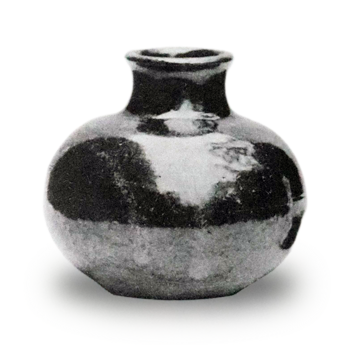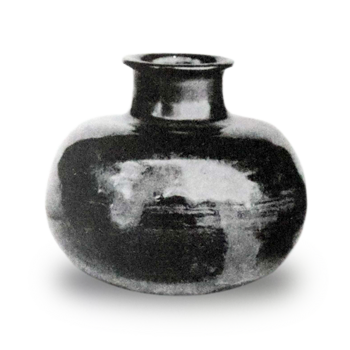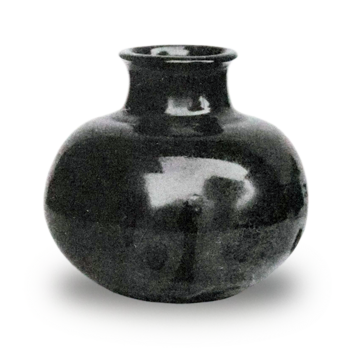


Made in China; Collection of Marquis Toshitame Maeda
Name
This is a round teapot that was once owned by Ishikawa Sōin.
Dimensions
Height: approx. 6.67 cm
Body diameter: approx. 7.12 cm
Mouth diameter: approx. 3.18 cm or approx. 3.03 cm
Base Diameter: Approx. 3.03 cm or Approx. 2.88 cm
Length of Lid: Approx. 1.58 cm or Approx. 1.52 cm
Weight: Approx. 66.8 grams
Accessories
One lid (1 piece) with a recess
One storage pouch: brown silk; cord tied in a “Enshu-cha” knot
Two pouches
Kensaki satin; lining damaged; cord tied in a purple tsugari knot
Aoki Koto; lining is brown Kaiki; cord tied in a purple tsugari knot
Separate old pouch; severely damaged; only the lining and a dark brown tsugari knot remain
One storage box: natural paulownia wood
“Ishikawa Maru Pot”
Ishikawa-maru Pot Tea Canister Pouch
Kensaki Donsu
Aoki Kanto
Hikiya storage box: Paulownia, unpainted wood with cut-out design, Shunkei lacquer
Pouch: Pale yellow-ground Donsu with woodgrain pattern; lining is a raised-weave “small cobblestone” pattern; cord is a dark brown tsugari knot
One inner box: Paulownia
One outer box: Paulownia, new
“Ishikawa-maru Pot”
Miscellaneous Notes
Ishikawa Maru-tsubo, made in China. The clay is mouse-gray and has taken on a distinctly reddish hue. The lower glaze is amber-colored and applied thickly; the upper glaze is similarly applied. There is a glaze crack on the left side of the “thread-cut” (nadaré) design on the base. There is one band-like streak on the body and two thin streaks at the rim. The finish has a deep luster, and overall, the glaze texture appears pear-skin-like (with fine speckles).
(Maeda Marquis Family Inventory)
Ishikawa Maru-tsubo: A famous piece, made in China. The Hikiya-finished base features a cobblestone pattern, and the cord is brown. It comes with two pouches: one made of kensaki satin and the other of Aoki Guangdong silk.
(Maeda Family Collection Record)
A tea caddy from the private collection of Sōhen (Yamada Sōhen). This is known as the Ishikawa Maru-tsubo, a Meibutsu of the realm, and is now in the possession of the Lord of Kaga (the Maeda family). It is said to have been purchased from Ishikawa Sōin for 18 da of gold. One day, when Dan’ō (Yamada Sōon) visited Sōin’s residence for a tea ceremony, this very Maru-tsubo was presented. It is said that Sōhen was also present at that time. After Sōon returned to his lodgings, he instructed the potter Nonkou (said to be the grandfather of the present-day Kichizaemon) to experiment with the clay and create a round teapot, which turned out to be indistinguishable from the Ishikawa Maru-tsubo. At that time, Sōon had instructed Nonkou to “take great care with the glaze during firing,” and the piece was completed accordingly. When Nonkou presented it to Sōon, the result was unexpectedly excellent—the glaze color and firing were both superb, and it was indeed an exact replica of the Ishikawa Marutubo. Consequently, Sōon named it “Shinmakura” and kept it as a treasured possession, later passing it on to Sōhen.
(From the Unshū Matsudaira Family Collection; recorded in the Sōhen Family Archives of the Tea Ceremony Society)
(Note) Nonkou’s replica of the Ishikawa-maru vase (a reproduction of a Chinese piece) is in the possession of Torii Shōbei. The clay is purple, and the areas where the glaze has turned yellow or black exhibit Nonkou’s characteristic glazing technique. The box bears an inscription by Sen Sōtan, and the reverse side bears an inscription by Yamada Sōhen.
(Sekishū-ryū Kagenroku)
In April of Meiji 35 (1902), the Ishikawa Maru-tsubo, a Tang-style piece, was exhibited at a special exhibition held at the Art Association in Ueno Park, Tokyo. It came with two pouches: one made of kensaki-donsu and the other of Guangdong silk. It belonged to Marquis Maeda.
(From Tsurezure no Tomo by Matsuyama Seika)
History of Ownership
It was originally owned by Ishikawa Sōin and later entered the Maeda family of Kaga. It is said that the purchase price was 18 da of gold. Sen Sōtan once visited Sōin and greatly praised this round teapot; upon returning home, he had Nonkou create a replica, named it “Shin-makura,” and kept it as a treasured possession. He later passed it on to Yamada Sōhen, as detailed in the aforementioned registered letter from the Sōhen family.
Record of Actual Inspection
On November 25, Taishō 8 (1919), I inspected this piece at the residence of Marquis Toshitame Maeda in Honfuji-chō, Hongō Ward, Tokyo.
The rim is twisted back somewhat deeply; the height of the body is average, and a single ridge runs around its circumference. There is also a single ridge on the body. Over the beautiful, lustrous amber-colored glaze, a bluish-persimmon-colored glaze is applied unevenly, as if dusted on. On the right side of the “nadarē” (slope), the persimmon-colored glaze forms two slopes that stop at the unglazed clay at the base. From the rim downward, the mature persimmon-colored clay is exposed; the thread marks are extremely fine, but a flat surface in the center covers part of them. The glaze is thick and viscous, with fine, scattered pores. Around the base, a blue-gray glaze forms a pattern in three places set against the ripe persimmon-colored clay. There is one trace of repair on the rim. Inside, the glaze covers the rim in places, while below that, wheel marks run all the way around. Overall, the piece displays beautiful visual character; the earthenware’s hue at the base is particularly magnificent, and the soft, earthy quality—reminiscent of dissolved white powder—is beyond words. Additionally, beneath the ridges on the body, there are areas where the glaze is thin, resembling unglazed sections, making this a teapot with a rich and varied visual character.