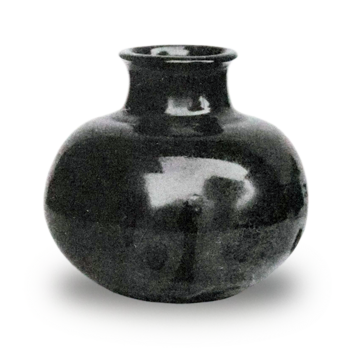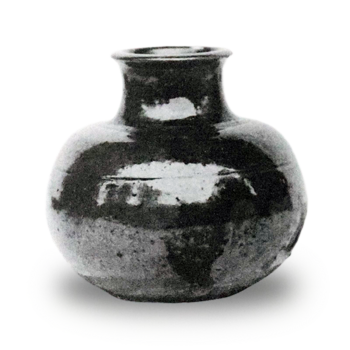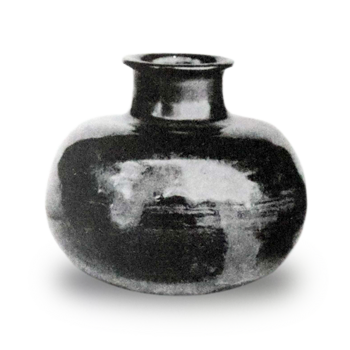


Chinese-made Round Vase—Collection of Duke Motoaki Mōri
Name
It is said that when this piece was presented to Emperor Go-Mizunoo for his imperial review, the Emperor—seeming reluctant to part with it—personally inscribed the opening verse of a haiku: “To those who feel regret, think of the cuckoo.” Thus, it has been called “Cuckoo” ever since.
Dimensions
Height: Approx. 5.91 cm
Body Diameter: Approx. 6.82 cm
Mouth Diameter: Approx. 2.79 cm
Base Diameter: Approx. 2.73 cm
Height of the Koshiki (rim): Approx. 1.52 cm
Shoulder Width: Approx. 0.76 cm
Weight: Approx. 61.5 grams
Accessories
One lid, ivory-colored
One imperial pouch, purple crepe; cord tied in a purple tsugari knot
Two pouches
Moe-green ground with tortoiseshell-patterned gold; lining in flower-colored umi-ke; cord tied in a purple tsugari knot
Bamboo-vine damask; lining in kabe-choro; cord tied in a purple tsugari knot
One pouch box, paulownia wood, natural finish
Replacement Pouch
One wooden form: Zelkova
Pouch: Bamboo-vine satin; lining: high-grade sea-mist pattern; cord: purple twisted knot
One handle: Hikiya; characters in gold powder
One inner box: Paulownia, natural wood
(Lid Front)
Accompanied by a haiku by Go-Mizuo
“Hototogisu”
(Inside of lid)
Cuckoo Tea Jar—Chinese import
Height: Approx. 5.91 cm (1 sun 9 bu 5 men)
Width: Approx. 6.82 cm (2 sun 2 bu 5 men)
Weight: Approx. 61.9 grams (16 monme 5 bu)
Accompanying poem: “Oshimuramu”
In the handwriting of Emperor Gosuiō
Accompanying letter: 1 letter by Sawaki
- Outer box: Tagayasan wood, with characters formed in gold powder
“Cuckoo”
The interior of the box is divided into two sections; one section has a round hole cut out of the Tagayasan wood to hold the tea caddy and the Hikiya. The other section holds a pouch-style box. - Outer case: Paulownia, natural finish
“Tea Jar”
Cuckoo (Hototogisu)
- Accompanying hanging scroll: 1 scroll
Plain strip of paper with calligraphy by His Majesty Emperor Go-Mizunoo
“If I think of the one I long for, it is the cuckoo (Hototogisu)”
Inner box: Black lacquer with characters formed from gold powder
“Calligraphy by His Majesty Emperor Go-Mizunoo: 1 scroll”
Outer Box: Paulownia, Shunkei-style lacquer, with inscription in ink
One: Accompanying Letter, 1 copy, by Priest Sawan
It has been quite some time since we last had the pleasure of seeing you. We, too, have been utterly occupied of late, and though we have been thinking of you, we have been unable to write. As you may have enjoyed playing with the theme the other day, we are returning the cuckoo tea caddy. From what we have heard, we understand this to be a touching matter. I understand that Tanshū (Governor of Tajima) is currently in your presence, so please deliver this letter to Governor of Yamato. I shall pay my respects in person in the near future. With the utmost respect.
18th day of Uzuki—Sōhō (Sawanan)
(The inscription on the front of the endpaper reads as follows)
(Sōan)
To Lord ○○, Sōhō
To All Concerned - Enclosed document: 1 copy
Certificate of Provenance
A Chinese-made cuckoo teapot (Toki-dori teapot), a round pot formerly owned by Shōteki
The aforementioned teapot came to the attention of His Holiness Emperor Go-Mizunoo several years ago. At the behest of His Imperial Highness Prince Sonchō, the Monzeki of Seirō-in, it was presented to him and retained in his possession. Although he made various requests, I did not part with it; when he returned it, he included the opening verse “Oshimuramu.” Subsequently, a tea master named Hirano Dōsetsu came into possession of it, and when Lord Sakai Sanuki-no-kami laid eyes on it, he offered 300 gold pieces for it. For that reason, I did not part with it. This tea caddy is well known to Lord Kobori Enshū, Lord Katagiri Sekishū, and Lord Kuwayama Shūryō. The accompanying letter from Takuan was passed down to me from Iwasaki Dōhan. That is all.
Provenance
The accompanying note reads, “Round caddy formerly owned by Shōteki,” and The Detailed Genealogy of the Tea Family states: “Takekuraya Shōteki studied under Jukō and excelled in the tea ceremony. He was also known as Chūkuraya or Kagoya. He lived in Sakai, Senshū, and was as renowned as Inshaku and Sōri. He was also a disciple of Takeno Jōō.” Subsequently, Emperor Gomizuo heard of it and, through Prince Sonchō, requested to view it; it was kept at the Sento Imperial Palace for several days. Upon its return, the Emperor bestowed upon him the opening verse of a haiku—“To those who lament, the cuckoo is a symbol of parting”—in his own handwriting; henceforth, this tea caddy came to be known as “Tokitori” (Cuckoo). Later, through the mediation of the tea master Hirano Dōsetsu, Sakai Gagaku-no-kami sought to acquire it for 300 gold coins, but it is said that he ultimately declined the offer. The exact date on which it entered the possession of the Mōri family is unknown.
Field Notes
On September 21, Taishō 10 (1921), I examined this piece in person at the residence of Duke Motoaki Mōri in Takanawa Minamichō, Shiba Ward, Tokyo.
It is thin-walled and extremely light when held in the hand. The rim has a deep, twisted curve; the base is flared; a single sunken ridge runs around the body; and below that, wheel marks encircle the vessel. The portion below the rim is made of vermilion-colored clay; the base is extremely small, the thread marks are fine, and there are splashes of black glaze. This tea jar shows signs of having been repaired after splitting cleanly in two from the rim to the base; there are fingerprints in several places around the base, and the glaze has a soft, plump texture, indicating exceptional craftsmanship. Overall, within the black amber glaze, a bluish-white glaze encircles the neckline, and from the shoulder tips, it cascades like a curtain down to the edge of the clay at the base. Brown glaze is mixed at the tips of the bluish-white glaze, creating an exceptionally beautiful luster. Brownish glaze forms streaks running above and below the ridges on the body, adding an extra layer of visual interest to this tea caddy. Inside, glaze covers the rim, while below that, fine wheel marks run around the interior; the center of the base is indented in a swirl-like pattern. Overall, the rounded form is exceptionally elegant. Against a black-amber background tinged with a hint of purple, the blue-white glaze and brown glaze on the body flow together like an avalanche, creating a truly magnificent visual effect. The reddish glaze around the middle also has a beautiful luster and is well worth admiring. In short, this is a tea caddy rich in visual appeal and full of points of interest.