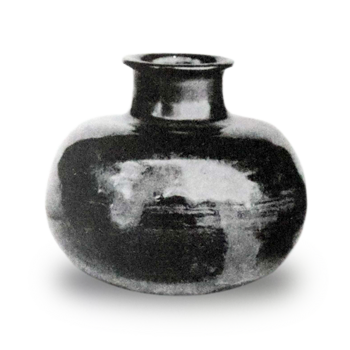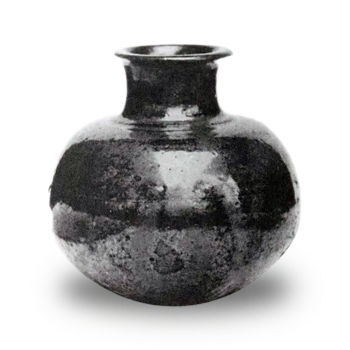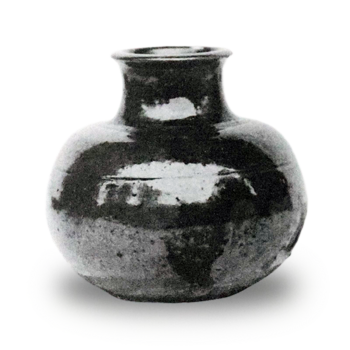


Chinese Ware, Daimeibutsu, Collection of Marquis Tokugawa Yoshichika
Name
This term means “round teapot of Chinese origin.” According to the Manpō Zenshū, “The term ‘maru-tsubo’ (round teapot) derives from its round shape, resembling a mandarin orange; the term ‘mikan’ specifically refers to the body of a teapot. Only styles such as Bunrin and Maru-tsubo are called ‘mikan.’ Maru-tsubo come in various shapes and colors, and most have small shoulders. There are also some without shoulders, featuring a round body, as well as tea caddies with high rims and footrings and low bodies.”
Dimensions
Height: Approx. 6.51 cm
Body diameter: Approx. 6.97 cm
Mouth diameter: Approx. 3.18 cm
Base diameter: Approx. 3.03 cm
Koshiki height: Approx. 1.88 cm
Weight: Approx. 65.6 grams
Accessories
One lid: 1 piece (with a recess)
One storage pouch: Purple habutae silk
One bag
White gome-donsu; cord tied in a white tsugari knot
One Hikiya: black lacquer
Bag: white ha-ni-bu; cord tied in a white tsugari knot
One box: paulownia wood, sumi-nuri lacquer; characters in gold powder
Miscellaneous Notes
Maru-tsubo: Takekoshi Toranosuke of Owari (owner).
(Meibutsu-ki)
Round Teapot: Chinese import; small teapot; owned by Toranosuke Takekoshi (Koshi) of the Owari domain’s retinue.
(Kanka Meibutsu Ki)
Round Teapot: Daimeibutsu; owned by Toranosuke Takekoshi of Owari.
(Kokon Meibutsu Ruiju)
Chinese Round Teapot: The clay of this tea caddy is a pale red color. However, it appears to contain fine grains of sand. The twisted rim is standard. However, the rim’s lip is high, and the thread cut is delicate. The lower glaze is light in color, while the black glaze has a strong silvery sheen, creating a silver-pearl finish. The upper glaze is a deep black, and the scattered glaze is similarly deep, though it exhibits variations in shade. This is referred to as a Chinese-style Seto glaze.
(Manpō Zenshū and Chaki Bengyoku Shū)
Tang-Style Round Jar: The overall body is persimmon-brown, with abundant black glaze patterns, resulting in an exceptionally splendid finish. The clay is pale yellow but has a slight blackish tint.
(Bakuan Bunko, Series B, No. 1)
Tang-Style Round Vase: The glaze is amber in color, with black glaze runs extending from the rim down the neck, body, and base. Horizontal streaks (threads) are visible at the base of the neck and below the shoulders, and thread-like marks are present on the base.
(Oshu Tokugawa Family Collection Register)
History of Ownership
Originally owned by Takenokoshi Toranosuke, it was later acquired by the Owari Tokugawa family. Generations of the Takekoshi family bore the title “Yamashiro-no-kami” and served as attached senior retainers of the Owari Domain.
Inspection Record
On June 5, Taisho 8 (1919), this piece was inspected at the residence of Marquis Tokugawa Yoshichika in Ozone-cho, Higashi Ward, Nagoya City.
This is a Chinese-style round jar with a shallow, twisted rim and a standard-height body. Overall, a black amber glaze is applied unevenly over a purple base glaze; the black amber glaze flows in a cascading pattern from the rim down the shoulder, stopping at the unglazed clay at the base, and there are slight “snake-and-scorpion” patterns (resembling the skin of a snake or scorpion) in the glaze pools.
Two sunken lines run around the rim of the kettle, and there is also a single line slightly above the center of the body, encircling two-thirds of the tea caddy. From the rim downward, the light grayish-brown clay is exposed; the thread marks are fine, with glaze splatters in the center or around the edge that slightly conceal them. Below the body, the purple is faint, and in some places the persimmon color predominates. Inside, the glaze covers half of the kettle; below that, wheel marks run around the interior, forming a swirl pattern at the center of the base. It feels light in the hand and is free of chips; as a Chinese-style tea caddy, it exhibits a subdued and refined design.