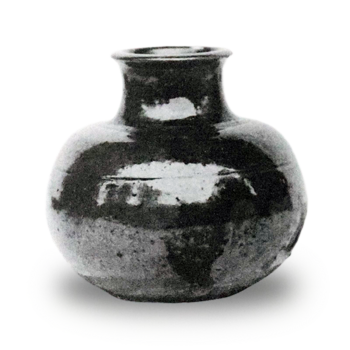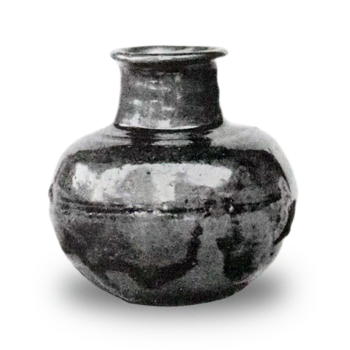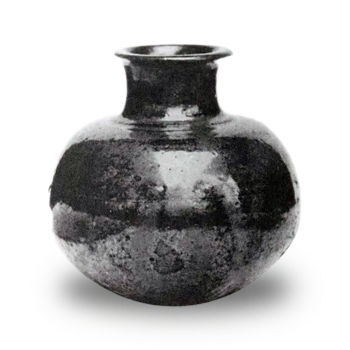


Chinese Import; Daimeibutsu; Collection of Mr. Tsuneyoshi Asabuki, Tokyo
Name
This is a round teapot that belonged to Sen no Rikyū.
Dimensions
Height: approx. 7.15 cm
Mouth diameter: approx. 3.33 cm
Body diameter: approx. 7.42 cm
Base diameter: approx. 2.73 cm or approx. 3.03 cm
Neck length: approx. 1.88 cm
Weight: approx. 70.5 grams (18 monme 8 bu)
Accessories
One lid (2 pieces) with indentations
One storage pouch: Purple habutae double-layered fabric; cord tied in a tsugari knot in onodo color
One purple habutae fukusa included
One bag
Main pouches: 3
Brown satin in the style of Furuta Oribe
Shino Kantō
Hachiemon Kantō—includes a tag from Ikeshima Tatsusa
All of the above are in very poor condition and are each wrapped in paper.
Replacement pouches: 4
Tomita-giri—lining: mon-kaiki; cord: dark brown tsugari knot
A wooden mold is contained within this one.
Wisteria-patterned satin; lining: Mon-Kaiki; cord: dark tea-colored tsugari knot
Velvety Kantō; lining: Kaiki; cord: dark tea-colored tsugari knot
Indigo-ground Kinran Buddhist motif; lining: Kaiki; cord: dark tea-colored tsugari knot
One Hikiya landscape maki-e; interior: pear-skin ground
Pouch: Smoked leather; cord is a tsugari knot in Onado color
One: Inner box: Plain black lacquer
Pouch: Smoked leather; cord is a tsugari knot in Onado color
One: Outer box: Copper; interior is wood
Contains a futon with an Okina lattice pattern
One: Outer case: Shunkei lacquer; comes with a lock
One: Accompanying document—a copy of the promissory note—1 copy
This round tea caddy was sent to Unshū by Kanamori Hōin some time ago. After being in my possession for a long time, it was bestowed upon our father, Tokujō. Although I had held onto it for a long time, I presented it to him as he recently requested it. In return, I received 200 gold coins as a token of gratitude. As stated above, I will also inform Tokujō of this matter for the sake of good order. That is all.
December 4, Keichō 17 (Year of the Rat, 1612)
Goto Eijō (seal)
Hasegawa Kiyoto
To Lord Mizuno Hyūga-no-kami Michishige (seal)
Miscellaneous Notes
The Minami-roku contains a volume titled “Records of the Layman’s Tea Ceremony”; from it, I will cite two or three particularly noteworthy tea gatherings.
Morning tea on October 25. Note, however, that this day is the anniversary of Takeno Jōō’s death.
Guests: Shōrei the Monk, Nanbō, Sōkyū, Sōkei
Hanging Scroll: A poem written in Takeno Jōō’s own hand
“Since my name is Daikoku-an, / I cannot place it on the bag shelf.”
Kettle: Unryū-kama; Water Jar: Seto; Feather Broom
Bag Shelf: In the first seating, the water jar remained as originally placed
Second Seating: Hoya incense burner; Tea bowl
Tea caddy: Maru-tsubo; Tea scoop: Oritame
(Continuation of “Chawa: Shin’ō”)
Maru-tsubo: Lord Mizuno Hyūga-no-kami.
(Higashiyama Imperial Treasures Supplementary Register)
Rikyū Maru-tsubo: Lord Mizuno Mimasaka-no-kami.
(Record of Ancient Meibutsu)
Rikyū Maru-tsubo: Chinese Small Jar: Lord Mizuno Mimasaka.
(Record of Treasures and Antiques)
Rikyu Maru-tsubo: Small Chinese Pot; Daimeibutsu; Lord Mizuno of Mimasaka.
(Kokon Meibutsu Ruiju)
Rikyu Maru-tsubo: Previously owned by Mandaiya Sōetsu. Lord Mizuno.
(Chaki Meibutsu Zui, by Kusama Waraku)
History of Ownership
Originally owned by Sen no Rikyu, it was passed down to Mandaiya Sōetsu. It was subsequently passed down to Kanamori Hōin (Nagachika) and his adopted son, Kanamori Izumo-no-kami Koshige; however, Koshige transferred it to Tokujō, the fifth-generation head of the Goto family of metal engravers in Kyoto. Tokujō’s son, Eijō, acceding to the earnest request of Mizuno Hyūga-no-kami, sold it for 200 gold pieces in Keichō 17 (1612). Furthermore, the reference to “Mizuno Mimasaka-no-kami” in the Kanka Meibutsu-ki and Kokin Meibutsu Ruiju refers to Mimasaka-no-kami Katsutoshi, the son of the aforementioned Hyūga-no-kami (Mizuno Katsunari). In other words, he is the founder of the Yūki Domain. The current owner (Tsuneyoshi Asabuki) acquired this item in the early Taishō era through his stern father, Eiji Asabuki (pen name: Shiban).
Field Notes
On April 21, Taishō 9 (1920), I examined the piece in person at the residence of Mr. Tsuneyoshi Asabuki in Shimo-Takanawa-chō, Shiba Ward, Tokyo.
The rim is flared and the edges are curved outward; a single raised ridge runs along the rim, and a single fine recessed ridge encircles the body. From the lower rim downward, the vermilion-clay-colored body is exposed; the base surface is uneven, and thread-like cracks are visible over about half of it. Overall, the deep purple ground is intermixed with reddish tones (metallic flecks), and a bluish persimmon color drifts in uneven patches. A single streak of glaze flows down from the shoulder tip, reaching the base (near the bottom). Beneath the ridge on the body, there is a pattern where the persimmon-colored metallic flecks have been lost, and small glaze splatters and missing areas are scattered here and there, making this a teapot with an exceptionally rich and varied appearance. Inside, the glaze covers the rim, while below that, the wheel marks are visible, and the center of the base is slightly protruding. It is an ancient piece, and there is a trace of a lacquer repair at the clay edge of the rim. Although the inscription on the box and other records lack clues to prove beyond a doubt that this is the “Rikyū Maru Pot” mentioned in tea ceremony texts, a close examination of the tea jar itself leaves absolutely no room for doubt that it is a Daimeibutsu once owned by Rikyū.