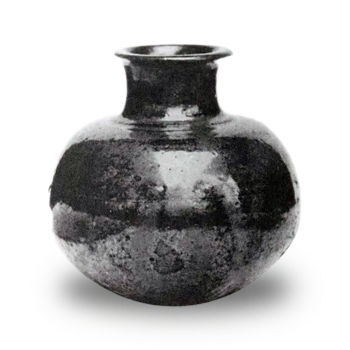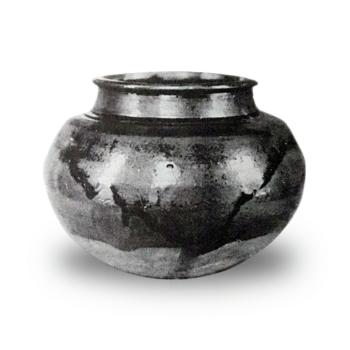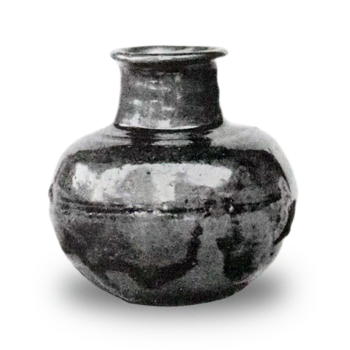


Chinese ware; formerly known as the Sōyuki Maru-tsubo; held in the collection of Ryukō-in, Kyoto
Name
This is a round tea caddy (maru-tsubo) treasured in the collection of Ryukō-in. It is also known as the “Sōyuki Maru-tsubo” because it was originally owned by Tsuda Sōyuki.
Dimensions
Height: approx. 6.36 cm
Body diameter: approx. 6.42 cm
Mouth diameter: approx. 2.73 cm
Base diameter: approx. 2.73 cm
Height of the lid: approx. 1.82 cm
Weight: approx. 53.2 grams
Accessories
One lid (1 piece) with a recess
Three pouches
Moe-green ground with swastika and plum blossom pattern on satin; lining: iridescent; cord: wisteria-colored with a tsugari knot
Aya-ground with gold-threaded satin; lining: purple sea mist; cord: purple
One box: paulownia wood, natural finish; maker unknown
“Marutsubo”
One accompanying tray: rhombus-shaped; interior black; exterior with a curved rim
Vertical diameter: approx. 19.39 cm; horizontal diameter: approx. 26.36 cm; bottom vertical diameter: approx. 19.70 cm; bottom horizontal diameter: approx. 13.33 cm
Box: Paulownia wood, Tame-nuri lacquer finish
Miscellaneous Notes
Chinese-style round teapot—a treasure of Ryukō-in. The lid of the box bears an inscription by Kobori Enshū reading: “Marutsubo—one piece; tray—a black-lacquered, rhombus-shaped tray with a curved outer rim accompanying the round teapot (illustration omitted)—one piece.”
(Kansei 11, Illustrated Guide to the Capital’s Springs and Scenic Spots)
Chinese Round Pot: A treasured artifact passed down to and owned by the founding abbot, Priest Ketsu.
(Unshū Matsudaira Family Record of Fine Artifacts)
On September 25, Tenmei 8 (1788), I went to visit Daitoku-ji. I climbed the mountain at 4:30 p.m., proceeded to ZuiGen-in, and from there, guided by the Head Monk of Kenju, toured the various temples in the mountains.
At Ryukō-in. A tea ceremony was held with a hanging scroll by Mikan displayed; after the ceremony concluded, the tea utensils were surveyed. They were as follows:
- Ido tea bowl
- Yōhen tenmoku
- Yuteki tenmoku
- Aogai tenmoku stand
- Sōyuki round tea caddy
- Chikushi Bunrin
- Tsuru-kubi
- Shunkei hyōtan
- Hishi tray
- Uchi-aka tray
1 Kuruwabon
1 Chashaku (tea scoop) by Sōyuki
A total of 12 items.
(From Yōkō Nikki by Sakai Gagaku-no-kami Sōga)
For maru-tsubo tea caddies, those with a long body and short mouth are preferred. The lid, like that of an eggplant-shaped tea caddy, is a recessed lid with an enoki nut-shaped knob. Furthermore, it is incorrect to refer to the body of a tea caddy as “mikan” in contemporary trade terminology. Names are given based on the resemblance to various objects; thus, they are commonly referred to as “eggplant,” “persimmon,” “citrus,” and so on, depending on their shape. The term “Marutubo” is also derived from the roundness of its body.
(Chayū Shōden Shū)
The term “Maru-tsubo” refers to its roundness, like a mikan, while the name “mikan” specifically refers to the body of the tea caddy. Only types such as Bunrin and Maru-tsubo are called “mikan.” Maru-tsubo come in various shapes and colors, and most have small shoulders. Some have no shoulders and feature a round body, while others have a high rim and a short body.
(Manpō Zenshū)
Round Teapot (Maru-tsubo): Length (height) approx. 7.33 cm, rim diameter approx. 3.48 cm, body circumference approx. 21.66 cm, base approx. 3.03 cm. The rim has a standard twisted finish, but the rim flange is high. The clay is a pale red color but appears to contain fine sand. The thread-cut decoration is delicate. The lower glaze is pale in color, while the black glaze has a strong silvery sheen, creating a “silver pear” ground. The upper glaze is a deep black, and the scattered glaze is similarly dark, though it exhibits varying shades of darkness. This is referred to as “Seto-glazed Tang ware.”
(Chaki Bengyoku-shū)
(Reference) Sōken of Shinjū-an was a master at appraising ancient calligraphy and was deeply devoted to the Way of Tea. Tea connoisseurs treated him with great hospitality, having the opportunity to have him appraise their ancient calligraphy. The fusuma paintings on the an’s karigami paper featured a scene of geese among reeds, painted by Jashaku. The building stood for many years without ever being destroyed by fire. There was also a round Chinese-style tea caddy, housed in a square box resembling a tea bowl case; the interior of the box was divided into four compartments, containing three pouches and the tea caddy. One pouch reflected the taste of Furuta Oribe, another that of Kobori Enshū, and the third that of Kanamori Sōwa. One year, when Nomura Sōji paid him a visit, he recounted the following: “The other day, Nanbu—the caretaker of the Kaga Domain’s residence in Kyoto—came to see me and said that an envoy from Kaga was coming to Kyoto to express gratitude for my frequent appraisals of ancient calligraphy, and that he would be accompanying the envoy. When we met, he presented gifts and various items and, with a polite address, expressed his gratitude for my past services. He then made a separate request: ‘In Kaga, too, we have recently been devoting ourselves entirely to the tea ceremony. Consequently, we have a great desire to catch a glimpse of your temple’s round-bodied tea caddy. However, as it is a precious item and difficult to borrow for transport over such a long distance, we are taking this opportunity to make our request. I would very much like you to part with it. Though the money in these two boxes is modest, please accept it to help with your temple’s repairs,” he said, presenting 2,000 ryō in gold. However, I thanked him profusely and returned the money, and I also declined his request for the tea caddy. The reason was that, as a monk, I have no lack of food, clothing, or shelter, and I have no need for 2,000 ryō. “There is no reason to exchange the joy of a lifetime for a mere sum of money. Furthermore, depending on the attitude with which a request is made, I might even part with it without payment, but given the circumstances this time, I find it difficult to part with it. Don’t you agree? If I had simply sold it off for 2,000 ryō, I probably wouldn’t have even inquired about the origin of the funds during this trip to the capital,” he reportedly said.
(Secret Records of Tea Ceremonies)
Provenance
It was owned by Tsuda Sōyuki and passed down to his son, the Venerable Kōgetsu, founder of Ryūkō-in; since then, it has been a treasured artifact of the temple.
Field Notes
I viewed the item in person on May 16, Taishō 9 (1920), at Ryūkō-in in Murasakino Daitoku-ji-chō, Kamigyō-ku, Kyoto. The twist at the rim is somewhat deep; the body is tall and flares outward at the base, with two black lines running around it. The sunken lines encircling the body are interrupted in places, and there is a chip on the rim. The glaze finish is irregular in height; in some areas it is slightly raised, revealing the grayish-brown clay, while in others the glaze has dripped down to the base. The clay at the base has a reddish tint and is chipped in places, but the thread-cut mark is extremely distinct. Overall, black glaze patterns emerge clearly within the purple glaze; in particular, some of the “nadaré” (dripping patterns) extend in long streaks from the cord-like lines on the body down to the base, while others stop somewhat shorter at the edge of the clay.
A hint of blue-lapis color within the pools of black glaze makes the patterns even more magnificent. There is a single instance of a fire blister (trace of a bubble) above the ribbing on the body; red glaze covers the grayish-brown clay at the base; and there is a spot of glaze adhesion nearby that covers one end of the thread-like glaze line—the variety of patterns is simply indescribable. Inside, the glaze covers the rim, and there is a single glaze run that extends down to the center of the base; wheel marks encircle the entire interior, and the center of the base forms a swirl pattern. It feels light in the hand, and with its well-proportioned form, it is a tea caddy of the highest refinement.