Important Cultural Property
Dimensions
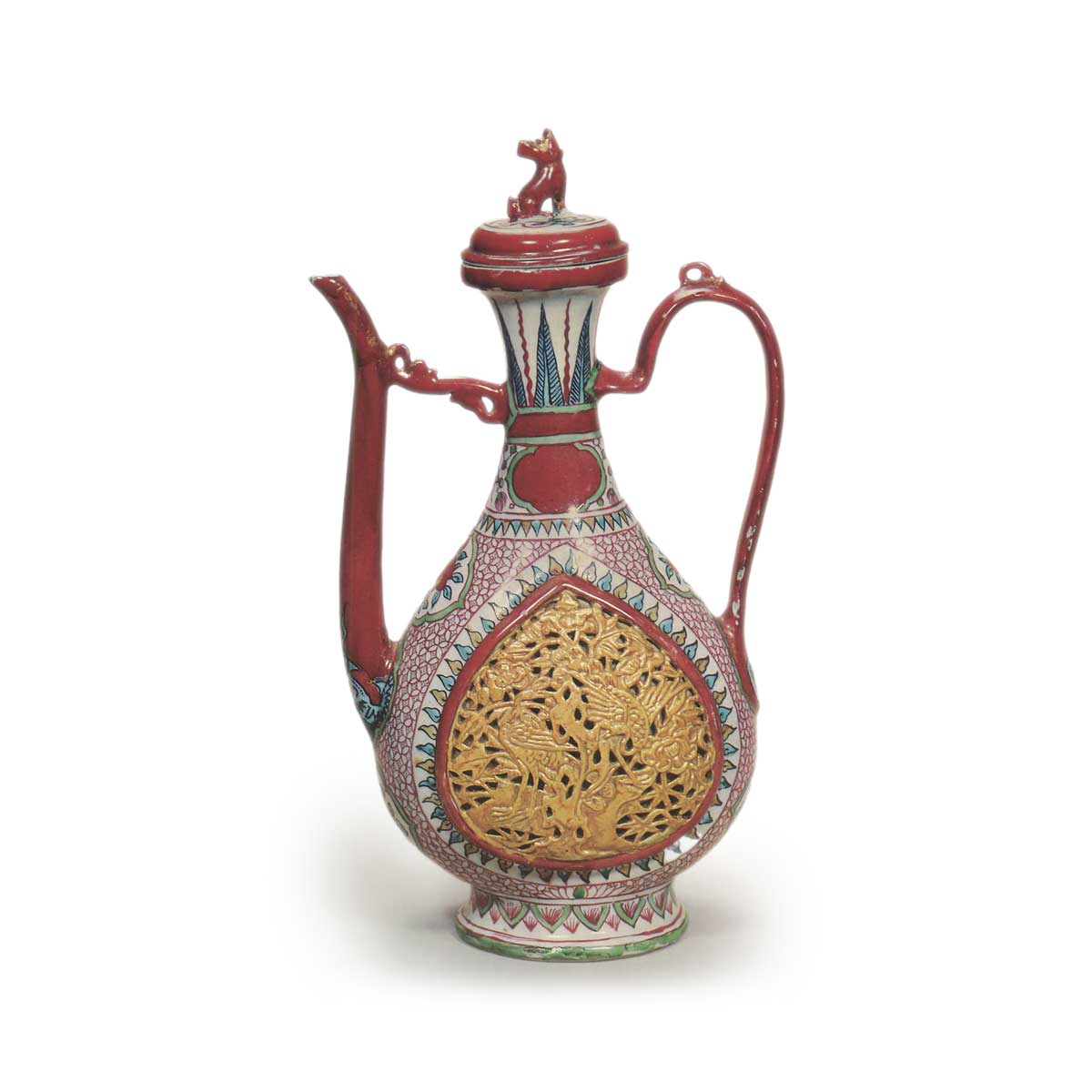
Height: 28.2 cm; Mouth diameter: 5.9 cm; Body diameter: 10.6–13.0 cm; Base diameter: 8.3 cm; Weight: 900 g
Collection: Goto Museum of Art, Tokyo
At first glance, this work can be identified as having been produced during the Jiajing era of the Ming dynasty. Specifically, the pale green hue of the footring is characteristic of the Jiajing period. While it is easy to identify it as a Jiajing-era piece, it is puzzling that, despite the existence of dozens of Kinran pieces in Japan, none of them can be found in China itself. It is questionable whether the Kinran technique was actually practiced in Jingdezhen.
As far as we can tell, Kinran refers to intricate, finely crafted objects. It is hard to imagine that such meticulously detailed pieces—the kind one might examine under a magnifying glass—were commonly produced in the official kilns of China.
As I mentioned in the introduction, my view is that such a magnificent piece likely originated from a master artisan living in a back alley somewhere in Jingdezhen, who spent a long time creating it.
In any case, it is fascinating that this world-class work of art remains shrouded in mystery.
In China, it was likely used as a water pitcher or a wine pitcher. It is believed to have been introduced to Japan around the early Edo period, but its use as a flower vase for tea ceremonies is a relatively recent development.