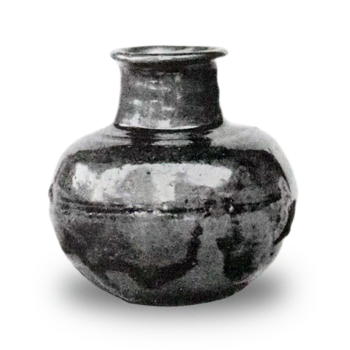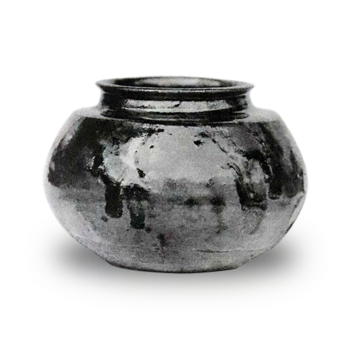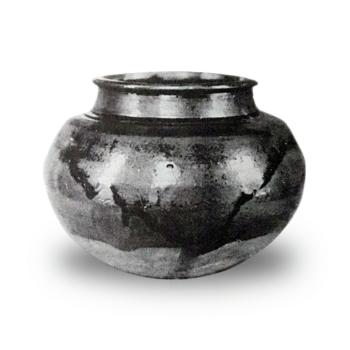


Made in China; Daimeibutsu from the collection of Duke Tokugawa Ietatsu
Name
Tsuda Sōyuki’s Tea Ceremony Diary states: “I saw Uchigumo Taikai for the first time. There are areas where the painted patterns appear to be clouded over, creating a magnificent glaze effect.” Furthermore, the Catalog of Tea Utensils from the Tokugawa family collection notes: “The entire piece is persimmon-colored, and the black glaze appears to be clouded over in places; it is said that Lord Higashiyama (Ashikaga Yoshimasa) bestowed this name upon it.”
Dimensions
Height: Approx. 7.12 cm
Body Diameter: Approx. 10.00 cm
Mouth Diameter: Approx. 6.06 cm
Base Diameter: Slightly over 4.55 cm
Koshiki (rim) Height: Approx. 1.21 cm
Weight: Approx. 168.75 grams
Accessories
- Lid: 1 piece (with a depression)
One imperial pouch: white ha-niji
One set of two pouches
Cloud-and-crane satin; lining: tamamushi-kai; cord: purple tsugari knot
Kinoshita-giri; lining: flower-colored kai; cord: purple tsugari knot
One Hikiya: black lacquer. Engraved on the underside of the base: “Made by Fujishige for use with rush mats in the Tame-zukuri style.”
Pouch: Pine, Bamboo, and Plum damask; lining: light green sea-wave pattern; cord: purple tsugari knot
One inner box: Paulownia, natural wood
Contents: White-tea sea-wave pattern
One outer box: Black lacquer; gold-powder lettering
Miscellaneous Notes
Uchikumori Ōkai is a Meibutsu valued at 1,000 Sen. However, it is questionable whether it is suitable as a tea ceremony utensil in the present day.
(Collection of Famous Tea Utensils)
Uchigumori Daikai: A “Daimeibutsu” valued at 3,000 kan. However, it is said that in the present day, regardless of quality, it is not used for the tea ceremony. From ancient times through the Edo period, it was used as a “Meibutsu.”
(Recorded by Yamagami Sōji)
Uchigumori Daikai: A major “Daimeibutsu” of Chinese origin; an “Omono” (owned by the Shogun’s family). Persimmon-colored with black, made with “Honito-kiri” technique; of relatively recent origin.
(Rinpō-kiryū)
Uchigumo Daikai: Owned by the Lord of Kii. A “Meibutsu” valued at 1,000 Sen; it was formerly owned by Kyogoku Doyu.
(From Illustrated Compendium of Famous Tea Utensils by Kusama Waraku)
Uchigumo Daikai: Chinese-made. Presented by the Lord of Kii, the Junior Counselor, on November 18, the 2nd year of Hōei (Year of the Rooster). Height: approx. 7.27 cm; body diameter: approx. 10.00 cm; mouth diameter: approx. 8.18 cm; base diameter: approx. 4.85 cm. It comes with two pouches: one in “Cloud and Crane” satin (lining: “Jeweled Beetle Sea Mist”; cord: purple tsugari knot) and one in “Kinoshita” (lining: “Sea Mist”; cord: purple tsugari knot); old texts refer to it as “Wakuda.” While “Wakuda” and “Kinoshita” are largely similar, this fabric is likely Kinoshita. The imperial artifact pouch is made of white habutae silk. The lid is ivory. The handle is black-lacquered, and the pouch is made of satin embroidered with the pine, bamboo, and plum crest (lined with light green “Kaiki” silk, with a purple cord). The inner box is made of natural paulownia wood. The outer box is black-lacquered with gold-powdered characters. Overall, the glaze appears to have a cloudy, black landscape pattern on a persimmon-colored base; it is said that Lord Higashiyama Yoshimasa (Ashikaga Yoshimasa) inscribed it for this reason. It is widely acclaimed as the finest example of a “Great Sea” tea caddy made in the Chinese style. The base features a left-side thread-cut design, with a fire crack (a crack formed during firing) in the center and glaze spatter in two places. (Illustration of the tea caddy omitted)
(Held in the Tokugawa Family’s Catalog of Imperial Utensils)
Morning of the 5th day of the first month of Tenshō 11 (Guiwei) — A gathering hosted by Lord Chikuzen (Hashiba Hideyoshi)
Guests: Sōkyū, Sōeki (Sen no Rikyū), Sōho, Sōyuki, Sōan
- Rurori: The kettle of Oto-gozen is suspended by a swivel hook. 1. Tea Table: A calligraphy scroll by Kyodo was hung, with a large pine-flower-patterned jar placed in front. Positioned between the tea masters, a “Uchigumo Daikai” tea bowl was placed on a four-sided tray, accompanied by a taro-root-shaped water jar, a well-style tea bowl, and a gold-inlaid tea caddy.
(Excerpt from Imai Sōkyū’s Diary)
Morning of the 5th day of the first month, Tenshō 11—At Yamazaki—A gathering hosted by Lord Chikuzen (Hashiba Hideyoshi)
Guests: Sōkyū, Sōeki, Sōfu, Sōji, Sōyuki, Sōan
- The tokonoma: A large “Uchikumori Daikai” teapot by Matsuka, placed on a square tray
The hearth: An “Otogose” (kettle) suspended by a swivel hook; a “Ido” tea bowl
I saw the “Uchikumori Daikai” teapot for the first time. It is a flat jar. The clay is not particularly good, but the glaze is splendid. The shoulders are narrow, with black spots on them and areas where the painted patterns appear slightly clouded—a truly magnificent glaze. That said, it is not inherently dark; compared to the “Banzai Daikai” and others, it is flatter, shorter in height, and overall a smaller jar. One should first and foremost examine the clay.
(Tsuda Sōyuki’s Tea Ceremony Diary)
July 2, Tenshō 11 (Guiwei), at noon: The first gathering with Lord Chiku (Hashiba Hideyoshi) at Osaka Castle
- The tokonoma featured a painting of the evening bell at Tamabune. Tea was poured into the Hatsuhana okeshichō and placed on a shihō-bon. Tea ceremonies were held daily, and flowers were arranged.
On July 7 of the same month, there was a Tanabata celebration, and flowers were arranged seven times.
He prepared tea daily in the “Uchikumori no Ōkai” (Cloudy Sea) tea bowl.
(Tsuda Sōyuki’s Tea Ceremony Diary)
September 16, Tenshō 11 (Guiwei) — Lord Hideyoshi’s Entertainment
On the tea platform: Bunrin, Sōyuki, and Hatsuhana’s offerings were followed by Matsumoto Nasu, which Chikushū (Hideyoshi) brought and presented. Performers included Sōan in the “Thrown Headscarf” style, Sōeki in the “Light Purple Shoulder-Punch” style, and Miyauchi Hōkyō in the “Palace King Shoulder-Punch” style.
Tea was served in the “Uchi-kumori no Ōkai” tea bowl. An Amago tenmoku and a well-style tea bowl were used.
(Tsuda Sōyuki’s Tea Ceremony Diary)
The Great Tea Ceremony at Kitano: His Lordship (Toyotomi Hideyoshi)
The Kanpaku’s Tea Ceremony
A painting of Asayama. In front stood a forty-koku jar; a blue Kinran cloth served as a mat, and a Bizen cylinder hung above it. A tea caddy depicting the setting sun. Nitta Katatsuki. On a shihō tray: an Otogose kettle, a thick chain, a water jar with a gold bucket, and a lid of pure bronze (karadō)—this was from Ishibashi. The Uchigumori Ōkai (Uchigumori Ōkai), with a triple-layered lid, a Chinese tin vessel, and a Bizen water spout by Shōō.
(Hōkyū Chakai-ki)
Regarding the use of the “Ōkai” in the Sukiya (tea room). Rikyū used the “Uchigumori Ōkai” to prepare tea in the Sukiya. This Ōkai was in the possession of Lord Kii Dainagon, and it is said that Rikyū used it for a “bon-zuke” (tea ceremony on a tray). This is the account of Sōfu, as recounted in response to inquiries from Lord Bitchū and Takuta. Other than the instance mentioned above, the Ōkai has never been brought out to the sukiya.
(Sōyūki)
Uchigumori Ōkai, Lord Kii.
(Kanka Meibutsu Ki)
Uchigumori Ōkai, Chinese small jar, Daimeibutsu, Lord Kii
(Kokin Meibutsu Ruiju)
Uchikumori Ōkai: On November 28, Hōei 2 (Year of the Rooster), a relic of Lord Kii Chūnagon—the third in a set of long chests. It consists of two pouches (one lined with “Shinkai-ki,” the other with “Chamaru”), and one lid.
(Imperial Artifacts)
Uchigumo Ōkai: Presented by the Kii Chūnagon on November 28, Hōei 2.
(Kishū Family Documents)
History of Transmission
This was a Higashiyama Imperial Treasure (a treasure of the Ashikaga Shogunate) that was passed down to Toyotomi Hideyoshi. Detailed accounts of its use at tea ceremonies in the first, seventh, and ninth months of Tenshō 11 can be found in the diaries of Imai Sōkyū and Tsuda Sōyuki. It was subsequently owned by Kyogoku Doyu and later became part of the collection of the Lord of Kii (the Kishu Tokugawa family). On December 8, Hōei 2 (1705), it was presented to the shogunate as part of the estate of Kii Chūnagon Tokugawa Tsunanori, and has remained a treasure of the Shogunate ever since.
Record of Actual Viewing
On November 8, Taisho 7 (1918), I viewed the piece in person at the residence of Duke Tokugawa Ietatsu in Sendagaya, Tokyo Prefecture.
The rim is slightly rounded, and the turned-back edge is standard. The base is flared, with three ridges running around its circumference. Overall, a glossy black amber glaze flows in large cascades over the persimmon-colored body, forming a distinctive pattern; there is one additional large cascade and two smaller ones. For a piece made in China, it feels light in the hand; there is one firing crack in the center of the distinct thread-like pattern, flanked by two areas where the glaze has spattered. From the waist down, the vermilion-clay-colored body features numerous clumps of clay about the size of a fingertip. The sight of the black amber glaze cascading over this clay to reach the base is indescribably vivid and beautiful. Generally speaking, the areas above the body where the glaze color is uneven and dense live up to the name “Uchigumo” (clouded). In contrast, the form below the body is vivid, and the areas where the clay is exposed up to the waist are truly radiant. With the upper and lower halves evenly balanced between shadow and light, this piece must be considered one of the most visually outstanding among Han-style Oumi tea caddies.