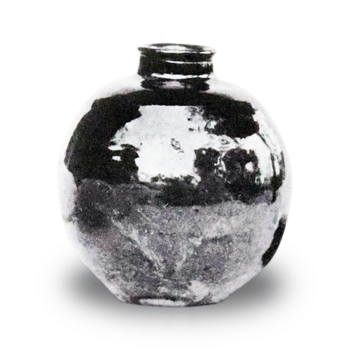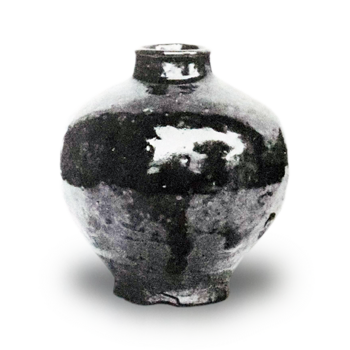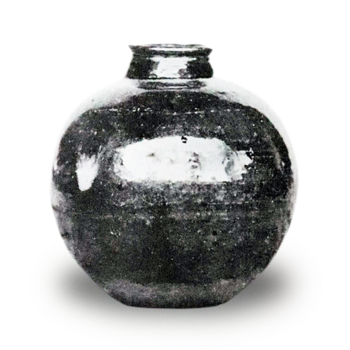
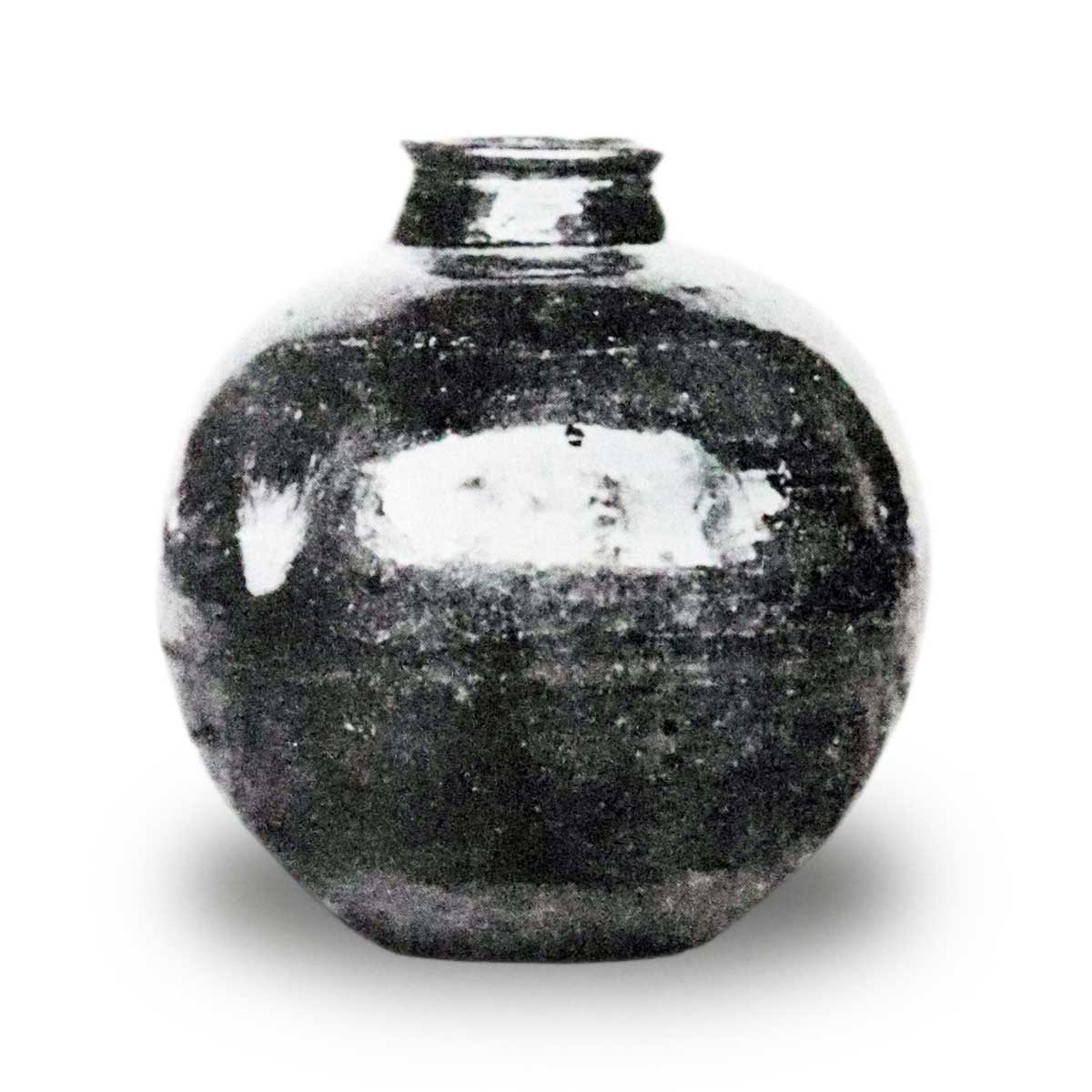
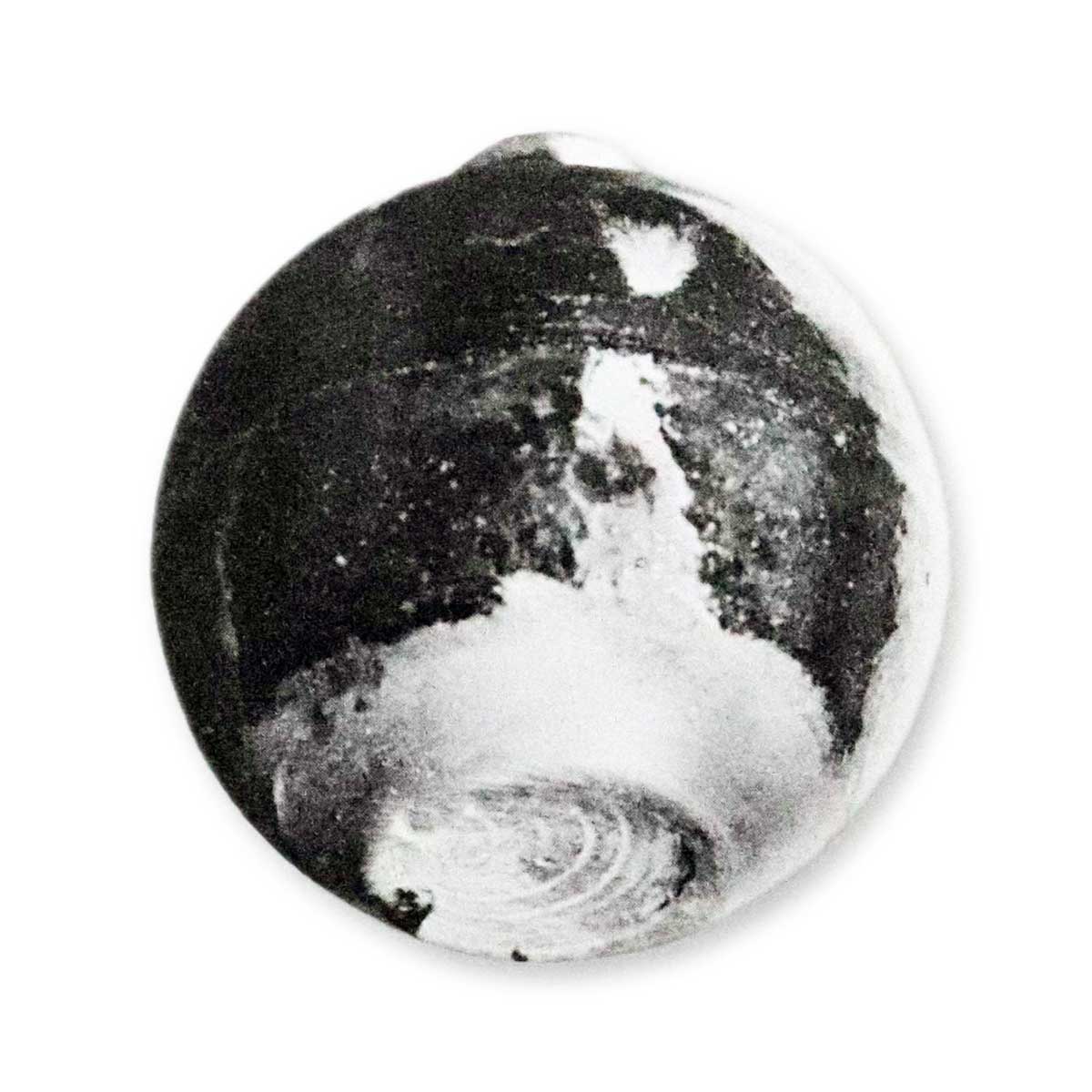
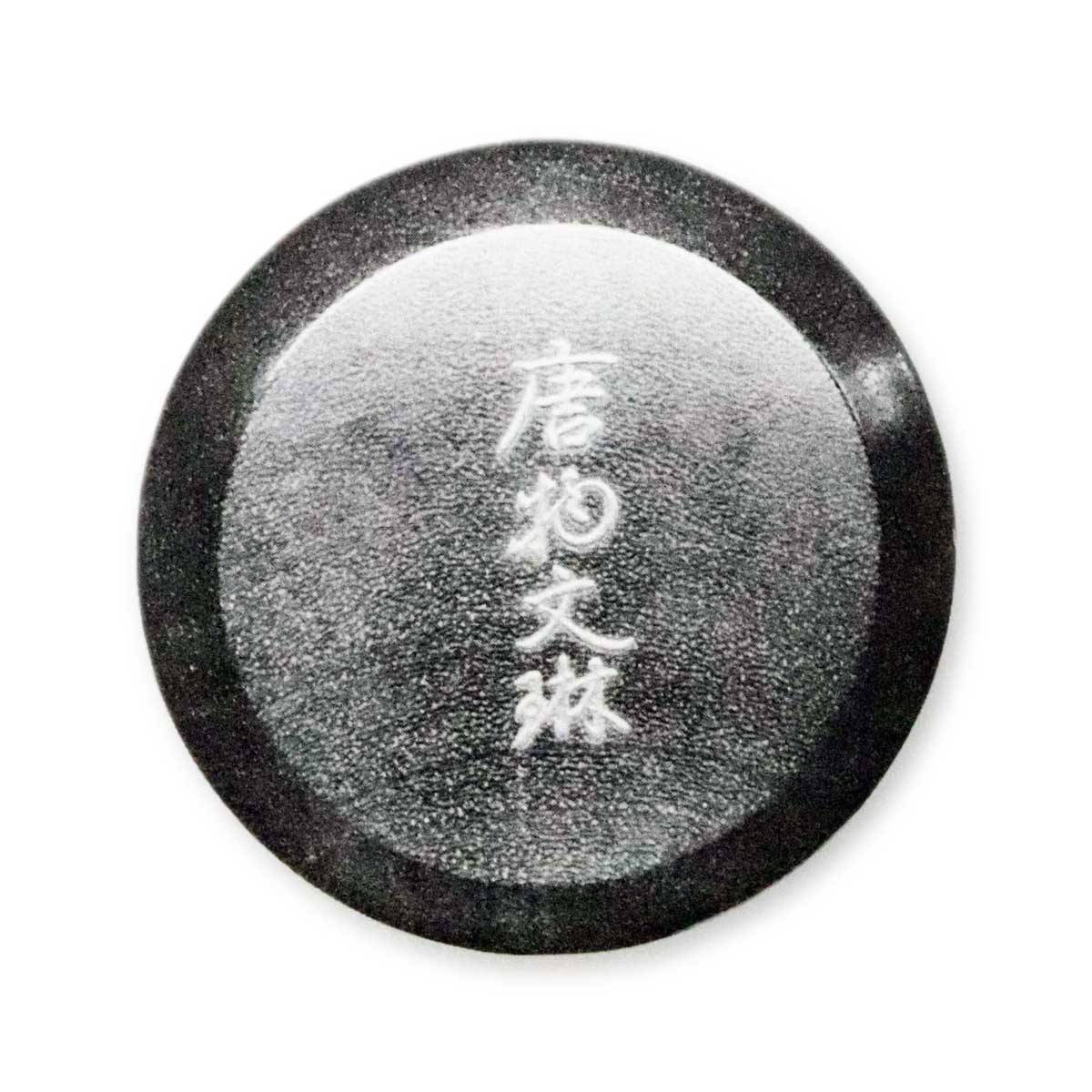
Made in China; Osaka; Collection of Mr. Ishii Teishichi
Origin of the Name
This tea caddy has been passed down through generations of the Mito Tokugawa family. Judging by the style of its inner and outer boxes, it appears to have originally belonged to the Shogun’s household. Lord Tōzan (Tokugawa Kokusun, the 13th head of the Mito Tokugawa family) inscribed it and named it “Mito Bunrin.”
Dimensions (converted using 1 sun ≈ 3.03 cm and 1 monme ≈ 3.75 g)
Height: Approx. 6.82 cm (2 sun 2 bu 5 rin)
Body diameter: Approx. 6.67 cm (2 sun 2 bu)
Mouth diameter: Approx. 2.27 cm (7 bu 5 rin) or approx. 2.42 cm (8 bu)
Base diameter: approx. 2.73 cm (9 bu)
Koshiki (steamer) height: approx. 0.82 cm (2 bu 7 rin) or approx. 0.91 cm (3 bu)
Weight: approx. 89.6 g (23 monme 9 bu)
Accessories
Lid: 1 (no indentation)
Storage Pouch (for the tea caddy): Light blue habutae silk; white cord
Covering Pouches: 2
・Kiyomizu-zori (lining: light green satin with a ground pattern; cord: brown)
・Fujitane-zori (lining: scarlet kai-ki; cord: purple)
Storage Box: Made of untreated paulownia wood; newly crafted. Bears an inscription by Tokugawa Kokujun-ko.
“Mito Bunrin”
Inscription on the pouch
“Mito Bunrin, two pouches, Kiyomizu-zori, Fujitane-zori” inscribed on both the front and back.
Hikiya (a tube for storing the tea caddy): Made of tagayasan wood. The lid bears an inscription in gold powder.
The “Karamon Bunrin” pouch is made of woolen fabric with silver thread (lined with purple Kai silk; cord is brown) .
Inner box: Made of paulownia wood; a box from the Ryōei (Shogun’s household). Decorated with gold powder.
Inscription in gold powder.
The inscription on the “Tang-style Bunrin” label stating “Supreme Masterpiece” is in the handwriting of Tokugawa Saishū (Ai-kō), the eighth head of the Mito Tokugawa family.
“Supreme Masterpiece”
Middle box: Black lacquered, a box of the Ryoei (Shogun’s household). Gold-powdered ikake finish.
Inscribed with “Tang-style Bunrin” in gold powder.
Outer box: Natural-finish paulownia wood, newly made. Inscription by Tokugawa Kokujun-ko.
“Mito Bunrin”
Front: “This is a tea caddy that has been passed down through generations in my family; it is called the Mito Bunrin. Tōzan (seal)”
Outer Case: Black persimmon wood with a striped, mottled pattern.
Miscellaneous Notes
On May 14, Kan’ei 4 (1627), when the retired shogun Tokugawa Hidetada paid a visit to the residence of Mito Yorifusa, the tea caddy “Bunrin” and a new tea bowl were used as tea room utensils.
(From Tōbu Jitsuroku)
On April 3, Kan’ei 5 (1628), when Hidetada paid a visit to the residence of Mito Yorifusa, the tea caddy “Funrin” was used as part of the tea ceremony set.
(From Tōbu Jitsuroku)
On August 10, Kan’ei 6 (1629), when Shogun Tokugawa Iemitsu paid a visit to the residence of Mito Yorifusa, the tea caddy “Funrin” and a blue-and-white tea bowl were used as tea ceremony utensils.
(From Tōbu Jitsuroku)
As mementos of Lord Tokugawa Tsunayoshi, a wakizashi (Shinshū style, valued at 150 me) and a tea caddy (Chinese-style Bunrin) were presented to the Lord of Mito, the Chūnagon, with Akimoto Tajima-no-kami serving as the envoy.
(From Shiojiri by Amano Nobukage)
On the last day of February in the 6th year of Hōei (1709), the personal effects of Lord Tokugawa Tsunayoshi were dispatched by imperial envoys.
・A hanging scroll depicting a dragon by Sesshū and an eggplant-shaped tea caddy with a vase-like spout were sent to the Empress Dowager (Imperial Envoy: Hōki-no-kami)
・A Masamune wakizashi (valued at 200 mon) and an Osumi katatsuki tea caddy were sent to the Lord of Owari (Imperial Envoy: Sagami-no-kami)
・A wakizashi by Shinsō (valued at 200 me) and a katatsuki-style tea caddy by Sōmu were sent to the Lady of Owari (Envoy: the same as above)
・A wakizashi by Shinsō (valued at 150 me) and a Chinese Bunrin-style tea caddy were sent to the Lord of Mito (Envoy: the same as above)
(From the Imperial University Historical Materials Collection Bunrosō)
Provenance
It is currently impossible to confirm whether this is the Bunrin tea caddy owned by Lord Mito Yorifusa during the Kan’ei era, as described in the Tōbu Jitsuroku, or the tea caddy that was passed down to the Mito family as a relic of Shogun Tsunayoshi, as described in the Shiojiri and Bunrosō. It left the Mito family in recent years and came into the possession of its current owner.
Record of Actual Viewing
On September 6, Taishō 7 (1918), I had the privilege of viewing this piece in person at the residence of Marquis Tokugawa Kunijun in Shin-Komeguchō, Honjo Ward, Tokyo.
The rim is extremely tight, the curve (warp) is shallow, and the neck is strongly flared. A single band of blue-green glazing runs around the base of the neck; the body is flared, tapering from the waist downward. The base reveals reddish-brown clay; the bottom is small, the thread-cutting is rough, and there are only six lines of varying lengths. On top of this, fine stripes appear irregularly; there is a small chip in the center and a somewhat larger crescent-shaped chip in one corner.
Overall, a lustrous amber-colored glaze and a yellow glaze (namely, Bunrin glaze) are blended in equal parts; a streak of yellow glaze flows down from the tip of the shoulder on the front view, and within the body there is a pattern resembling a single drop of blue-lapis-lazuli-colored dew. Its luster is beautiful and bears a striking resemblance to the glaze pools found in “White Jade Bunrin” ware. A small, similar droplet of blue-lapis-lazuli-colored glaze is also found slightly to the right of the front, and there are additional specks of yellow glaze within the amber-colored base; the charm of the overall pattern is so captivating that it defies description.
From the lower rim down, the clay is vermilion-colored; the area around the base and the part in contact with the tray are generally worn down, and there is a single speck of yellow glaze on the rim. Inside, yellow glaze covers the rim of the mouth, with a blue-lapis-lazuli hue visible within it. Below that, the wheel marks spiral very gently, and there is a small, pointed protrusion in the center of the base. It feels quite heavy in the hand, and—much like the “Shirayuki Bunrin”—it can be said to represent a distinct category among Chinese tea caddies.