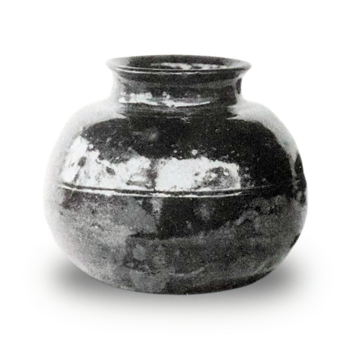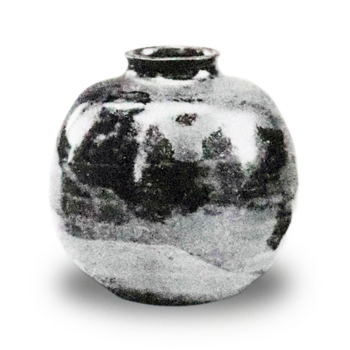


Made in China; Collection: Mr. Ryuhei Murayama, Osaka
Origin of the Name
This name was given because the tea caddy features a half-moon-shaped design on its shoulder.
Dimensions (converted using 1 sun ≈ 3.03 cm and 1 monme ≈ 3.75 g)
Height: Approx. 5.70 cm (1 sun 8 bu 8 rin) or approx. 5.76 cm (1 sun 9 bu)
Body diameter: Approx. 5.82 cm (1 sun 9 bu 2 rin)
Mouth diameter: Approx. 2.12 cm (7 bu)
Base diameter: Approx. 2.73 cm (9 bu)
Height of the koshiki (base ring): Approx. 0.45 cm (1 bu 5 rin)
Weight: Approx. 47.6 g (12 monme 7 bu)
Accessories
・Lid: 1 (no indentation)
・Storage pouches: 2
Round satin with a dragon crest on a floral background (lining: Chinese silk; cord: purple)
Shaoguo Guangdong weave (lining: brown sea-green silk; cord: purple)
・Storage box: Made of natural paulownia wood
Inscribed with “Half-Moon Bunrin,” “Spare Pouch,” and “Half-Moon Bunrin”
・Inner box: Made of natural paulownia wood, with an inscription by Kobori Enshū
“Half-Moon Bunrin”
・Hikiya (cylinder for storing the tea caddy): Made of mulberry wood, with gold-leaf lettering
“Half-Moon” Inscription by Kobori Enshū
The pouch is made of Shu-ren (lined with iridescent Kai silk, with a brown cord)
・Outer box: Made of natural-finish paulownia wood, with a lock
“Half-Moon”
Miscellaneous Notes
“Half-Moon” Tang-style Bunrin Tea Jar—Made in China. Height approx. 5.76 cm, body diameter approx. 5.76 cm, mouth diameter approx. 2.12 cm, base diameter approx. 2.88 cm. The pouch is made of round-patterned dragon-motif satin on a floral-colored ground (lining: Chinese silk; cord: purple). The Hikiya is made of mulberry wood with signs of insect damage; it includes a cord and features gold-powder calligraphy. The other pouch is made of red-ground satin (lined with iridescent silk; purple cord). The outer box is made of paulownia wood with rosewood trim on the lid. The inscriptions on both the carrying case and the box were written by Lord Kobori Enshū, and the accessories, such as the protective cover, reflect his personal taste. “Half-Moon Bunrin (Half-Moon)”
(From Kokin Meibutsu Ruiju)
Half-Moon Bunrin: Made in China. The rim is coated with a yellow glaze both on the overglaze and the base glaze; the clay is red, resembling the color of unglazed earthenware (kawarake). It retains its original thread-cut markings and is slightly coarse. (Dimensions and descriptions of accessories are the same as in Kokin Meibutsu Ruiju. Includes an illustration of the tea caddy.)
(From Unshū Matsudaira-ke Honmeibutsu-ki)
Half-Moon Bunrin: Height approx. 5.76 cm, mouth diameter approx. 2.12 cm, body diameter approx. 5.76 cm, base diameter approx. 2.88 cm. The pouch is made of satin with a floral background and dragon motifs. Box
Half-Moon Bunrin
Bears an inscription by Kobori Enshū. It retains its original thread-cut finish, and the clay has a color resembling that of unglazed earthenware (kawarake).
(From Chaki Zū Jōbō)
Half-Moon Bunrin: A square tray with a cloud pattern.
(From Kamio Storehouse Register)
History
Originally owned by Kamio Wakasa-no-kami Mototaka, it eventually entered the collection of the Doi Viscount family. During the Meiji 45 (1912) auction of the Doi family’s collection of “ryujō” (a format in which hats or canes are displayed instead of plaques), Yasuzō Umezawa, a tea utensil dealer from Tokyo, won the bid, and it was soon purchased by the Murayama family. In response to an inquiry regarding this auction, Umezawa’s reply included the following passage:
“I acquired the ‘Half-Moon Pattern Bunrin’ at the Doi family’s Ryujō auction in Meiji 45. Needless to say, this is the tea caddy described in Sanzaku-mono, Kokin Meibutsu Ruiju, and the Kamio Storehouse Register. Items offered at that auction included a set of three hanging scrolls painted by Sesshū—featuring Hotei in the center and flowers and birds on the left and right—as well as a square colored paper scroll by Lord Fujiwara no Yukinari. The Sesshū scrolls were won by Lord Yoshida Tanzaemon, and the square colored paper scroll was won by Baron Mitsui Takayasu; the ‘Half-Moon Bunrin’ was purchased by the Murayama family a short time later, and so on.”
Record of Actual Viewing
On September 25, Taisho 9 (1920), I had the opportunity to view this piece in person at the residence of Mr. Ryuhei Murayama in Mikage, Muko District, Hyogo Prefecture.
It is small in size with a tight rim and a shallow curve; its craftsmanship is unparalleled in its precision. It has sloping shoulders and a broad waist, with shallow wheel marks forming steps as they run from the tips of the shoulders. The glaze stops at a lower level on one side and a higher level on the other; the portion below the hem reveals the vermilion-clay-colored (reddish-brown) clay, with three tiers of wheel marks running above it. The thread-cutting marks vary in thickness from coarse to fine; starting from their origin and extending toward the left, there are two small, worm-eaten-like holes and a slightly elongated trace of a frayed edge (chip).
Overall, the yellow glaze has a beautiful luster; glaze of the same color, which has slightly worn away around the neck to form a cloud-like pattern, covers half of the shoulder and flows down to the body. On the other half of the surface, a half-moon-like shape emerges from a grayish-brown glaze tinged with purple; this is likely why it was named “Half-Moon Bunrin.” Indeed, the fascinating scene—as if one were gazing at a half-moon alongside the mottled, drifting clouds of dawn—is beyond words.
Inside, the glaze covers only the rim; below that, the wheel marks are fine and intricate, with the center of the base rising in a swirl-like pattern. Small, elegant, and rich in visual appeal, this piece must be considered among the finest (jōjō) of small Chinese tea caddies.