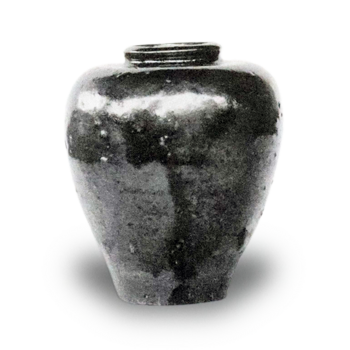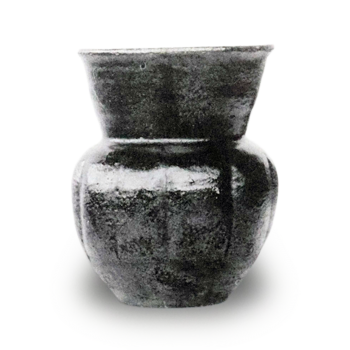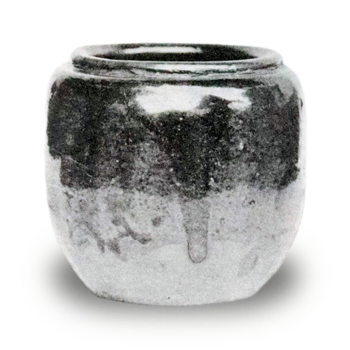
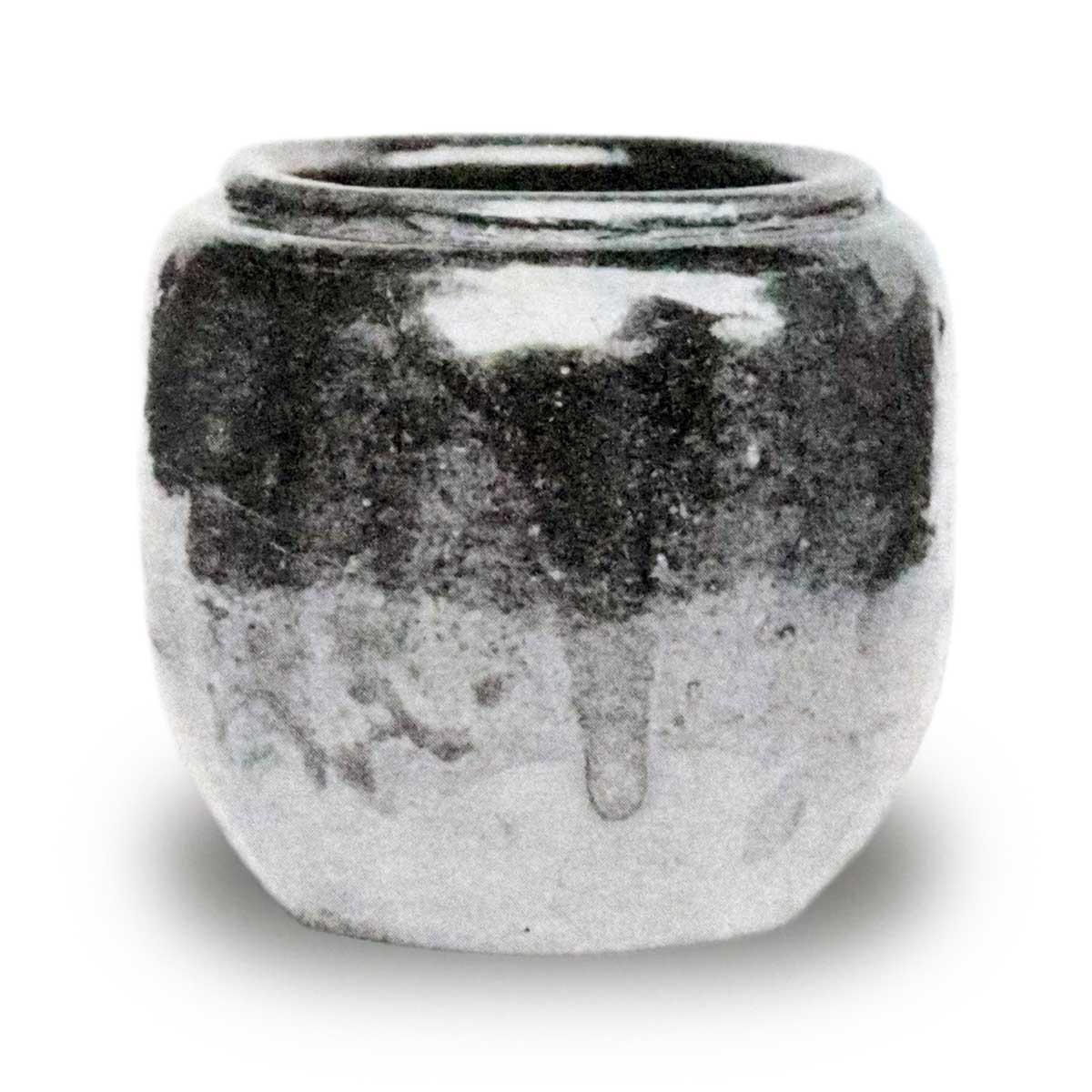
Made in China; Collection of Marquis Toshitame Maeda
Name
The Manpō Zenshū states, “Minaguchi refers to a vessel with a wide mouth and a rounded bottom.”
Dimensions
Height: Just under 6.0 cm (just under 2 sun)
Body diameter: Approx. 6.6 cm (2 sun 1 bu 7 rin)
Mouth diameter: Approx. 5.3 cm (1 sun 7 bu 5 rin)
Base diameter: Approx. 4.6 cm (1 sun 5 bu 2 rin) or Approx. 3.9 cm (1 sun 3 bu)
Height of the neck: approx. 0.4 cm (1 bu 2 rin)
Shoulder width: approx. 0.2 cm (6 rin) or approx. 0.3 cm (9 rin)
Weight: approx. 91.1 g (24 monme 3 bu)
Accessories
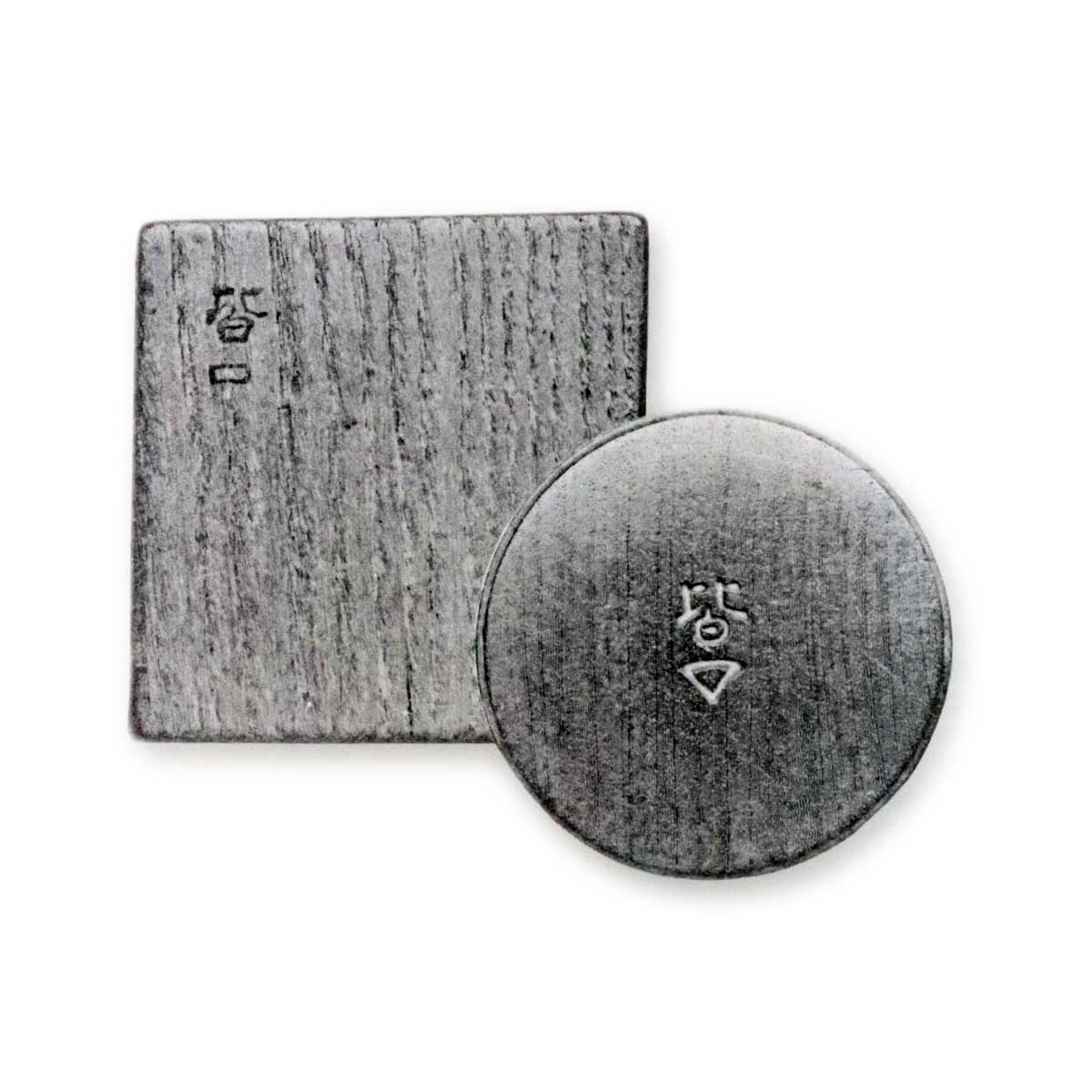
・Lid: 1 piece, with a “su” (pattern)
・Storage pouch: Gray-brown ha-niwa fabric, newly made
Old pouch: Tsumugi fabric with a checkered pattern (the wisteria-colored tying cord is severely damaged)
・Pouches: 4
White-brown ground with Kinran brocade featuring a cloud, reishi mushroom, and circular dragon motif (lining is storeroom brown; tying cord is purple)
Lily motif on dark floral-patterned Kinran (lining: grayish-brown kaiki; drawstring: pale yellow)
Circular dragon motif on brown twill-weave gold-and-silver Kinran (lining: pale yellow kaiki; drawstring: light brown)
*This features the ground pattern of the Meibutsu tea ceremony set.
Nine-dragon motif on white-brown ground with a pure-white Donshu in the corner (lining: heavily damaged; drawstring: dark brown)
・Pouch Box: Paulownia, natural wood
(Boxed text) “Han-style ‘Minaguchi’ pouches, set of four”
・Wooden Mold: 1 piece
Fits into the aforementioned “Dark-colored floral Kinran lily crest” pouch
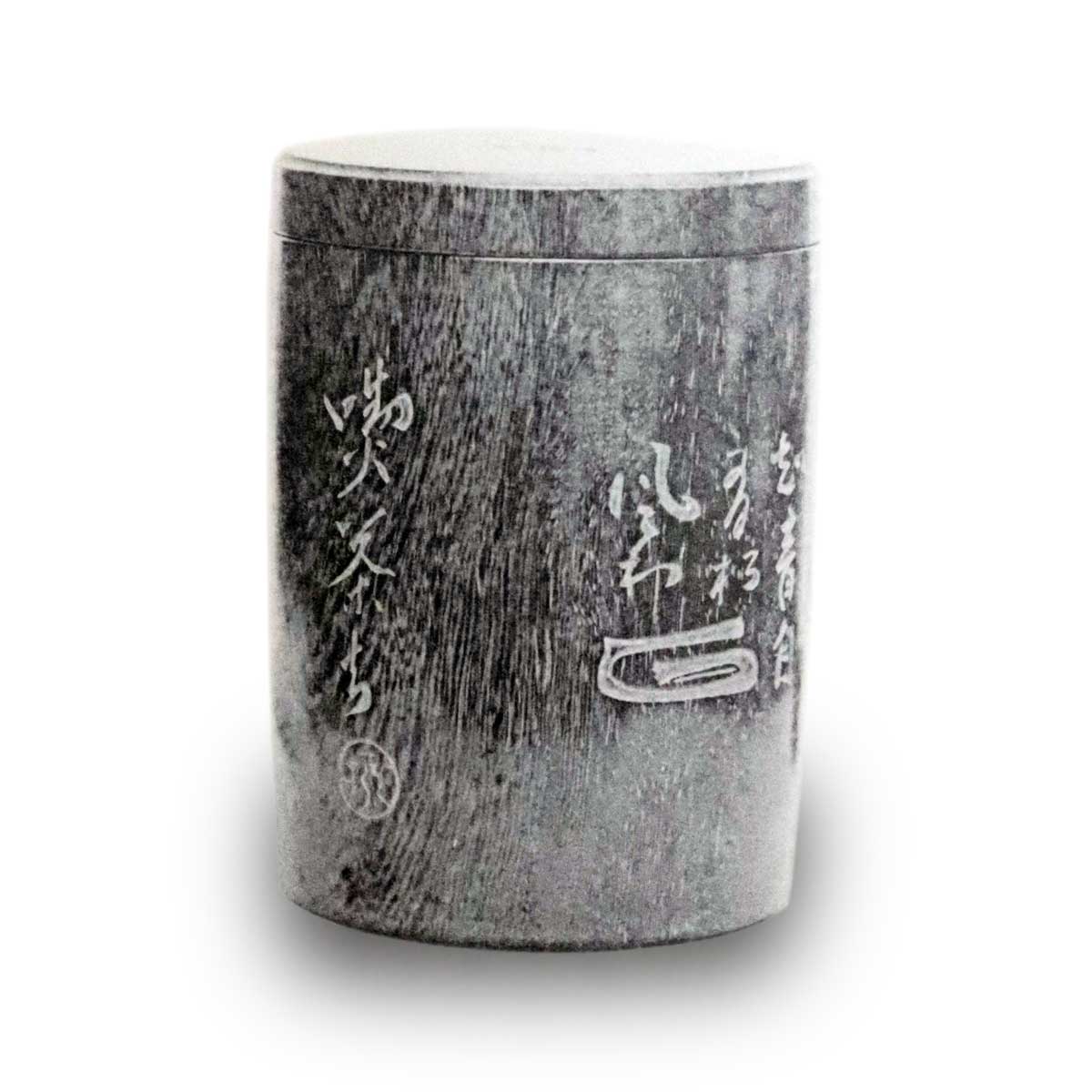
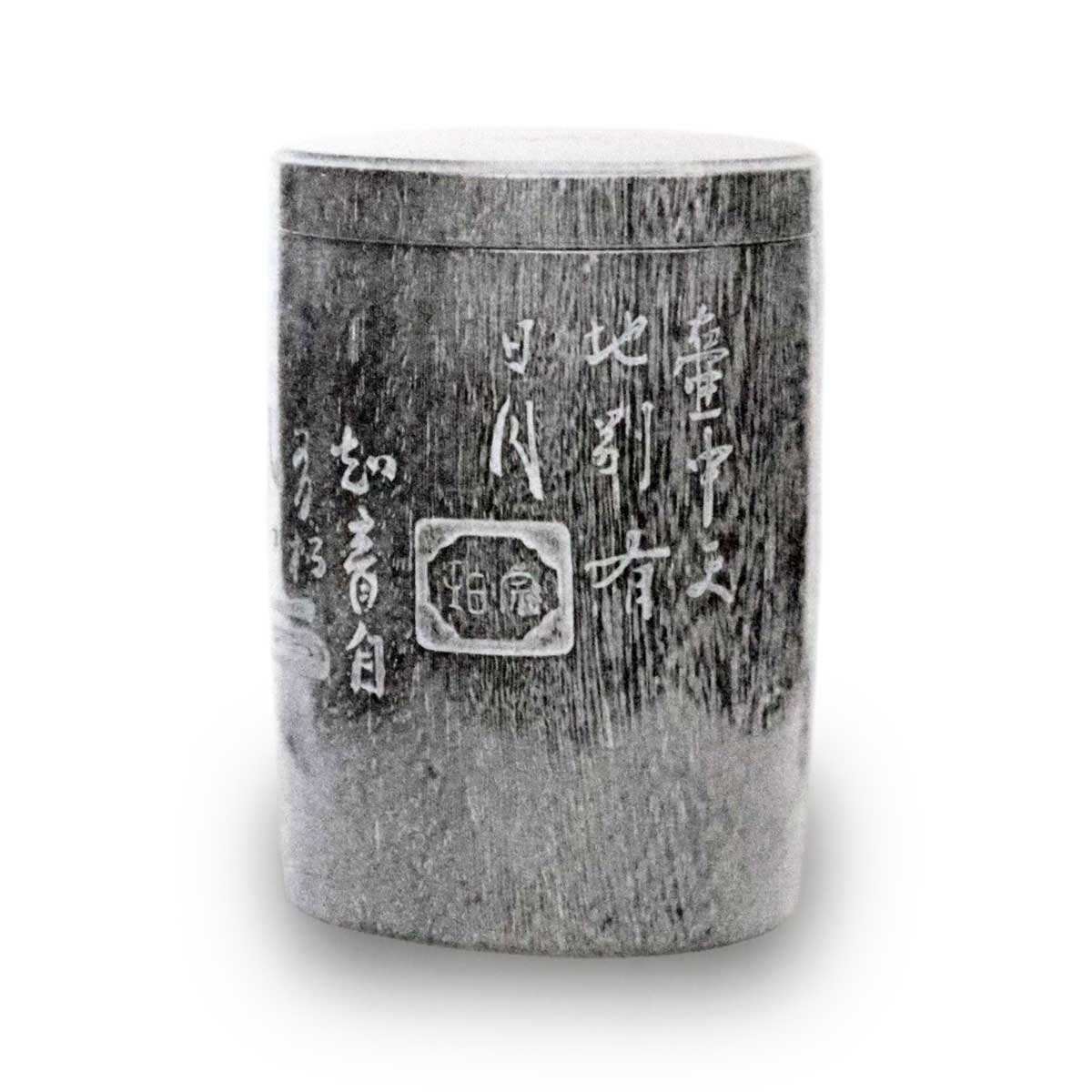
・Hikiya (tea caddy storage tube): Tagayasan wood
(Circled) “Kaiguchi”—sunken carving by Kobori Sōho (Enshū)
The body of the Hikiya features carvings by the following three artists
(Boxed)
“Within the pot, heaven and earth are distinct; the sun and moon exist separately—Sōhaku” (Venerable Gyokushitsu)
“A kindred spirit naturally finds harmony in the pine breeze (seal)” (Venerable Sōan)
“Drink Tea and Go (Wan)” (Kōgetsu)
・Inner Box: Paulownia, natural wood; paper label affixed to the back
Pouch: Yellow Donshu plum double-vine pattern (lining: floated-weave Donshu bamboo-vine pattern; tying cord: brown)
Front
(Bordered) “Minaguchi”
Back
(Diagonally bordered)
“Han—Minaguchi Tea Jar (written in vermilion)
Confiscated from Usuya Ryōtaku; it also has other provenance.”
・Outer Box: Shunkei lacquer, with an iron lock
(Bordered) “Minaguchi—Chinese Import”
・Main Box: Paulownia, natural wood
(Bordered) “Minaguchi”
Miscellaneous Notes
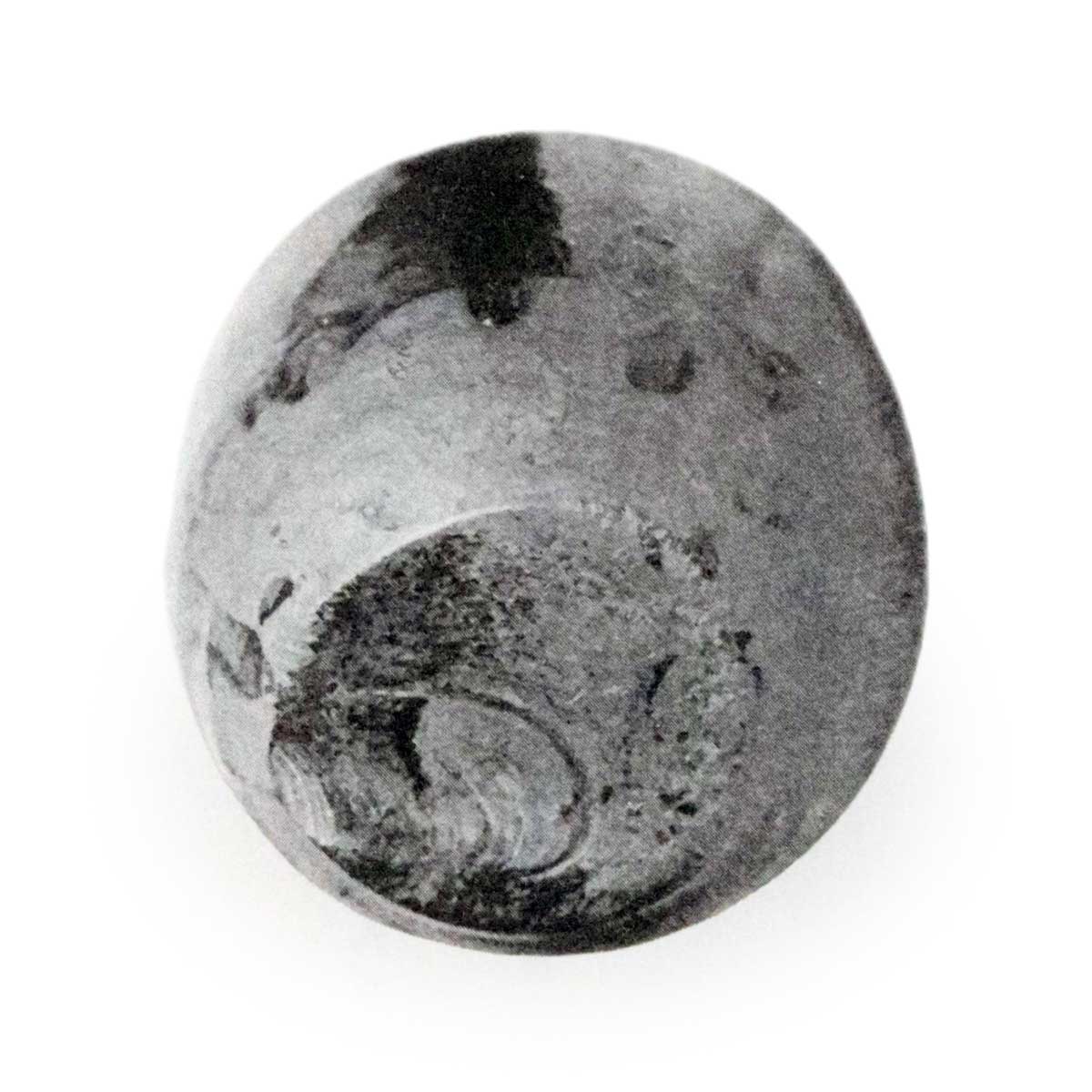
Minaguchi: The clay is pale red, and its texture is extremely fine-grained. The underglaze is amber-colored, and the overglaze is black. The base (bottom) features a “thread-cut” finish. There is a single ridge on the body; the point where this ridge is clearly defined is approximately 12.9 cm (4 sun 2 bu 5 rin). There are areas on the interior where the glaze has not adhered (“hima”). Both the interior and exterior show wheel marks, and the rim has been shaped by scraping the inside with a spatula.
(From The Maeda Marquis Family Inventory)
Hikiya Kansaku. The lid features a single fern-leaf pattern. The lid handle is made of rosewood and is carved, and bears the inscriptions: “Within the jar, a separate heaven and earth; the sun and moon exist—Sōhaku”; “A true connoisseur finds harmony in the sound of the pine wind—Sakuan (seal)”; and “Drink tea and enjoy.” The character “Minaguchi” on the front of the lid is carved in the handwriting of Lord Sōfu (Enshū). It comes with four pouches: one with a wisteria pattern, one with a Kinran bowl pouch, one with a woven fastener, one from Kōfuku-ji Temple, and one made of high-grade satin. The inscription on the upper box reads “Minaguchi”; a paper label affixed to the back states, “This item was confiscated from Usuya Ryōtaku, and it has other provenance as well.”
(From Maeda Family Collection: Lower Volume)
Minaguchi: A vessel with a wide mouth and a rounded bottom.
(From Manpō Zenshū)
Provenance
As indicated on the paper affixed to the underside of the box lid, this piece was originally owned by Usuya Ryōtaku. The exact date it entered the Maeda family’s possession is unknown.
Record of Actual Inspection
On December 1, Taishō 8 (1919), the actual object was viewed at the residence of Marquis Maeda Toshitame in Honfuji-chō, Hongō Ward, Tokyo City.
The rim is rounded, with the inner edge chamfered. Overall, the black amber glaze is sparsely and faintly mottled with a persimmon-gold hue (a persimmon color with a metallic sheen); the design forms a single cascading pattern, and the black amber glaze is beautiful, with faint “snake-and-scorpion” patterns (resembling the scales of snakes and lizards) appearing in the pools of glaze. True to its name, it has a wide mouth and a jar-like shape; midway up the body, there is a single sunken ridge extending around approximately two-thirds of the tea caddy’s circumference. The rim is formed of off-white clay that rises slightly; the base is circular and uneven, with one side of the rim slightly warped. The thread marks are fine, but there is one thicker section among them; there are “sticky spots” here and there, and due to glaze splatter, the design lacks sharp definition.
The interior is coated with the same glaze as the exterior overall, and shallow wheel marks run around it. Since wide-mouthed tea caddies made in China are extremely rare, it is likely that, in accordance with the aesthetic sensibilities of Enshū tea masters, the verses of three eminent monks were carved onto the body of this piece, which is known as Hikiya. Of course, while it excels in its rarity, it lacks a noble dignity; nevertheless, it can be described as a “wabi-style” piece among Chinese tea caddies.