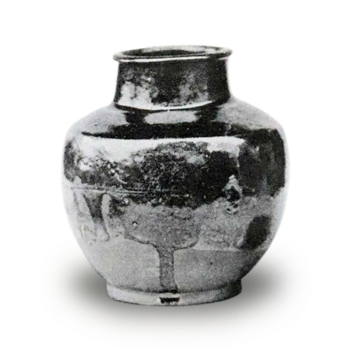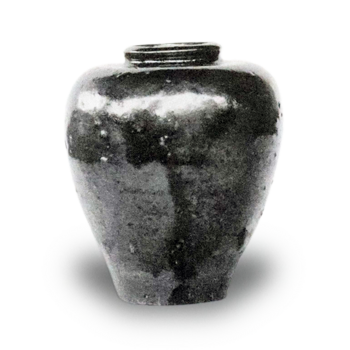
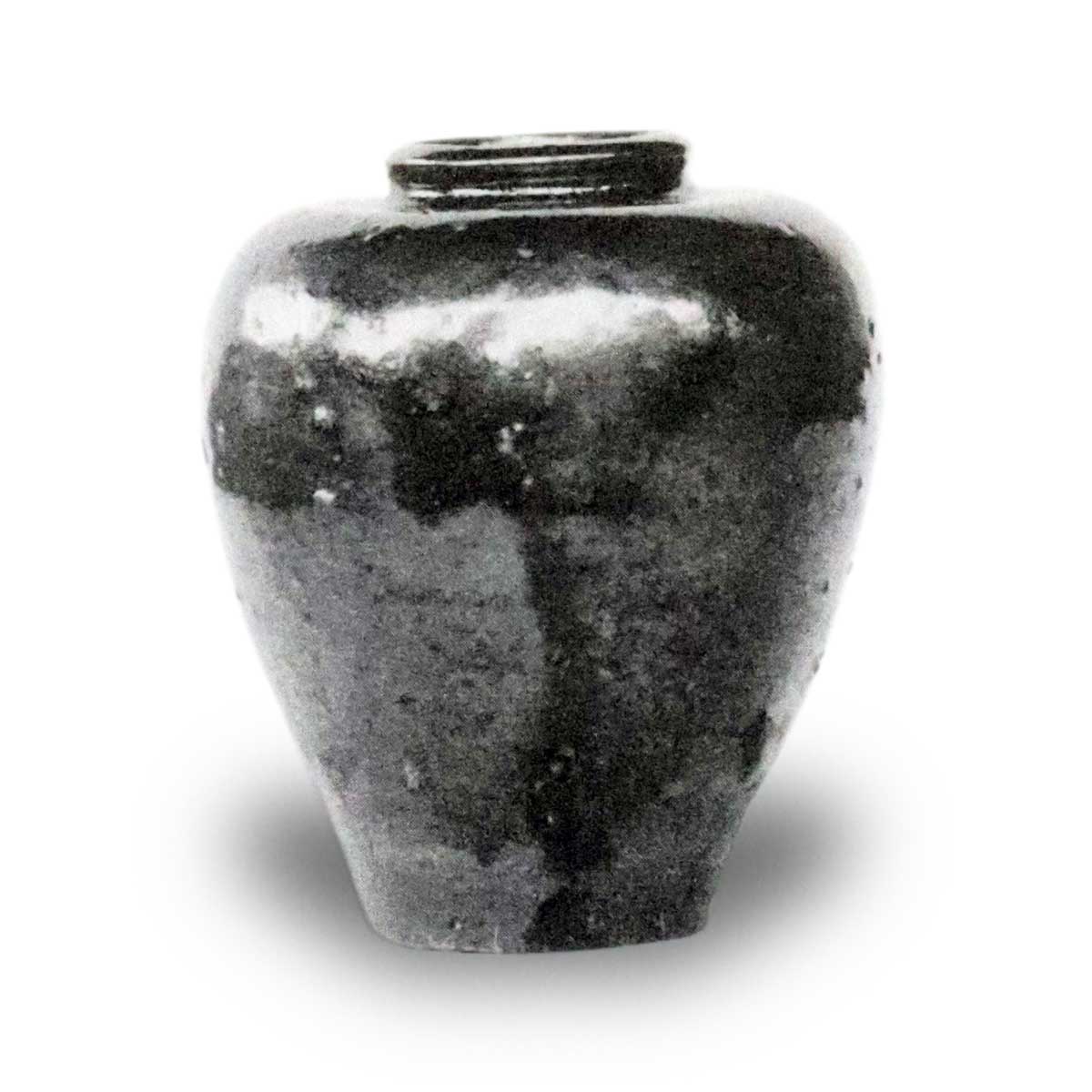
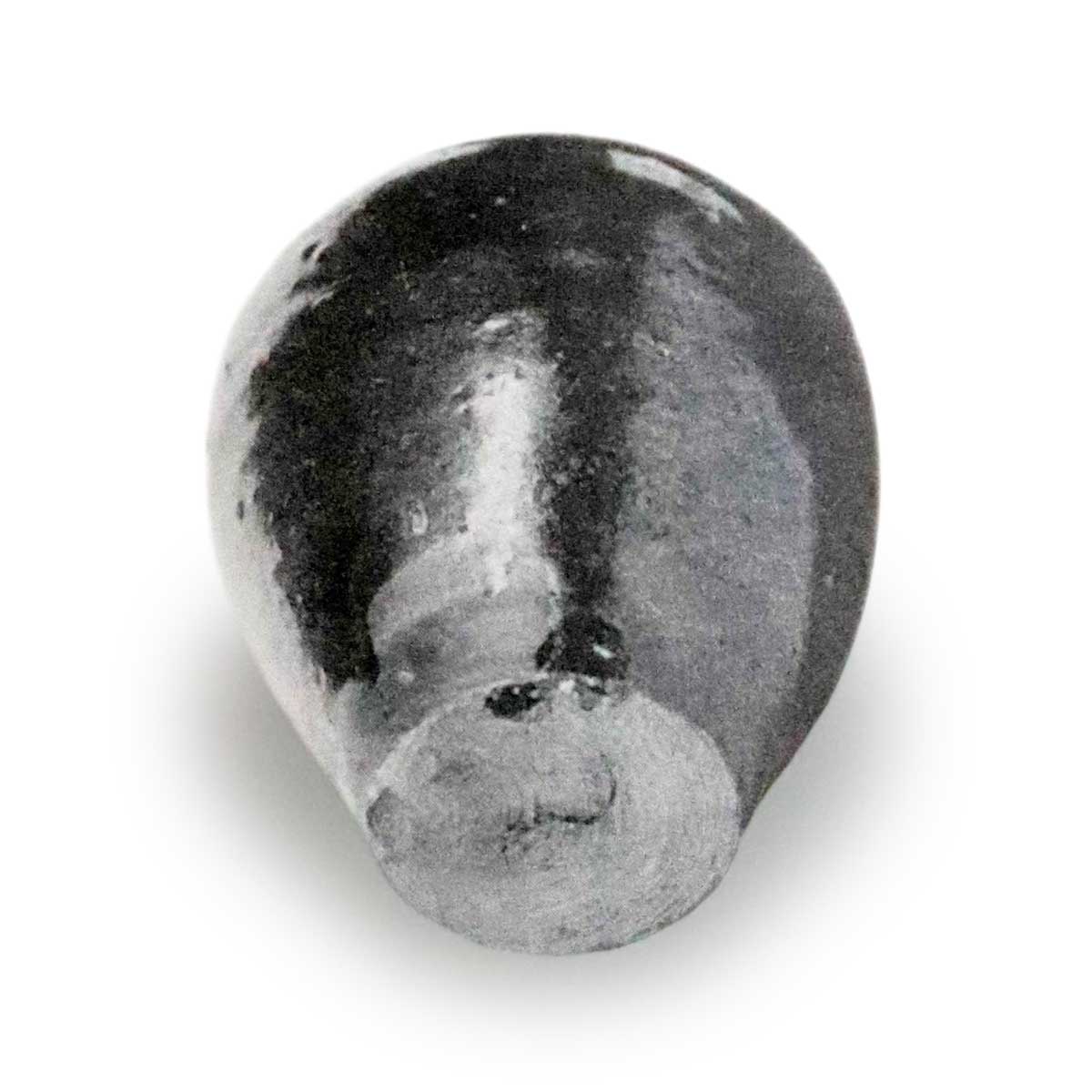

From the collection of Count Tadamichi Sakai
Name
The Manpō Zenshū states: “The heishi is a vessel for sake, and its name derives from its shape. However, there is a difference between a heishi and a taru: Lord Kobori Enshū is said to have remarked that a heishi is one that flares outward from the base, while a taru is one with a straight base.” The Kanteki and Chaki Bengyoku-shū all contain the same information.
Dimensions
Height: Approx. 6.4 cm (2 sun 1 bu)
Body diameter: Approx. 5.8 cm (1 sun 9 bu)
Circumference at widest point: Approx. 17.6 cm (5 sun 8 bu)
Mouth diameter: approx. 2.6 cm (8 bu 5 rin)
Base diameter: approx. 2.9 cm (9 bu 5 rin)
Height of the neck (koshiki): approx. 0.4 cm (1 bu 2 rin)
Shoulder width: just under 0.9 cm (just under 3 bu)
Weight: approx. 58.5 g (15 monme 6 bu)
Accessories
・Lid: 1 piece, with “Su” (pattern)
・Storage pouch: Navy blue ground (lining: white “Umi-ki”; tying cord: brown)
・Pouches: 2
Brown ground with “Donshu” pattern (lining: “Umi-ki”; tying cord: purple)
“Karabino”
Rough-textured “Arashi-iso Kinran” (lining: “Umi-ki”; tying cord: purple)
・Storage box: Paulownia, natural wood
(Bordered) “Tang-style Bottle, Pouch” Inscription by Unshirō
・Hikiya (cylinder for storing the tea caddy): Spinning top (koma)
Pouch: Dutch cotton (lining: crimson-ground Amaryu-mon Donshu; tie cord: Enshū brown)
・Box: Paulownia, natural wood
(Framed) “Teapot” Inscription by Sōfu (Kobori Enshū)
・Accompanying Inscriptions
Teapot
Author of the box inscription: Sōfu
Author of the pouch box inscription: Unshirō
The wrapping on top of the teapot, the wrapping on top of the pouch box,
and the pouches and small tags bearing the inscriptions are all believed to be
in Unshirō’s handwriting
Recorded by Sōchū (Kobori Sōchū)
Miscellaneous Notes
Tang-style bottle with two lids and two pouches: one in Seigaiha-patterned satin and the other in tea-colored carp-patterned satin. The lid is shaped like a spinning top; the pouches are made of Champa fabric. The outer box is made of paulownia wood, with an inscription by Sōfu.
(From the Tsuchiya Collection Register)
Chinese Vase: Two lids; the Hikiya is shaped like a spinning top; the pouch is from Cochin (Jiaozhi); the box is made of paulownia wood; the inscription is by Lord Sōfu; the pouch is made of pure silk with a “Seigaha” (blue waves) pattern.
(From Tsuchiya Meibutsu-ki)
Chinese-style bottle: Length approx. 7.9 cm (2 sun 6 bu), body circumference approx. 15.0 cm (4 sun 9 bu and a half), mouth diameter approx. 2.6 cm (8 bu and a half), base diameter approx. 2.9 cm (9 bu and a half). This bottle is a sake vessel and is so named because of its resemblance to one. However, there is a difference between a “binzo” and a “taru”: Lord Enshū is said to have remarked that a “binzo” is one that flares outward from the base, while a “taru” is one with a straight base. The clay has a whitish hue, though it is sometimes referred to as “tatsuchi” (paddy field clay).
The rim is well-formed with a turned-in edge, and the thread-cut finish is delicate. The underglaze is a light ink-gray color, with clusters of black within the glaze around the middle. The flowing glaze is a deep black. (Illustration of the tea caddy available)
(From Manpō Zenshū)
History
It was owned by Tsuchiya Sagami-no-kami and is recorded in the Tsuchiya Storehouse Register and the Tsuchiya Meibutsu Record. The exact date it was subsequently passed down to the Sakai family of Wakashū is unknown.
Record of Actual Observation
On April 28, Taishō 8 (1919), I viewed the actual piece at the residence of Count Tadamichi Sakai in Yarai-chō, Ushigome Ward, Tokyo.
This is a Chinese-style bottle with a single-sided beveled rim and no fold; the neck is extremely short, with the rim slightly indented. The shoulders are rounded, and the body bears two wheel marks. The overall background color is a pale purple, with patterns emerging in black glaze; the design consists of a single line formed where two streams of slightly lighter black glaze converge from both sides, flowing down nearly to the base. At the tips of these glaze drips, the glaze has pooled, creating black raised areas. There are small, cracker-like bulges here and there, and on the opposite side of the design, a single spot of black glaze appears like a drifting cloud. From the rim downward, the vermilion-clay body is exposed; the thread marks are fine, and there is a trace of a repair over a thin crack in the center, while the rim of the base is slightly chipped. The glaze has a soft, supple texture and an elegant charm, and the shape is exceptionally graceful. The Hikiya of a spinning top (koma) is the shape that best suits a tea caddy, and as always, I am deeply impressed by Enshū’s refined aesthetic sensibility in favoring this form.