From the collection of Count Tadamasa Sakai
Name
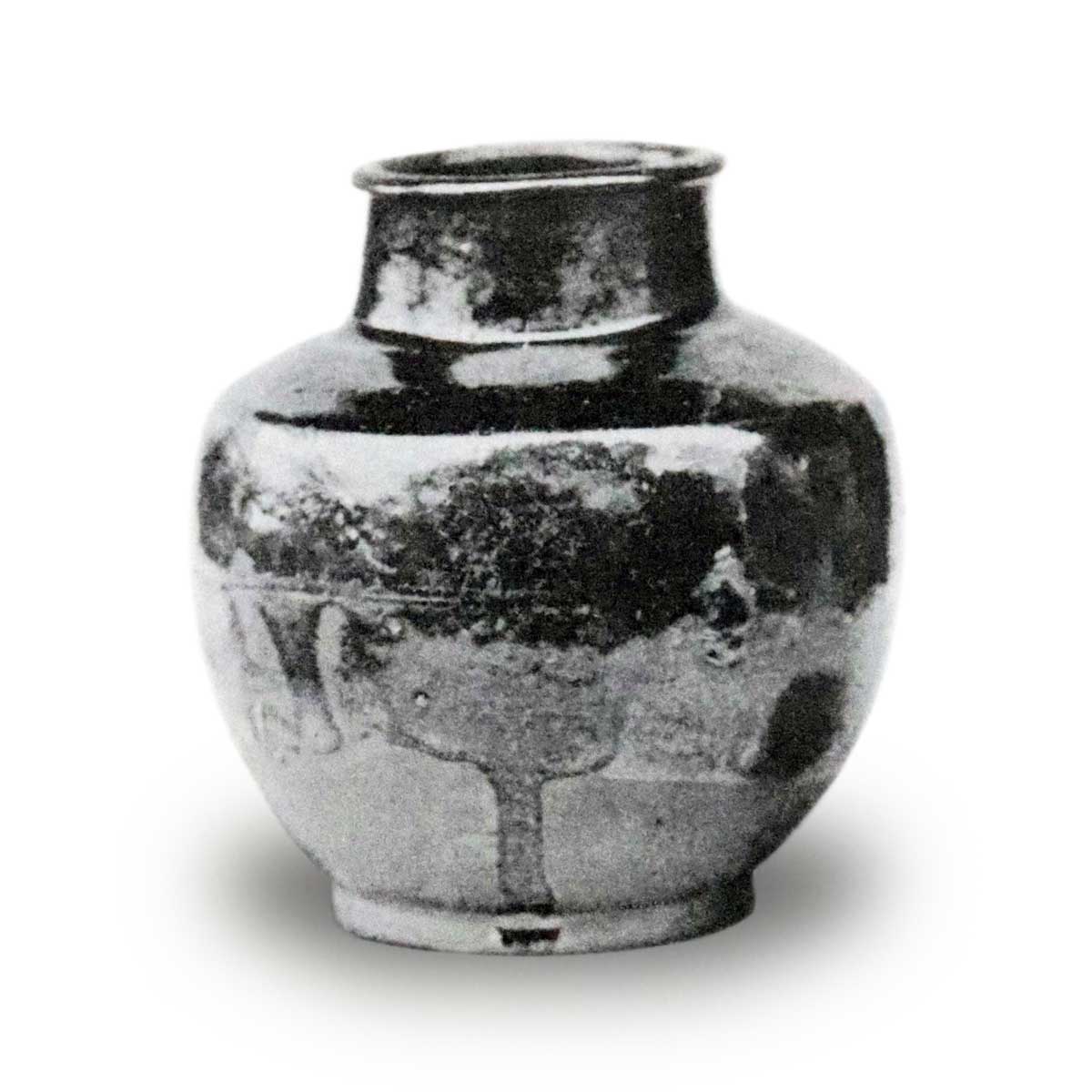
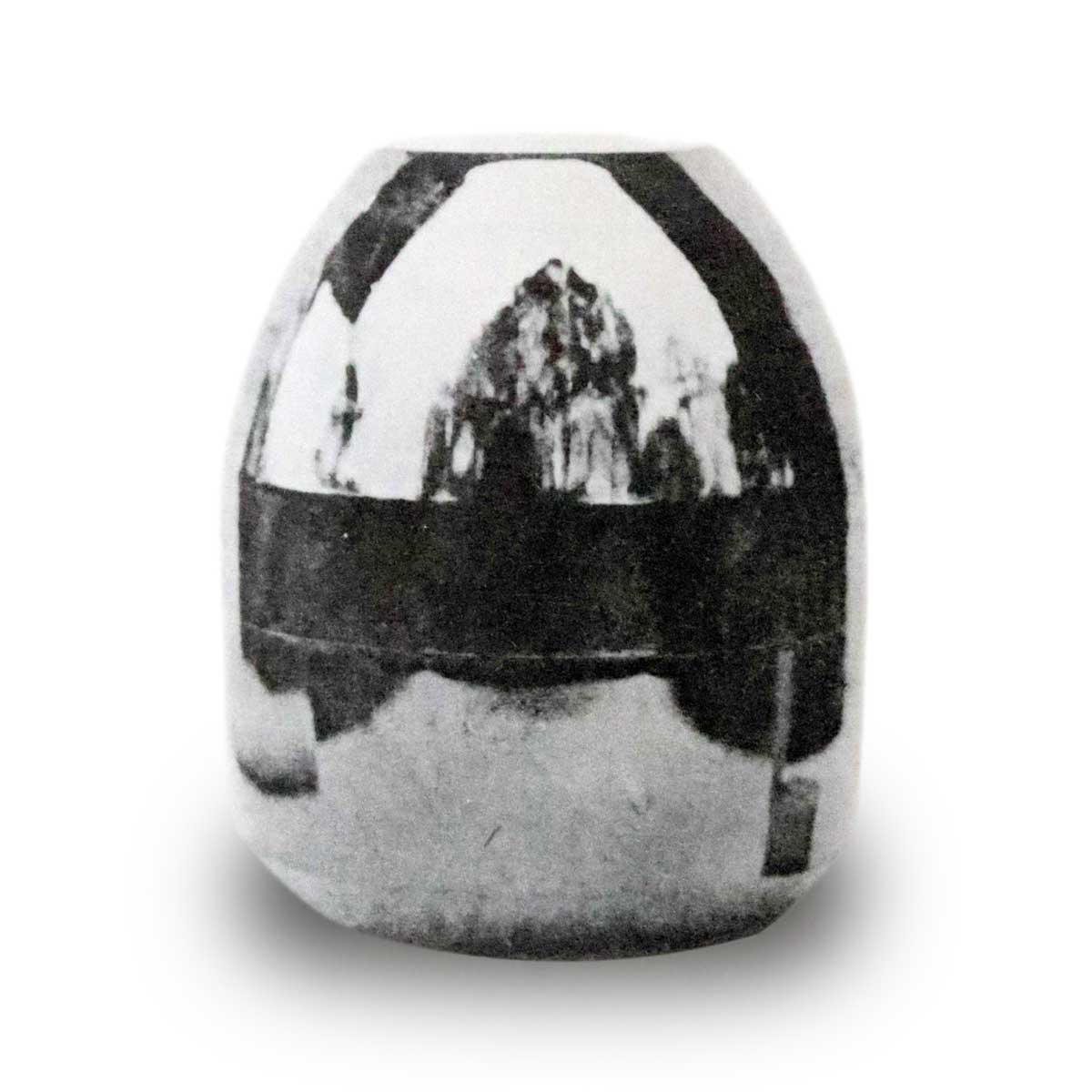
Named for its shape—a Karamono tea caddy in the “Enza” style (characterized by a base that is raised by one step).
Dimensions
Height: Approx. 8.4 cm (2 sun 7 bu 6 rin)
Body diameter: Approx. 8.0 cm (2 sun 6 bu 5 rin) at the shoulder; approx. 7.7 cm (2 sun 5 bu 5 rin) at the center
Mouth diameter: Approx. 4.1 cm (1 sun 3 bu 5 rin)
Base diameter: Approx. 4.8 cm (1 sun 6 bu)
Height of the “Enza” section: Approx. 0.5 cm (1 bu 5 rin)
Height of the “Koshiki” (neck section): Approx. 1.7 cm (5 bu 5 rin)
Shoulder width: Approx. 1.8 cm (6 bu)
Weight: Approx. 136.5 grams (36 monme 4 bu)
Accessories
・Lids: 4 pieces
In the styles of Rikyu, Oribe, and Sōfu (Kobori Enshū); one of unknown artist
・Storage pouch: Asagi Donshu (lined with scarlet silk; fastening cord is pale yellow)
・Pouches: 4 pieces
Antique Kinran with large peony pattern (lined with mon-patterned kakidai; fastening cord is brown)
Donshu in Pearl-Glow pattern (lining: kakidai; tie cord: purple)
Fursu in brown ground (lining: kakidai; tie cord: purple)
Donshu in brown ground (lining: iridescent; tie cord: purple)
・Storage box: Paulownia wood, natural finish, with labeled paper overlay
“Kan’enza Tea Canister”
・Hikiya (cylinder for storing the tea canister): Black lacquer
Pouch: Made of Shimizu-zori fabric (lined with striped satin, purple cord)
・Inner box: Paulownia wood, Shunkei lacquer, with a lock
“Kan’enza Tea Caddy” Inscription in black lacquer; author unknown
“Owned by Rikyu”
・Outer box: Black lacquer; paper label on the underside of the lid
“Tang-style Round Tea Caddy
Honno-ji artifacts (treasures)
Transmitted from the Miyoshi clan
Possessed by Kanpaku Hideyoshi
and later bestowed upon Sōeki (Rikyū)”
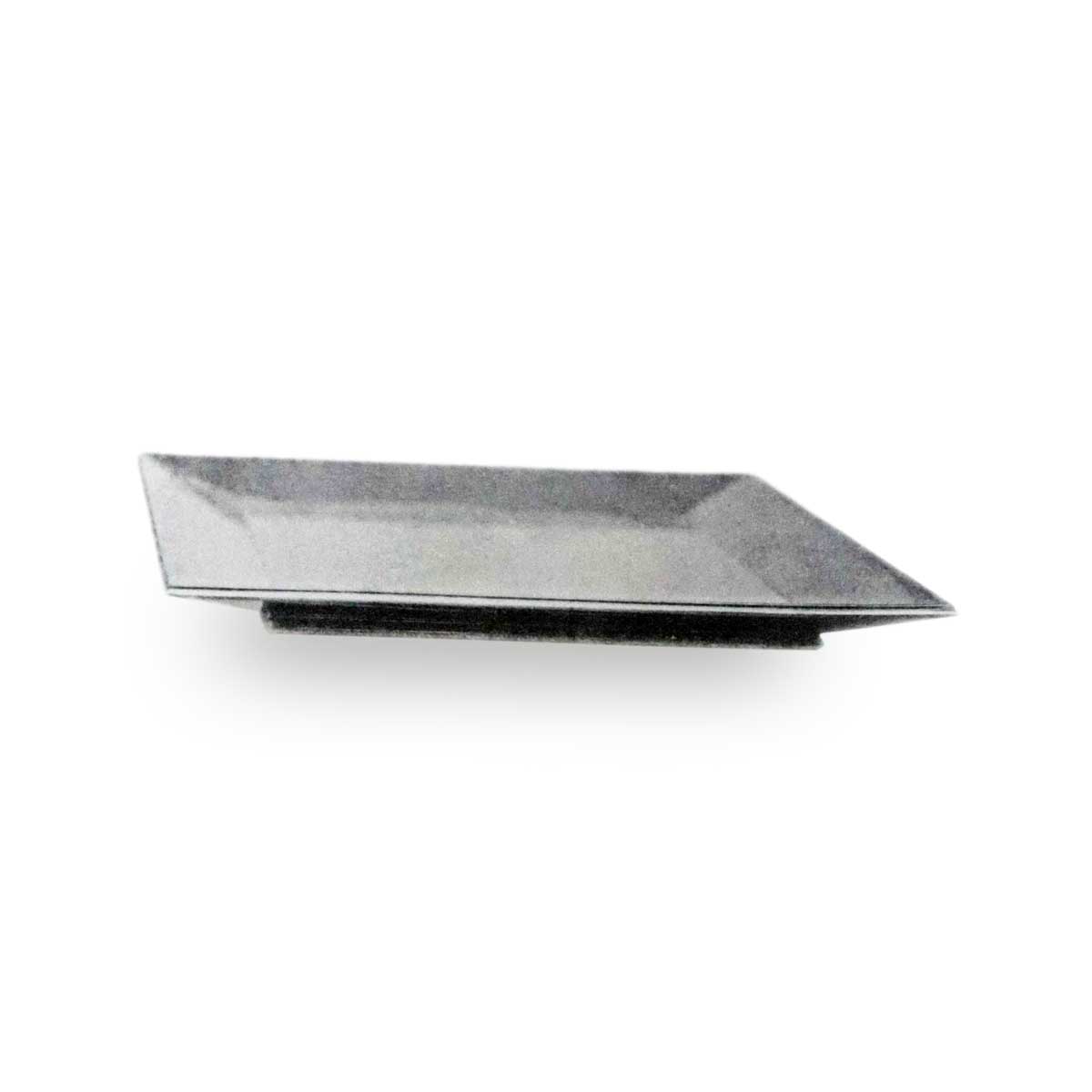
・Accompanying tray: Haneda-style tray
Diameter: approx. 27.6 cm (9 sun 1 bu); diameter of the “mirror” (flat inner surface): approx. 19.4 cm (6 sun 4 bu); base diameter: approx. 20.0 cm (6 sun 6 bu); height: approx. 2.6 cm (8 bu and a half)
Miscellaneous Notes
It is only recently that tea caddies have become so expensive. When I was a boy, the only Meibutsu generally recognized as “masterpieces” were the tea caddy called “Gyokudō” and Rikyū’s “Enza Katatsuki.” While I cannot say exactly how much they cost, they are said to be Meibutsu without equal.
(From Rōjin Zawa by Emura Sensai)
Enza Katatsuki: This was once owned by Shimoma Hyogo and is now in the possession of Sen Sōeki (Rikyū) in Sakai. The pouch containing this teapot is made of pure Donshu leather. As it is a type of “Mei-ki” (masterpiece), it is a particularly exquisite tea ceremony utensil, meant to be displayed in the tokonoma. It is a very interesting teapot.
(From Yamagami Sōji Ki)
Known as the “Enza Katatsuki,” this is a Chinese import that was once owned by Rikyu. It is approximately 8.2 centimeters (2 sun 7 bu) tall, with a body circumference of approximately 25.5 centimeters (8 sun 4 bu), a mouth diameter of approximately 4.5 centimeters (1 sun 5 bu), and a base diameter of approximately 4.8 centimeters (1 sun 6 bu); it has a flat bottom. This piece was once owned by Shimoma Hyogo. The pouch is made of Ryuzume Donshu. In Yamagami Sōji’s catalog, it is described as a stylish tea caddy and an item for connoisseurs.
(From the Kusama edition of Rikyū Kōji Hyakue Cha no Ki)
The morning of April 7, Tenbun 18 (1549): Shimoma Hyōgo’s tea gathering
A kettle with an “Ubaguchi” spout and two Shigaraki-yaki pieces are placed on a single slab of wood.
On the tokonoma, a Maruza Katatsuki is placed on a shihō-bon and housed in a white bag. The Maruza Katatsuki has a tall, flared rim and is glazed in a single color. The surface has a slight overglaze, giving it a crisp appearance, and the base is plump. The clay is of good quality, with a faint reddish tint on one side—a pale reddish hue.
(From Tsuda Sōyuki’s Tea Ceremony Diary)
Tenshō 14 (1586), Year of the Fire Dog, December 16. After breakfast, a tea gathering hosted by Sōeki (Rikyū)
His Lordship (Toyotomi Hideyoshi) arrived. The guests were Priest Shōrei and Sōkyū.
A kettle adorned with a cloud-and-dragon design was suspended over the irori hearth; a calligraphy scroll by Yokuryo-an was hung on the tokonoma; and in front of it, a long tray held a chidori incense burner paired with a Hotei incense container. Before His Lordship, a single pinch of incense from Todai-ji was burned; His Lordship savored the fragrance, and we were also permitted to partake as his companions. A Seto water jar, a round, shoulder-resting tea caddy, a black tea bowl, a lid rest shaped like a box, and a ken-sui with a drawstring.
Afterward, His Highness proceeded to the study, where he dined and drank thin green tea.
(From Excerpts from the Diary of Imai Sōkyū)
History
Originally part of the treasures of Honnō-ji Temple in Kyoto, it was passed down through the Miyoshi clan. It later became the property of Toyotomi Hideyoshi, who subsequently bestowed it upon Sen no Rikyū. Subsequently, it briefly became the property of the Tokugawa Shogunate, which then bestowed it upon Lord Sakai of Himeji; however, the exact dates of these events remain unclear.
Record of Actual Observation
On December 5, Taisho 9 (1920), I viewed the actual object at the residence of Count Tadamasa Sakai in Haramachi, Koishikawa Ward, Tokyo.
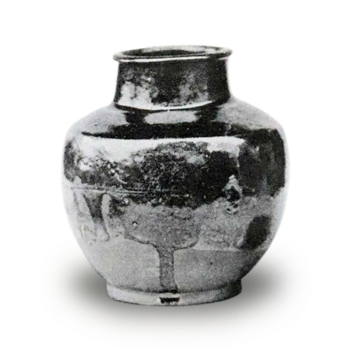
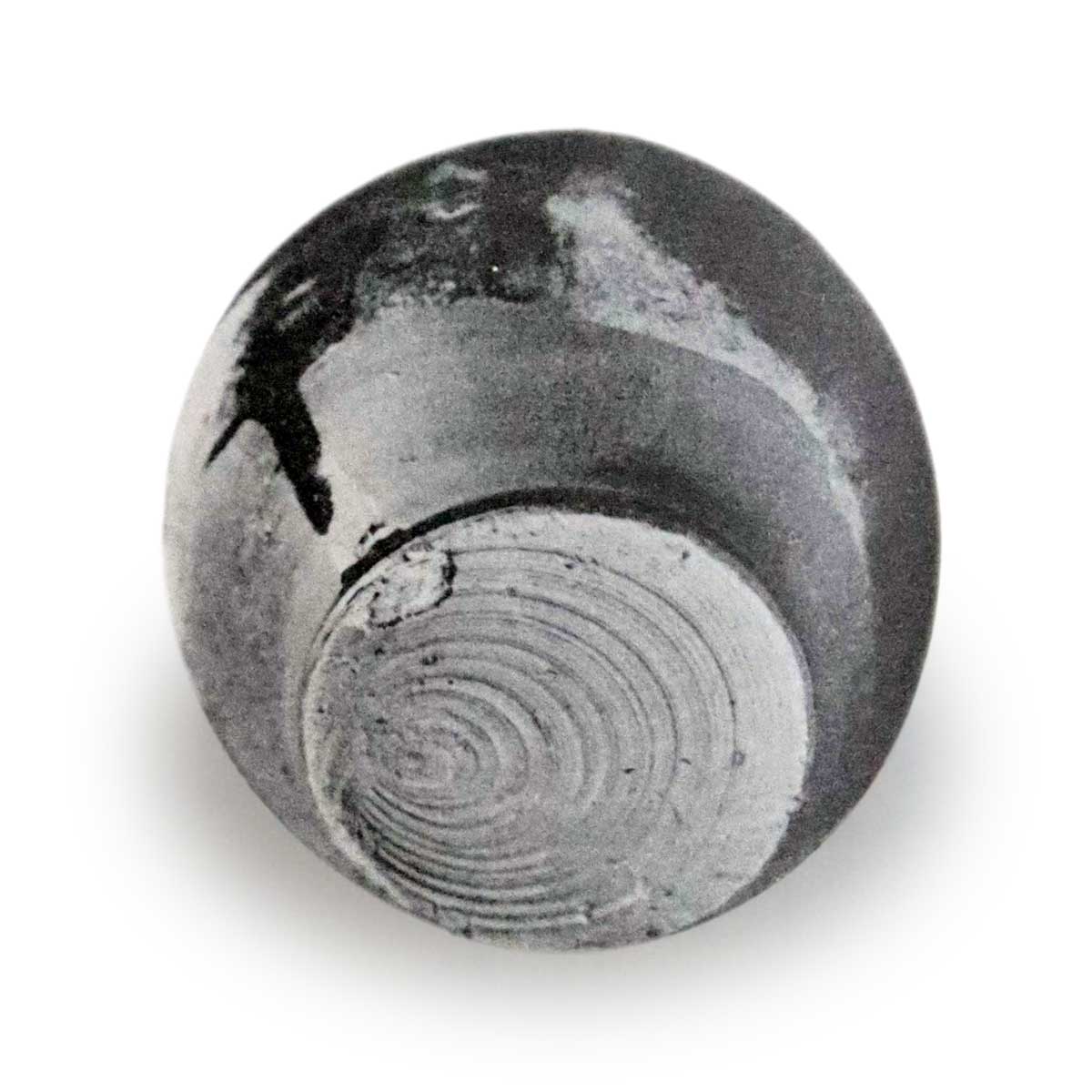
The rim is rounded, and the lip is distinct and shallow. The body is slightly tall with a flared lower section, and there are two rows of recessed ridges around it. The shoulders are flared (katatsuki), and the recessed ridges running around the body are interrupted in places. The vessel tapers from the lower rim downward, and the circular base is slightly raised. Overall, the black amber glaze has a beautiful luster, and in some areas along the body ridges, there are patches where the glaze has not adhered, revealing a persimmon-gold hue (a persimmon color with a metallic sheen). Additionally, a streak of black amber glaze drips from the mid-section, extending from the rim of the base to the thread-cut edge, displaying a beautiful luster, with a hint of blue-lapis lazuli visible within it. In other areas, there is a cascade of black amber glaze flowing from the shoulder down to the rim, and this, too, reveals a hint of blue-lapis color in the pools of glaze. In addition, there are areas where the persimmon-gold glaze has been lost, and the vermilion-clay-colored body is visible below the rim, though the surface is uneven. The thread-cut finish is somewhat rough, and there are places where the edge is slightly chipped. Inside, the glaze covers the rim; below that, coarse wheel marks run around the interior, and the center of the base is slightly raised, forming a large swirl. It is free of damage, the glaze has a lustrous sheen, and the blue-lapis hue appears in places. The pattern of exposed persimmon glaze is intriguing, making this a tea caddy that can be regarded as a model (original) for Tang-style round-based tea caddies.