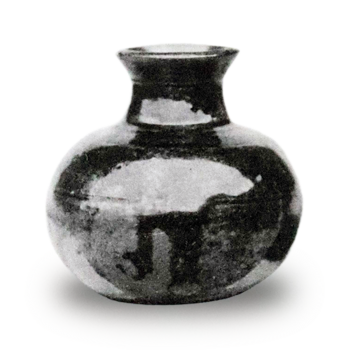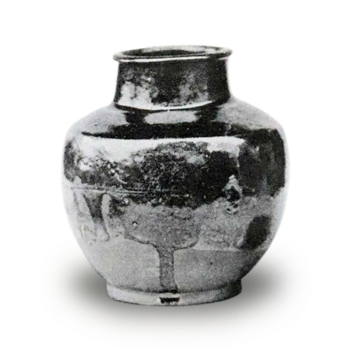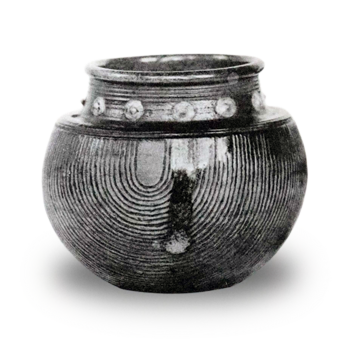
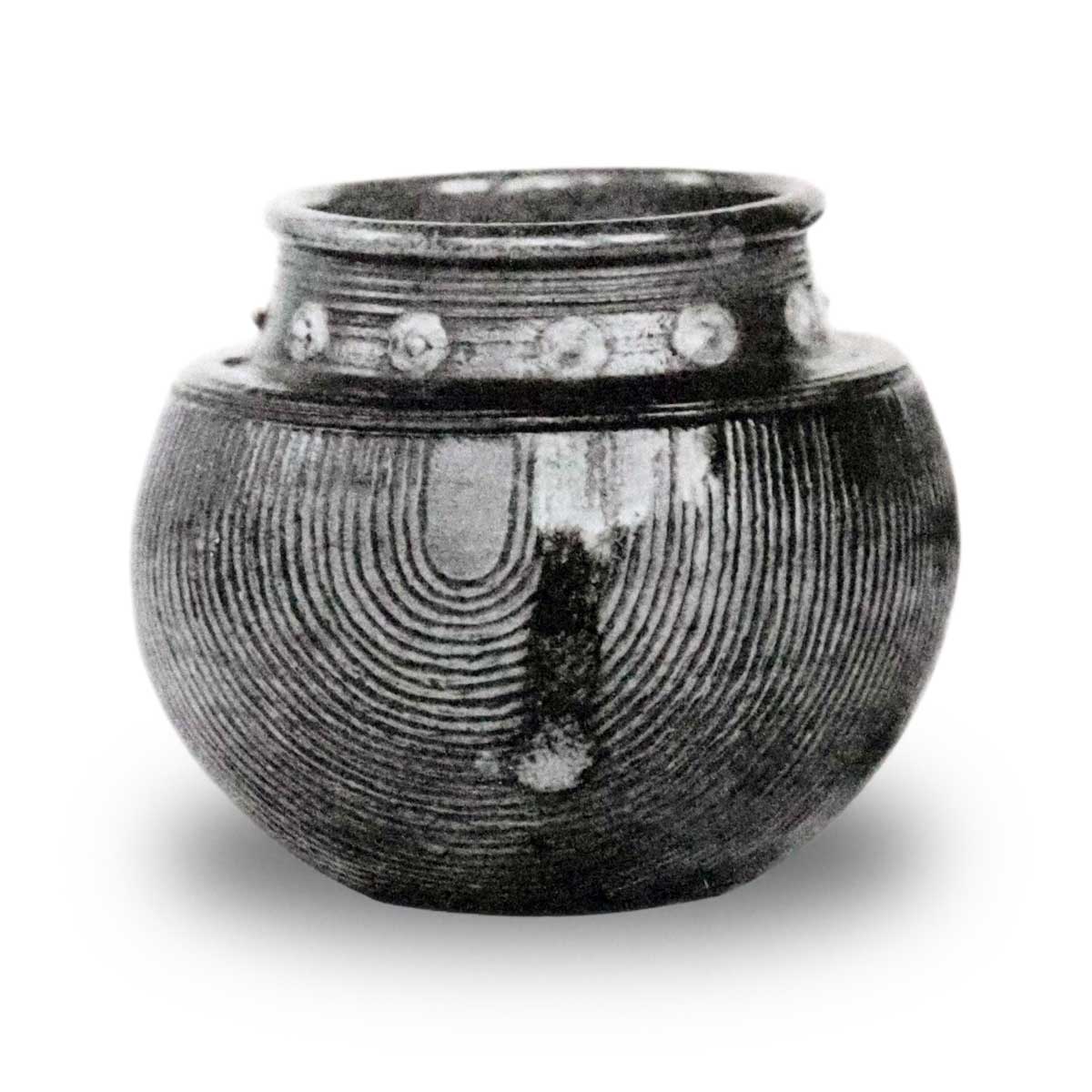
From the collection of Ms. Imoko Hayakawa, Nagoya
Name
“Ground tea (ruiza)” is also written as “磑茶 (ruiza)” or “累座.” The Chaki Ben’gyoku-shū states: “In China (Tang Dynasty), ‘Lücha’ refers to the practice of grinding tea leaves for brewing; the grinding tool used is called a ‘liú mù’ (pomegranate wood), which is round and has studs around its head. Therefore, the name is a reference to this grinding tool.” This tea caddy is a Tang Dynasty piece, and because the neck (koshiki) features “rui cha” (stud-like decorations), it is referred to as “Tang Rui Cha.”
Dimensions
Height: approx. 6.7 cm (2 sun 2 bu)
Body diameter: approx. 8.3 cm (2 sun 7 bu 5 rin)
Mouth diameter: approx. 5.5 cm (1 sun 8 bu)
Base diameter: approx. 4.1 cm (1 sun 3 bu 5 rin)
Height of the neck (koshiki): approx. 0.8 cm (2 bu 5 rin)
Shoulder width: approx. 0.6 cm (2 bu)
Weight: approx. 142.5 g (38 monme)
Number of “rei-cha” (rivet-like decorations): 12
Accessories
・Lid: 1 piece, with a “su” (pattern), made by Insai
・Pouches: 3
Flower-colored Dianthus with gold-stamped crest (lining: iridescent “Kaiki” color; tying cord: Enshū brown)
Bamboo-vine Donshu (lining: “Kaiki” color; tying cord: purple)
Five-color-striped bamboo-vine Donshu (lining: “Kaiki” color; tying cord: Enshū brown)
・ Pouch Box: Paulownia
(in a frame) “Tang-style Ground Tea Pouch”
・Hikiya (a tube for storing the tea caddy): Zelkova, with Shunkei-style “Kaki-awase-nuri” lacquer; interior finished in black lacquer
Pouch: Striped “Umi-ki” (lining: “Donshu” on a red background; tie cord: floral color)
・Inner Box: Paulownia, natural wood
“Tang-style Ground Tea”
Inscription written by Kobori Enshū
・Outer Box: Ikkan-bari style with a clamshell lid
“Tang Lei Cha”
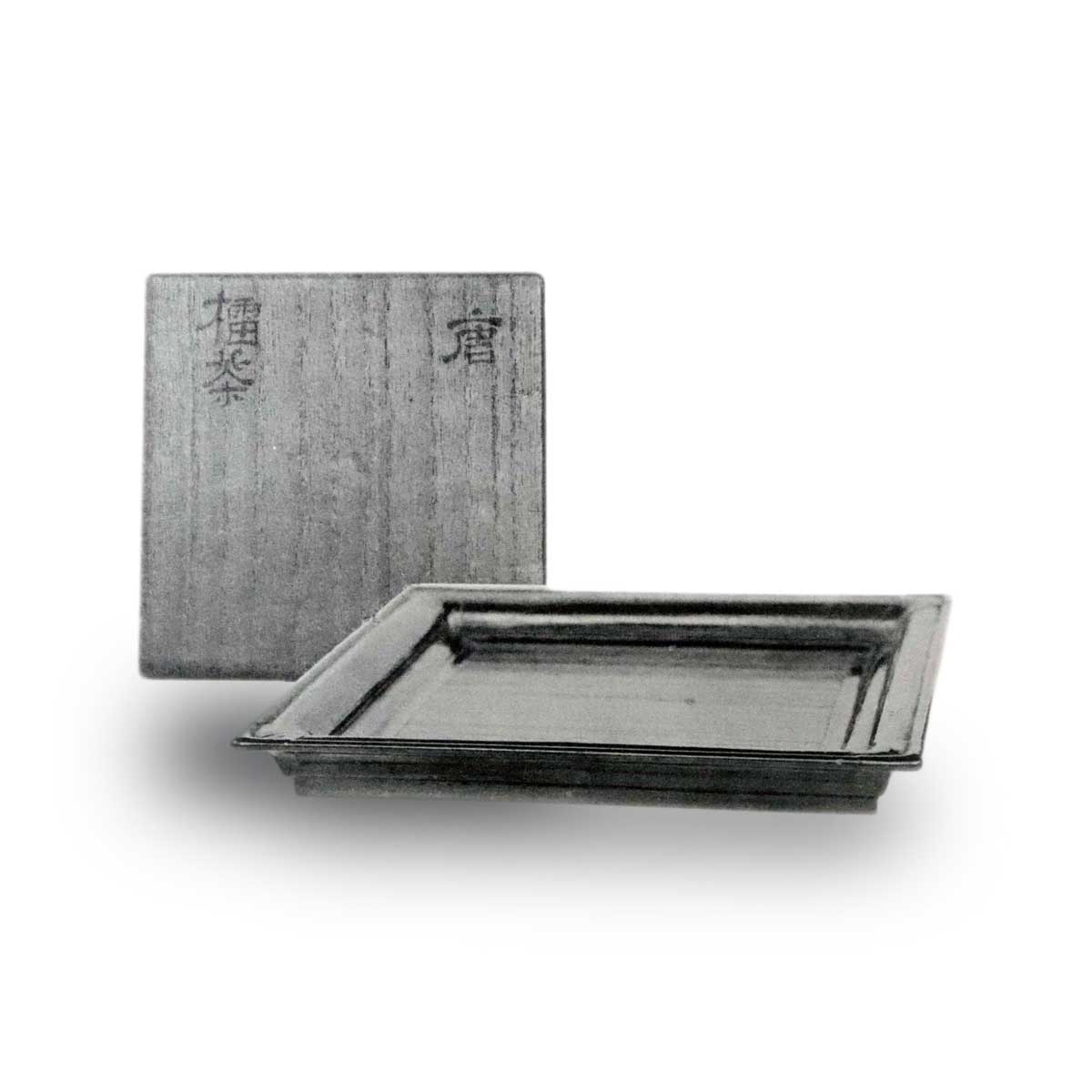
・Accompanying Tray: Square tray with Sen Sōtan’s signature on the bottom
Side length: approx. 21.5 cm (7 sun 1 bu), inner side length: approx. 16.4 cm (5 sun 4 bu), base diameter: approx. 20.0 cm (6 sun 6 bu)
Inner box for the accompanying bowl: Paulownia, natural wood
Front inscription: “Hisa (Hisago?) Square Bowl”
Back inscription: “Hisa Square Bowl; bears Sen-tan’s seal; Sotakusai (signature)”
Outer box for the accompanying bowl: New paulownia, natural wood
(framed)
“Hida Square Tray—Bears the seal of Genpaku (Sen Sōtan); box inscription by Sōtaku-sai (Sen Sōsa)—possibly an accompanying letter; left (seal)”
・Accompanying Document: Letter from Sōtaku-sai to Nagai Yataro (regarding the box inscription on the square tray)
Miscellaneous Notes
Tang-style ground tea bowl—Tsuchiya Soshū (owner). Height approx. 6.7 cm (2 sun 2 bu 1 rin), body diameter approx. 8.2 cm (2 sun 7 bu 1 rin), mouth diameter approx. 5.6 cm (1 sun 8 bu 5 rin), base diameter approx. 3.9 cm (1 sun 3 bu). The lid is a single piece with a depression.
There are three pouches: one with a gold-stamped pattern of flower-colored dianthus (lining in iridescent “Umi-ki” color, tie cord in Enshū brown); one in bamboo-vine satin (lining in “Umi-ki” color, tie cord in purple); and one in five-colored striped bamboo-vine satin (lining in “Umi-ki” color, tie cord in Enshū brown). The Hikiya (cylinder) is made of zelkova wood, finished with Shunkei-style scraped lacquer, with a black lacquered interior. The pouches are in Shima-asagi (lining: red-ground mon-ori; tying cord: flower-colored). The box is made of untreated paulownia wood, and the inscription reads “Tang-style ground tea,” as described above. The number of decorative studs on the base is 12. (Illustration of the tea caddy included)
(From Meibutsu-ki)
Tang Lei Cha (Dimensions and details of accessories are the same as in Meibutsu-ki)
(From the “Supplementary Section” of Kokin Meibutsu Ruiju)
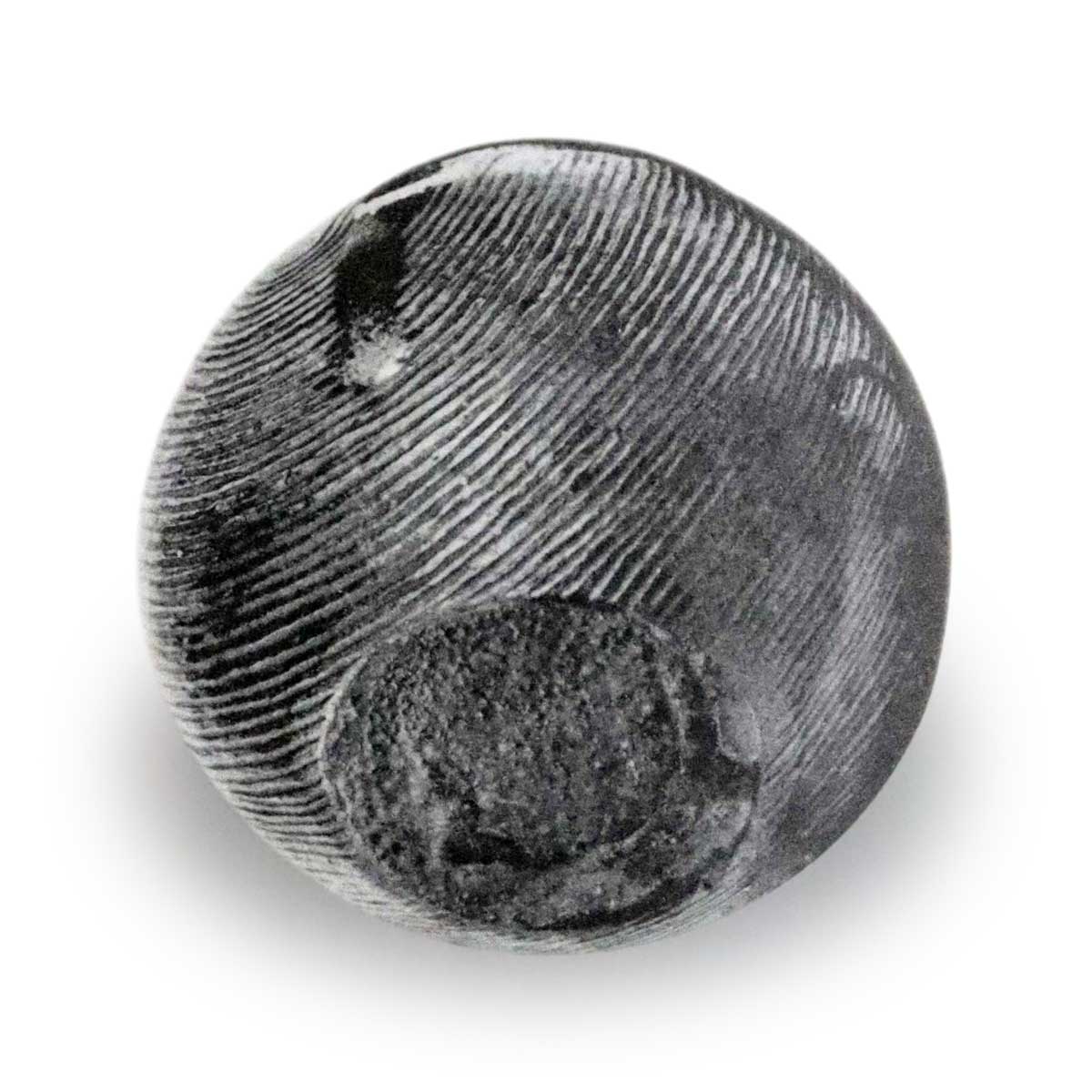
Tang Lei Cha: Height approx. 6.8 cm (2 sun 2 bu 3 rin), circumference approx. 8.3 cm (2 sun 7 bu 3 rin), mouth diameter approx. 5.6 cm (1 sun 8 bu 5 rin), base diameter approx. 3.9 cm (1 sun 3 bu), weight approx. 144.4 g (38 monme 5 bu). The lid is a flat lid. The pouch is made of satin with a “tea cloud” pattern (lined with “sea mist” fabric; the tying cord is purple). Hikiya crafted the tea grinder; it is chestnut brown. The pouch is by Santome Okujima (lined with a tea-receiving cloth on a vermilion background; the tying cord is a long purple cord). The outer case is made of paulownia wood and bears the “Tang-style ground tea” motif; the fukusa is made of sarasa fabric with a lining of patchwork in pale yellow and purple. The entire piece features streaks extending to the shoulders, and the water glaze covers the entire surface without exception. The ruiza (ground tea stand) is coated with white glaze, and there are two streaks on top of the ruiza. The rim is turned back, and the glaze is thickly applied. Brown and blue glazes are slightly visible; the base features a glaze known as “bon-zuri,” and the interior is also glazed.
(From Tōan Bunko, Series B, No. 1)
Tang-style Ground Tea: One lid, made by Insai. Three pouches: one with a gold-stamped floral dianthus design, one with five-colored stripes on bamboo-vine satin, and one plain bamboo-vine satin. The Hikiya style is used for the handle; the pouches feature a vermilion stripe pattern. The outer box is made of paulownia wood; the inscription is by Sōfu (Kobori Enshū).
(From the Tsuchiya Storehouse Ledger)
Tang-style Tea Grinder: Its shape is described in detail in three-volume works (such as the Manpō Zenshū), so I will omit the details here. The interior is glazed, while the exterior appears unglazed. The grinding surface is coated with white glaze; there is a “sticky spot” near the base, and it has a flat bottom. The box is made of paulownia wood with square slats and bears the inscription “Tea Grinder.”
(From Tsurezure no Tomo by Matsuyama Seika)
Tang-style Tea Grinder: It is believed to be an island-made piece (originating from Southeast Asia or similar regions). It came from Tsuchiya Soshu-no-kami and later became the property of Chigusa-ya Sojuro.
(From Kansō Zaki by Kinokuniya Hikojiro)
History of Ownership
It was originally owned by Tsuchiya Sagami-no-kami and was passed down to Chigusa-ya Sojuro. It subsequently became part of the collection of Matsudaira Iga-no-kami, lord of Ueda Castle in Shinano Province; however, when the family’s tea utensils were put up for auction at the Ryogoku Art Club in the early Taisho era, it was purchased for just over 8,000 yen by the late Shuzo Hayakawa, a member of the House of Peers residing in Maetsu, Nagoya City. The current owner, Imoko Hayakawa, is his widow.
Record of Actual Viewing
On June 6, Taishō 8 (1919), I viewed the actual object at the residence of Ms. Imoko Hayakawa in Kasuga-chō, Nishi Ward, Nagoya City.
This is a Chinese-style tea grinder with a rounded, thick rim. Against a chestnut-brown background, patches of “snake-and-scorpion glaze” (a glaze pattern resembling the scales of snakes or lizards) appear in places. Three raised ridges run around the rim, and below them, twelve white glazed “ruiza” (glazed indentations) are arranged at equal intervals. Three ridges run around the chamfered shoulder, and below that, thin, semi-circular ridges resembling thread cuts form horseshoe shapes facing each other on both sides of the tea caddy. The decorative pattern features a single streak of “snake-scorpion glaze” cascading from the shoulder to the waist. The base is raised and glazed, with some “sticking” or “chipping” of the clay visible on its surface. Additionally, slightly off-center from the middle of the base, there is a bow-shaped depression. The interior is fully glazed, and the piece feels somewhat heavy when held. Against the overall chestnut-brown hue, the tea-grinding seat stands out in white, creating a particularly interesting visual contrast. Furthermore, within the fine lines around the body, there are areas where the glaze appears powdery white, while the area near the base takes on a reddish tint reminiscent of Bizen ware, giving it an exceptionally splendid luster.